 The last time I saw Jimi Hendrix, he was getting into a helicopter to take him away from the Isle of Wight, still wearing the stage clothes, flowing silks in orange and dark red, in which he’d performed in the early hours of August 31, 1970. It was a chilly, misty morning, not long after dawn. Eighteen days later he was dead, and the speculation began about what, in musical terms, he might have left undone.
None of the posthumous releases have given us much of a clue, and that’s certainly true of People, Hell and Angels, the Hendrix estate’s latest production, in which mostly familiar songs are presented in the guise of alternative takes or versions cleansed of the overdubs undertaken after his death. Hard-core obsessives will find more than enough to satisfy their appetites, but it’s foolish now to hope for revelations.
So what would he have gone on to accomplish? Could he really have moved on beyond the basic template laid down by “Hey Joe” and Are You Experienced soon after his arrival in London in 1966? What happened to truncate the arc of musical progression created when that first album was followed within the next two years by Axis: Bold As Love and Electric Ladyland?
The year 1969 was the one in which he seemed to hint at future directions. Not just the staggering Woodstock version of “Star Spangled Banner” — a Guernica for the Vietnam era — but the jams that took place whenever he was in New York, often involving musicians associated with Miles Davis. In March of that year the guitarist John McLaughlin took a night off from playing with Tony Williams’ Lifetime to jam at the Record Plant with Hendrix, the bassist Dave Holland (then a member of Davis’s quintet) and Buddy Miles. In May there was a much bootlegged session with Hendrix, the organist Larry Young (another member of Lifetime), Billy Cox and Mitch Mitchell. Later that summer a session was booked at the Hit Factory for Hendrix and Miles Davis, at Miles’s behest, but was aborted half an hour before the scheduled start time when the trumpeter demanded $50,000. And there were rumours that Hendrix and Gil Evans, the arranger of Davis’s Sketches of Spain and other classics, were planning to make an album together.
None of this resulted in anything of consequence and Hendrix never found himself with those musicians in a structured environment where serious work might have occurred. For all his sublime talent, would he have been technically capable of taking McLaughlin’s place in Lifetime, the most adventurous jazz-rock group of its time? (“He wasn’t very schooled; he had a limited knowledge as far as harmony is concerned,” McLaughlin later reflected. “But he had such an imagination that he made up for it.”) How would he have sounded with a group of post-Coltrane free improvisers? Could a meeting of Hendrix and Albert Ayler have worked out? But these weren’t the sort of projects in which his managers were interested, and Hendrix’s own way of life probably militated against any more rigorous pursuit of musical adventure.
There’s an interesting quote from Carlos Santana, who was present at the Record Plant during a session in November that year: “This was a real shocker to me. He said, ‘OK, roll it,’ and started recording and it was incredible. But, within 15 or 20 seconds into the song, he just went out. All of a sudden, the music that was coming out of the speakers was way beyond the song, like he was freaking out, having a gigantic battle in the sky with somebody. It just didn’t make sense with the song any more, so the roadies looked at each other, the producer looked at him and they said, ‘Go get him.’ I’m not making this up. They separated him from the amplifier and the guitar and it was like he was having an epileptic attack… When they separated him, his eyes were red. He was gone.”
The following summer, Ian Anderson of Jethro Tull was surprised by what he saw when his band shared the bill with Hendrix at the Randall’s Island festival in New York. He seemed like a different person, Anderson said, from the one he had known a year earlier. “I wanted to go and talk to him, but I couldn’t get anywhere near him because he was surrounded by a phalanx of very sinister people. I saw him briefly as he made his way to the stage and he looked very out of it.”
It all reminds me of Charlie Parker, who had a similar revolutionary effect on the way music is played before meeting a similarly premature demise in 1955 (Hendrix was 27 when he died; Parker was 34). The tinest scraps of Parker’s output are preserved and cherished, and we know that he remained capable of great improvisation all the way to his death. But, like Hendrix, Parker died leaving questions about what would have happened next. Was his work already done, or might he have found a new context to stimulate and nourish further artistic growth? In both cases, the odds seemed to have been stacked against it. But, of course, we’ll never know.
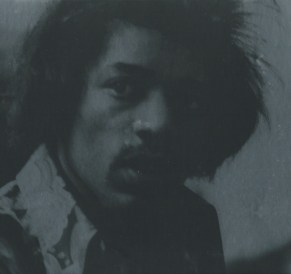
* The photograph of Hendrix is by Gered Mankowitz and is taken from the cover of People, Hell and Angels, just released by Sony Legacy. The quotes are from Eyewitness Hendrix by Johnny Black, published by Carlton (1999).