Skip to content

Posts from the ‘Uncategorized’ Category

Frances Ha

It’s not often I want to get up and dance in the aisles of a cinema, but that’s how I felt halfway through Noah Baumbach’s Frances Ha the other night, when David Bowie’s “Modern Love” erupted out of the speakers. I’ve never been keen on Bowie (although I admire the stuff from his Berlin period), but “Modern Love” is one of those tracks — like Boffalongo’s “Dancing in the Moonlight”, Danny Wilson’s “Mary’s Prayer” or the New Radicals’ “You Get What You Give” — that automatically quicken the heartbeat and turn the world’s colours up a shade. It doesn’t matter who it’s by. Listen without prejudice, as someone once suggested.

Frances Ha benefits from an excellent soundtrack, including a fine cello-led piece by Joan Jeanrenaud (the Kronos Quartet’s original cellist) and incidental music by Dean Wareham and Britta Phillips. You might or might not remember Wareham from the indie rock bands Galaxie 500 and Luna, in which he was joined by Phillips, to whom he is now married. They’ve also recorded as Dean and Britta, and they contributed music to Baumbach’s first film, The Squid and the Whale, in 2006.

I hadn’t expected to like Frances Ha as much as I did. It’s not nearly as cutesy as this trailer might make it seem. By the end, Greta Gerwig turns Frances into a character with real depth, someone you really care about.

Don’t forget the Motor City

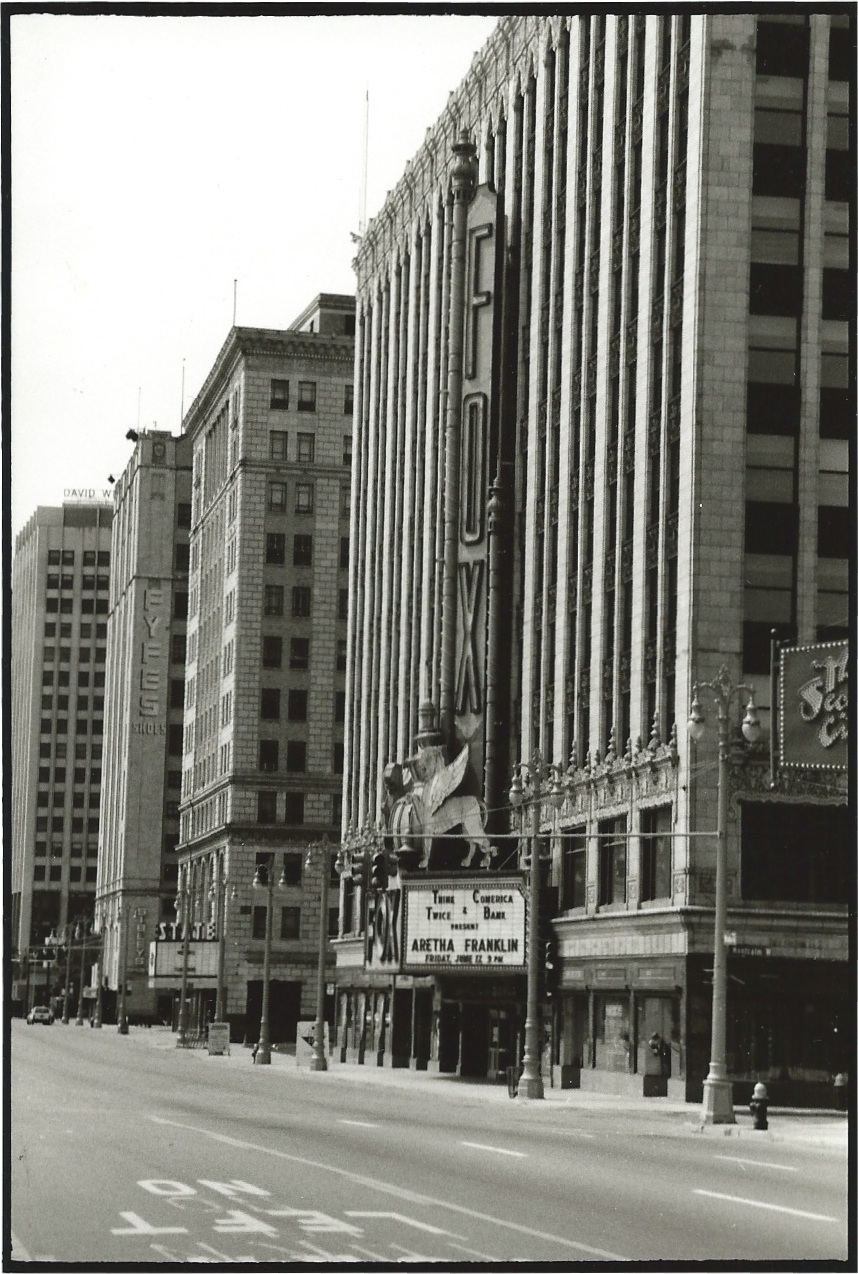
Fox TheatreYou’ll have read that Detroit went bankrupt the other day, and you might have felt more than a twinge of sympathy for the city that gave us so much music. (The Independent‘s Ian Burrell did, and wrote about it very touchingly here.) You might also have seen The Ruins of Detroit, the 2010 book in which Yves Marchand and Romain Meffre photographed the abandoned hulks of factories and municipal buildings, lending them a terrible glamour. I’m currently reading Mark Binelli’s widely praised The Last Days of Detroit, in which a Rolling Stone journalist returns to examine the fate of his home town. It made me go and dig out a photograph I took in 1994, during the World Cup, when I was in Detroit to watch Brazil play Sweden in the Pontiac Silverdome.

This is not a photograph of a ruin. Quite the reverse, in fact. It shows the Fox Theatre, a famous establishment on Woodward Avenue in the downtown area. Opened in 1928, with 5,000 seats, lavishly appointed and built at great expense, it became the world’s first cinema to install sound equipment for the screening of talkies. Live shows were also a part of its programme: Swing Era stars like Benny Goodman packed the place, Elvis Presley played there for three nights in 1956 (his first appearances in the city), and the Motortown Revue got into the habit of taking over the theatre for 10 days over the Christmas period in the ’60s. By the 1980s, however, “white flight” to the suburbs had changed the character of downtown and the heavily dilapidated Fox was showing kung-fu movies. Then along came the family who own the Little Caesars pizza chain, the Detroit Red Wings (ice hockey) and the Detroit Tigers (baseball), who bought and renovated it, re-opening in 1988 with a show starring Count Basie and Smokey Robinson.

The day I passed by with my camera, the marquee was still advertising an Aretha Franklin concert which had taken place a week earlier. (Detroit is also Aretha’s home town: it was where her father, the Rev C.L. Franklin, set up his New Bethel Church in 1946.) A check on the Fox’s website tells me that this year’s future attractions include Steely Dan, John Legend, Get Back: The Beatles Laser Experience, Sarah Brightman and the Moscow Ballet. Aretha sang there again last year.

Hope you like the picture. And good luck to Detroit, whatever its future holds.

New brushes and palette

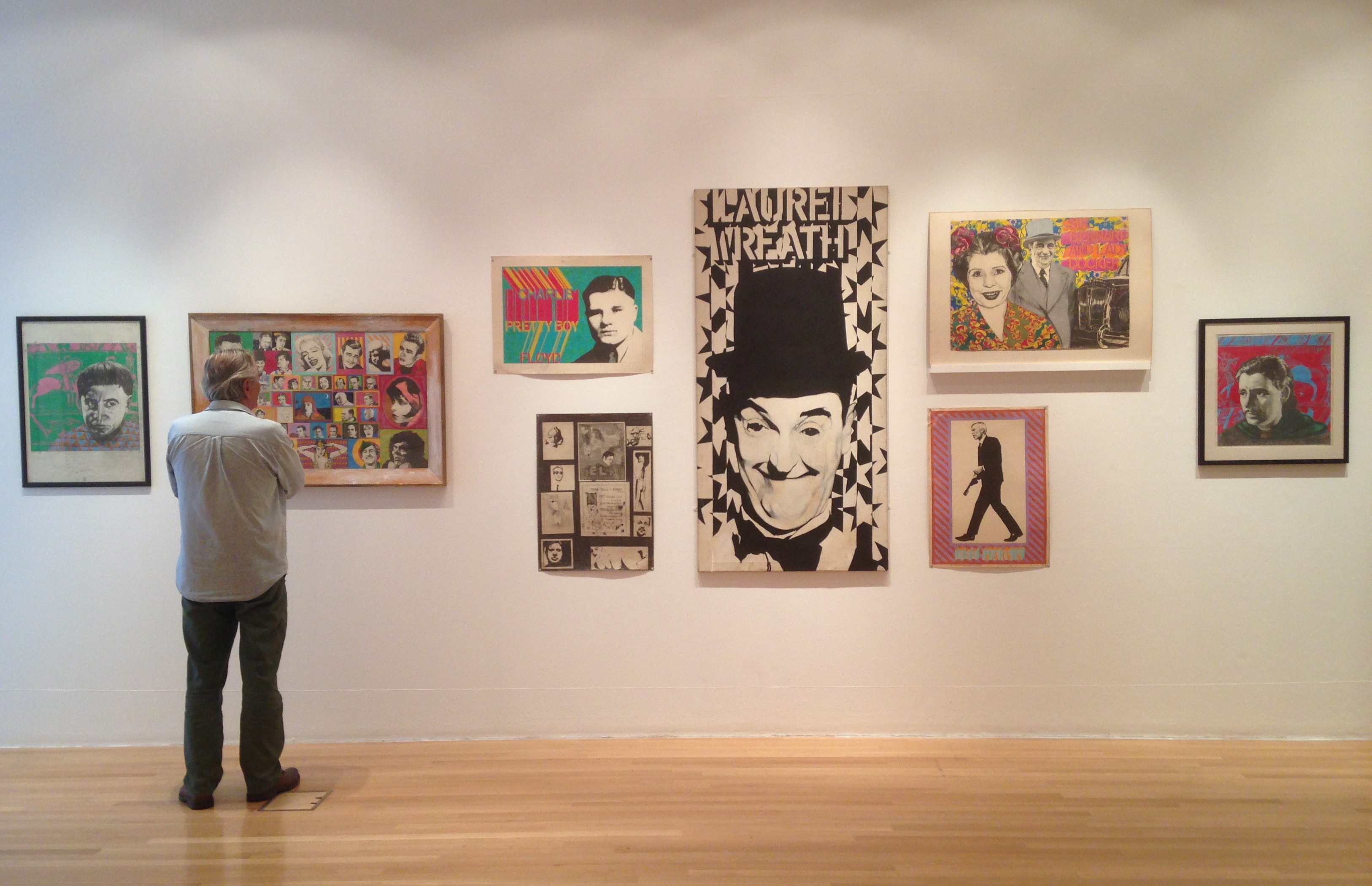
DuryIan Dury may well have been the only pop artist who became his own subject. On the walls of a new exhibition of his paintings, drawings and graphic design at the Royal College of Art in London, where Dury studied in the early ’60s, hang a handful of interesting self-portraits. For his true self-portrait, however, you have to search YouTube for the remarkable official videos for “Hit Me With Your Rhythm Stick” and “Reasons to Be Cheerful, Part 3”, where you will find the artist who invented himself in the medium that best suited him. Nevertheless the RCA show, called More Than Fair, is well worth a visit for the glimpse it provides of a young man who grew up amid the benign ferment of British art colleges half a century ago.

Dury went to Walthamstow School of Art in 1959, studied with Peter Blake, and won a place at the RCA in 1963. This was a time when popular culture was becoming an acceptable subject for fine artists, thanks to the work of Blake, Richard Hamilton and others, and Dury welcomed the opportunity to take on a range of subjects including Hollywood stars, Sonny Liston, celebrity industrialists (Lord and Lady Docker, famous for their Daimler with gold door handles) and the soft-porn nudes who take up just about half the show.

The influence of Blake — who remained a friend — is evident in the presentation of such works as “Flo Diddley” and “Miranda Aureole: The Nipple Princess”, and in the work he did for the Sunday Times Magazine and London Look. Here from the ST Mag (which continually bylined him “Ian Drury”) are spreads devoted to features on “The Immortals” (Bogart, Gable, Harlow, etc) in 1966 and “Lost Heroes” (James Dean) the following year. Rainbow stripes are bursting everywhere, sometimes accessorised with sequins. Titles are roughly stencilled. The energy is unmistakeable, even in the representatives of his commercial work, such as the cover of World Record Club’s “The Wonderful Vera” (Lynn) and the box for EMI’s reel-to-reel tape version of Sinatra Sings of Love.

Four LivesThis didn’t turn out to be the work Dury was put on earth to do, but he was pretty good at it. Curated by Jemima Dury (the artist’s daughter), Julian Balme and Kosmo Vinyl, the show was assembled from the family collection and loans from friends and former colleagues, including Terry Day, the drummer of Kilburn and the High Roads (who contributes a Dury-decorated bass drum head), Davey Payne, the Blockheads’ saxophonist, Andrew King, Dury’s music publisher, and Laurie Lewis, the dance photographer.

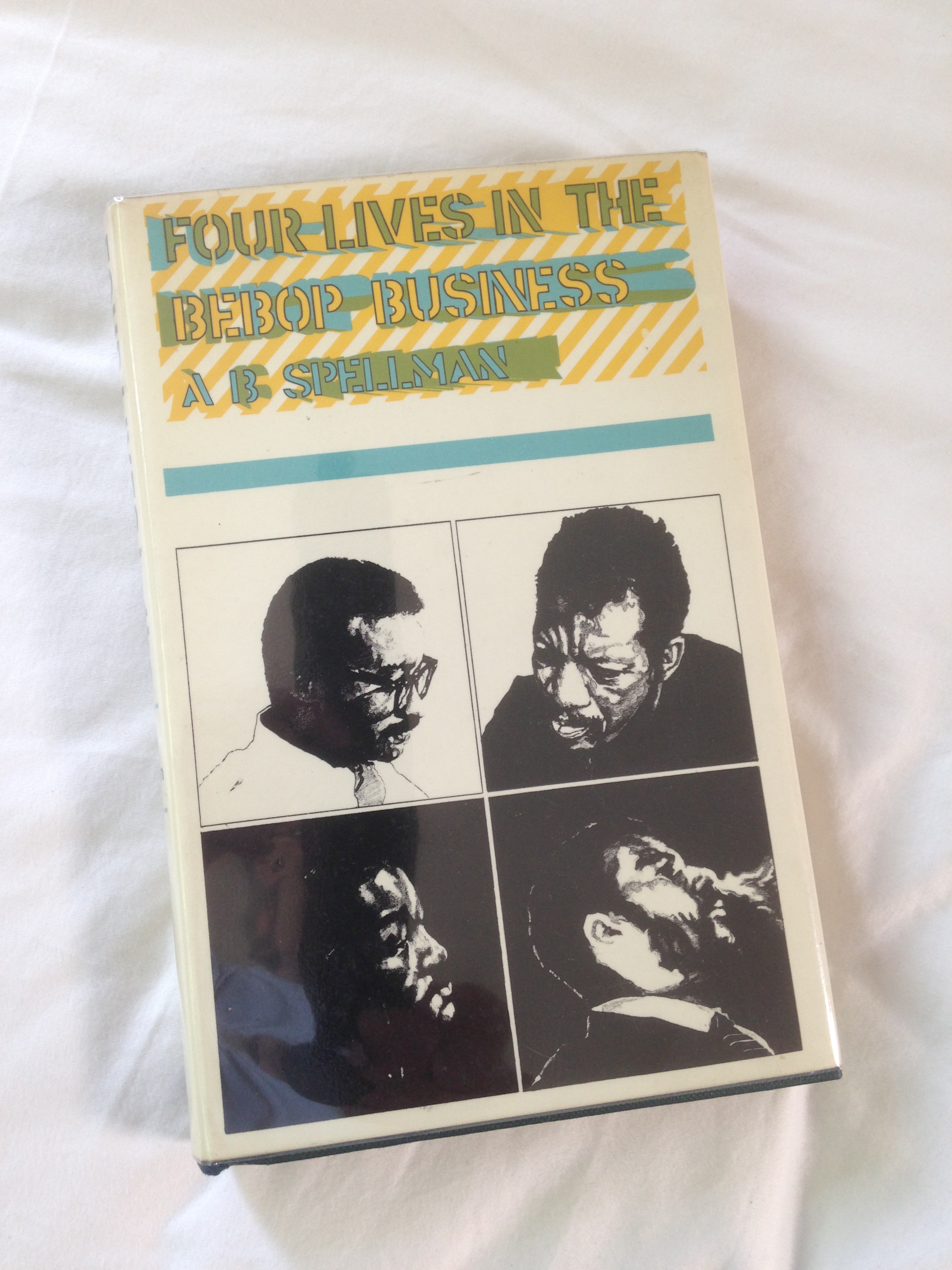
I wish I’d known about the exhibition in advance. Then I’d have lent them my own bit of Duryana: a copy of the first UK edition of A.B.Spellman’s Four Lives in the Bebop Business, published in 1967, for which MacGibbon and Kee commissioned the artist to provide a new cover (above). His ink portraits of Cecil Taylor, Ornette Coleman, Herbie Nichols and Jackie McLean, the subjects of Spellman’s classic quartet of encounters with modern jazz musicians, are perfect, as is the stencilled typography.

The show opened this morning and closes on September 1. Admission is free. Details are here. A new book of Dury’s lyrics, titled Hello Sausages, edited by Jemima Dury and published by Bloomsbury, is on sale in the gallery at a tenner off the £25 price. All in all, it’s worth the trip.

Bert Stern: an eye on jazz

Six weeks before Marilyn Monroe died in the summer of 1962, Bert Stern spent three days in a Los Angeles hotel room taking the photographs that will forever make it difficult to believe that the actress took her own life. Not surprisingly, it was the story of the Monroe sessions that led the obituaries marking his death last week, at the age of 83, such as this one in the New York Times and this one in the Guardian. And here I am, falling for the same temptation.

Four years earlier, however, Stern, then a top advertising photographer, had earned the permanent gratitude of jazz fans when he travelled to Rhode Island to record the Newport Jazz Festival for a feature film titled Jazz on a Summer’s Day. Thanks to him, and his co-director and editor Aram Avakian, we have a beautifully shot first-hand record of how Louis Armstrong, Chuck Berry, Jimmy Giuffre, Thelonious Monk, Mahalia Jackson and many others looked as well as sounded in performance at that point in their careers.

Most of the famous sequences from the film were shot during the hours of daylight, capturing the garden-party atmosphere of the early Newport festivals. That’s certainly what you get in the clip of Anita O’Day above. Look a bit harder on YouTube, however, and you’ll find a night-time sequence of the magnificent Big Maybelle, dressed as if for her own wedding, singing “I Ain’t Mad at You”, with a band led by Buck Clayton, who takes the trumpet solo. For some technical reason I can’t share it with you here, but a simple search should lead you to it. Better still, buy the whole thing on DVD, and say a little thank-you to the late Mr Stern.

La vida tombola

Manu Chao

Despite the urging of various friends, I came late to Manu Chao, and I’ve been trying to make up for it ever since. If I were my kids’ age, I probably wouldn’t have been listening to much else for the past decade. La Radiolina (2007) is one of my very favourite albums of recent years, songs such as “13 Dias” and “Besoin de la Lune” forming an endless source of energy-renewal. So I’m pleased to have been reading Peter Culshaw’s Clandestino, a biography of the singer who, more than anyone, accepted the responsibility of carrying the spirit of Bob Marley into a new century. It’s been telling me most of what I needed to know about the creator of a music that blends first world languages, third world rhythms, and a rebel soul also heavily influenced by the British punk movement of the late 70s.

Subtitled “In Search of Manu Chao”, the book (published by Serpent’s Tail) incorporates a full account of the subject’s life and career from his birth in a Paris suburb in 1961 as the son of Basque and Galician parents and his early life as a street kid through his early success with the band Manu Negra to his solo superstardom. The focus often shifts, however, to become the story of the author’s engagement with the artist and his music, which takes him around the world, from Algeria to Brazil to New York to Brixton, and through many encounters and conversations.

Culshaw never bothers to hide the fact that he is awestruck by Manu Chao, and I can’t find it in me to criticise him for that. His enthusiasm is so transparently genuine that it’s impossible to get too exasperated by paragraphs that begin like this: “I ring up Manu’s management in Paris to try and find out where Manu might be. No word. So I hole up on the beach for a few days, in a fishing village called Prea, a really tranquil place. It’s so beautiful that I feel the urge to express my gratitude to someone, and who better than the deities? Signs and portents seem to be everywhere…” He’s taking a gamble that this discursive approach will match the unstructured existence it describes, and he just about brings it off.

I’m not absolutely certain that Manu Chao’s “La Vida Tombola” (also from La Radiolina) is the best song ever written about a footballer, but I’d suggest that its only rival is Jorge Ben’s “Filho Maravilha”. Maybe that’s just another version of the endless Maradona v Pele debate: Argentina versus Brazil. One day I’ll have more to say about the great Jorge Ben. But here’s Manu Chao serenading the great albiceleste No 10 in person with the song he dedicated to him, in the poignant final scene from Emir Kusturica’s superb film titled Maradona, released in 2008. “If I were Maradona,” the lyric goes, “I’d live like him / A thousand fireworks, a thousand friends, and whatever happens at a thousand per cent / Life is a game of chance…” The subject of the song looks on, the hint of a smile on his lips giving no clue to the thoughts hidden behind his shades.

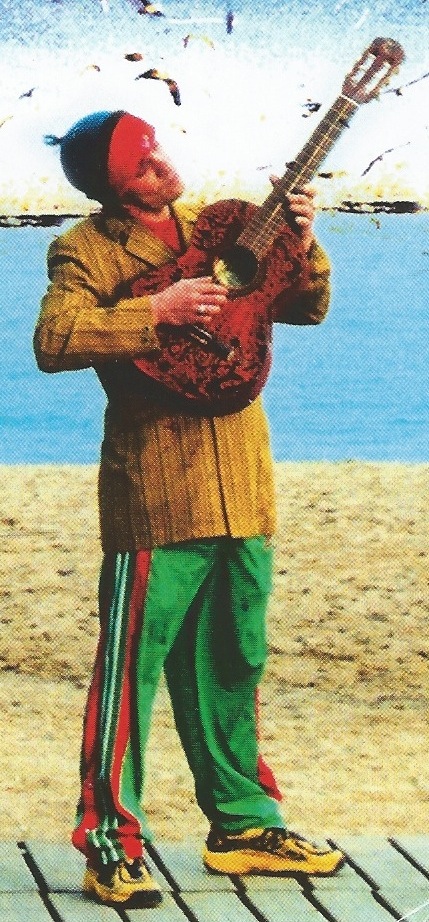
* The photograph of Manu Chao is taken from the cover of Proxima Estacion: Esperanza, his second solo album, released in 2001.

Looking at Monk

SchlippenbachThe phenomenon of piano players committing themselves to a study of Thelonious Monk’s compositions is neither new nor unusual; it probably started with Monk’s friend Bud Powell, who cut a wonderful version of “Off Minor” during his historic trio session for the Roost label in 1947 and recorded an album called A Portrait of Thelonious in Paris in 1961. Perhaps no one, however, has got so deeply under the skin of Monk’s music as the German pianist Alexander von Schlippenbach, who appeared at the Cafe Oto in London last night as part of an all-star free jazz quartet with the saxophonist Evan Parker, the bassist John Edwards and the drummer Eddie Prevost.

Eight years ago Schlippenbach released a three-CD set on the Intakt label called Monk’s Casino, in which he and four other musicians (including the remarkable bass clarinetist Rudi Mahall) performed all 70 of Monk’s known compositions, arranged as a sort of giant medley and recorded in three one-hour sets at the A-Trane club in Berlin, the pianist’s home town. It was, I think, one of the great achievements of modern music, a phenomenally detailed and multi-faceted exploration of a seemingly inexhaustible resource. There don’t seem to be such things as canonical works in jazz any more, but if there were, this would deserve to stand high among them.

I thought of Monk’s Casino towards the end of the first of last night’s two enthralling sets, when Parker, Edwards and Prevost fell silent and the pianist spent several minutes creating what sounded to me, at least, like a miniature distillation of that three-hour epic. All of Monk seemed to be in those few minutes — and all of the player himself, too, because there is nothing imitative about Schlippenbach, who shines the light of a piercingly original intellect upon whatever material he happens to be investigating (a couple of years ago he released two fascinating albums of serial compositions for solo piano: Twelve-Tone Tales Vols 1 and 2, also on Intakt).

Schlippenbach was 75 last month. His recent releases include Blackheath, a performance with Prevost on the drummer’s own Matchless label, recorded at Blackheath Halls in South London in 2008 and consisting of a solo improvisation by each and a 25-minute duo invention called “Skipping With Monk”. His latest solo album is called Schlippenbach Plays Monk, in which his own brief interludes are slipped between new thoughts on eight of Thelonious’s tunes. Once again you can hear his principal characteristic: the warmth beneath an apparently austere surface. I listened to it on the way home, and I know I’ll be playing it often.

It was nice to meet him again during the interval, more than 40 years since I interviewed him for the Melody Maker during the annual Anti-Festival held at Berlin’s Quartier Latin club, an event set up in opposition to the formal Berliner Jazztage at the Philharmonic Hall (he was polite enough to pretend to remember me). In the mid-60s he had founded the Globe Unity Orchestra, the first multi-national ensemble devoted to the new jazz; now, like Parker and Prevost, who are also in or approaching their eighth decade, he is an elder statesman of a movement that, on a night like this, seems capable of infinite self-renewal.

* The photograph of Alexander von Schlippenbach is by Manfred Rinderspacher and is taken from the insert to Schlippenbach Plays Monk (Intakt CD 207). Parker, Edwards and Prevost are at the Cafe Oto again tonight (May 29), with the German trombonist Christof Thewes as their guest.

A meeting of hearts and minds

Hawkins-MoholoIt’s almost half a century since Chris McGregor’s Blue Notes arrived in London: five refugees from apartheid South Africa whose impact on the UK jazz scene was so profound that the sound and spirit of their playing continue to echo in the music of succeeding generations. Four of them — the trumpeter Mongesi Feza, the altoist Dudu Pukwana, the pianist Chris McGregor and the bassist Johnny Dyani — are no longer with us. The sole survivor of the classic Blue Notes line-up is Louis Moholo-Moholo, their firestarting drummer, who is now 73 and living back in a very different Cape Town from the one he and his comrades left in 1964.

Louis returns to Britain every now and then, reminding us that he has lost nothing of the spark that ignited a thousand sessions in those early years. One of his current projects is an occasional duo with the young English pianist Alexander Hawkins, and if you have 70 minutes to spare, and you’re in the mood to concentrate, I advise you to click on this link. You’ll find a set played during the Gateshead Jazz Festival a few weeks ago which is a fine testament to the musical relationship developing between two musicians who are four decades apart in age but soul-mates on the stage.

In October 2011 they recorded an album, Keep Your Heart Straight, which has just been released on the Ogun label. It’s a record on which Hawkins reminds his listeners that the piano, too, is a percussion instrument. He and Moholo attack the music with a brusque desire to get to the heart of the matter, even when they’re playing romantic ballads like “If I Should Lose You” and “Prelude to a Kiss”, which both get a good pummelling. It’s an exceptional document.

The Gateshead set is very different in tone: more relaxed and expansive, the 50-minute opening medley beginning with the stately, hymn-like tune of Pule Pheto’s “Dikeledi Tsa Phelo” (which reappears at the very end of the concert) and containing the same two standards, treated more tenderly this time. The medley is succeeded by a heartfelt treatment of Dudu’s “B My Dear”, a staple of the Blue Notes’ repertoire: originally titled “Marie My Dear”, it appeared under that name on Very Urgent, their wonderful 1968 album, and is one of the loveliest ballads ever written by a jazz musician, blending a dollop of Ellingtonian lyricism with a dash of Monkish astringency.

Moholo is magnificently alert and responsive throughout (and occasionally droll), while Hawkins, who continues to impress in all sorts of contexts, shows his ability to play alongside the great drummer without falling for the obvious temptation to imitate the distinctive South African piano styles of McGregor and Abdullah Ibrahim. He can absorb the sounds and syntax of the past while forging a style that is on its way to becoming distinctly his own.

* The photograph of Louis Moholo-Moholo and Alexander Hawkins is from the inner jacket of Keep Your Heart Right, and was taken by Roberto Cifarelli.

Empress of the supper club

Mabel MercerNow here’s a find, picked up for a tenner out of the vinyl racks at Ray’s Jazz Shop in Soho yesterday. I’m no longer a vinyl hound, but I couldn’t resist this well-preserved original US Atlantic copy of an album by a singer who influenced Billie Holiday and Frank Sinatra, with its elegant typography and an artfully out-of-focus photograph by Jay Maisel, who shot the cover of Miles Davis’s Kind of Blue.

By the time I saw Mabel Mercer, she was in her early seventies and performing from an ornate armchair to audiences at the St Regis Hotel in New York City, in a room that held around 75 people. She was giving two shows a night on Tuesdays, Wednesdays and Thursdays, and  three on Fridays and Saturdays, with Sundays and Mondays off, and she was filling the place. At each show she performed around two dozen songs with her long-time accompanist, Jimmy Lyon, at the grand piano.

She could no longer sing. Instead she more or less talked her way through her repertoire, which was based on the classic American songbook: the theatre songs of Gershwin, Rodgers and Hart, Jerome Kern and so on, sprinkled with more recherche items from the likes of Alec Wilder or Cy Coleman, sometimes written specially for her. But in the way she spoke the lyrics, in the understated dramatic precision of her phrasing, you could easily see why other singers admired her so much.

Strangely enough, the woman who came to epitomise the civilised entertainment to be found in Manhattan’s mid-century supper clubs was born in Burton upon Trent, the daughter of a white English music-hall artist and a black American who is sometimes referred to as a jazz musician — although, since we are talking about the year 1900, that description might have been slightly premature. At any rate, she never knew him, and she was still a child when her mother and stepfather left for the United States, leaving her to board at a Manchester convent, where her colouring and short, dark hair led her fellow pupils to nickname her “Golliwog”.

At 14 she left to join her aunt’s song-and-dance troupe, beginning a career in show business that took her to London in the 20s, to Paris in the 30s, to the Bahamas in the early 40s, and eventually to New York, where she settled. In each of those cities, her audiences included the A-list celebrities of the day: film and theatre people, literary stars, fellow musicians, royalty. But it was in New York that she found her niche and secured a recording contract with Atlantic Records; here’s an example of this remarkable artist in her prime, singing “Les Feuilles Mortes” on one of her earlier albums, produced by the label’s founders, Ahmet Ertegun and Herb Abramson. She usually performed solo but Whitney Balliett, the New Yorker‘s nonpareil jazz critic, saw her share the Philharmonic Hall stage with Stan Getz  during the Newport Jazz Festival in 1973 and remarked that she induced the saxophonist to play “in a hymnlike manner he hasn’t shown in years”. There’s a black and white clip of her, a year later, performing Lerner and Lane’s “Wait ‘Til We’re 65” and Sondheim’s “Send in the Clowns” at a benefit concert. She appeared twice at Carnegie Hall in the mid-70s with the great cabaret singer Bobby Short, a musical soul-mate, and in 1983, the year before her death, she travelled to the White House to receive the Presidential Medal of Freedom from Ronald Reagan.

Alec Wilder, contributing a sleeve note to The Art of Mabel Mercer, released by Atlantic in 1965, described the human variety to be found among those who came to listen to her: “From pompous executives to wild-eyed hepcats; from fragile Victorian spinsters to bumptious banner-bearing avant-gardists; from graphologists to trumpet-players; from Back Bay to Broadway; from conservative to radical — behaving with respectful quiet in the presence of Mabel’s songs.” There’s isn’t much of an audience any more for what she did. A fair proportion of those following the links above will probably find her care for diction alone hopelessly old-fashioned. They should listen to her languid, lustrous version of Cole Porter’s “So in Love”, recorded in 1954: if it was good enough for Lady Day and Ol’ Blue Eyes, it’s good enough for me.

C’est Chic, encore

Norma JeanIt was while watching the series of YouTube mini-interviews with the collaborators on Daft Punk’s new album, Random Access Memories, that I started thinking about Nile Rodgers and found myself catching up with The Hitmaker, Martyn Stevens’s hour-long bio-documentary on the co-founder of Chic, made last year for BBC Wales. One of the people Stevens interviewed was Norma Jean Wright, Chic’s first lead singer when Rodgers and Bernard Edwards put the band together in New York in 1976. Norma Jean sang on “Dance, Dance, Dance”, their first hit, and then became the first singer to have them serve as the writers and producers on her own record, thus becoming the precursor of David Bowie, Madonna and many others.

Her first single with them, “Saturday“, became a club hit and still sounds great. It has all the Chic trademarks, including a characteristic of their earliest records: as well as Rodgers’s rhythm guitar licks, Edwards’s tentacular bass lines and Tony Thompson’s perfect four-on-the-floor drumming, there was often a distinctive keyboard or tuned percussion sound. In the case of Chic’s “I Want Your Love”, for instance, it was a set of tubular bells; with “Saturday” it was a vibraphone, played by the jazz musician Dave Friedman. On the original 12-inch disco mix, you don’t hear much of Friedman for almost four minutes: he restricts himself to sounding the chord changes, the traditional role for the vibes in Motown-and-after soul music. But then, at 3:56, he eases out of the rhythm section with a solo that adds a lovely cool new flavour to the track, a kind of mentholated sophistication. It isn’t jazz, exactly, but there’s no surprise that it comes from a guy who studied at Juilliard and recorded with Chet Baker, George Benson and others. (In the same year that he laid down his part on “Saturday”, he also recorded an album for ECM with Double Image, the band he co-led with his fellow vibist Dave Samuel.)

Nile Rodgers has done many wonderful things, but I still love that early stuff. If you haven’t already seen it, here’s the BBC documentary, in full: http://youtu.be/VVmAXWZu_PQ

A feudal horn

Feudal horns

They were playing Blood on the Tracks in the shop I wandered into yesterday. “Lily, Rosemary and the Jack of Hearts” was halfway through: a song that always lightens my step. The choice of music in shops is an underrated business and although I didn’t really want to buy anything, their sound system was good enough to make me stick around to listen to some more of Bob. Two songs later it was “Shelter from the Storm”, with that quietly impassioned vocal set against the strumming acoustic guitars and the halved-time bass guitar.

An hour later I was in a restaurant, having lunch with a friend who loves Dylan as much as I do, and I mentioned that I was always amused by a line in the seventh verse: “And the one-eyed undertaker, he blows a feudal horn…” No, no, she said. That’s not it. It’s funeral horn. Undertaker. Funeral horn. Get it? Well, I said, I’d always thought it might be flugelhorn, with a slightly mangled pronunciation, but “funeral horn” sounded too literal, particularly for Bob. So she got out her smartphone and went on to bobdylan.com and discovered just here that the official version is “futile horn”.

Not for me it isn’t, and nor will it ever be. Do we really imagine, I said to my friend, that Bob Dylan transcribes his own lyrics? That’s just some devoted functionary getting it wrong. In fact there’s an entire website devoted to mishearings of Dylan lyrics (find it here) and sure enough someone agrees with me on the matter of the one-eyed undertaker’s “feudal horn”. (Someone else also thinks it might be “flugelhorn”; there appears to be no recorded corroboration of my friend’s “funeral horn”. Only Dylan could be the subject of four conflicting versions of a single word.) To settle the matter, take a listen to the driving version on Hard Rain, from the Rolling Thunder tour in 1976: the vocal is very clear, and that’s a “d”, not a “t”. And I know exactly what a feudal horn sounds like, even though I’ve never heard one. So does Bob.