Skip to content

Posts from the ‘Journalism’ Category

Keith Altham 1941-2026

Next to their manager and their record producer, the most important person in a rock star’s life in the second half of the 20th century was their PR man or woman. Between 1969, when I joined the Melody Maker, and the end of the ’80s, I knew a bunch of them. Some I liked a lot and found easy to deal with. The trickier ones were easy to identify and not hard to avoid. Keith Altham, who has died aged 84, was definitely in the former camp.

There’s a very good obit by the Guardian‘s Robin Denselow here, telling the story of how Keith got into the music business, first as a writer for Fabulous magazine. He’d moved on to the NME by the time I met him, but a couple of years later he transitioned to the dark side and set up his own PR company.

He never lost his feeling for journalism or his ability to be objective about the stars he was now dealing with on a very different basis and whose antics fed his wonderful sense of humour. His book No More Mr Nice Guy!, a memoir in the form of open letters to some of his famous clients, was written and published in 1999, after his retirement; he always told great stories, and some of the funniest are here. Keith gives you a very different view of famous people, since he was capable of appreciating the talent of his clients while remaining clear-eyed about their human foibles and appreciating their contradictions.

Van Morrison: “What a talent. What a singer. What a songwriter. What a pain in the arse.”

Rod Stewart: “Having declared your great passions as ‘soccer, drinking and women, in that order’, none of them seem to have made you hugely happy.”

Mick Jagger: “…do you remember anything without the aid of Bill Wyman’s diaries? Very mean of him not to let you plagiarise them for the benefit of your own autobiography, I thought. After all, what are friends for, if not to be used? Giving back the million-dollar advance must have hurt.”

Ray Davies: “There is something of the rock and roll Howard Hughes about you. I would not be entirely surprised if you wound up a lonely old man with vast wealth in a huge house with one light bulb, growing your nails and wiping your fingers with Kleenex after shaking hands.”

By contrast, there’s the real fondness for such disparate characters as Noddy Holder, Donovan, Eric Burdon, Sting, Reg Presley (whose surname was bestowed by Keith), Justin Hayward and Marc Bolan (“Your heart was always in the right place even when you mislaid your head”). And Eddy Grant: “You are a perfect role model for any aspiring young popular musician trying to make it on their own terms, and having done so while remaining a decent human being first and a gifted artist second.”

And maybe most of all there was Pete Townshend. Despite enduring years of heavy-duty tantrums and frequently being fired from his role as the PR for the Who, the band he loved more than any other, Keith could write this: “When you were going through the hell of drug addiction and we were all at our wits’ end trying to stop you turning into the person you had always warned us not to become, I swore then that if this killer of a business destroyed you, then I would quit and become a postman or a milkman or anything. Fortunately you had sufficient mental strength to drag yourself back — and you also fortunately had friends and family who were not content to see you destroy yourself.”

About 25 years ago, Keith’s chance encounter with Tom McGuinness at an exhibition of old Eel Pie Island posters in Richmond led to a lunch date, to which each of them invited a friend from the business. In turn, that led to the biannual Strummers, Thumpers and Scribblers lunches, held in Barnes and still going strong, albeit with numerous changes of cast over the years. I’ve been attending them for two decades and treasure some happy memories, such as seeing P. P. Arnold and Linda Thompson sitting next to each other at one lunch, or earwigging a drummers’ conversation between Clem Cattini, Brian Bennett, Don Powell and Rob Townshend at another.

Keith could, of course, have written an equally remarkable book about the journalists with whom he came into contact (but who’d want to read that?). Here, they remain anonymous. But thinking about trying to get members of the national press interested in talking to one of his clients, he writes: “Most of my conversations with them went like this: ‘How would you like to interview Eddy Grant?’ ‘Latest single isn’t doing much.’ ‘How would you like to interview Eddy Grant in Barbados?’ ‘When do we leave?'”

Had he written that book, he might have included an episode from 1978 in which, as editor of the Melody Maker, I accepted his invitation to send John Pidgeon to the US to write about what I guess was the Police’s first American tour. I never promised covers, but I think that might have been the understanding. Anyway, John came back with a very good piece, and the Police were extremely hot at the time, but I also had what I thought were some good pictures of the Cramps to go with an interview, so Ivy Rorschach and Lux Interior ended up on the front of the MM that week. It was one of the most stupid editorial decisions I ever made. Keith was tight-lipped, as I recall. He’d be amused to know that, almost 50 years later, I still wake up in a sweat over it.

Cheers, old friend. See you down the road.

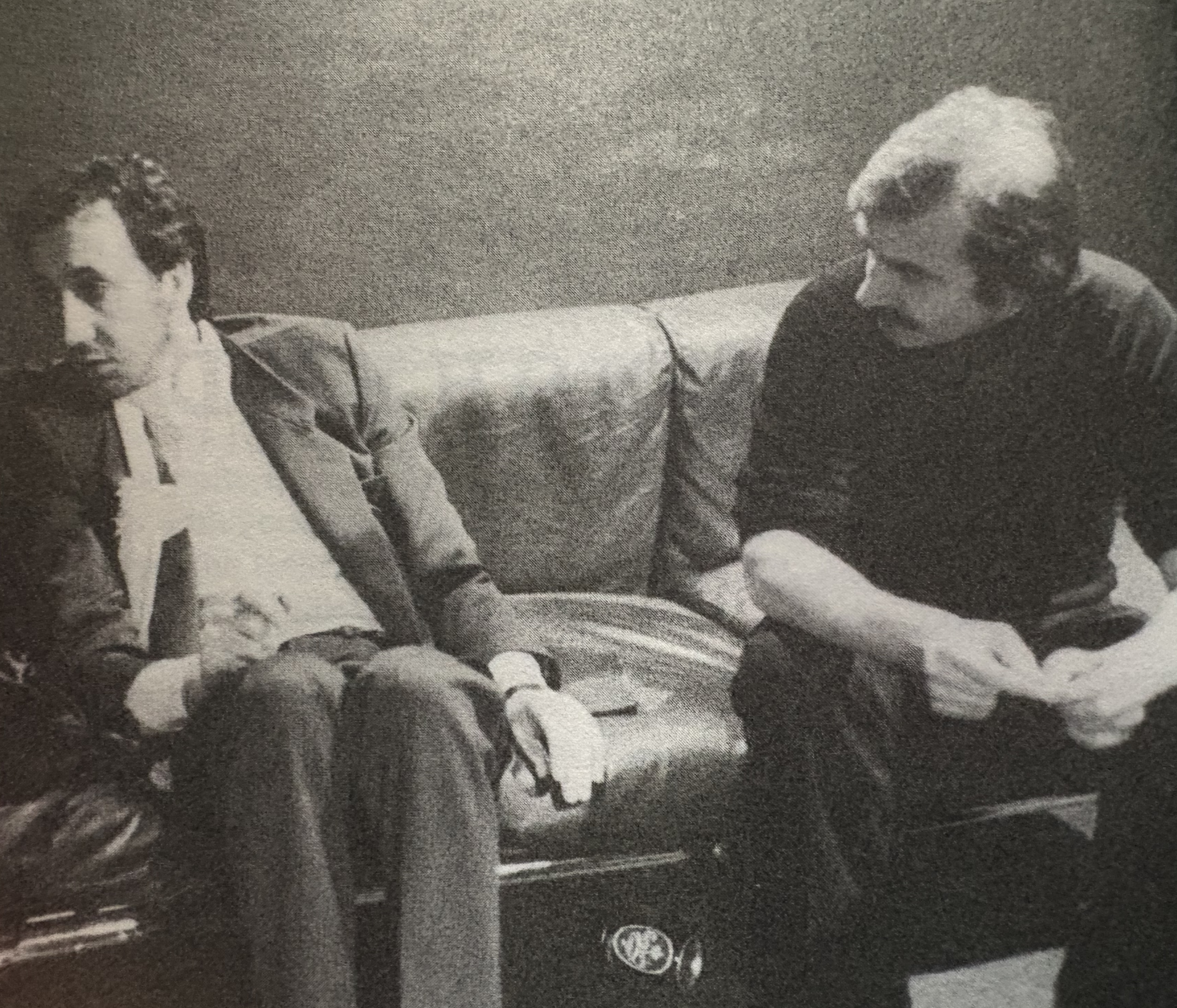
* The photo of Keith with Pete Townshend is from No More Mr Nice Guy!, reprinted by Blake Publishing in 2001 as The PR Strikes Back.

On Kate Mossman’s ‘Men of a Certain Age’

(For the last decade and a half, Kate Mossman has written clever, funny, perceptive and quite candid interviews with ageing rock stars. They are, she admits, her speciality. Discussing Journey’s Steve Perry, she says: “I was drawn to him for his ageing vulnerability, his giant ego and his extreme oddness… the perfect combination for me.” She’s just published a collection of the interviews, with commentary and reflections. But I wasn’t very interested in my own opinion of her book. I wanted to know what a woman music journalist of my generation, who interviewed some of the same musicians when they were in their young prime, and for whom being hit on by male musicians was a largely unremarked fact of life, made of the views of a woman born in 1980. So I invited a friend whom I first met in 1969, when I’d just arrived at the Melody Maker and she was already well established along the corridor at Disc & Music Echo, to read the book and, if so moved, to give me her thoughts. She said yes, and here they are. — RW)

By CAROLINE BOUCHER

Is it a good idea to meet your heroes? I’ve met most of mine and the jury’s still out, and I think it’s probably the same for Kate Mossman.

In Men of a Certain Age Mossman meets 19 of them – pieces  previously published in The Word and the New Statesman. The subjects are all elderly, as were those chosen by Rolling Stone’s founding editor, Jann Wenner, when he published a selection of interviews claiming, justifiably, that only in their senior years do rock stars attain articulacy and eloquence (and, rather more controversially, that no women at all qualified under those criteria).

Mossman kicks off with the unashamed obsession with Queen’s drummer, Roger Taylor, that meant her teenage family holidays in Cornwall became a pilgrimage to every site connected with him, so that when she was finally granted an interview at his house she could have found it blindfold. Fortunately she reeled away from that confrontation still enamoured.

As she points out: “Rock journalism is unique in that it’s the only place where writers are also obsessive fans, though part of the art is pretending not to be.” A chunk of her early wages was spent on airfares to America where she’d travel to gigs by Greyhound buses or, in the case of a 5,000-mile pilgrimage to meet Glen Campbell in California, walking for three hours down the edge of a freeway.

I’m in awe of her fluid writing style, and jealous of the editorial freedom that now allows her to tell it like it is. By the time she meets Gene Simmons, Kiss have been in the business for 44 years. She likens his hair to “loft insulation”. Or on Trans-Siberian Orchestra’s Paul O’Neill (I know, who he?), who has amassed an extraordinary collection of first-edition books (one signed by Queen Victoria to Kitchener): “He wanders out on to the patio, where the sun beats down so strongly that he must be melting in his leathers… and for a moment he epitomises the contradiction at the heart of rock ‘n’ roll wealth: the baby boomers who bought the lifestyles of the landed aristocracy but insist on looking like pickled versions of the boys they were when they first picked up a guitar.”

Her subjects are a fascinating mix – not all of them out front onstage. For me, the most interesting was Cary Raditz, Joni Mitchell’s former lover and “mean old daddy” from “Carey”, the song named after him. It’s a vivid and fascinating portrayal of the two characters– who initially lived in a cave, and drifted in and out of each other’s lives as Mitchell’s star ascended.

When I was on a music paper in the late Sixties we helped peddle lies. I can still feel the boiling disappointment after an interview with the Byrds who were rude, arrogant and condescending, yet I wrote a bland piece. Syd Barrett was slumped out cold for the entire hour of my interview slot; he couldn’t utter a word. I can’t remember how I got round it, but my editor insisted on filling half a page and afterwards EMI sent me a congratulatory telegram.

An Engelbert Humperdinck review bore no mention of his chauffeur chasing me down the seafront to bring me back for some “entertainment’” Nor did a Mick Jagger interview betray my difficulty taking shorthand notes as his head was resting on my (fully clothed) chest.

As Mossman is meeting her idols in the twilight of their careers the testosterone has ebbed somewhat, although Kevin Ayers gives it a half-hearted try at his dusty French home. His self-belief seemed to be as strong as ever and I can wholeheartedly attest to how irritating he was when I had briefly turned gamekeeper from poacher and was doing PR for Elton John’s office. At the time Elton’s manager, John Reid, signed Ayers, so I flew some journalists out to Paris to see him perform and then talk to him over supper. I knew things were about to go spectacularly wrong when, from my balcony seat, I could see a blonde, cloaked figure at the side of the stage and recognised Richard Branson’s wife, Kristen, with whom Ayers was having an affair. We were spared a Daily Mail front page as fortunately none of the hacks knew who she was and were anyway spared interviews as he went straight back to the hotel with her.

Mossman’s original interviews are pre-Covid, each topped with an explanatory introduction, and many of the subjects have since died, but it’s an excellent read. Previously I had had no interest in many of  her heroes — Terence Trent D’Arby, Bruce Hornsby, Jon Bon Jovi, and I’d never even heard of the Trans-Siberian Orchestra — yet those, for me, were the most interesting and insightful pieces.

* After Caroline Boucher left Disc, she worked at Rocket Records and was then for many years at the Observer. Kate Mossman’s Men of a Certain Age is published by Nine Eight Books (£22). The photograph of Mossman with Kiss is from the book jacket.