The Island story, pt 3
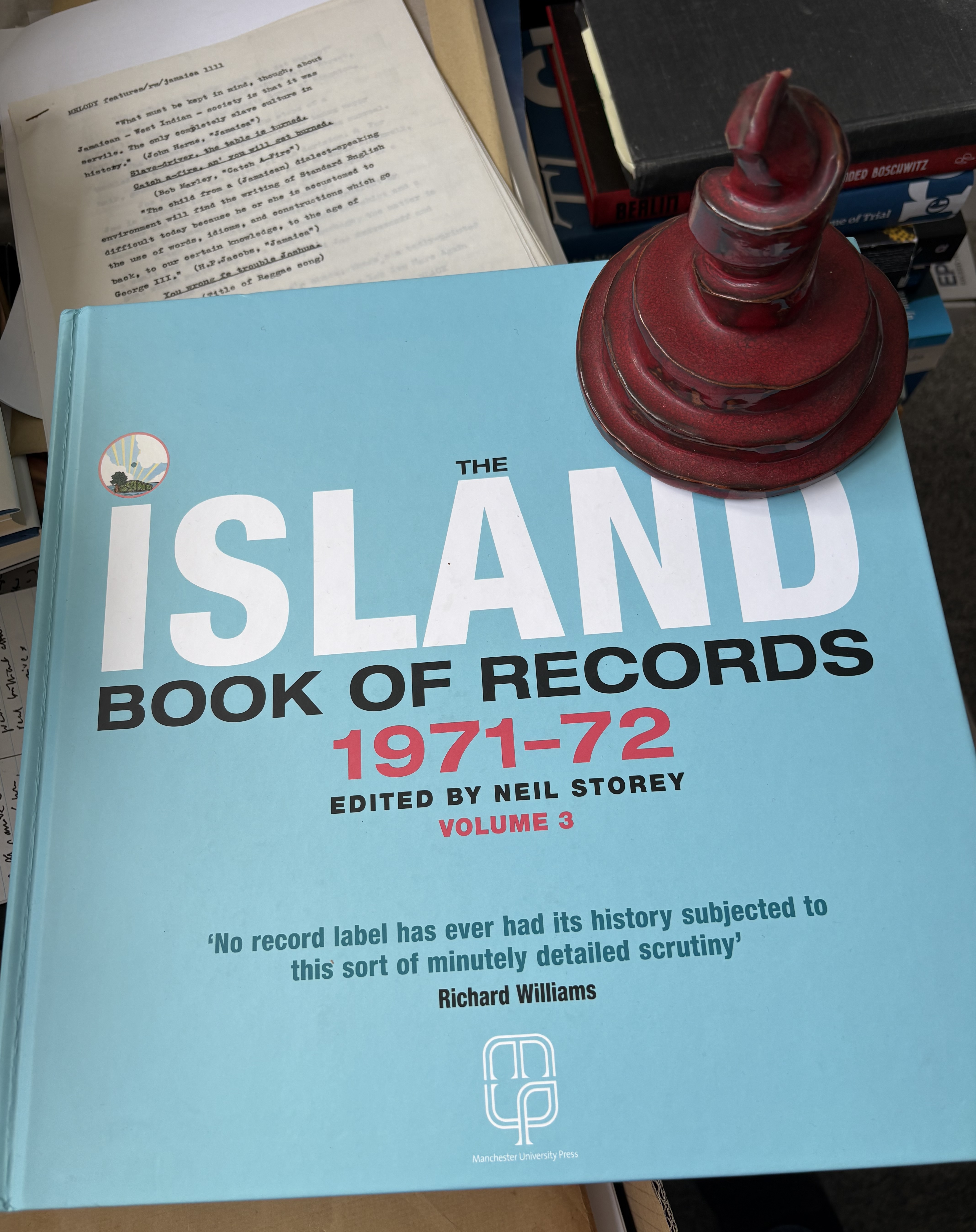
Every year or so there’s a little reunion of people who worked at Island Records in its early and earlyish days, held in a pub near the offices in St Peter’s Square, Hammersmith, to which the company moved in 1973. The most recent of these family affairs was a week ago, and it coincided with the publication of the third volume of Neil Storey’s mammoth Island Book of Records, an illustrated oral history of just about everything that went on to make the label what it was and became. Mammoth in the depth of research that goes into documenting every release on the label and its associates, albums and singles, no matter how seemingly insignificant, and mammoth also in its sheer physical proportions.
Each volume is 12 inches by 12 inches, hardbound with sturdy covers and good paper. This one has 480 pages, and you would not want to carry it up too many flights of stairs. It covers only two years, 1971-72, when the company was headquartered in Basing Street, Notting Hill, but what years they were: Traffic’s John Barleycorn, King Crimson’s Islands, Fairport Convention’s John Babbacombe Lee, Free Live!, the first solo albums from Sandy Denny, Richard Thompson and Jim Capaldi, Cat Stevens’s Teaser and the Firecat and Catch Bull at Four, Nick Drake’s Bryter Later and Pink Moon, the Harder They Come soundtrack, and the debut of Roxy Music. Also a torrent of albums from the sort of bands that ZigZag readers loved: Spooky Tooth, Mott the Hoople, Free, Quintessence, Uriah Heep, the Incredible String Band, Vinegar Joe, Juicy Lucy and Bronco. Not to mention Claire Hamill, the Sutherland Brothers and Amazing Blondel. And Emerson, Lake & Palmer.
Storey’s interviewees range from musicians, backing singers and executives to promotion people and sales representatives, designers and photographers. Everyone has interesting stories to tell, be they founder Chris Blackwell, A&R chief Muff Winwood, the producers Joe Boyd and Paul Samwell-Smith, the art director Ann Sullivan (a rare woman at this stage of the story), the photographer Brian Cooke, the publisher Lionel Conway or the engineers in the label’s studios, including Phill Brown, Tony Platt and Richard Digby Smith. There are frequents shafts of illumination, like the great engineer/producer John Wood on John Martyn: “John always wanted to be something he wasn’t.” Or the late Mike Kellie of Spooky Tooth, summing up Island’s early-’70s vibe by describing the Basing Street offices, with their famous non-hierarchical round tables, as “a home away from home.”
These years also saw the birth of the HELP label, a cut-price line for compilations, live albums and experimental projects. It took its name from ELP, whose live recording of Pictures from an Exhibition was its first release, followed by Ashley Hutchings’ Morris On, King Crimson’s Earthbound, John Surman’s Westering Home (the forerunner of his ECM albums), Stomu Yamash’ta’s Come to the Edge, and others.
The one that interests me most is Tibetan Bells, a project by Henry Wolff, Nancy Hennings and Drew Gladstone, an unlikely project which ended up selling quite well. Tony Platt’s description of solving the problems involved in recording bells and bowls is both enlightening and entertaining. And David Betteridge, who took over as the company’s managing director in 1971 when Blackwell felt like spending less time in the UK, gives us a sharp little reminder of the modus operandi at even the most seemingly enlightened and progressive of record labels: “The sleeve was a damned indulgence with that special inner bag… but don’t forget that at the end of the day the costs of that were recouped. We weren’t that stupid. The artist paid out of the royalty for that sort of indulgence.”
There’s a delightful description of the 1972 visit of Johnny Nash and Bob Marley to a school in Peckham, South London, where they give the pupils an impromptu concert — and where Bob played football with the boys. And it’s Marley whose arrival gives the book its postscript: an account of Blackwell’s first meeting with the Wailers, of his decision to advance them the money (£12,000, as I recall) to make an album which he would then market as of they were a rock band, and of how he felt when he heard the first results of his gamble, at Harry J’s studio in Kingston, where a new future would begin.
* The Island Book of Records Vol 3: 1971-72 is published by Manchester University Press, price £85. The curious object sitting on the book is a ceramic by Bryan Ferry, who presented it to me with his tongue in his cheek and a little label (now lost) saying ‘Roxy Music Rock Critic of the Year Award 1972’. The piece of paper under the book is the original typescript of the feature I wrote for the Melody Maker that year on visiting Jamaica to listen, with Blackwell, to the first recordings from the Catch a Fire sessions. Normally I chucked the carbon copies of my typescripts away; this one I kept.


It is indeed a beautiful book, worthy of its topic. Looking forward to Volume 4!
You certainly whet our appetites with your further account of the Island Records story…. What a clearly wonderful piece of work from Neil S! I was particularly interested to see your reference to Tibetan Bells. I am not sure who it wasd that connected me with Henry Wolff, Nacy Hennings and Drew. Maybe the press people at Island. They knew I was one of the lovers of edgy, off-piste music at the BBC, where I worked in the inctedible Saturday night live arts programme , on BBC-2 Whome I persuaded to do a live version of Side One of Tubular Bells (I had met Branson as a student, when he came to consult me about starting “Student”, and although he was still a schoolboy and several years younger than me, he clearly had miraculous business savvy, and I couldn’t teach him anything about that side pf journalism. We kept in touch, and I got to hear of Tubular Bells… It’s possible that someone at Island tipped me of about the TIbetan Bells people, though it could also have been their friend Sheldon Rochlin, NYC underground film. maker who hung out at our Baywaster basement, and had made a film about the Dagar Brothers.. I can remember Henry, Nancy and Drew setting their complex rig of hanging bells,gongs and cymbals in Studio 2 (( think) of Television Centre, a few feet away from Jimmy Savile who was recording TOTP in the next-door studio and doing all kinds of horrors in his dressing rooms.) We smoked loads of weed, of course, at the heart of the BBC. It would have been in 1972 or 1973. It was a show where an act like Tibetan Bells could be followed artist Stuart Brisley half submerged in a bath of offal ( this was years and years before “Sensation”), anad we had David Bedford conducting 180 or so schoolgirls from super-posh Queens College School (W1), all of them playing kazoos, to a score which had no notes, only little pigs dancing around on musical staves… There was Mike Westbrook, comedy from Henry Goodman, sarangi-playing from the master Ram Narayan. Wild stuff, and the prequel, in my case , to the co-creation of WOMAD.
Thanks Richard, always nice to be reminded about Island records…. and its role in all our lives. Bought many of them……remember with particular fondness… as a hardup school boy in the early 70s the amazing Samplers ….Nice Enough to Eat… and You Can All Join In. Have got to know Claire Hamill recently… as she’s come back home to Middlesbrough, to our local theatre club to play gigs. She told a great story about how her then manager John McCoy arranged a meeting with Chris Blackwell at his well appointed London home to potentially sign her up to Island…and she spilt red wine over his beautiful deep white rug…great he showed faith in her.
Regards
Barry Coppinger
Nice to see Tibetan Bells mentioned . Still have it , along with other favourites ( Surman’s Westering Home and Morning Glory , Sun Treader , Yamash’ta , Quiet Sun ) . Halcyon days . .
Nice to see Tibetan Bells mentioned . Still have it , along with other favourites ( Surman’s Westering Home and Morning Glory , Sun Treader , Quiet Sun , Yamash’ta ) . Halcyon days .