Coltrane at 100
I loved jazz as soon as I discovered it, but it was when I heard John Coltrane that I realised it could take me to a different place. That would have been around 1960, and the first thing I heard was his solo on Miles Davis’s “Milestones”, on an EP. Then I used the money from my paper round to buy another EP, this time released under Coltrane’s own name.
Issued in the UK on the Esquire label, it paired “Bass Blues” and “You Leave Me Breathless” from his third studio album for Prestige, recorded in 1957. These were fairly conventional performances but I already knew, from reading Down Beat, that he was heading somewhere else. Soon there would be Coltrane Plays the Blues and Olé, which made that new direction very clear.
From the very start, though, there was that sound. You can hear it in the opening notes of his solo on “Bass Blues”. It was like nothing you’d ever heard before. Nothing like Lester Young or Dexter Gordon or Sonny Rollins. It spoke in a different way, to a different part of the brain. It wasn’t pretty in any normal sense. But it was immediately and transcendentally beautiful. Even then, it seemed to be searching for something beyond the tune, beyond the notes. I couldn’t put it into words then and I still can’t. I’ve never read anybody who really could.
Today, 23 September 2026, is the centenary of Coltrane’s birth. I could have listened to any of the favourites — the album with Monk from Carnegie Hall, “Mr Syms”, “Impressions”, “Africa”, “Alabama”, the whole of A Love Supreme, Crescent and Expressions — but instead I chose to honour his memory by listening to two of his most challenging albums, Om and Kulu Se Mama, both from 1965, They’re the sort of thing that gave critics the ammunition with which to attack his entire career, and 60 years later they still sound chaotic, beyond all structure and restraint and explanation, the product of a man searching for something beyond himself.
His death in 1967 robbed us of the chance to get answers from Coltrane himself, either in words or in his playing, to the questions raised by his later music. What did it all mean? That’s something we have to work out for ourselves. What I can give is my own interpretation of that thing he once said about wanting to create music that started in the middle and then proceeded in both directions simultaneously. To me, those directions are inward and outward, at the same time. That’s what his sound said, and still does.
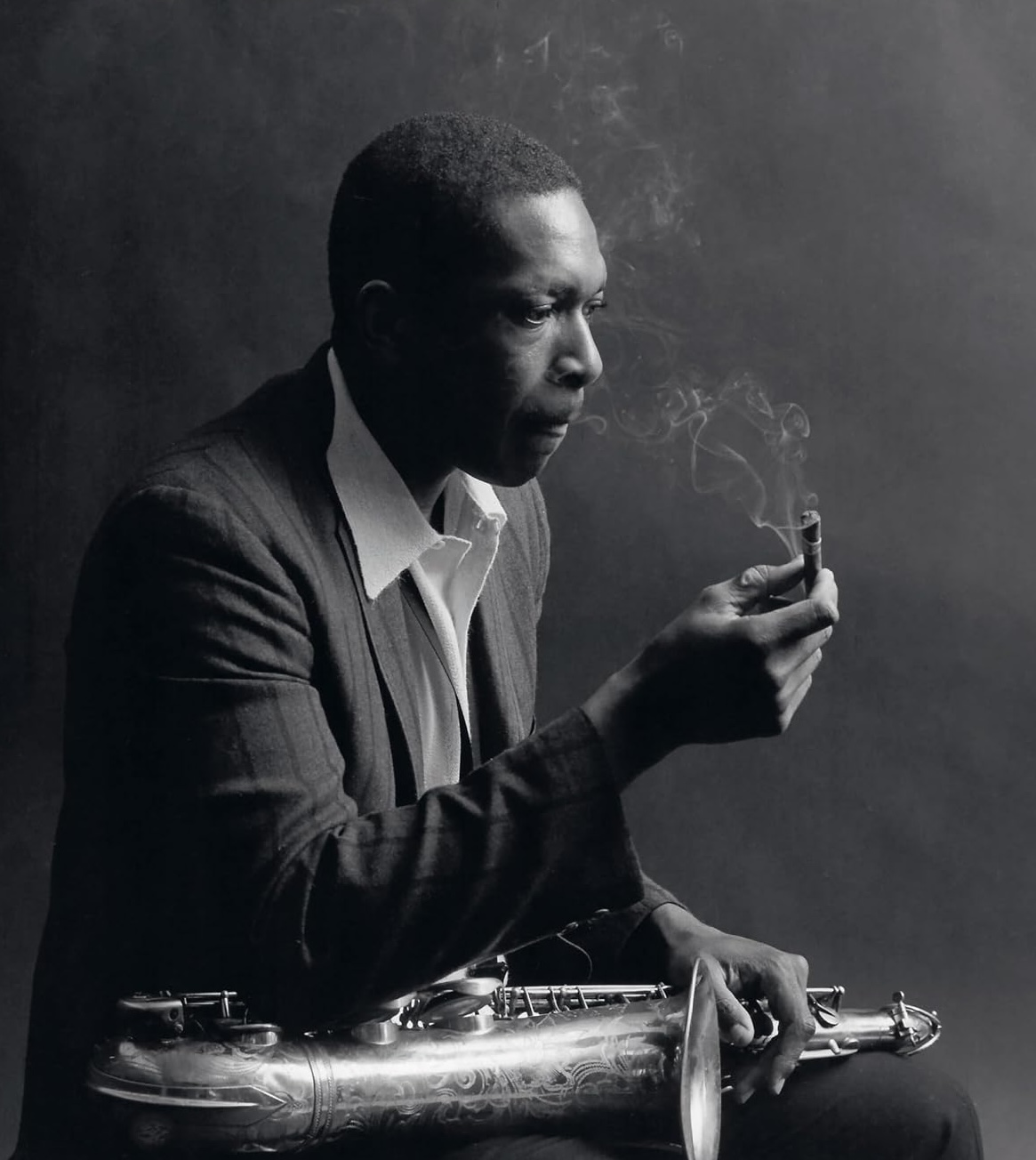
* The photograph was taken by Chuck Stewart in 1964 is from the cover of Coltrane: The Definitive Visual Celebration of the Legend by Ravi Coltrane and Wayne Coyne, published this month by Ten Speed Press.