A Northern Soul film
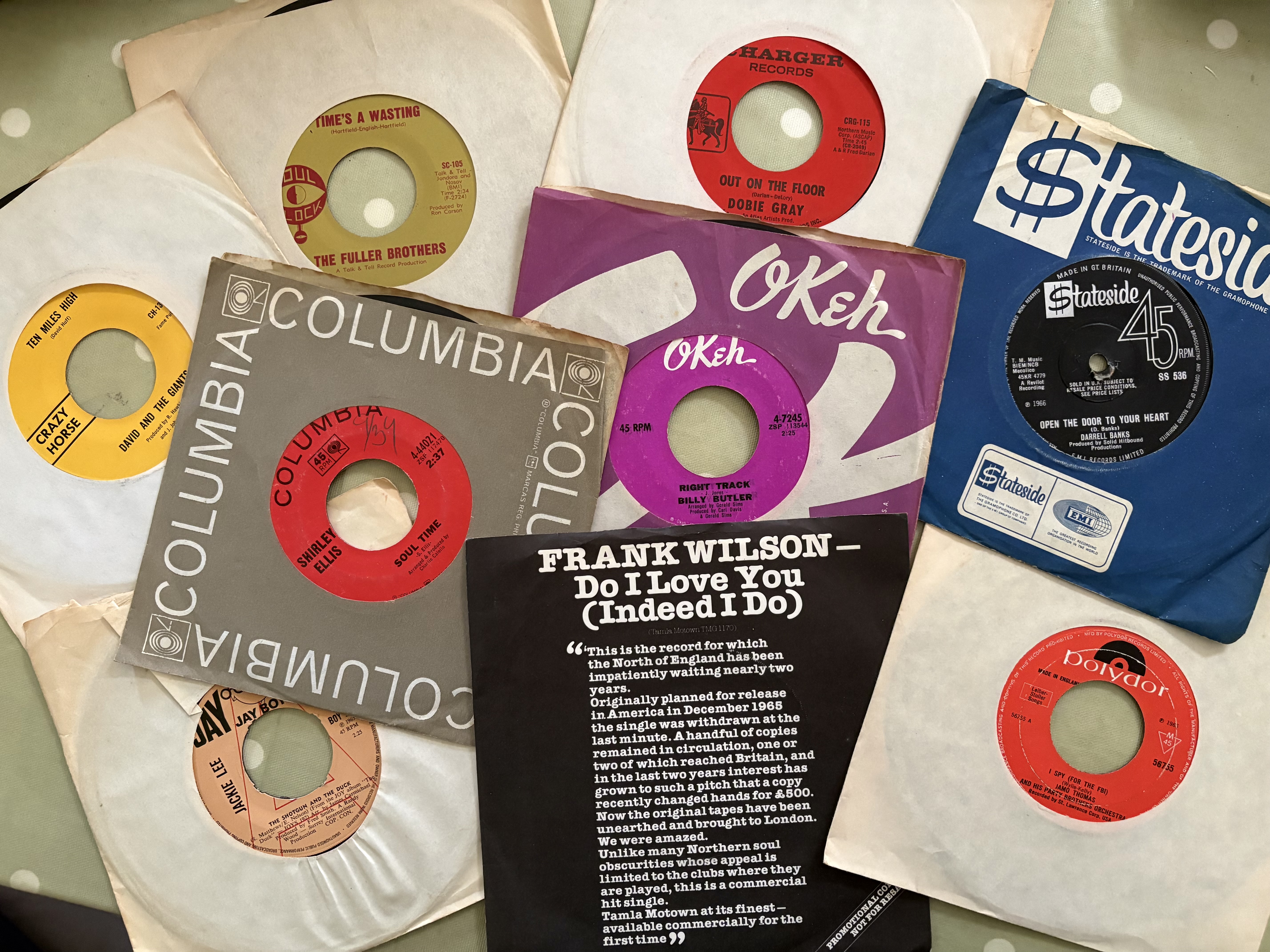
When I left Nottingham for London just before the end of the ’60s, Northern Soul was still in its embryonic stage. We’d danced to “I Can’t Help Myself”, “This Old Heart of Mine”, “You Don’t Know Like I Know”, “Helpless” and “Knock on Wood”, but something different was about to emerge from that club culture. On a visit back home in, I think, 1972, my friend David Milton — who had a shop in Derby called R. E. Cords — told me what it had become, after Dave Godin had given it a name in his Blues & Soul column. At Brian Selby’s Selectadisc, on long-gone Arkwright Street, I bought the Fuller Brothers’ “Time’s A Wasting” on Soul Clock and a bootleg of David and the Giants’ “Ten Miles High”.
I’d pretty much stopped dancing by then, but although I was always at arm’s length from Northern Soul (no visits to the Torch in Stoke on Trent, Blackpool Mecca or Wigan Casino), it always exerted an emotional pull on me: geographical, tribal and musical. It reminds me of the wonderful Welsh word hiraeth: the longing for a home you may never have known.
Northern Soul: Still Burning is a new 90-minute documentary film written and directed by Alan Byron, on show in cinemas this week. Against a constantly changing background of appropriate music, it consists mostly of talking heads — the disc jockeys (Richard Searling, Russ Winstanley. Ian Levine, Kev Roberts), the participants and the observers, including the journalist Paul Mason, who was both, the designer Wayne Hemingway, the documentary maker Tony Palmer, whose 1977 Granada TV film provides priceless footage from Wigan in 1977, and Elaine Constantine, whose feature film Northern Soul (starring Steve Coogan and Lisa Stansfield) came out in 2015 and also provides clips. From the contemporary scene, we hear from Ady Croasdell, who deejays all-nighters at London’s 100 Club, and two young chaps running Northern Soul nights in Deptford. And there’s Tony Blackburn, whose story of how he became an accidental Northern Soul star is the film’s comic highlight.
But the principal concentration is on evoking the emergence 50 years ago of a social and cultural phenomenon in northern and midlands towns already feeling the blight of post-industrial decline through the closure of steel works, woollen mills and coal mines. The music itself is barely discussed: we don’t hear much about the (mostly) African Americans who made it, or why, or what effect its belated rccognition in the UK might have had on them. Or, come to that, what it meant in musical terms (it would have been nice to have someone talking about the importance of vibes and baritone sax on so many of the records). No mention of the Northern Soul Prom of 2023, and the mixed reactions it provoked. Maybe all that is for another time.
You do get a sense, though, of how the combination of factors — summarised by Paul Mason as the music, the dancing, the fashion, and the drugs — so profoundly illuminated apparently ordinary young lives, and of how that feeling refuses to fade. Among the surviving witnesses, a woman named Marie Gillespie provides the most touching testimony; decades later, the meaning of it still shines in her eyes. It made me think how so many of the finest Northern Soul favourites — or even the lesser ones, the smudged copies of “Uptight” and “Reach Out, I’ll Be There” — add a potent hint of sadness and yearning to the relentless beat, and of how those complex emotions found a response in the dancers.
There’s no better example of that than the “three before eight” — Tobi Legend’s “Time Will Pass You By”, Jimmy Radcliffe’s “Long After Tonight Is All Over” and Dean Parrish’s “I’m on My Way” — traditionally played at the end of a Wigan Casino all-nighter. What feelings there are in those records: a urgent plea not to waste your life, a pledge of lasting faith, a shout of belief in the value of persistence despite the odds. On the Casino’s last night, in 1981, Richard Searling played the sequence three times before the doors of the old ballroom opened and the dancers met the morning light for the final time, their hearts full.
* For what it’s worth, here’s a baker’s dozen of my favourites, with no apologies for a complete lack of originality: 1 Frank Wilson: “Do I Love You (Deed I Do)” 2 Rita and the Tiaras: “Gone With the Wind Is My Love” 3 Billy Butler: “Right Track” 4 Ad Libs: “Nothing Worse Than Being Alone” 6 Tobi Legend: “Time Will Pass You By” 6 Shirley Ellis: “Soul Time” 7 Doni Burdick: “Bari Track” 8 Fuller Brothers: “Time’s A Wasting” 9 The Crow: “Your Autumn of Tomorrow” 10 The Tomangoes: “I Really Love You” 11 Frankie and the Classicals: “What Shall I Do” 12 Jackie Lee: “The Shotgun and the Duck” 13 David and the Giants: “Ten Miles High”


