Skip to content

Posts from the ‘Uncategorized’ Category

Two kinds of modern beauty

Necks1.
It was my friend and erstwhile Guardian colleague John L Walters who made the neat comparison between the experience of listening to the Necks and a stroll through an art gallery, during which the attention might wax and wane as the eye is caught, becomes absorbed, moves on, glances briefly at something else and moves on again. While listening to the Australian trio’s new CD, Open, which consists of a single 68-minute piece, I thought of a different analogy, one that works better for me. It’s like being on a long train journey, perhaps through several countries: the view can change many times in the course of the trip, gradually but inexorably, perhaps from vast wheatfields to industrial landscapes to valleys between snow-capped mountains, and the weather modulates along with the scenery. Occasionally you might dive into a tunnel, requiring the senses to adapt, and the landscape might have changed again when you re-emerge.

“Open”, which is also the name of the piece, starts with the gentle clanging of something that sounds like (but almost certainly isn’t) the strings of an abandoned piano being struck with a rubber mallet. Little cymbals are struck, a double bass enters (with the sort of sparse, sonorous, simple figure that so often provides an underpinning to the Necks’ long-form pieces), and a real piano makes its appearance, sounding a series of vaguely oriental arpeggios with the sustain pedal held down. Tony Buck, Lloyd Swanton and Chris Abrahams are all aboard, and we’re on our way.

The landscape changes pretty slowly on this trip. As it does, there’s always one element — perhaps the bass figure, or the tapping of a closed hi-hat, or the piano holding the key centre — to maintain a sense of continuity. There are quiet periods when nothing much seems to be happening, and passages of great intensity. In the first third there’s some fine drumming from Buck, whose ability to draw a lovely tone from his instruments reminds me of the young Tony Williams; around about the mid-point the oscillations of a single octave-doubled note held on a Hammond organ blend with a baleful industrial noise; there are several passages in which Abrahams moves between the quietly ecstatic approaches of Alice Coltrane and Charlemagne Palestine; and the gentle final stages feature what sounds like a choir of Swanton’s overdubbed basses.

It’s their 17th album, and even at this early stage of listening it sounds like one of their best, up there with Aquatic and Silverwater, in my view. And there are UK gigs — including three nights at Cafe Oto — to look forward to next month.

2.

Arve Henriksen is also visiting the UK in November, to play Andrew Smith’s Requiem (inspired by the Utoya massacre) with a choir and the organist Stale Storlokken at St Luke’s in London and elsewhere. In the meantime there’s his new CD, Places of Worship, a work of very special beauty.

I’ve never heard Henriksen’s trumpet (or his counter-tenor vocals, for that matter) sound as profoundly and consistently expressive, that ability to mutate tone and attack matched by some wonderful phrase-making and a powerful sense of continuity. Nor has he ever benefited from more lustrous electronic backgrounds, the samples and programming mostly manipulated by Jan Bang and Erik Honore, with occasional help from Eivind Aarset’s guitar and Jon Balke’s keyboards. As a tailpiece, there’s a pretty song called “Shelter from the Storm” (not that one), sung by Honore.

In his five-star review in this morning’s Guardian, John Fordham drew a comparison with Sketches of Spain. That had been going through my head, too, particularly when listening to “Le Cimetiere Marin” and “Bayon”, two of the album’s 10 tracks. I was also reminded of Siesta, Miles Davis’s soundtrack to a 1987 film (directed by Mary Lambert) that nobody seemed to like but for which Miles, with the help of Marcus Miller, produced some beautiful moments at a time when conventional ideas of beauty did not seem to be high on his agenda.

Where Open demands a proper degree of commitment, Places of Worship opens its arms to any listener. In their different but equally wonderful ways, these are likely to be the albums by which I’ll remember the year.

* The photograph of the Necks — left to right: Lloyd Swanton, Tony Buck and Chris Abrahams — is by Camille Walsh. Their album is released on the RnR MEGACORP label. Henriksen’s album is on Rune Grammofon.

Volume control

Romain PilonNo one influenced the way jazz has been played on the guitar for the last 40 years more profoundly than Jimi Hendrix, who wasn’t a jazz musician in any way but nevertheless exerted an influence as profound as that of Charlie Parker or John Coltrane on saxophone players.

Hendrix’s example granted guitarists a licence to exploit the variations in tone and attack made possible by their electronic equipment, to break away from the restrained approach of earlier giants, from Charlie Christian to Wes Montgomery, and to spend more time exploring colour and texture in sound. A list of those players whose conception was touched by his influence to a greater or lesser degree might include such figures as Larry Coryell, Sonny Sharrock, John McLaughlin, Terje Rypdal, David Torn, Vernon Reid, Bill Frisell, Pat Metheny and the man we saw in London last week, Marc Ribot.

So it makes a nice change to listen to a young guitarist whose playing, while thoroughly modern, shows no traces whatsoever of a similar inclination. Romain Pilon was born in Grenoble, spent four years studying at Berklee, lived in New York for a year and is now based in Paris. The Whirlwind label released his first album, by a trio, last year, and now comes its successor, called Colorfield. This one features a quartet in which Pilon is joined by three Americans: the tenor saxophonist Walter Smith III, the double bassist Michael Janisch and the drummer Jamire Williams. Recorded in London, the album contains seven of Pilon’s absorbing compositions plus Horace Silver’s lovely ballad “Lonely Woman” (not to be confused with Ornette Coleman’s oft-performed piece of the same title).

Here is an hour of music in which substance triumphs over style. The tunes are attractive and varied but never flamboyant, and they inspire solos which have no ambition beyond a thorough exploration of their themes and structures. Pilon plays with a small, rounded, soft-edged tone reminiscent of the great Jim Hall, and uses absolutely no effects other than his great ear for harmonically acute, melodically elegant, rhythmically fluid improvisation. His colleagues are equally outstanding, particularly Smith, who confirms the impression he made last year on the trumpeter Ambrose Akinmusire’s much praised debut album — he’s another unshowy player, avoiding the customary influences in favour of an approach that might be what you’d get if you blended Warne Marsh with Sam Rivers and added a dash of Joe Henderson.

Janisch and Williams play a full part in these outstanding conversations, in which everyone has something worth saying and no one tries to shout anyone down. If you want a lesson in how to swing very hard indeed without raising the voice above a civilised murmur, listen to the final track, “7th Hour”. All in all, highly recommended.

John Abercrombie is a guitarist of an earlier generation, similarly unflashy and always worth hearing. His 39 Steps caught my eye before it caught my ear. It’s on ECM, whose releases are noted for the quality of the photography adorning their covers. But where there’s usually a moody land- or sea- or cityscape, with this one there’s an aerial picture of part of a football pitch: just the mown grass and the whitewash of the halfway line, the centre circle, the penalty area and the D. No players, however. In this context the image has more to do with geometry than sport; it seems to have no relationship to the music, which is by the American guitarist’s quartet, including  Marc Copeland on piano, Drew Gress on double bass and Joey Baron on drums. Or, indeed, to the album’s title, which is reflected in several tunes named after other films by Alfred Hitchcock.

This is an even quieter album than Pilon’s. With six compositions from Abercrombie and two from Copeland, plus the standard “Melancholy Baby” and one short collective improvisation, it barely disturbs the air in the room. A form of chamber music, certainly, but of a very high order when the four men are exploring the nuances of tunes as elegantly appealing as the guitarist’s “Vertigo” or the pianist’s “Spellbound”. Copeland occasionally inserts a hint of astringency that I suppose you could call noir-ish, but no violence is committed. For those prepared to listen closely, the relatively circumscribed emotional range will be no barrier to enjoyment of another exceptional album.

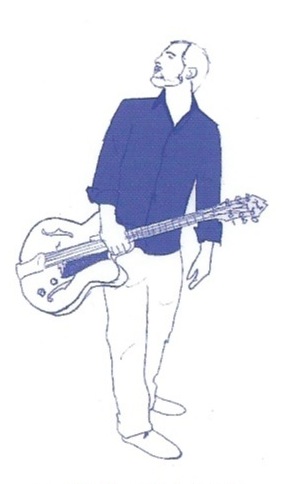
* The drawing is from the cover of Colorfield. It is uncredited.

Old apple, new garden

The Serpent TailThe only time I visited Wilton’s Music Hall, in the old streets just north of Tower Bridge, was on New Year’s Eve in 1998, to hear the actress Fiona Shaw recite The Waste Land, an experience rendered all the more unforgettable by taking place close to several of the locations mentioned in Eliot’s poem (“The river sweats / Oil and tar / The barges drift / With the turning tide…”).  I wish I were able to return there tomorrow night, to see Kate and Mike Westbrook perform their new song cycle.

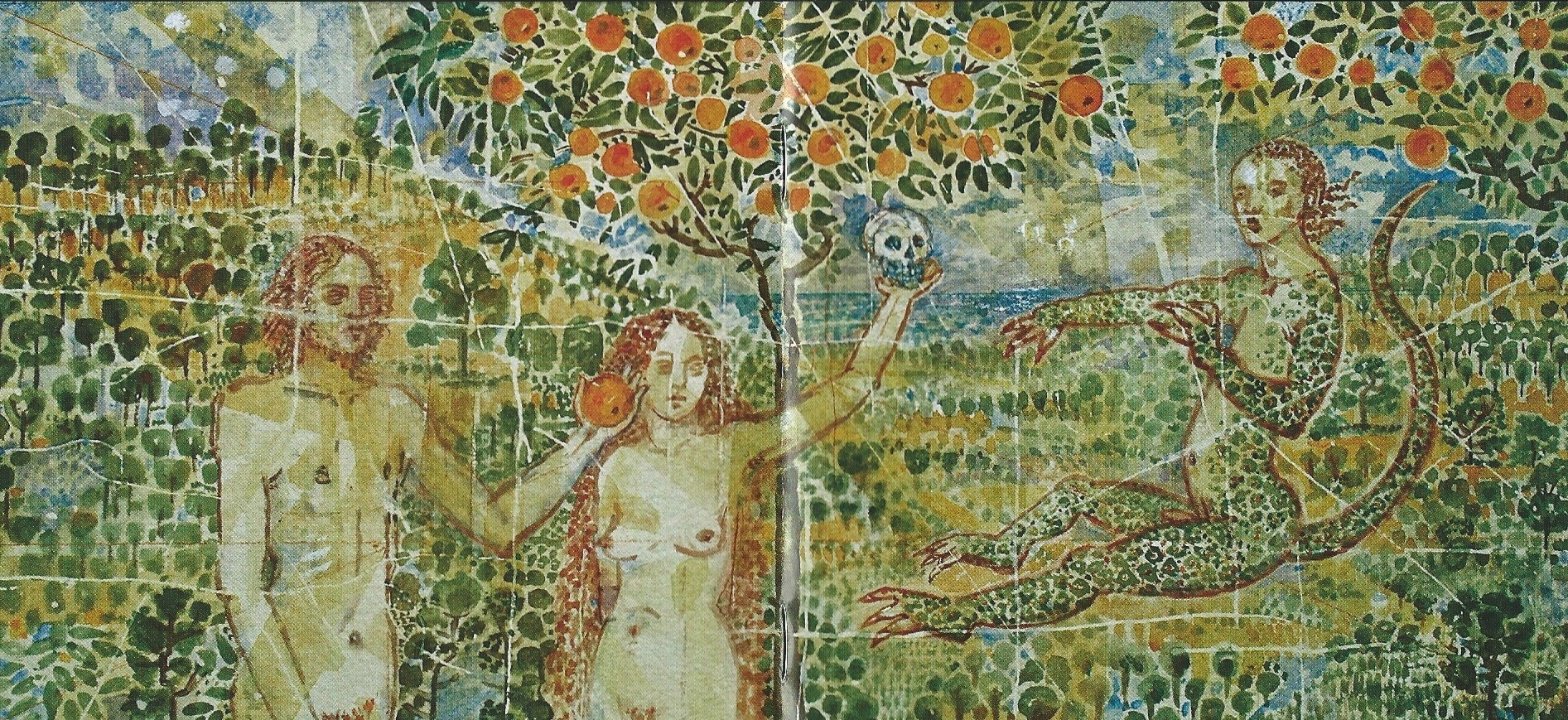
The Serpent Hit is its title, and also that of Kate Westbrook’s painting (above), the illustration on the cover of the CD, just released on the their own label. The piece deals with a big theme: mankind’s continuing fall from a state of grace, through the careless disregard of warning voices.

Five of the six individual pieces making up The Serpent Hit are written for Kate’s voice, a saxophone quartet (Andy Tweed, Chris Biscoe, Karen Street and Chris Caldwell) and a drummer (Simon Pearson); the sixth is an instrumental interlude. The music is Mike’s, and reminds us of his very personal gift for voicing: there are passages that echo his very earliest recordings, Celebration and Release, which were made with his big band in the late ’60s and still sound startlingly fresh. He writes beautifully for the saxophones, and in turn the soloists — notably Biscoe on alto and Caldwell on baritone — rise to the occasion, driven by the tireless Pearson. The effect of the ensemble is somewhere between the Ellington reed section and a Southern European marching band, but dominated by that pungent Westbrook flavour.

No less striking are Kate’s lyrics, spoken and sung in a theatrical style that has its roots in Lotte Lenya’s work with Brecht and Weill. It is an approach built for music of protest, and those three would have appreciated this harsh and bitter tirade against those who would rob the world of its innocence, its fruit and its future.

So, perhaps, would Eliot. And I can imagine Wilton’s — said to be the world’s oldest surviving music hall, with origins as an alehouse going back to the early 18th century — providing the perfect ambiance.

Oh, what a sound (September 1963)

September 1963For me, music changed exactly 50 years ago this month. It was in September 1963 that, as a 16-year-old schooolboy, I first heard all the 45s you can see in the photograph above. They are, clockwise from top left: “You’re No Good” by Betty Everett,”The Monkey Time” by Major Lance, “Heat Wave” by Martha and the Vandellas, “Anyone Who Had a Heart” by Dionne Warwick, “Can I Get a Witness” by Marvin Gaye,”It’s All Right” by the Impressions, “You Lost the Sweetest Boy” by Mary Wells, and “Hello Stranger” by Barbara Lewis.

When you’re 16, everything seems important. But these records really were. All of them were brand new; together they rearranged the possibilities inherent in a fusion of R&B, gospel and pop. Beamed in from Detroit, Chicago and New York, they announced the birth of soul music.

“Heat Wave” was the first, and it remains the closest to my heart. I can remember the feeling of being transfixed as those guitar and piano chords and that driving snare-drum came out of the radio. But each of them was a lesson of its own.

As you can see, I preserved the original copies, each in its proper seven-inch bag. They’re the ones I bought back then — with a single exception. One summer night in 1967, during a party at my parents’ house on the day my sister got married, someone stole my complete run of Martha and the Vandellas’ Stateside 45s, half a dozen of them, from “Heat Wave” to “Wild One”. Nothing else; just those. A thief with impeccable taste, obviously.

Mulatu Astatke’s Sketches of Ethiopia

Mulatu AstatkeThere’s a party scene in Paolo Sorrentino’s The Great Beauty — a film I like a great deal, although if Fellini’s La Dolce Vita, its spiritual and stylistic ancestor, is universally known by its Italian name, then so should be La Grande Bellezza — in which an elegant woman of a certain age says something like: “Everybody knows that Ethiopian jazz is the only kind worth listening to these days.”

She’s trying to be superior, but there’s something to what she says. Lots of kinds of contemporary jazz are worth listening to, of course. But when I first encountered the saxophonist Getatchew Mekurya on one of the volumes of Francis Falceto’s Ethiopiques series, it was like walking into a parallel universe, one in which Albert Ayler had been born and spent his entire life in the Horn of Africa. Like discovering jazz all over again, in a way.

Falceto’s series began its schedule of releases in 1998, became a favourite of hipsters and is now up to Vol 28. The extraordinary Mekurya — The Negus of Ethiopian Sax, to quote the title of Vol 14, which is devoted to his work — was the one who caught my ear, while others were knocked out by Mulatu Astatke, the vibraphone player and bandleader. Now Astatke has a brand-new album on the Jazz Village label, titled Sketches of Ethiopia, mostly recorded in London and featuring a basic band including names that will be familiar to followers of the contemporary British jazz scene — the trumpeter Byron Wallen, the pianist Alexander Hawkins, the bassist John Edwards and the drummer Tom Skinner — alongside others from Africa, France and elsewhere, such as the singers Tesfaye and Fatoumata Diawara, plus a chorus.

The album is very far from being a showcase for Astatke’s vibes-playing: it’s all about interlocking rhythms (he also plays congas) and shifting instrumental combinations. His best moment on his main instrument comes during a piece based on a traditional tune called “Hager Fiker” in which the vibraphone rides a sinuous conga-driven rhythm quite beautifully before giving way to two traditional instruments: first Messale Asmamow’s krarr, a five-string instrument, then Yohanes Afwork’s washint, an end-blown flute. His mallets also provide a sound-bed for  a glorious out-of-tempo introduction to an original titled “Gambella”, the metre gradually seeping in before the piece evolves into one of the irresistible funk grooves in which the album abounds. But the highlight is “Motherland Abay”, written by Astatke: eight and a half minutes of constantly changing textures, in which Wallen’s fine muted solo is shadowed by a wonderfully subtle horn arrangement.

At such a moment, as Kevin Le Gendre notes in his review of the album in the new issue of Jazzwise, what we’re hearing is music that seems to exist “right on the cusp of African and Arab culture” — but, I’d add, with a seemingly limitless horizon. It’s the music, in some respects, that I was always disappointed Weather Report didn’t quite get around to making. A terrific album.

* The photograph of Mulatu Astatke is by Alexis Maryon and is taken from the insert to Sketches of Ethiopia.

The day the music stopped

Gene Phillips 2It was, without doubt, one of the strangest episodes in the history of the record business. Twice in the 1940s — from August 1942 to November 1944 and from January 1948 to early 1949 — the American Federation of Musicians banned its members from entering the recording studios. On the first occasion James C Petrillo, the union’s president, took action because believed that musicians were losing jobs as places of public entertainment closed and radio became a dominant medium; in compensation, he called for royalty payments by the record companies to the AF of M.

It took a while to get them to the negotiating table. Before the first ban ended, following piecemeal agreements with individual companies for royalties of between 0.25 and 0.5 cents per disc, a great deal of interesting music had gone undocumented. In particular, I think of the young Charlie Parker’s stints with the Earl Hines Orchestra between December 1942 and May 1943 and with the Billy Eckstine Band between April and August of 1944, neither of which were recorded; his fellow members of these fascinating aggregations included Dizzy Gillespie, Benny Harris, Fats Navarro, Wardell Gray, Oscar Pettiford, Shadow Wilson and Art Blakey, while the Eckstine Band’s book included arrangements by Gillespie and Tadd Dameron. An important period in Bird’s career was lost.

(Singers, curiously, were exempted from the ban, which is why Frank Sinatra’s first solo recordings for the Columbia label, made in 1943, featured strictly acapella treatments of such songs as “People Will Say We’re in Love” and “Oh! What a Beautiful Morning”, suavely arranged for the singer and the Bobby Tucker Singers by Alec Wilder.)

By the time the second ban loomed, imposed by Petrillo as a protest against the Taft-Hartley Act, passed in 1947 to restrict the power of labour unions, the labels had their pre-emptive plans in place. The appetite for recorded music was huge, and to stockpile the material that would enable them to meet it they scheduled round-the-clock sessions — with the willing collaboration, it seems, of the musicians whose services were about to be withdrawn. Most of the companies tried to stash away enough material to keep them supplied with new releases for what turned out to be a rather shorter recording hiatus.

Among those getting busy were the Bihari brothers of Los Angeles, who had started their Modern Records label three years earlier, concentrating on making records for the black audience, which Jules Bihari had encountered while servicing juke boxes in Watts. Their first hit, in their initial year, had come with “Swingin’ the Boogie” by Hadda Brooks, an accomplished pianist and a sultry singer, and their roster had expanded to include the Ebonaires, a vocal quartet, the gospel singer Madam Ira Mae Littlejohn and bandleaders such as the guitarist Gene Phillips, the drummer Al “Cake” Wichard, the saxophonist Little Willie Jackson and the trumpeter-singer Butch Stone.

All these were pressed into service to build up a stock of material for however long the ban lasted, but since it ended after barely a year, most of the sides went unreleased. Now Tony Rounce of Ace Records, which has licensed the catalogue of Modern and its associated labels for the past 30 years, has delved into the vault to assemble 49 of the 80-odd tracks recorded during that burst of activity, all but 10 of which are seeing the light of day for the first time, on a two-CD set titled Beating the Petrillo Ban: The Late December 1947 Modern Sessions.

Apart of from its curiosity value, the compilation provides a marvellous snapshot of black popular music at a time of change, when mainstream jazz styles were starting to mutate into early rhythm and blues. So most of the music is an invigorating combination of big, burly blues shouters — half a dozen tracks under Wichard’s leadership feature the young Jimmy Witherspoon — and excellent jazz soloists, all of whom, sadly, go uncredited, since no personnel information has survived the intervening 66 years.

The leaders’ names will be unfamiliar to many people, but the quality of the material and the musicianship is invariably high. So is the recording quality: most of the tracks could have been recorded this week. The offer of a dozen new tracks by the gifted Ms Brooks (born Hattie Hapgood) and her excellent accompanists is too good to refuse, and the four sides by Gene Phillips and his Rhythm Aces (pictured above, in a photograph taken from the well annotated and illustrated CD insert) are notable for the leader’s eloquent guitar playing, particularly on “Gene’s Guitar Blues”, where he plays in a Hawaiian style that Chuck Berry later utilised on his instrumental “Surfin’ Steel”.

But the real find, for me, is Madam Ira Mae Littlejohn, whose six tracks expose us to a gospel singer of quite staggering power. “The technology has only just arrived to allow us to copy what was once an extremely bent and unplayable acetate,” Rounce says, further informing us that these may have been her only recordings. Thank goodness for digital technology, then, allowing us to discover Madam Littlejohn’s raw, throat-tearing delivery, accompanied by rudimentary piano and acoustic guitar and occasionally by a handful of supporting voices. The rest of the set would make a fine addition to the collection of anyone interested in the music of the period, but this is real treasure.

James Caesar Petrillo, by the way, died in 1984, aged 92. He had started life as a trumpeter before devoting himself to union affairs, ran the Chicago branch for 40 years, and once wrote to Benito Mussolini to complain that the city’s Italian consul had hired a non-union band. He took control of the national body in 1940 and the recording bans quickly made him a national figure, but in the mid-Fifties there were attempts to dislodge him, led by Local 47 in Los Angeles and Local 802 in New York — two branches in which jazz musicians were prominent. He resigned from the presidency in 1958 and was ousted from the leadership of Chicago’s Local 10 four years later. The bandshell in the city’s Grant Park bandshell was named after him.

Some thoughts on Bob Dylan

Bob Dylan faces21.
There are 12 works in Face Value, the new Bob Dylan exhibition at the National Portrait Gallery in London, on until January 5 and free to enter. One room, three walls, four paintings on each wall, identical proportions, symmetrically hung. A dozen faces, any or all of whom could have stepped out of his recent songs. He’s given them names, but we don’t know whether “Ivan Steinbeck”, “Ursula Belle”, “Red Flanagan”, “Sylvia Renard” and the rest are real people, or whether they’re products of the imagination that created Lily, Rosemary and the Jack of Hearts. “These are conventional people,” the artist says during a Q&A contained in the slender but handsome £25 catalogue. “One of the men is actually a member of the Sydney Yacht Club. One’s a limo driver.” Well, maybe. It doesn’t matter.

This is not my area of expertise, but Dylan seems to me to have mastered the use of pastels — the chosen medium here — quite well enough to bring his subjects to life. The eyes are the key to a portrait, and every one of these characters has a certain regard of his or her own: they’re looking at you, or past you, or through you, or inside themselves. Each has a subtitle, which might or might not be significant: “Slap in the Face” is the line accompanying “Ken Garland”, who has a broken nose and looks like a prizefighter. They could be the 12 Most Wanted, or they could be a jury. They could be devils or they could be angels. Or a bit of both, like most people.

2.

When you add the illustration on the front of Another Self Portrait: The Bootleg Series Vol 10 to the dozen pictures in Face Value, with which it shares its format, it starts to make more sense. Dylan’s image of himself — if that is what it is — floats between reality and fiction, neither one nor the other.

I bought the four-CD box, mostly because I wanted the disc containing the complete concert at the Isle of Wight in 1969, but I’m glad to have many of the items among the 35 tracks collected on the first two CDs (the fourth disc is yet another remastering of the original Self Portrait, which I didn’t need). As many people have already said, “Tattle O’Day” is a major discovery, a mysterious traditional song beautifully delivered by Dylan with David Bromberg’s guitar and Al Kooper’s piano: the sort of thing that very probably formed the inspiration for the material recorded on the Basement Tapes. There are excellent alternative versions of “Went to See the Gypsy” and “When I Paint My Masterpiece”, and another lovely voice-and-piano treatment of “Spanish Is the Loving Tongue”, a song I’d be happy to hear him sing every day for the rest of my life.

But this version of “House Carpenter”, also with Kooper on piano and Bromberg on guitar, isn’t a patch on the electrifying one he recorded by himself during the sessions for his first album in 1962, with which he began his long tradition of omitting some of his finest work (an omission corrected in 1991 with its inclusion in Vols 1-3 of the Bootleg Series). I don’t like “All the Tired Horses” without its string arrangement, or “New Morning” with banal horns and without Ron Cornelius’s magical guitar solo, or “Time Passes Slowly” done as a homage to Joe Cocker’s “With a Little Help From My Friends”. And so on.

A mixed bag, in other words, just like Self Portrait itself back in 1970, from which the two tracks I play most today, as I did then, are Gordon Lightfoot’s “Early Mornin’ Rain” and Gilbert Becaud and Manny Curtis’s “Let It Be Me”, both completely enchanting.

3.

As I said, I bought the deluxe edition in order to get the full set from the Isle of Wight in 1969, and therein lies the real revelation. Here’s where the remastering has really helped, dispelling the sonic fog that shrouded over the three tracks that were released in a jumble on Self Portrait and, of course, improving even more on the terrible sound of the audience-recorded bootleg LP version I bought a few weeks after the event itself.

Thanks to the impression created by those recordings, and to the general lack of enthusiasm of the contemporary reviews and word of mouth reports, I’d never regretted not making it to that particular IoW festival, even for Bob. Now I do. It becomes clear that Dylan and the Band were in top form, hitting their marks on every song they play together, finding an excellent balance between the driving electrified Hawks of 1966 and the rustic Big Pink sessions of two years later. And when you hear everything laid out in its proper context, Dylan’s four-song acoustic set is wonderful, with “Wild Mountain Thyme” among his very best recordings of traditional material (or any material, come to that).

I can’t help thinking that three factors militated against a proper appreciation of the set by many of those who were there. First, the audience was exhausted, coming to the end of the weekend and having endured a three-hour wait before the Band’s nine-song set and then a further 40-minute hiatus before Dylan made his appearance. Second, after a weeks-long build-up that took hype to new heights, there was an expectation that the main attraction would be joined on stage by, at the very least, all four Beatles and Eric Clapton; it didn’t happen, of course. Third, the musicians’ self-presentation might not have helped: although John Wesley Harding and Music from Big Pink had made it clear that things were changing, I can’t help feeling that if Dylan had come on in a leather jacket, jeans and Wayfarers instead of that white suit, and performed exactly the same songs in exactly the same way, he might have been given a different hearing.

Big hit records

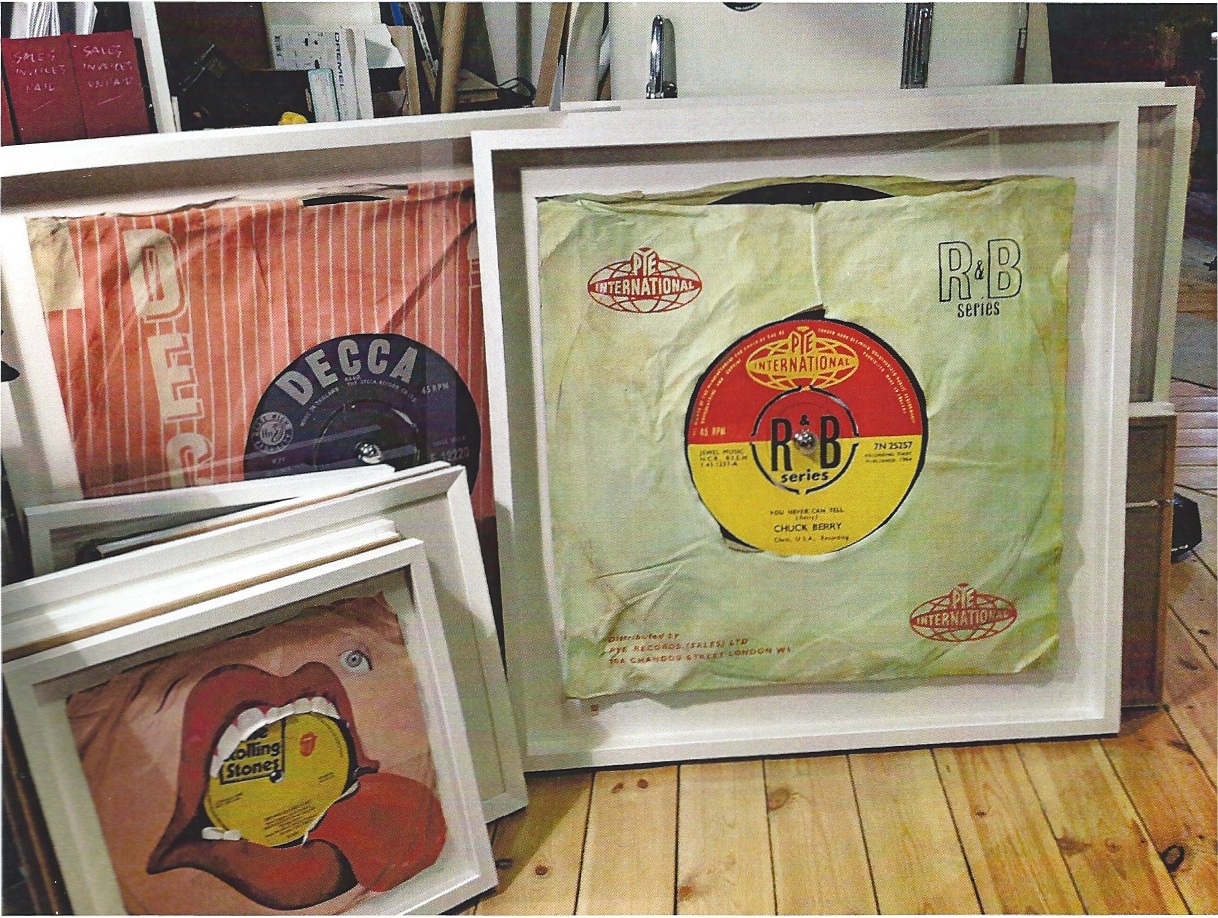
Morgan Howell's 45sMorgan Howell recreates 45s as pieces of art because he wants to make them larger than life. As big, in fact, as the space they take up in your heart and mind. That means making 27-inch discs rather than seven-inch, encasing the enlarged vinyl facsimile in a reproduction of the original paper bag made out of canvas and painting the original graphics and type from the label and the bag, and then mounting the result in a 32×32 frame. But Howell is not trying simply to reproduce the record as it came out of the freshly delivered box of 25 on the record shop counter one Friday morning two or three generations ago. He wants to show the whole history of the individual record: the signs that it has been played and played and played again, treasured and cherished and carried from bedsit to party and onwards through life. So, with infinite care, he reproduces all the creases and tears, all the fading, all the smudges and lipstick smears, and even the traces of a long-since removed sticky label.

Thirty of these three-dimensional objects — several full-scale originals, and some smaller prints — are on show all this month at the Snap Gallery, situated in an arcade between Piccadilly and Jermyn Street in London W1. Among them is Chuck Berry’s “You Never Can Tell”, issued on the gorgeous yellow and red Pye International R&B label in 1964, about which David Hepworth wrote quite beautifully in his blog a few weeks ago (click on http://www.davidhepworth.com/blog.html and scroll down to June 19, 2013). You’ll also find “Shakin’ All Over” (with that marvellous expressionist 1960 EMI bag), “Green Onions” on Stax, “Good Luck Charm” on UK RCA, “My Generation”, the Chiffons’ “Sweet Talkin’ Guy” on Laurie, the original US Columbia issue of “Like a Rolling Stone” and many others.

When Morgan Howell told me that the first one on which he’d tried the technique was Martha and the Vandellas’ “Heat Wave”, borrowed from his big sister’s record collection, I knew he was a man after my own heart. I told him that I could remember precisely where and when I heard that record for the first time, standing beside my parents’ KB valve radio one evening in September 1963: my first blast of the full-strength, fully developed Motown sound. His own favourite is one of which he’s done both the A and B sides: “Get Back” and “Don’t Let Me Down” by the Beatles, which has a special meaning for him since he happened to be sitting in the back of his father’s Ford Zodiac, aged three, when they got stuck on Savile Row in an unexpected traffic jam on January 30, 1969, the day the Beatles played together in public for the last time on the Apple roof.

They’re not cheap: the originals cost £9,600, prints at the same size are £2,000, and the scaled-down versions are £595. In any size they’d be a very nice thing to have on your wall, even if you preferred “Paranoid” or “Hotel California” to “You Never Can Tell”. And, inevitably, you start playing the game of what you’d commission him to paint, if you could afford it. At the moment — and this is a purely imaginary exercise, you understand — I’m thinking Billy Preston’s “Billy’s Bag”, on the UK Sue label, with that fantastic paper bag listing all the label’s artists. Or maybe the Reflections’ “(Just Like) Romeo and Juliet” on Stateside. No, it’s got to be Kenny Dino’s “Your Ma Said You Cried in Your Sleep Last Night”, with my then-girlfriend’s name inscribed in nail polish on its HMV/United Artists label 51 years ago. Now there’s a record that deserves to have its portrait painted.

Rod’s Miura

Rod's MiuraThe last time I saw this car, in May 1971, it was parked outside Morgan Studios in Willesden, North London. Its owner was inside the building, finishing off Every Picture Tells a Story.

That February I’d been on the road with Rod Stewart and the Faces in Boston and Jersey City, writing a story for the Melody Maker. You can imagine it was pretty good fun, as long weekends go. Now here I was, three months later, listening to Rod waxing lyrical about David Ruffin as he put the final touches to his cover of the Temptations’ “(I Know) I’m Losing You”. Then came the wonderful experience of having “Mandolin Wind” and “Maggie May” played back through the studio speakers. Martin Quittenton was in the studio that night, having made a vital contribution to the album as guitarist, mandolinist and co-writer. “Mandolin Wind” remains my favourite of Rod’s recordings, by a distance.

On the way into the studio I’d admired the brand-new yellow Lamborghini Miura parked on the forecourt. There weren’t many of those in London in 1971. This was the first of Rod’s many exotic cars, including a whole string of Lamborghinis, and probably the prettiest of the lot. Who cared that the clutch was unbearably stiff or that it overheated constantly? He’s very funny about it in his droll autobiography, put together last year with the help of Giles Smith. “The Miura was a considerable investment: £6,500,” he recalls. “Bear in mind that the first house I had just bought, in Muswell Hill, had only cost me £5,000. So, for a while there, my car was worth more than my house. And there was no off-road parking, so I had to leave it on the street. Small wonder I couldn’t sleep at night.”

The car over which he lost sleep is now to be auctioned by Bonhams at the Goodwood Revival in September. The picture above is of the sale brochure, and the estimate for the car is between £750,000 and £850,000. A lot of money, but almost certainly a great deal less than the value of whichever of his houses its first owner will be sleeping in tonight.

I’ll save my story about seeing Rod for the first time in 1964, with one of my favourite bands ever, for another day.

Mick Farren 1943-2013

Mick FarrenMick Farren collapsed and died on stage at the Borderline in London on Saturday night while singing with the latest version of his band, the Deviants. After three decades in New York and Los Angeles, he had spent the last few years back in Britain. Here’s a tribute by his old friend and NME colleague Charles Shaar Murray, and here’s my obituary, both from today’s Guardian.

I knew Mick at the end of the ’60s and the beginning of the ’70s, which was probably his best time, and I always enjoyed his company. I’d first clapped eyes on him in Nottingham in 1967, when an enterprising friend of mine organised the city’s first (and only) “happening” at the Rainbow Rooms, and booked the Social Deviants — as they were then called — along with a projector and a print of Kenneth Anger’s Scorpio Rising, a bubble machine and the bits and pieces to make a rudimentary light show. How cool we were, suddenly transformed from mods into hippies! I bought a Tibetan love bell and gave my friend Paul Smith, then managing the men’s floor of a boutique called Birdcage, 25 shillings to get his tailor to make me a royal blue kaftan with floral braid. It looked fine until I tried to dance and discovered that the arm-holes had been made so small that I could barely move. So much for letting it all hang out. (Having some sense of history, I kept the garment; it made a second public appearance in True Brit, the exhibition devoted to Paul’s work at the Design Museum a few years ago.)

The photograph above is taken from the back of the dust jacket of Mick’s excellent memoir, Give the Anarchist a Cigarette, published by Jonathan Cape in 2001. It was taken by Barrie Wentzell, the Melody Maker‘s staff photographer, and it records a round-table discussion at the MM‘s old Fleet Street offices, probably in 1971. The discussion was being moderated by Michael Watts, who has his back to the photographer, and our much-missed colleague Roy Hollingworth, on Watts’s left. Neither of us can remember who the hippie on Hollingworth’s left is. That’s Farren next to the unknown person, with Sandy Denny opposite him at the top of the table (no, it’s not Sandy Denny: see Comments). On Sandy’s left, wearing a cap, is Robert Wyatt. On Robert’s left is another person whom neither of us can identify. We can’t remember what the subject of the discussion was, either. Maybe someone out there can help.