2017: the best bits
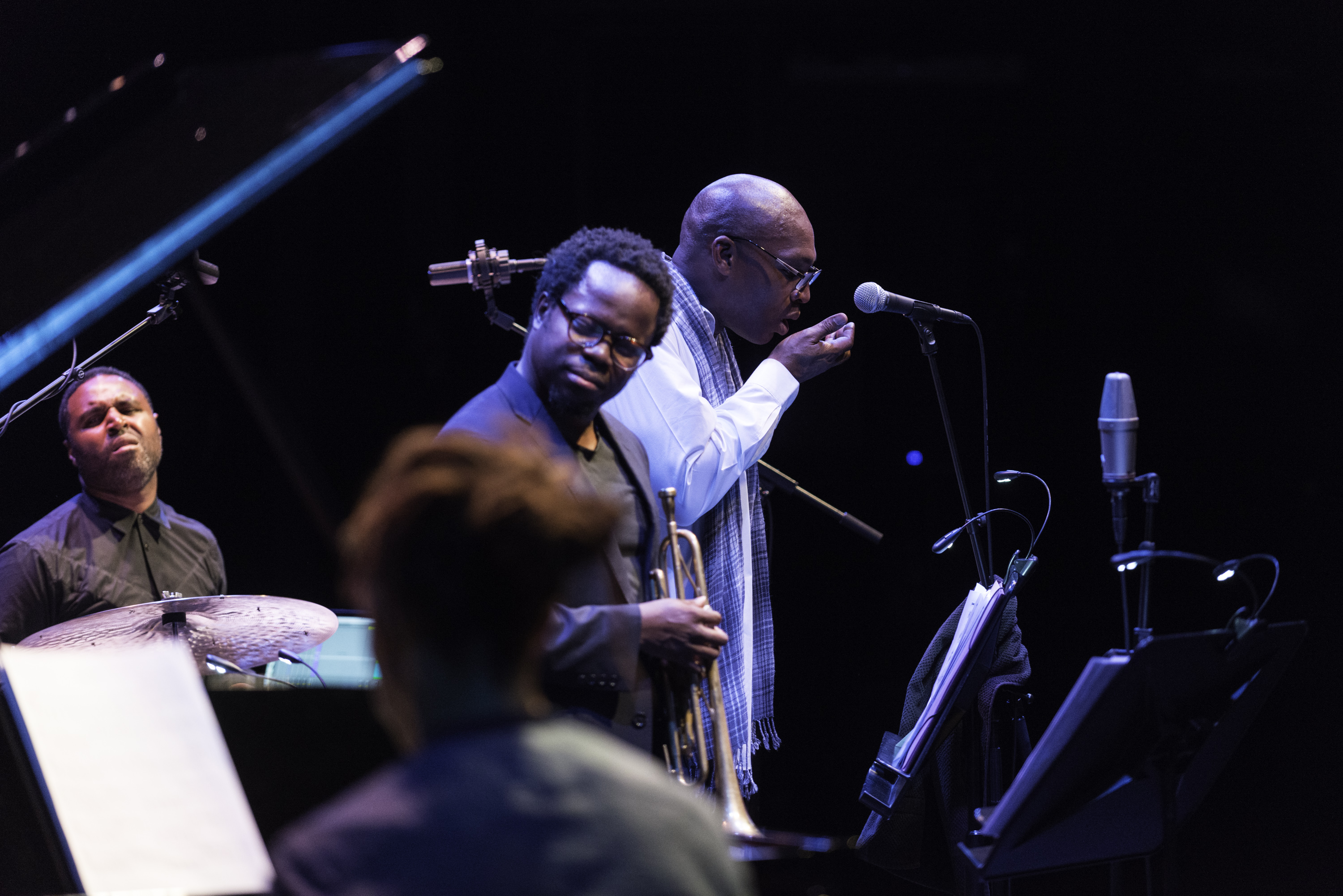
L to R: Kendrick Scott, Gerald Clayton, Ambrose Akinmusire, Dean Bowman (pic: Camille Blake)
Ambrose Akinmusire’s MaeMae
About a year ago I invited the trumpeter and composer Ambrose Akinmusire to listen to the four short blues songs sung in 1939 by Mattie Mae Thomas, an inmate of the women’s wing of the Mississippi State Penitentiary at Parchman Farm. She sang them into a recording device set up by Herbert Halpert, a musicologist from the Library of Congress, in the prison’s sewing room, where the female inmates made uniforms and bags for collecting cotton. Unheard by the outside world until 1987, when they were released on a LP by the Rosetta label, these unaccompanied songs are just about as deep and powerful as any blues singing I know. (Here’s one of them: “Workhouse Blues”.) And they are all we know of Mattie Mae Thomas. No details of her life have survived. We don’t know where she came from, how old she was, why she was in prison, or what became of her. All we know is that voice, with its astonishing strength, self-confidence, and nuanced phrasing.
After listening to her, Ambrose accepted a commission to create a piece for the 2017 Berlin jazz festival, my last as artistic director. He told me that Mattie Mae’s voice reminded him of his grandmother, who came from a small Mississippi town called Drew, not far from Parchman Farm, singing in the kitchen when she visited them in Oakland during his childhood. His mother’s middle name, he told me, was also Mae. She had picked cotton as a girl and left Drew to move to California as soon as she could. When he suggested that they make a visit to her old home, she declined. She never wanted to go back there.
In the months between our meeting and his arrival at the festival in the first week of November, I didn’t ask Ambrose any questions about the nature of the piece. All I knew was that he would be bringing a specially assembled sextet including the guitarist Marvin Sewell, the pianist Gerald Clayton, the bassist Joe Sanders, the drummer Kendrick Scott, and the singer Dean Bowman. Once they were in Berlin, I didn’t even go to their rehearsal. I wanted to be surprised.
And I was. The 70-minute song cycle, called MaeMae, contained elements of all the rich sophistication that characterises Ambrose’s music, but dialled right down so that what emerged was a restrained, often sombre, blues-drenched meditation on the music and the culture of the Delta and its echoes in the present day. Samples from Mattie Mae Thomas’s recordings emerged like ghost fragments, lying against the music or integrated into it. Variations on her phrases were sung by Bowman, who sometimes shaped his tone to evoke the texture of voices heard on old shellac 78s and at others ululated to dramatic effect. In one section he explored other hallowed blues motifs (“Another man done gone…”).
The piece took a while to settle — this was a new band, and a new piece — but before long Kendrick Scott was exploring a deep rhythmic pocket, a master drummer of the 21st century channeling the Chicago blues backbeats of Sam Lay and Fred Below. Marvin Sewell played a magnificently eerie unaccompanied bottleneck solo that paid homage to the masters of the Delta blues. Ambrose, the most eloquent of today’s trumpeters, announced the piece with an unaccompanied liquid fanfare but held back in his solos with a masterful sense of economy.
For me, MaeMae is a composition that involves itself in some of the deepest currents flowing through this period of history, a time in which old battles are suddenly needing to be refought. I hope its life is not confined to a single performance on November 3, 2017 in the Haus der Berliner Festspiele, because it deserves a chance to evolve and deliver its message to the widest possible audience. And to make Mattie Mae Thomas live again.
Now here’s the rest of what I’ve particularly enjoyed this year.
Live performances
1. Vijay Iyer Sextet (Wigmore Hall, October)
2. Darcy James Argue’s Secret Society (Kings Place, November)
3. Paolo Conte (Royal Festival Hall, November)
4. Mary Halvorson Octet (New School, New York, January)
5. Caetano Veloso / Teresa Cristina (Barbican, April)
6. Art Ensemble of Chicago (Cafe Oto, October)
7. The Weather Station (Lexington, October)
8. Samora Pinderhughes’ The Transformation Suite (New School, New York, January)
9. Aarset / Bang / Henriksen: The Height of the Reeds (Humber Bridge, Hull, April)
10. Wanja Slavin’s Lotus Eaters (Tiyatrom, Berlin, January)
11. Catherine Christer Hennix (Silent Green, Berlin, March)
12. Steve Winwood (Hammersmith Apollo, July)
13. Giovanni Guidi Trio (Rosenfeld Porcini Gallery, May)
14. Han Bennink / John Coxon / Ashley Wales (Cafe Oto, August)
15. Vyamanikal + 2 (Kings Place, September)
New albums
1. Hedwig Mollestad, Nels Cline, Bill Frisell, David Torn etc: Sky Music: A Tribute to Terje Rypdal (Rune Grammofon)
2. Mavis Staples: If All I Was Was Black (Anti-)
3. Roscoe Mitchell: Bells for the South Side (ECM)
4. Trio Da Kali / Kronos Quartet: Ladilikan (World Circuit)
5. The Weather Station: The Weather Station (Paradise of Bachelors)
6. Amir ElSaffar / Rivers of Sound: Not Two (New Amsterdam)
7. Kendrick Lamar: DAMN. (Top Dawg)
8. Tyshawn Sorey: Verisimilitude (Pi)
9. Little Steven: Soulfire (UMe)
10. Alexander Hawkins: Unit[e] (AH)
11. Bill Frisell / Thomas Morgan: Small Town (ECM)
12. Matt Wilson: Honey and Salt (Palmetto)
13. Binker and Golding: Journey to the Mountain of Forever (Gearbox)
14. Jaimie Branch: Fly or Die (IARC)
15. Ron Miles: I Am a Man (Yellowbird)
16. Yazz Ahmed: La Saboteuse (Nain)
17. Sharon Jones: Soul of a Woman (Dap-Tone)
18. Jimmy Scott: I Go Back Home (Eden River)
19. Gerald Clayton: Tributary Tales (Motéma)
20. Rhiannon Giddens: Freedom Highway (Nonesuch)
Archive / reissue albums
1. Tony Williams Lifetime: Live in New York 1969 (HiHat)
2. The Transcendental Music of Alice Coltrane Turiyasangitananda (Luaka Bop)
3. Isaac Hayes: The Spirit of Memphis 1962-1976 (Stax)
4. Chris Wood: Evening Blue (Hidden Masters)
5. Bob Marley & the Wailers: Lively Up Yourself (Wewantsounds)
6. Bobby Hutcherson & Harold Land: UCLA 27 September 1981 (Timeless)
7. Jon Hassell: Dream Theory in Malaya (Tak:til)
8. Mike Westbrook Concert Band: Marching Song (Turtle)
9. Gillian Hills: Zou Bisou Bisou (Ace)
10. Harry South: The Songbook (Rhythm and Blues)
Feature films
1. A Quiet Passion (dir. Terence Davies)
2. Moonlight (dir. Barry Jenkins)
3. Certain Women (dir. Kelly Reichardt)
4. Land of Mine (dir. Martin Pieter Zandvliet)
5. Personal Shopper (dir. Olivier Assayas)
Documentary films
1. I Am Not Your Negro (dir. Raoul Peck)
2. Chasing Trane (dir. John Scheinfeld)
Books
1. Svetlana Alexievich: The Unwomanly Face of War (Penguin Classics)
2. Sam Shepard: The One Inside (Knopf)
3. Thomas Dilworth: David Jones: Engraver, Soldier, Painter, Poet (Jonathan Cape)
4. Timothy Snyder: On Tyranny (Bodley Head)
5. Jeremy Whittle: Ventoux (Simon & Schuster)
Music books
1. Peggy Seeger: First Time Ever (Faber & Faber)
2. Todd Mayfield w/ Travis Atria: Travelling Soul: The Life of Curtis Mayfield (Chicago Review Press)
3. Bob Dylan: The Nobel Lecture (Simon & Schuster)
4. David Hepworth: Uncommon People (Bantam)
5. Trevor Barre: Convergences, Divergences & Affinities (Compass)
Exhibitions
1. Cy Twombly (Centre Pompidou, Paris)
2. Soul of the Nation (Tate Modern)
3. States of America (Nottingham Contemporary)
4. Cézanne portraits (National Portrait Gallery)
5. John Singer Sargent watercolours (Dulwich Picture Gallery)
 Otis Redding died 50 years ago today, on December 10, 1967, when his light plane crashed into a lake near Madison, Wisconsin. Six others — the pilot, Otis’s valet, and four members of his band, the Bar-Kays — also lost their lives. A fifth musician, the trumpeter Ben Cauley, was the only survivor.
 On this side of the English Channel, we spent decades laughing at Johnny Hallyday. He was the eternal proof that the French couldn’t do rock ‘n’ roll. At all. But if there was one quality that defined Johnny, apart from his obsession with American popular culture, it was persistence. And eventually I saw past the dreadful cover versions of US hits (“Viens danser le Twist”) and found myself starting to enjoy and even admire what he did.
 This is the line of ticket-holders waiting to enter Cafe Oto for the Necks’ sold-out lunchtime concert today. It might have seemed an unusual time of day to experience the intensity of free collective improvisation, but the Australian trio’s music tends to work its unique magic at any time of day or night, in any location.
 Abrahams began the first set with tentative piano figures, joined by Buck’s bass drum and, eventually, Swanton’s arco bass. The pianist tended to hold the initiative throughout, creating arpeggiated variations that slowly surged and receded, gradually building, with the aid of Buck’s thump and rattle and the keening of Swanton’s bow, to a roaring climax — including, from unspecified source among the three, a set of overtones that gave the illusion of the presence of a fourth musician — before tapering down to a perfectly poised landing.
 As the shops started to close and the street-food vendors began to disperse, twilight was falling on Deptford High Street. Arriving an hour early for last night’s concert by Mike Westbrook’s Uncommon Orchestra at the Albany Theatre, I heard a strange sound and walked towards it.
 If you were to draw a straight line connecting Hank B. Marvin to Jimi Hendrix and then extend it a bit further, the next point on the line would be Terje Rypdal, the Norwegian guitarist and composer who celebrated his 70th birthday this weekend with a couple of concerts at Oslo’s Victoria Nasjonal Jazzscene, an old cinema converted into a 300-capacity theatre for improvised music. I went to the first of the concerts, in which Rypdal was joined by the trumpeter Palle Mikkelborg, the keyboardist Ståle Storløkken and the drummer Pål Thowsen. It was an unforgettable evening, and a reminder of his singular importance.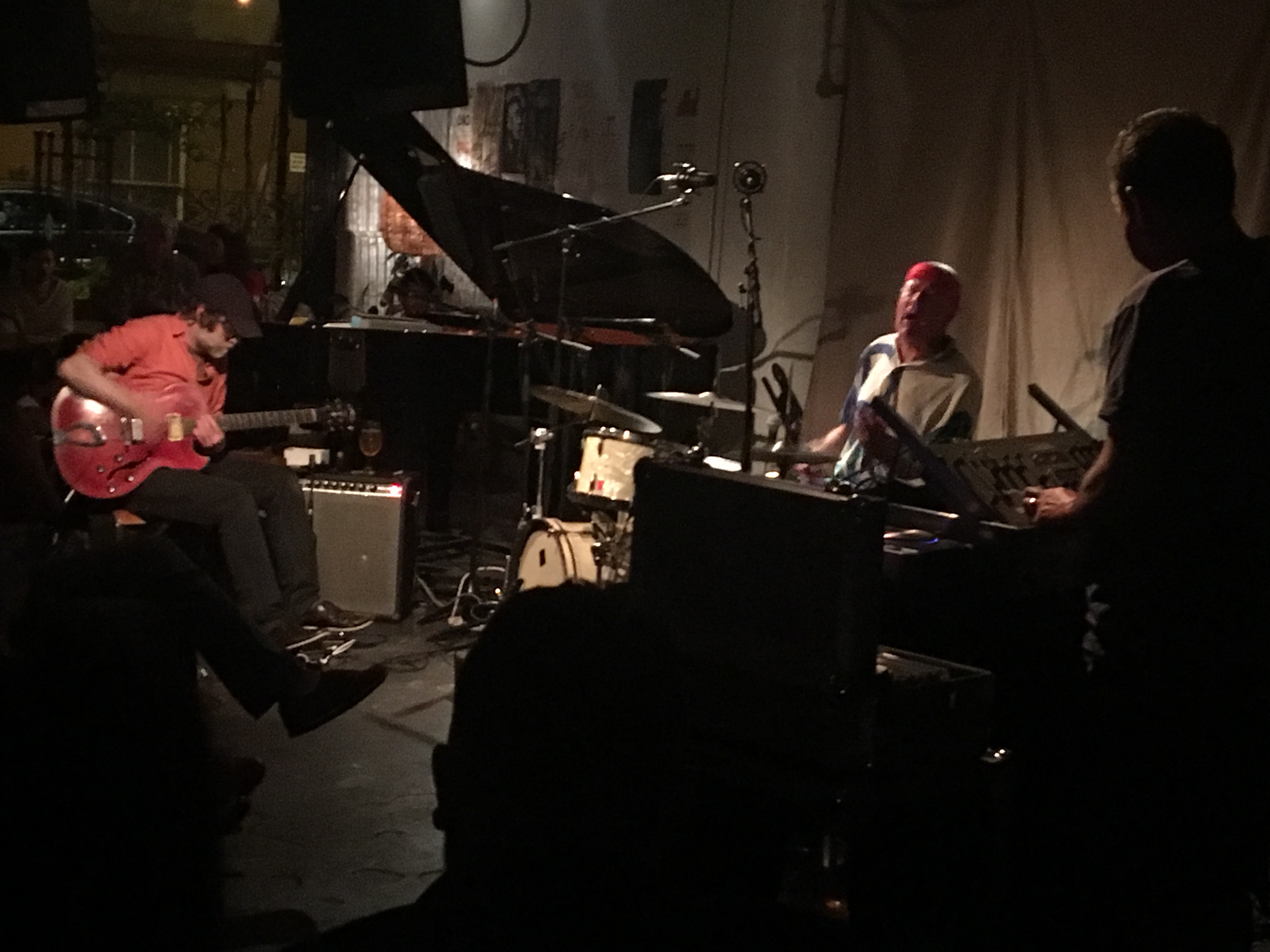
 If you want to convince someone — even yourself — that Bob Dylan is a great singer, a place to go might be “Brownsville Girl”, an 11-minute epic from the otherwise threadbare 1986 album Knocked Out Loaded. More specifically, attend to the first line of the penultimate verse, at 8:51. “Strange how people who suffer together have stronger connections than those who are most content,” Dylan sings in a ruminative and rueful tone, delivering the line in a single breath, exhaling the sentence in such a way as to create a complete design, the internal rhythm gently coiling with a sing-song inflection and a slight but telling deceleration on the last four words, making the sense of it linger after the sound has moved on.

