A Mingus discovery
While listening to Louis Moholo, Jason Yarde, John Edwards and Alex Hawkins come very close to taking the roof off Cafe Oto the other night, I started thinking about Charles Mingus. The ingredients of the music were so similar: the warmth, the drive, the spontaneity, the shouted cues, the sudden turns from brusque lyricism to maximum intensity, an extreme sophistication drenched in the blues at its most elemental, the way the past was metabolised into the present, the feeling that this summed up why jazz really is different from everything else.
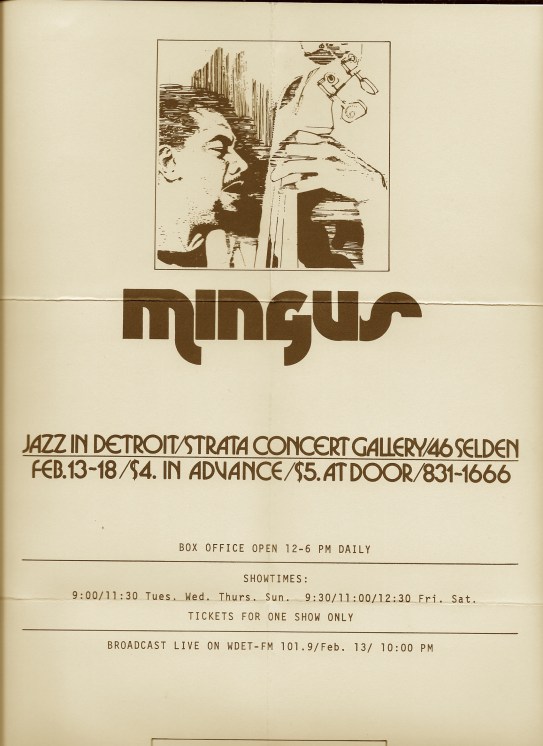
Then, the next morning, an unexpected package dropped on to the mat: a five-CD box called Jazz in Detroit / Strata Concert Gallery / 46 Selden, a recording of a club gig by one of Mingus’s later quintets in February 1973, previously unheard and released with the approval of Sue Mingus, the great bassist’s widow and guardian of his legacy.
The recording was made by Roy Brooks, the fine drummer who was a member of the Mingus band during this period, while Dannie Richmond was off exploring the world of rock. A Detroit native who had replaced Louis Hayes in Horace Silver’s quintet in 1959, Brooks died in 2005; it is to his widow, Hermine, that we owe the discovery of the tapes.
Mingus went through something of a personal and artistic trough at the end of the ’60s. I saw him at the Village Gate one night in, I think, 1971, playing with a complete absence of fire and commitment — a devastatingly desolate experience for one who had grown up on the volcanic excitements of Blues and Roots and Oh Yeah. By 1973, however, he had recovered his appetite for battle and regained all his old characteristics, as we can hear in his Philharmonic Hall and Let My Children Hear Music recordings from the previous year.
Just about everything that was great about Mingus was on display at the Strata Concert Gallery at 46 Selden Street in Detroit’s Midtown. The band is superb: Joe Gardner on trumpet, big-toned and confident; John Stubblefield on tenor, bringing to mind the fluent bluesiness of Hank Mobley; the mercurial Don Pullen on piano, brilliantly spanning the eras as many of Mingus’s pianists (Jaki Byard, Roland Hanna) were expected to do; and Brooks himself, providing an unflagging, explosive drive.
The repertoire includes Mingus favourites such as “Pithecanthropus Erectus” and “Orange Was the Colour of Her Dress (Then Blue Silk)”, and a handful of those compositions that demonstrate how beautifully he could structure and pace a fine melodic line: “Celia”. “Peggy’s Blue Skylight”, “Dizzy Profile” and “The Man Who Never Sleeps”. In that respect he was the peer of Benny Golson. And anyone who wants to hear a medium-up 4/4 walking bass that hustles without hurrying should listen to “Peggy’s”, where he gives a masterclass in that difficult art. And the slow blues called “Noddin’ Ya Head” is an after-hours symphony (complete with Brooks’s musical saw).
This was a club gig, so the atmosphere is relaxed and the customers’ voices are sometimes heard. But it was recorded for broadcast on a local radio station, WDET-FM, so the balance of informal atmosphere and undistorted instrumental sound is just about perfect. There’s also an interview with Brooks, and a soliloquy by the station’s jazz DJ, Bud Spangler.
As a representation of how Mingus sounded in a club, it would be hard to beat. One of the finds of the year, without a doubt.
* The box set is released in November on the Barely Breaking Even label. Mingus fans might like to note that the programme of this year’s EFG London Jazz Festival includes an event called “Jazz Experiments: Exploring Jazz through the Music of Charles Mingus”, in which the excellent band Blues & Roots will encourage members of the audience to play with them before performing their own set. It’s in the South Bank’s Clore Ballroom on the afternoon of Sunday, November 18, and it’s free. If you want to play, apply via the website: efglondonjazzfestival.org.uk