Skip to content

Posts from the ‘Uncategorized’ Category

Nik Bärtsch at the Barbican

Nik Bartsch Barbican

This is how is began, with a seven-foot Steinway marooned on a dais in a lagoon of water installed on an enlarged stage at the Barbican Hall, silhouetted against a rhombus of light projected on to the back wall. As the house lights dimmed to blackness, the Swiss pianist and composer Nik Bärtsch, as usual shaven-headed and dressed in the black robes of a ninja monk, emerged from the wings and made his way to the instrument across a causeway which was then removed by stagehands. Bärtsch settled himself before launching into an hour-long piece called When the Clouds Clear, a “light and sound poem” created in conjunction the London-based visual artist Sophie Clements.

Bärtsch’s music is utterly sui generis: a highly personal version of minimalism that is most often expressed with the other musicians of his quintet Ronin, a project developed over almost 20 years at weekly sessions in a Zurich club that he co-owns. Each of his compositions is titled “Modul” and given a number. This mirrors the seemingly industrial precision with which they are conceived and performed, based on small melodic cells and exacting rhythmic overlays whose teasing syncopations generate tension, but it gives no idea of the emotion generated when, on a sudden shouted cue, one locked groove instantly gives way to another, the intensity rising exponentially.

All this was reflected in his unaccompanied playing last night, opening with a single repeated note tested for overtones and modified for attack and decay before evolving through an hour of contrasting moods and densities, often displaying his highly personal use of the prepared-piano techniques now common among those of his and subsequent generations of acoustic keyboard improvisers. Bärtsch can stun a note so that it acts like a rimshot from Philly Joe Jones or Clyde Stubblefield, laying it against a frantic weave of arpeggiation or letting it punctuate in a moment of silence. Sometimes he reached inside the instrument to make it hiss or growl, before building fantastic cataracts of sound that forfeited all note-definition and seemed about to burst the walls of the auditorium.

Sophie Clements’ lighting and projections began with minimalistic monochrome geometries creeping across the set before she introduced backdrops of waves and skies, washed in blue or grey. This seemed worryingly literal — waves of water, waves of sound — but only for the briefest moment until it became apparent how beautifully the visuals and the music were creating (to paraphrase Wallace Stevens) something beyond them, but themselves. Towards the end, drops of water began to fall from the roof into the lagoon: an illusion of the elements invading the music. (There was some wry amusement about this afterwards, given that parts of Britain had spent the week battling floods.)

The  austere, almost hieratic air of Bärtsch’s music and self-presentation is utterly deceptive; its end product is human warmth, and the prolonged ovation he shared with Clements was generated by art that, for all its refinement of technique and conception, communicated on the most immediate level. I’d be surprised if there were a soul in the hall who, having absorbed a genuinely extraordinary experience, wouldn’t have been happy to sit through it all again straight away.

* Nik Bärtsch and Sophie Clements were appearing on the first night of the 2019 EFG London Jazz Festival. This was the second performance of When the Clouds Clear, which was co-commissioned by the Enjoy Jazz Festival and the Barbican and received its première in Mannheim earlier this year.

A Nordic Sunday

Hubro 1

Why, I asked Andreas Mæland today, did he call his record label Hubro? “It’s a North European eagle owl,” he said. “I thought we should name it after an endangered species, because this is endangered music.”

Mæland was in London to celebrate Hubro’s 10th anniversary, bringing with him from Norway three of the label’s groups. For members of an endangered species, they sounded in pretty good condition as they played short sets at the Spice of Life, a Soho pub whose basement is a regular venue for jazz.

Like his compatriot Rune Kristofferson, the founder of Rune Grammofon, Seth Rosner of Pi in New York and Patrik Landolt of Intakt in Zurich, Mæland has succeeded in demonstrating that record labels still have a significant role to play in documenting important music, building trust with listeners along the way through the taste of their producers. Kristoffersen and Mæland both served an apprenticeship working for Manfred Eicher’s ECM company: in fact Mæland succeeded Kristoffersen as ECM’s label manager in Norway, whose music Eicher has done much to promote. Eventually Mæland wanted to start his own label. “I released Christian Wallumrød’s first solo album,” he told me between sets. “And then it wasn’t possible to be ECM’s label manager any more.” Over the past decade he has released 120 albums by artists such as the percussionist Håkon Stene, the harmonium player Sigbjørn Apeland, the bassist Mats Eilertsen, the trio Moskus, the multi-instrumentalist Geir Sunstøl and the mixologist Erik Honoré.

The first of the three bands — all trios — to perform at the Spice of Life was led by Erland Apneseth, a specialist in the Hardanger fiddle, accompanied by the bass guitarist Stephan Meidell and the drummer Øyvind Hegg-Lunde. As is usual with this generation of Norwegian musicians, the music floated free of genre but was strongly rooted in the cadences and modes of folk music. It was delicate but adventurous: in one passage all three musicians were bowing something — a violin, a bell, the bass guitar — to create an texture that seemed somehow appropriately early-Novemberish The closing section of an absorbing set was underpinned by Meidell’s use of a handheld single-bladed electric propeller to strike the strings in rapid succession, controlling the rate and weight of the notes with precision.

Building Instrument featured Mari Kvien Brunvoll on voice, zither and sampler, Åsmund Weltzien on keyboards and Hegg-Lunde on drums. Brunvoll is an intriguing singer, the purity and flexibility of her voice particularly well suited suited to a long passage in which her zither and Weltzien’s ability to reproduce the sound of Mellotron flutes evoked the baroque-psychedelic phase of British pop circa 1968. At times the whole trio sounded appealingly like a melting Chinese musical box.

Last came Bushman’s Revenge, a sort of power trio fronted by the guitarist Even Helte Hermansen, with the noisest and most assertive music of the afternoon. Their regular bassist is recovering from a broken arm, so Meidell stepped into the breach; there were times when the music made me think of how I’d like Cream to have turned out, freed from the thumping repetition of witless blues clichés. The group’s most recent album, Et Hån Mot Overklassen, is more of an essay in resraint and texture: lots of heavily reverbed Stratocaster with rolling tom-toms, that kind of thing (and it includes a track titled “Ladies Night at the Jazz Fusion Disco”).

The little woodcut of a flying owl on the album jackets, the naïve hand-lettering and the snapshot photography of the covers give Hubro albums a visual signature as distinctive as, but quite distinct from, ECM and Rune Grammofon. What the signature says is that the contents are likely to be worth hearing, as today’s showcase amply demonstrated.

* The photograph shows (from left) Stephan Meidell, Øyvind Hegg-Lunde and Erland Apneseth.

Binker in the Round

Binker in the Round 1

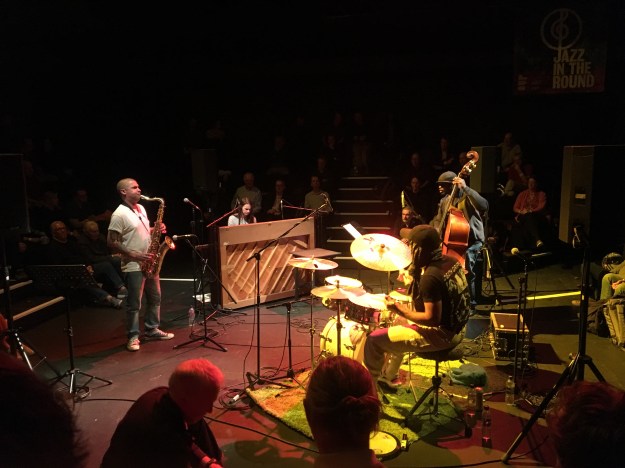
It takes a brave bandleader to offer Sarah Tandy the first solo of the set. And when the pianist was presented with that opportunity while depping for Joe Armon-Jones in Binker Golding’s quartet at Jazz in the Round at the Cockpit Theatre on Monday night, she made the most of it. As she can do, she simply took flight, pulling together the strands of the opening theme, focusing the efforts of the whole band and raising the intensity to a level sustained for the next 40 minutes.

It took four of them to bring that off, of course. Not just Tandy or Golding, whose playing seems to have reached a new level of authority in the past year, but the band’s bassist, Dan Casimir, who deploys a huge tone and a massive drive, and its drummer, Sam Jones, who is loose and sharp at the sane time and has a lovely way of infusing eights with a triplet-based feel (and who managed to make an adroit recovery when his bass-drum pedal flew off just as Golding’s tenor solo was building in the climactic “Fluorescent Black”).

They played tunes from Golding’s new album, Abstractions of Reality Past and Incredible Feathers, whose delightful title owed something, he said, to the poet Emily Dickinson: “‘Hope’ is the thing with feathers — That perches in the soul — And sings the tune without the words — And never stops — at all — ” It was, he added, the result of his desire to make something more melodic than the music he created in his duo with the drummer Moses Boyd and its various extensions.

How well he has succeeded. The album is like a modern version of a tenor-and-rhythm session by someone such as George Coleman or James Clay at the zenith of the hard-bop era: original themes that are strong and complex, full of immediately attractive twists and turns, blowing that is fierce but constantly aware of the need to build a narrative. Occasionally, as in “Exquisite She-Green”, there is a Monkish angularity that seeps into the solos. A ballad like “You, That Place, That Time” is not afraid to explore a glowing but always alert lyricism. Others, like “Fluorescent Black” and the Latin-inflected “I Forgot Santa Monica”, have a built-in swing that allows the musicians to take off and show us the extent of their old-school chops while making it clear that they have new things to say.

Tandy on the live gig provided a rewarding contrast with Armon-Jones’s work on the album: the former constantly launching her combination of soulfulness and rhapsody, fingers flying as she goes deeper and deeper, the latter a virtuoso of funky feeling, with a surprise in every bar and making each one count towards the whole.

The gig had the Cockpit audience roaring its approval. The album is a beautiful (and very beautifully recorded) document capturing a young London musician’s discovery that there’s more than one way for his generation to wreck the house. Most highly recommended.

* Abstractions of Reality Past and Incredible Feathers is out now on the Gearbox label.

Terry Riley’s ‘Sun Rings’

Kronos Sun Rings

Back in 2002 I was fortunate enough to be present when Sun Rings, an extended composition written by Terry Riley for the Kronos Quartet and a 60-voice choir, was given its world premiere in the University of Iowa’s Hancher Auditorium. The partnership between the composer and the quartet celebrates its fortieth anniversary next year; among Riley’s works premiered and recorded by the group have been Sunrise of the Planetary Dream Collector, Cadenza on the Night Plain, Salome Dances for Peace, The Cusp of Magic and Requiem for Adam. But Sun Rings was something different: the musicians and singers were accompanied by sounds harvested from space by the scientists at NASA as their Voyager probes hurtled past Saturn, Uranus and Neptune.

The sound of space — strange chattering, howling and chirruping — was originally captured by Don Gurnett, a research scientist at the university in Iowa City who designed the plasma-wave equipment carried by the probes to record the noises — called “whistlers” — made by electrons whizzing about in the magnetic fields surrounding the planets. Gurnett told me that while their existence had been detected by a German scientist during the First World War, he was the first person to retrieve them from space and to turn the signals into sound.

He had given cassettes of the recordings to Riley, divided under headings like “auroral hiss”, “electron plasma oscillation” and “electron cyclotron harmonic emissions”. The composer chose the ones he liked and made them an integral part of the piece, triggered in real time by the four members of Kronos using fibre-optic wands. The hour-long work, commissioned as part of NASA’s long-standing arts programme, featured lighting and back-projections created by Willie Williams, a Yorkshireman who worked with Deaf School, Stiff Little Fingers and others before joining U2 for the Zoo TV tour and then moving on to collaborate with the Stones and Bowie.

After the Iowa concert, which was quite an experience, the work was given its European premiere at the Barbican. Now an album, recorded in a studio in 2017, makes the piece available to everyone.

Here’s what David Harrington, Kronos’s leader, has to say about Riley in the notes to Sun Rings: “There is no other composer who has added so many new musical words to our vocabulary, words from many corners of the musical world. Terry introduced Kronos to Pandit Pran Nath, Zakir Hussein, Bruce Connor, La Monte Young, Anna Halprin, Hamza El Din, Jon Hassell, Gil Evans… I have never once heard him say an unkind word about another musician. In a crazed world laced with violence and destruction, he has consistently been a force for peace. Through his gentle leadership, a path has emerged. Terry sets the standard for what it means to be a musician in our time.”

All that is apparent in the 10th and final section of Sun Rings, titled “One Earth, One People, One Love”. Those words belong to the writer Alice Walker, and a recording of her voice intoning them is the leitmotif of a piece which begins with a description of the astronaut’s experience of looking at Earth from space by Eugene Cernan, the commander of the Apollo 17 mission. This extraordinarily beautiful nine-minute piece is slow-paced, the strings moving gently through the sounds of space, with Sunny Yang’s lyrical cello prominent as the passing of time is marked by what might be a tuned drum and a damped bell. Bringing us back home, this is music that speaks to everyone.

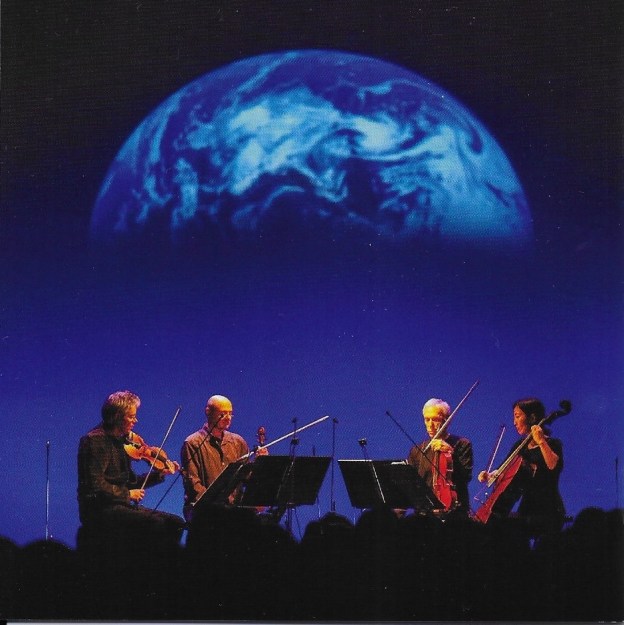
* Sun Rings is out now on the Nonesuch label. The photograph of the Kronos Quartet performing the piece in Krakow in 2014 is from the accompanying booklet and was taken by Wojciech Wandzel.

Steve Howe’s ‘New Frontier’

A-2136670-1486326162-2636.jpeg

I hadn’t heard any of the Steve Howe Trio’s previous albums, so New Frontier, their third release, came as a pleasant surprise. I knew of Steve as the guitarist who took over from Peter Banks in Yes — a band in which my interest diminished as their songs got longer — in 1970, and I knew the trio’s drummer, Dylan Howe, who is Steve’s son and whose album of instrumental versions of David Bowie’s Berlin compositions, Subterranean, I liked a lot on its release five years ago.

The trio is completed by Ross Stanley, a fine keyboards player who is heard here on organ. Guitar-organ-drums trios were a thing in the ’60s: Jimmy Smith, Baby Face Willette, John Patton, Richard “Groove” Holmes and Larry Young were among the organists who made that line-up a favourite format. The guitarist on such albums was often Grant Green, and it’s interesting to discover that a prog-rock guitarist can absorb Green’s spare, bluesy style into his own approach, as he does here on several tracks. There are hints of Wes Montgomery, too, in the occasional burst of octave picking (and Montgomery led a fine organ trio of his own on a couple of Riverside albums).

The result isn’t as heavy and bluesy as some of that music. Stanley doesn’t go for the full Leslie-speaker throb and stays away from the bass pedals, so there’s an airness about the sound, while Dylan Howe has a light, deft touch. Steve Howe varies his tone and effects pleasantly without overdoing it, and uses an acoustic guitar on a couple of tracks. All three contribute compositions, as does Bill Bruford, another former Yes man and Dylan Howe’s one-time drum tutor. Sometimes it’s a little bit like early-’70s Santana without the percussion, or Danny Gatton without the absolute authority. But it’s an extremely nice album, and occasionally — as on the lyrical “Western Sun”, co-written by both Howes — rather more than that.

* The Steve Howe Trio’s New Frontier is out now on the Esoteric Antenna label.

Mark Lewisohn’s ‘Hornsey Road’

Abbey Road

When the Guardian ran my interview with Mark Lewisohn about his Abbey Road stage show last week, the piece got 800,000 page views in 24 hours: more than that day’s Brexit coverage, they said. I don’t know what this means, except that the Beatles are still pretty popular. More popular than Brexit, anyway.

Mark had a lot of interesting things to say. What I didn’t have room to discuss in the piece was the use made in the show — which is actually titled Hornsey Road — of the original multitrack tapes, downloadable (astonishing as it may seem) from the video game called Beatles Rock Band, released in 2009. This allows anyone with the necessary equipment to make their own remixes: a dangerous opportunity, but one that Mark has used with care and sensitivity to form part of his two-hour show, which had its first night in Northampton this week and is touring around the country until early December.

I went to a run-through last week, and learnt a lot from his remixes of the original eight-tracks from Olympic, Trident and EMI’s Abbey Road studios between February and August 1969. He brought out a single bar of absolutely sublime McCartney bass-playing on “Because” that I’d never noticed before, ditto the cowbell on “Polythene Pam”. Thanks to him, I was paying closer attention and therefore better able to enjoy the sequence of guitar solos from McCartney, Harrison and Lennon on “The End”: two bars each, then repeat twice. Eighteen quite revealing bars — particularly Lennon’s — in a track that was the last thing they recorded together.

Revisiting Abbey Road was funny for me because it was 50 years ago to the week — on September 10, 1969, in fact — that I’d tipped up at the ICA in the Mall for a screening of several films by John & Yoko, including Two Virgins and Rape. It was a long and gruelling evening, during which an unidentified male and female in a white canvas bag led us all in a chant of “Hare Krishna” that lasted the entire 52 minutes of Yoko’s Film No 5. Was it the Lennons inside the bag? At first we assumed it was. Then we thought, almost certainly not. But it was Bag-ism in action, for sure.

The unexpected treat was a preview of Abbey Road, a couple of weeks ahead of its release. Side one was played in the interval, followed by side two as an accompaniment to John’s film Self Portrait, a 20-minute study of his penis rising and falling. By the time the evening ended, only a handful of the invited audience remained in the theatre.

It was a time when the Beatles — and the Lennons in particular — were in the headlines almost every day. Fleet Street was obsessed with their relationships, their business affairs, their eccentricities. It was also a time when Lennon was happy to sit and talk in the Beatles’ room at Apple HQ at 3 Savile Row, as he did a couple of days later. The following day he was in Toronto for the Live Peace Festival, with Eric Clapton, Klaus Voormann and Alan White. On the Monday morning he called me up at the Melody Maker offices to give me the story, and specifically to deny the reports that he and Yoko had been booed off.

“That’s a load of rubbish,” he said. “It was a fantastic show — really unbelievable. It was magical. The band was so funky and we really blew some minds. We only had time to rehearse on the plane going over, and we did things like ‘Blue Suede Shoes’, ‘Money’, ‘Dizzy [Miss Lizzy]’, and a new song I’d never played before.” That would have been “Cold Turkey”, which the Beatles were about to turn down as their next single. “Then Yoko joined us,” he continued, “and sang one number [“Don’t Worry Kyoko”] before doing things like our Life with the Lions album. It was incredible because the crowd was howling along with us and they all joined in for ‘Give Peace a Chance’. Everyone was singing — it was like a great big mantra.”

My impression of Lewisohn’s show was that Hornsey Road tells the story in rewarding detail and with a nicely judged sense of how wonderfully absurd the events surrounding the Beatles sometimes were, half a century ago.

* The photograph of the Beatles was taken on the Thames at Twickenham on April 9, 1969 and is from the booklet accompanying the 2009 remastered version of Abbey Road. It is © Apple Corps Ltd.

More music for a new society

Punkt.Vrt.Plastik - Jazzfest Berlin 2017 - 4 Nov -® Camille Blake - Berliner Festspiele-2

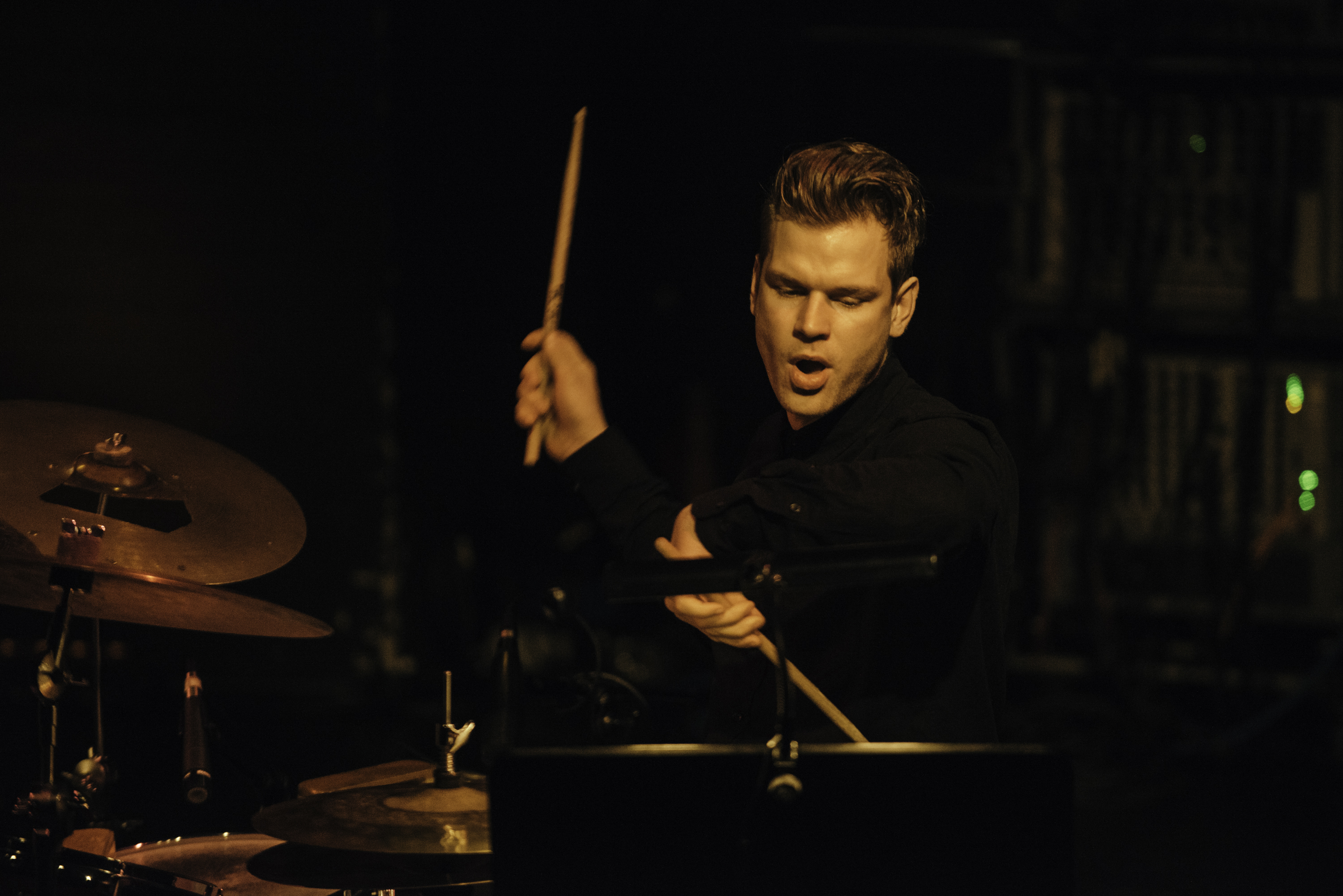
The first time I saw Christian Lillinger, with a trio called Hyperactive Kid at Berlin’s X Jazz festival a few years ago, I found it impossible to take him seriously. It was as if some New Romantic poseur had decided to become a free-jazz drummer for the night. The hair, the gestures: they got in the way of listening. Then I saw him a few more times, and it became impossible not to take him very seriously indeed. Not to think of him, in fact, as one of the most interesting musicians working in Europe today.

He has a septet called Grund: two saxophones (Toby Delius and Wanja Slavin or Pierre Borel), vibes (Christopher Dell), piano (Achim Kaufmann) and two basses (Jonas Westergaard and Robert Landfermann). If you don’t know the names of his sidemen, you should; they’re all exceptional improvisers. What makes the music so distinctive, however, is Lillinger’s composing. Imagine something Andrew Hill might be doing today and you might get an idea: knotty but satisfying themes, surprising structures, brilliant interplay.  When I saw them at the Jazz Kollektiv festival in Berlin a year after the Hyperactive Kid gig, it was one of those sets I never wanted to stop. (Another comparison might be with those intense but brilliantly organised quintet and septet sides Cecil Taylor recorded for Impulse in 1961: “Pots”, “Bulbs” and “Mixed”.)

Then, another year later, I saw Lillinger in two more groups: the quartet Amok Amor (with Slavin, the trumpeter Peter Evans and the bassist Petter Eldh) at the Vortex in London and a trio called Punkt.Vrt.Plastik, with Eldh and the pianist Kaja Draksler, at Jazzfest Berlin. In both cases the music was of phenomenally high quality and gave me the chance to appreciate the breathtaking detail of Lillinger’s playing. He is indeed hyperactive, flying around a kit that includes many auxiliary percussive devices with extraordinary deftness and precision, seldom settling on a pattern for more than a few seconds. But once your ears are attuned, they can discern the incredible responsiveness and egoless interaction he brings to the music.

His new album, Open Forms for Society, is something different: a series of 13 densely woven compositions and five improvisations for a group featuring Dell, Draksler, Landfermann and Eldh, plus Lucy Railton on cello, Antonis Anissegos on piano, Elias Stemeseder on piano and synthesiser, and Roland Neffe on tuned percussion. Again, these are all remarkable musicians, perfect for Lillinger’s seamless blend of composition and improvisation, so beautifully integrated — in a form of musical quilting — that you can’t tell where one bleeds into the other.

There are beautiful textures and unexpected juxtapositions of timbre, fragments of melody left hanging in space, sudden bursts of shuffling momentum, abrupt silences, a sense of alertness and inquiry in every ting, squiggle, sigh and shuffle. It’s not easy music, but neither it is at all forbidding: pieces like “Titan” and “Lakat” are disciplined essays in dramatic tension, creating grooves for a world that hasn’t yet quite come into existence.

* Grund’s albums are on the Pirouet, Clean Feed and Plaist labels. Albums by Amok Amor and Punkt.Vrt.Plastik are on the Intakt label. Open Form for Society is on Plaist. The photograph of Christian Lillinger was taken in Berlin in 2017 by Camille Blake; more of her work can be found at http://www.camille-blake.com.

Laura Jurd and friends

Laura Jurd__7852-Credit - Monika S. Jakubowska

Laura Jurd is a prolific musician, so it was an unselfish gesture on her part to invite friends and collaborators to provide compositions to go alongside her own pieces on Stepping Back, Jumping In, her new release on the Edition label. Taking advantage of the palette offered by an unusual combination of instruments, the composers offer a variety of approaches that makes for a kaleidoscopic and satisfying experience.

The 14-piece line-up consists of a brass trio (Jurd’s trumpet, the trombones of Raphael Clarkson or Alex Paxton and the euphonium of Martin Lee Thompson), the Ligeti Quartet (Mandhira de Saram and Patrick Dawkins on violins, Richard Jones on viola and Cecilia Bignall on cello), Soosan Lolavar on santoor and Rob Luft on banjo and guitar, and a rhythm section containing the other members of Dinosaur, Jurd’s regular quartet: Elliot Galvin on piano, Conor Chaplin on bass and Corrie Dick on drums, plus Anja Laudval on synthesiser and electronics and Liz Exell on a second drum kit.

There’s a lot of scope, and Jurd is the first to take advantage with a bracing piece called “Jumping In”, its crisp syncopations occasionally disrupted by a sudden rallentando, her bright-toned trumpet to the fore. Galvin’s “Ishtar” locates a darker mood, with ululating violin and eerie glissandi over an intermittent slow groove carried by minimalist drums. Soosan Lolavar’s “I Am the Spring, You Are the Earth” begins serenely, the sound of her santoor (an Indian version of the hammered dulcimer) percolating gently through the drifting veils of strings, guitar and electronics. “Jump Cut Blues” is an interestingly deceptive title for a string quartet in which Jurd explores skittering pizzicato lines and unorthodox bowing techniques before plunging into a fast ostinato passage reminscent of Terry Riley’s work in the same field, and thence to a pensive conclusion. The austere opening textures of “Companion Species”, by Anja Laudval and Heida K. Johannesdottir, seem to grow out of the preceding piece, but soon mutate into something very like the surging, growling free-jazz shout-ups associated with the Jazz Composers Orchestra under Michael Mantler or Alex von Schlippenbach’s Globe Unity Orchestra; when the sky clears, it’s to reveal a brisk, purposeful 4/4 groove over which Jurd solos — with a lucid lyricism reminiscent of Henry Lowther — against the low brass. Jurd’s closing “Stepping Back” begins like a brass band gatecrashing one of Terry Riley’s solo organ concerts before some lovely writing for the string players and a calliope effect add extra dimensions.

That’s a rapid tour through an album which shows what can be done with open minds, fresh ideas, an appropriate degree of ambition and a willingness to transcend idioms. Everyone involved deserves enormous credit — most of all Jurd, a musician who knows exactly what she is doing, and for whom Stepping Back, Jumping In represents something of a triumph.

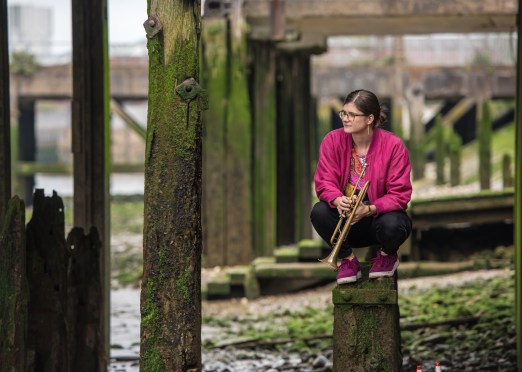
* The photograph of Laura Jurd is by Monika S. Jakubowska.

A Christmas song

The last time I did a Christmas post on this blog, in which I listed my seasonal favourites, William Brown wrote in to mention his choice, which comes from a live radio concert by Laura Nyro in 1990. I’ve been listening to Laura for 50 years, since the release of Eli and the Thirteenth Confession in 1968, and she’s more important to me with each passing year. Since I’ve written about her before, at some length, I won’t repeat my thoughts. I’ll just let her wish everybody reading this, on my behalf, a merry Christmas — and, although she doesn’t mention it, a happy new year.

2018: the best bits

Girl from the North Country 2

Sheila Atim (photograph: Manuel Harlan)

Girl from the North Country

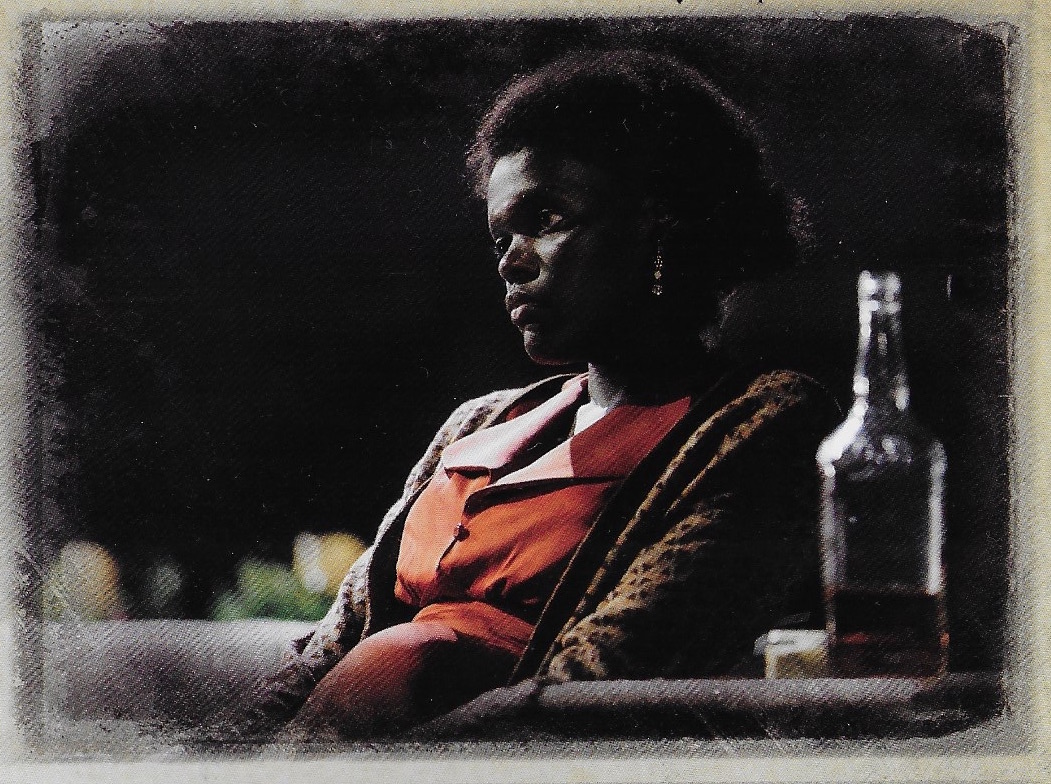
Outside of the Rogers-and-Astaire films and Jersey Boys — and Broadway’s contribution to the American songbook, of course — musicals have never played much of a part in my life. I went to the opening night of Conor McPherson’s Girl from the North Country at the Old Vic in January only because I was asked to write a piece about how the playwright had responded to the invitation to build an evening around Bob Dylan’s songs. I got a pleasant surprise. The play was a little predictable and sometimes melodramatic. But Alan Berry, the musical director, and Simon Hale, the orchestrator, arranger and musical supervisor, had taken McPherson’s pleasingly eccentric selection and recreated them as something standing apart from a story set in Duluth, Minnesota – Dylan’s birthplace – around the time of the Depression, but entirely of a piece with the atmosphere. A little band played beautifully behind the singing of the cast, which was uniformly excellent – and in the case of Sheila Atim, delivering “Tight Connection to My Heart”, something rather more than that. I enjoyed it so much that when it transferred to the West End, I went back and was not inclined to change my view.

Here are the other things I particularly enjoyed this year:

Live performances

1 Ry Cooder (Cadogan Hall, October)

2 Mavis Staples (Union Chapel, July)

3 Ingrid Laubrock’s Anti-House (Cafe Oto, May)

4 Amir ElSaffar + Rivers of Sound (Kings Place, November)

5 Louis Moholo-Moholo Quartet (Cafe Oto, October)

6 Mary Halvorson Octet (Haus der Berliner Festspiele, November))

7 Nérija (Elgar Room, Royal Albert Hall, March)

8 Nels Cline 4 (Vortex, April)

9 Richard Thompson (Richmond Theatre, August)

10 Anthony Braxton’s ZIM Music (Cafe Oto, May)

11 Bill Frisell (Cadogan Hall, November)

12 Irreversible Entanglements (Haus der Berliner Festspiele, November)

13 Tony Malaby (Vortex, May)

14 Elaine Michener’s Sweet Tooth (St George’s, Bloomsbury, February)

15 Peter Hammill (Queen Elizabeth Hall, April)

16 The Necks (Cafe Oto, October)

17 Hamid Drake / Yuko Oshima (Haus der Berliner Festspiele, November)

18 Kit Downes / Tre Voci / Southbank Gamelan (Union Chapel, February)

19 Jamie Branch’s Fly or Die (Cafe Oto, November)

20 Martin Speake Quartet (Vortex, April)

New albums

1 Ambrose Akinmusire: Origami Harvest (Blue Note)

2 Moses Boyd Exodus: Displaced Diaspora (Exodus)

3 Arve Henriksen: The Height of the Reeds (Rune Grammofon)

4 Betty LaVette: Things Have Changed (Verve)

5 Tyshawn Sorey: Pillars (Firehouse 12)

6 Marc Ribot: Songs of Resistance 1942-2018 (Anti-)

7 Louis Moholo-Moholo’s Five Blokes: Uplift the People (Ogun)

8 Swing Out Sister: Almost Persuaded (SOS)

9 Mary Halvorson: The Maid with the Flaxen Hair (Tzadik)

10 The Necks: Body (ReR)

11 Barre Phillips: End to End (ECM)

12 Mike Westbrook: Starcross Bridge (hatOLOGY)

13 Michael Mantler: Comment c’est (ECM)

14 Geir Sundstøl: Brødløs (Hubro)

15 Lio: Lio Canta Caymmi (Crammed Discs)

16= Brian Eno: Music for Installations (Opal)

16= Bryan Ferry: Bitter-Sweet (BMG)

18 Jon Hassell: Listening to Pictures (Ndeya)

19 Peter Hammill: From the Trees (Fie)

20 Lewis Wright: Duets (Signum Classics)

Archive / reissue albums

1 Negro Church Music (Man in the Moon)

2 Charles Mingus: Jazz in Detroit / Strata Concert Gallery/ 46 Selden (BBE)

3 André Hodeir: Essais (Fresh Sound)

4 Eric Dolphy: Musical Prophet (Resonance)

5 John Coltrane: Both Directions at Once (Impulse)

6 Mike Westbrook: In Memory of Lou Gare (Westbrook)

7 Chuck Jackson: The Best of the Wand Years (Ace)

8 Don Cherry: Studio 105, Paris 1967 (Hi-Hat)

9 Shirley Ellis: Three Six Nine (Ace)

10 Keith Jarrett / Gary Peacock / Jack DeJohnette: After the Fall (ECM)

Feature films

1 A Woman’s Life (Une Vie) (dir. Stéphane Brizé)

2 Shoplifters (dir. Hirokazu Kore-eda)

3 Cold War (dir. Pawel Pawlokovski)

4 The Guardians (Les Gardiennes) (dir. Xavier Beauvois)

5 Loveless (dir. Andrey Zvyagintsev)

6 Jeune Femme (dir. Léonor Serraille)

Books: non-fiction

1 Berlin 1936 by Oliver Hilmes (The Bodley Head)

2 Left Bank by Agnès Poirier (Bloomsbury)

3. Moneyland by Oliver Bullough (Profile)

Books: fiction

Warlight by Michael Ondaatje (Jonathan Cape)

Books: poetry

The Long Take by Robin Robertson (Picador Poetry)

Books: photography

New York Scenes by Fred W. McDarrah (Abrams)

Exhibitions

1 Ilse D’Hollander (Victoria Miro Mayfair)

2 Jean-Michel Basquiat: Boom for Real (Barbican)

3 The Age of Jazz in Britain (Two Temple Place)

4 London 1938 (Max Liebermann Villa, Wannsee)

5 Journeys with ‘The Waste Land’ (Turner, Margate)

YouTube

Childish Gambino: “This is America”

Lana Del Rey: “Venice Bitch”