Mike Westbrook’s Bigger Show
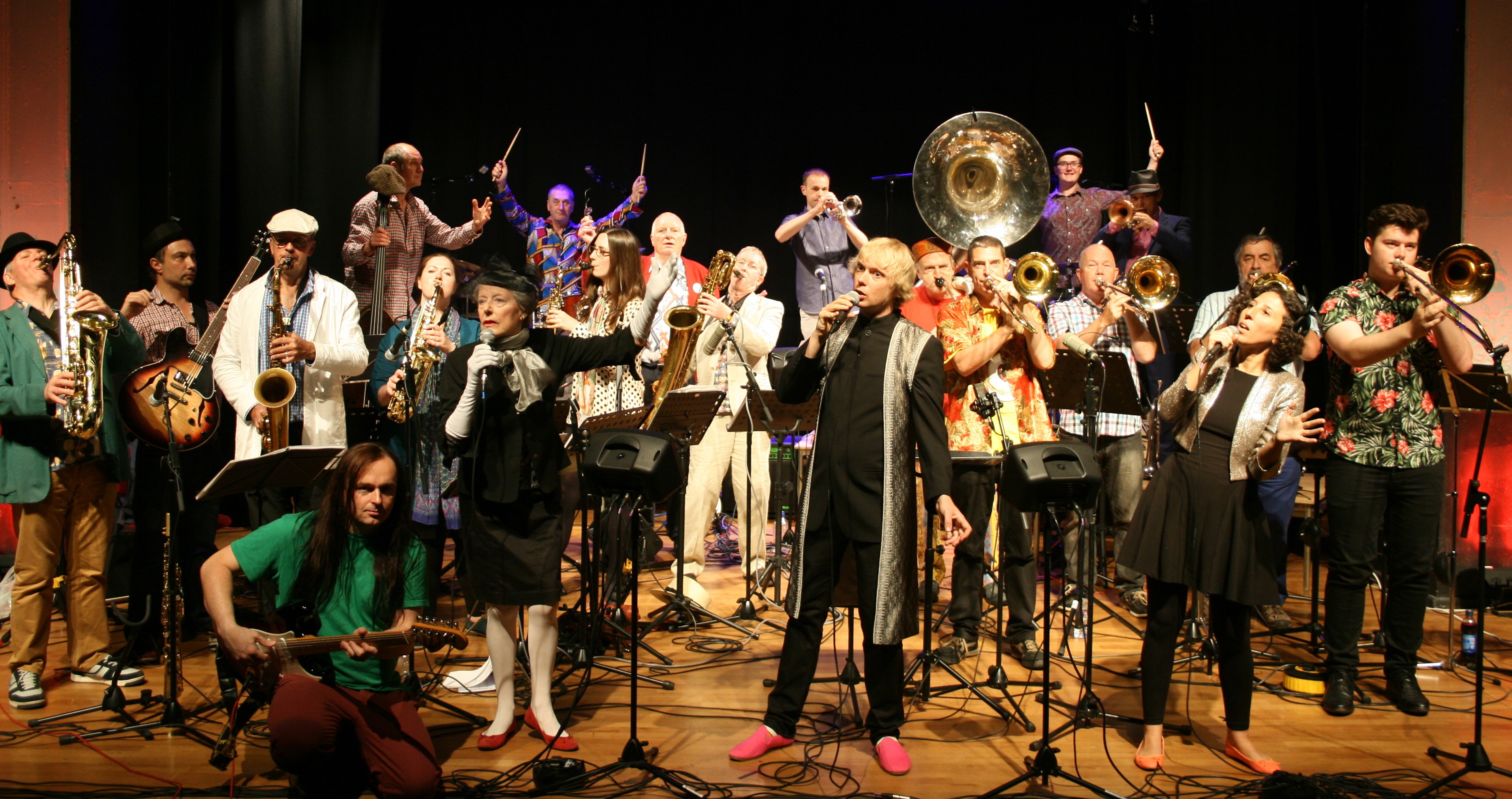 The great English jazz composer and bandleader Mike Westbrook turns 80 next month — on March 21, to be exact. His long career is studded with extended works of great ambition and achievement: Marching Song, Metropolis, Citadel/Room 315, The Westbrook Blake, The Cortège (his masterpiece, for my money), On Duke’s Birthday, London Bridge Is Broken Down, Mama Chicago, and others. What began in the late 1960s as a distinctively Westbrookian conception of jazz — with undertones of the approach Ellington and Mingus took to blending composition and improvisation — was broadened by an engagement with street theatre and brass bands, and by a collaboration with his wife, the singer and librettist Kate Westbrook, on pieces that reflected the influence of Berlin theatre song and British music hall.
And now there’s another magnum opus to celebrate. A Bigger Show is a piece in eight sections, lasting almost two hours, performed by Westbrook’s latest large ensemble, the Uncommon Orchestra, a 21-piece unit based around his home in Devon. Due to its size, it doesn’t often show its face. But last summer a recording of the piece was made at Exeter’s Barnfield Theatre, and the results — produced by Jon Hiseman — are out now on a 2CD set.
The suite was inspired by the old St Bartholomew’s Day fair, which took place in Smithfield, in the City of London, continuously between the 12th and 19th centuries until it was closed down in 1855 on the grounds of excessive rowdiness and debauchery. Back in 1975 Westbrook’s Brass Band took part in a production of Ben Jonson’s play Bartholomew Fair, and the idea grew into its present incarnation.
Once again the Westbrooks’ vision of modern life finds powerful expression in a work featuring rousing and often turbulent ensemble work with instrumental solos of real substance from such familiar figures as Alan Wakeman on soprano and tenor saxophones and Dave Holdsworth on pocket trumpet and Sousaphone, and newer names like the altoist Roz Harding, the trumpeter Sam Massey and the tenorist Gary Bayley. As has been the case with Mike Westbrook since the beginning of his career, the improvisations emerge from the arrangements in an organic and dramatically satisfying way — the work of composer who has paid close (but never imitative) attention to the lessons handed out by Ellington, Mingus and Gil Evans.
The tone is variously raucous and tender, celebratory and scathing. Kate Westbrook’s lyrics, sung by herself, Martine Waltier and Billy Bottle, are etched in acid (particularly in a song satirising the social media). Human nature and human behaviour, they suggest, are little altered since the days of Blake and Hogarth: in an era when the gap between affluence and poverty is widening rapidly, only the superficial symptoms of excess and deprivation differ.
All this is achieved with a courage, a vigour and a generosity of spirit always characteristic of Mike Westbrook’s work. A Bigger Show is ambitious, thought-provoking, and exhilarating; when it ends, you feel as though you’ve been on a journey. Perhaps one day his extended pieces will be acclaimed as belonging among the most acutely relevant cultural artefacts of our time. Until then, here’s a new one to treasure.
* A Bigger Show is released on ASC Records. Westbrook and the Uncommon Orchestra will perform the piece at the Brewhouse Theatre in Taunton on April 1, Kings Place in London on May 20, and the Plough Arts Centre in Torrington on June 10.
 When Maurice White told me that he’d deputised for the absent Elvin Jones with the John Coltrane Quartet at a Chicago jazz club called McKie’s in the early 1960s, I was as impressed as I’d been by anything Earth, Wind & Fire had played at the OMNI arena in Atlanta the previous night.
 Through his contribution to the first two Velvet Underground albums, John Cale was one of the people who shifted the tectonic plates of popular music in the 20th century. Maybe it was unreasonable to expect more. But I always believed, based on his work with La Monte Young’s Dream Syndicate, the three albums of archive material from 1965-69 released by Table of the Elements a few years ago, his arrangements on Nico’s The Marble Index, his collaboration with Terry Riley on The Church of Anthrax, his instrumental music for the Warhol films Eat and Kiss, and various other pieces of evidence, that he had the potential to go a long way beyond the rock and roll template into which he settled with Vintage Violence, Paris 1919 and their various successors, whatever his occasional flirtations with punkish sedition (such as the line “We could all feel safe/Like Sharon Tate” which so upset the Island Records hierarchy in 1976).
 When a friend asked me this week to name the most memorable gig I’ve ever attended, I could answer him in a heartbeat: the Tony Williams Lifetime at the Marquee on October 6, 1970. Nothing has ever felt more like the future exploding in the audience’s ears.
 Had he lived, the most influential of all bass guitarists would have been 80 years old this week: on January 29, to be precise. Many of us will never stop marvelling at the creativity shown by the one and only James Jamerson during an era when session musicians who played his instrument were expected to do little more than mark the song’s chord changes and keep in step with the drummer.
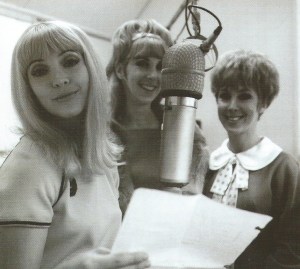 So now we know that Veronica Bennett was not the first lead singer of a female vocal trio to whom Phil Spector proposed marriage. That would be Priscilla Paris, according to the testimony of her sister Sherrell in the sleeve notes to Always Heavenly, the first proper retrospective of the Paris Sisters’ intriguing career, put together by the Ace label from the group’s recordings for several labels between 1961 and 1968.
 Matana Roberts was reminiscing about the first time she played with the great bassist Henry Grimes. It was during the New York blackout of 2004, when she was scheduled to appear at the Jazz Gallery with a group including Grimes and the pianist Vijay Iyer. She had been travelling on the L train from her home in Queens, and it had just emerged from the tunnel under the East River when all power vanished across the length and breadth of the city.
 For many years I dismissed David Bowie as a shallow opportunist. What was he doing that Andy Warhol and Lou Reed, conceptually and musically, hadn’t done with more wit and originality? I saw him at the Greyhound in Croydon in the summer of 1972, supported by Roxy Music in a pub room that can’t have held more than 200 people. He did the Ziggy Stardust thing, he and the band in full costume, and I didn’t care for it much.

