Stevie Wonder in Docklands
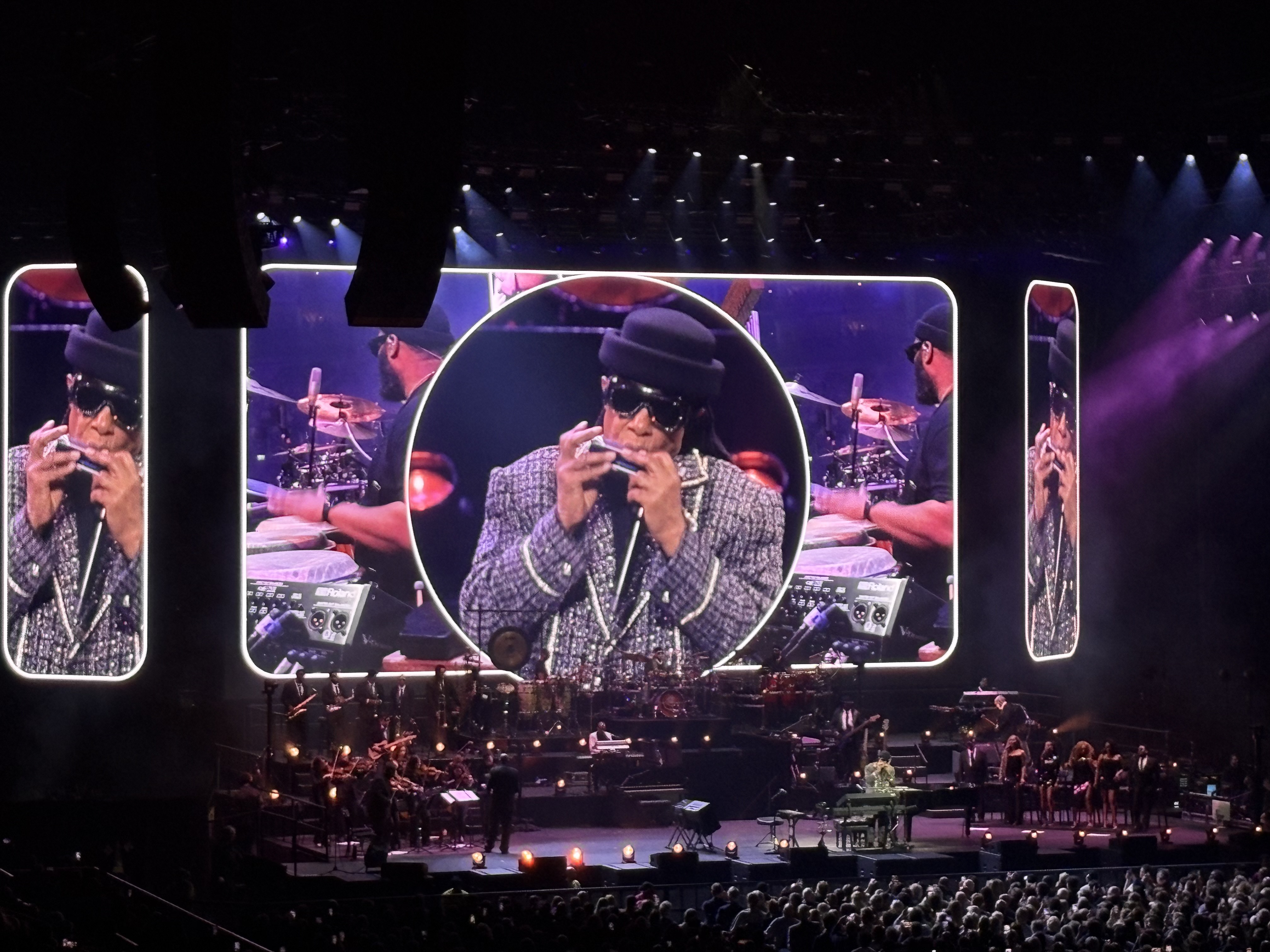
In February 1966 the 15-year-old Little Stevie Wonder astounded a packed crowd of 200 or so kids at the Dungeon Club in Nottingham, a gig which retains its place in local legend. Many of my friends were there, although I wasn’t. Probably I was working an evening shift on the local paper. But when I was told about it afterwards, I promised myself never to miss him whenever the opportunity arose.
Luckily for me, there have been several such occasions, including a fabulous mini-concert at a theatre in Cannes during a music business festival in 1974, a storming show with greater resources at Earl’s Court a decade later and a little semi-impromptu solo performance at Abbey Road Studios, whose nature and date I forget. Last night, in front of 20,000 people at the O2, he celebrated the 50th anniversary of Songs in the Key of Life by running through the entire album, including bonus tracks omitted from the original release.
I detest the O2. As a venue for music, it has all the intimacy and charm of an out-of-town shopping mall — which is basically what it is. But it was very good to see that the great majority of the audience could not have been born when Songs in the Key of Life was released in 1976. The place came to life as soon as he appeared, in front of a band that filled the stage. And it was instructive to hear how the audience joined in his call-and-response passages in a way that had been quite beyond his listeners at Earl’s Court in 1984.
He always brings great musicians, and the current touring outfit rests on the foundation provided by Stanley Randolph on drums and Nathan East on five-string bass guitar. There are five horns (two trumpets, trombone, alto and tenor saxophones), two guitarists, two keyboard players (one of then Greg Phillinganes), two percussionists, a harpist, a double string quartet (four violins, two violas, two cellos), and six backing singers (four women, two men). It’s enough to say that they made many of the songs sound more powerful than the recorded versions, despite the rather strident amplification. And there was a little between-songs riff on “Billie Jean” that, as I think Wonder said, could have gone on for ever.
He is 76 now, and his voice has lost a little of its elasticity, but not its musicality. He never did sound quite like anyone else, and he still doesn’t. It was at its best on the two songs that provided the highlights for me: first a rampaging “I Wish”, with those smeary horns figures digging into the chattering funk provided by the rhythm section, and second “Pastime Paradise”, which floored me when I first heard it — sounding like nothing I’d ever heard before — and was even more affecting last night with the live string section and a more aggressive edge.
In 1972, on the eve of the release of Music of My Mind, I had the privilege of talking to him on BBC2’s The Old Grey Whistle Test. He was the most thoughtful and interesting interviewee you could imagine. And although his songwriting output slowed after that astonishing run of albums in the ’70s, he remains the true successor to Duke Ellington: a musician who brings it all together and makes it his own.


Stevie opting for that “Higher Ground” at the Obama Presidential Center Grand Opening Ceremony… magic…
Heres the link… https://youtu.be/vd2g6shAKSw?si=JGj7xAdkbyb3ycBa