Skip to content

Posts by Richard Williams

Between the world and the Black Panthers

Out to Lunch

Others will be better qualified to talk about the substance of The Black Panthers: Vanguard of the Revolution, Stanley Nelson’s documentary, which is currently showing in London. I found it extremely moving. There’s an initial sense of exhilaration at the spectacle of the human spirit responding to adversity with pride, resilience and creativity, only for that spirit to be crushed by the relentless efficiency of J. Edgar Hoover and his FBI.

Nelson modulates the tone of the film to match its narrative arc with great sensitivity, and that is where the soundtrack plays its part. At the start of the story we see the Chi-Lites singing “(For God’s Sake) Give More Power to the People” in ruffled costumes on Soul Train and hear Billy Paul’s “Am I Black Enough For You”, Philadelphia International’s most confrontational moment. These are reminders of how the ideas represented by the Panthers were able to gatecrash mainstream culture. Later the musical backdrop is supplied by the stripped-down street-funk of the early ’70s (“Express Yourself” by Charles Wright and the Watts 103rd Street Rhythm Band being a good example). At the close, with the Panthers’ unity and sense of purpose destroyed by police bullets (notably in the assassination of Fred Hampton, the eloquent, charismatic 21-year-old who Hoover feared would become the movement’s “messiah”) and internal rivalries (the post-prison Huey P. Newton versus the exiled Eldridge Cleaver), the profound darkening of the mood is expressed through the voice of Gil Scott-Heron, singing “Winter in America”.

I’ve been reading Ta-Nehisi Coates’s Between the World and Me, a recent best-seller which takes the form of a letter to his 15-year-old son, relating Coates’s own experiences as a black boy growing up in America. His grandfather was a research librarian at Howard University in Washington DC, with a profound love of books: “…all over the house, books about black people, by black people, for black people spilling off shelves and out of the living room…” His parents were radicals: “We would not stand for their anthems. We would not kneel before their God.” His father had been a captain in the Black Panther Party.

The book is a brilliant analysis of the journey taken by several generations of African Americans, always facing the same enemy. Coates was born in 1975: “To be black in the Baltimore of my youth,” he writes, “was to be naked before all the elements of the world, before all the guns, fists, knives, crack, rape, and disease.” He was 11 years old when another boy pulled a gun on him. His son’s reality is the Black Lives Matter movement.

Nelson’s film contains another music-related moment that made me catch my breath. We see photographs of the room in a Panther house on Chicago’s West Side where Fred Hampton was gunned down by police in December 1969, its layout revealed to them by an FBI informant. Amid the blood-spattered debris lying on the bedroom floor, it’s possible to glimpse the sleeve of Eric Dolphy’s Out to Lunch. On its appearance in 1964, Dolphy’s album represented a high point in the African American research project that jazz had become. It’s still being analysed and copied today. And to me it’s an affirmation of some sort that Out to Lunch was part of the soundtrack of that Panther household, and — or so we may infer — of Fred Hampton’s short life.

Dick Twardzik 30/4/31–21/10/55

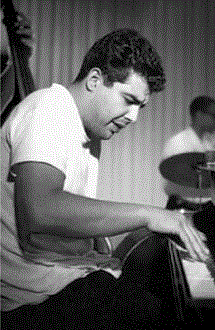
Dick_TwardzikTomorrow evening it will be exactly 60 years since the pianist and composer Dick Twardzik was found dead in his room at the Hôtel de la Madeleine on the Rue de Surène, in Paris’s 8th arrondissement. He was on tour in Europe with the Chet Baker Quartet, and the previous night they had played at the Club Tabu, where they were joined by the great Swedish baritone saxophonist Lars Gullin. After returning to the hotel in the early hours, they were due to reconvene at 4pm for a recording session at the Pathé-Magellan studio. When, after an hour, he hadn’t showed up, a search party went back to the hotel and his body was discovered. A heroin overdose had killed him. He was 24 years old.

Twardzik was a prodigy. Born in Boston, the son of two artists, he had studied with Madame Margaret Chaloff of the New England Conservatory of Music, a renowned teacher who is better known to jazz fans as the mother of Serge Chaloff, one of the great post-war baritone saxophonists. Serge and Dick would play and record together. And share a heroin habit that eventually killed the other man, too.

By the time Twardzik was 21, he was good enough to play with Charlie Parker. You can hear the results on Boston 1952, a Parker album compiled from radio broadcasts recorded at the Hi-Hat Club and released on the Uptown label a few years ago. Symphony Sid Torin, the radio show’s announcer, can’t get the young man’s name right, but listen to the wonderful inventiveness of the piano solo on a relaxed “Don’t Blame Me”, to the way he spins out his double-time lines, shaping them so beautifully, allowing them to float and curl and wind before moving into a passage of contrapuntal and parallel lines, followed by the lightest of block chords. By that time, he had already been using heroin for three years.

After Bud Powell, he might have become Parker’s most stimulating keyboard partner, if they’d both lived and been given time to develop their partnership. Twardzik’s ear and imagination, and his knowledge of modern classical music, would surely have appealed to Bird, and might have inspired an escape from the bebop cul-de-sac into which Parker was heading by the time of his own death in 1955.

But that’s speculation. What we know is that Twardzik made a brilliant set of trio recordings for the Pacific Jazz in October 1954, half a dozen tracks first issued as one side of an LP called Trio which he shared with the group of Russ Freeman, his predecessor as Baker’s pianist, who had brought him to the attention of the label’s boss, Dick Bock. The tracks, with one addition, were later released by themselves as The Last Set. There are three standards — “Round Midnight”, “I’ll Remember April” and “Bess You is My Woman” — along with three of his own compositions, all of them immediately striking, and not just for their titles: “Albuquerque Social Swim”, “Yellow Tango”, “A Crutch for the Crab”. They’re as full of playful character and unexpected twists as those of Herbie Nichols — a comparison that also strikes Alexander Hawkins, the English pianist, who is a student of such matters and a confirmed Twardzik fan. Thinking you might like a break from my views, I asked Alex for a few words. Here’s some of what he sent me:

For me, he fits squarely within that magical clutch of pianists from mid-century who are just so wonderfully sui generis (Monk, Powell, Hope, Nichols, and a few years later, the likes of Hasaan etc). I think it naturally comes out most clearly in his compositions; and to me it’s extraordinary to reflect that we can get such a strong sense of a radical original from so few works. However, it’s also fascinating to listen to him play standards: his arranger’s touch was such that he could make such a ‘standard’ standard as “I’ll Remember April” all his own – in the way he mysteriously stalks the notes of the first eight bars of this over the swinging drums, I hear a weird pre-echo of Misha (Mengelberg) and Han (Bennink).

I love the headlong intensity and clarity of purpose, despite such knotty compositions: in this I hear a real kinship with Bud Powell (“Glass Enclosure”, etc). There’s also clearly an affinity with Bartok, Hindemith, and so on; and I hear elements of Bernstein and Sondheim, too. I can also hear a possible line through to early Cecil Taylor. In the way both composers graft together different melodic/rhythmic strands, I hear some deep similarity with (especially pre-Unit Structures) Cecil: in particular, I’m thinking of the session which produced ‘Pots’, ‘Bulbs’, and ‘Mixed’, and also tunes like ‘Excursion on a Wobbly Rail’. I also hear a kinship with Cecil in the love of contrary motion figures.

The historical context also fascinates me too: just like with Bird, Hasaan, Nichols – where on earth could this music have gone had he lived? It’s so much at the vanguard of what seemed possible at the time that trying to put oneself in contemporary shoes as far as possible and hearing the future directions is completely baffling, and as such, deeply inspiring as a player and composer.

After Twardzik arrived in Le Havre on the liner Île-de-France on September 13 with the rest of Baker’s rhythm section — the bassist Jimmy Bond and the drummer Peter Littman — and met up with the trumpeter, the band began their tour at the Concertgebouw in Amsterdam (supported by the Tony Crombie All Stars!) and continued through Germany, Switzerland, Belgium and France. There were 10 concerts in all, several of which were recorded and are available on various bootlegs. In Paris on October 11 and 14 they also recorded the nine tracks — eight compositions by Bob Zieff, a friend of Twardzik’s from Boston, and one by the pianist himself — that would make up one of the most remarkable small-group records of the 1950s.

Zieff’s cool little pieces have wonderful beatnik titles: “Rondette”, “Mid-Forte”, “Sad Walk”, “Pomp”, “Brash”. Perfectly balanced and slightly formal modernist mechanisms, they’re clean-lined but unpredictable, absolutely devoid of any hint of cliché (jazz or otherwise), stretching the musicians — particularly the trumpeter and pianist — in interesting ways without inducing contortions. It’s no surprise to discover that Gil Evans later became a fan of the composer, and a terrible shame that he was destined to remain in obscurity. And Twardzik’s tune, “The Girl from Greenland”, is typically intriguing and memorable.

Issued on the Barclay label in France soon afterwards, this set is still available and is, I’d say, essential — not just for itself, but also because it represents the last view we would ever get of a great talent taken away, like so many others, by a plague that is still with us, and still taking lives.

* If you want to know more, I warmly recommend Jack Chambers’ excellent biography, Bouncin’ with Bartok: The Incomplete Works of Richard Twardzik, published in Canada by the Mercury Press in 2008, from which the photograph is taken. There’s also an interesting CD of Twardzik’s home rehearsal recordings called 1954 Improvisations, all variations on standards, released by the New Artists label in 1990. Recordings of the Baker Quartet’s concerts in Cologne, Amsterdam and elsewhere are available on various bootlegs.

Don Henley’s Cass County

Don Henley - Publicity Shot #2 (Credit Danny Clinch)During one of the interviews given to promote his new solo album, Don Henley mentioned that he writes poetry. When his voice gives out, he said, that’s probably what he’ll turn to. This would have been no surprise to admirers of “The Boys of Summer”, his solo hit from 1984, which has an opening verse whose perfect cadences seem to come complete with punctuation: “Nobody on the road, nobody on the beach. I feel it in the air: the summer’s out of reach. Empty lake, empty streets; the sun goes down alone. I’m driving by your house though I know you’re not home.”

It’s a great pop song, of course, with a dark undertow — just like many of the best Eagles songs, from “Hotel California” to “King of Hollywood”. In the Eagles’ world, no pleasure was ever unmixed. The same trait also marked out the best products of Henley’s solo career, including the four great songs from The End of the Innocence, his third solo album: “The Last Worthless Evening”, “New York Minute”, “The Heart of the Matter” and the title track. These were songs that had something to say about the human experience back in 1989 and have lost none of their truth and resonance.

His new album, Cass County, contains many outstanding moments, beginning with the opening track, Tift Merritt’s “Bramble Rose”, a gorgeous slow waltz with a killer chord change, in which Henley takes the first verse, Miranda Lambert the second, and Mick Jagger — in his “Wild Horses” mode — the third. It’s one you can play over and over again, just waiting for that change, which Henley brings out more effectively than Merritt did on her excellent original version in 2002 (clue: listen for the words “a bramble rose”).

The album arrived on a Saturday morning. I put it on while I was having breakfast and ended up playing it all the way through three times, non-stop. Among the other notable tracks are Jesse Lee Kincaid’s “She Sang Hymns Out of Tune”, a favourite from the Dillards’ Wheatstraw Suite album back in 1968; the rocking “That Old Flame”, with a great lyric on which he’s joined by the wonderful Martina McBride; and Jesse Winchester’s ever-lovely “The Brand New Tennessee Waltz”. Merle Haggard and Dolly Parton are among the album’s other participants.

On these songs, the poetry isn’t in the words. It’s in Henley’s voice. That sound of bruised longing is one we know so well,  immediately evoking good and bad times and the complex feelings that went with them. Whatever he had back then, he’s hung on to it.

* Cass County is out now on Capitol Records. The photograph of Don Henley was taken by Danny Clinch.

Matana Roberts in Hackney

Matana Roberts Oslo 2Matana Roberts asked for “comments, questions and critiques” at the end of her remarkable performance at Oslo in Hackney last night (“Well, maybe not the critiques,” she added). That doesn’t happen at every gig. There were many questions from an enthusiastic audience, and she answered them all — whether on David Cameron’s attitude to reparations for slavery or the influence of early ’60s free jazz on her music — with conviction, insight and wit.

A genuinely extraordinary artist of our time, she pursues a vision that places her beyond category. Last night she gave us a version of her latest record, the third chapter of the Coin Coin series, in which she is exploring various aspects of American history. On Oslo’s low stage she sat in front of a screen showing a loop of film she created with the use of family ephemera and other images, and divided her time between cueing and modifying the sound bed created from all sorts of audio sources (the “panoramic sound quilting” of which she speaks) and playing brief alto saxophone passages with her fibrous tone and hymn-like delivery, singing snatches of seemingly half-remembered songs, and reading from an old, scuffed, pocket-sized Bible into which she had pasted the various texts used in Chapter Three: River Run Thee.

She is a natural actor, with a powerful presence even in repose. She can draw us in with the warmest of smiles but suddenly switch and flash her eyes with a Simone-like disdain. Her powerful voice sometimes dissolves into strange mumblings and twitterings.

Some thematic fragments recurred. “Come away with me,” she crooned. “Black lives matter / All lives matter.” “I pledge allegiance to… I pledge allegiance to… I pledge allegiance… to a flag with liberty and justice for some.” And, frequently repeated, “I like to tell stories…” That, most of all, was how it felt. In her voluminous skirt, grey shawl, face paint and wild locks, patiently thumbing through her defaced Bible, fiddling with her laptop and electronics, taking her time as the story unwound, she had brought the meaning and textures of the lives of her ancestors into her own existence — and, quite unforgettably, into ours.

Phil Woods 1931-2015

Phil Woods 2Phil Woods, the great alto saxophonist, died yesterday, aged 83. He was featured on the first jazz LP I ever bought, with money saved from a paper round: East Meets West: The Birdland All Stars on Tour, recorded in 1956, with Kenny Dorham, Conte Candoli, Al Cohn, Hank Jones, John Simmons and Kenny Clarke. It was a second-hand copy, found on a market stall. Not a great album, but not a bad place to start, either. More important, Woods went on to play a wonderful solo on one of my very favourite records: the version of Willie Dixon’s “Spoonful” on the expanded reissue of The Individualism of Gil Evans, recorded in 1964.

I couldn’t begin to count the number of things I love about music that are contained in this 14-minute piece, from the deepest blues to the most sophisticated modern jazz. In strategic terms, it creates, intensifies and sustains an extraordinary mood that is quite unlike anything else I know. The tactical details include Gil’s Zen piano and his at times almost subliminal arrangement (those woodwinds painted across the horizon!), the magical combination of Paul Chambers’ calm bass and Elvin Jones’s brooding drums, Kenny Burrell’s super-cool guitar ruminations, Johnny Coles’ heart-piercing trumpet, the brilliant use of Harry Lookofsky’s tenor violin… and the sense of space, space, space, and time, time, time. Time and space became what Gil made of them, and never more so than here.

In the eighth minute the tension rises as the arrangement prepares the way for a passage of two and a half minutes in which Woods’s improvisation makes the most of the landscape Gil has established, exploiting the freedom offered by the modal framework to drill down from a different angle into the essence of the blues. As elegantly funky phrases coalesce into a double-time flurry, the solo reaches its climax — the climax of the whole 14 minutes, in effect — before meandering carefully back to its starting point, finally decompressing though a series of beautifully syncopated two-note phrases into a light-fingered imitation of the walking bass, deliberately lowering the temperature before an ensemble section leads to the drifting, dissolving finale.

I have no idea whether for Woods this represented more than just another good day’s work in the middle of a long and distinguished career. For me, it’s an example of perfection.

Georgie Fame: R&B in Maida Vale

Georgie Fame Maida ValeClimbing the stairs from the basement of BBC’s Maida Vale studios yesterday, it was a shock to emerge into bright autumn sunshine. Just like coming out of an all-nighter 50 years ago, in fact. “Don’t forget to grab a pint of milk for the journey home,” a fellow member of the audience said, remembering old rituals. The actual time was five o’clock in the afternoon, but the illusion was understandable. Downstairs we had just spent two hours in the company of Georgie Fame, reliving the night he made his first album, Rhythm and Blues at the Flamingo, back in September 1963, for the benefit of Radio 4’s Mastertapes series.

As you can see from the photograph above, the old studio provided a period setting — although not much resembling the basement on Wardour Street that was Fame’s headquarters. Quite a lot like the settings for his occasional BBC broadcasts from that era, however. And it was certainly a period audience: a large majority of the 200 or so looked as though they could remember the sense of mingled delight and disappointment when “Yeh Yeh” knocked the Beatles off the top of the charts, turning Fame overnight from a cherished cult hero to a star of mainstream pop.

Georgie turned up for the gig with the two men who have been his travelling guitarist and drummer for many years, his sons Tristan and James Powell, thus recreating the old Jimmy Smith line-up, in which the organist uses his pedals to supply the bass line. The surprise was the presence of three comrades from the early editions of the Blue Flames: the trumpeter Eddie “Tan Tan” Thornton, the tenor saxophonist Mick Eve and the guitarist Colin Green.

Together they played a nice version of “Humpty Dumpty”, the ska tune from the Flamingo album. Only Eve had been present on the original recording. Tan Tan was probably playing his regular gig at the Blue Angel in Mayfair that night and Green had, as Fame put it, temporarily opted for a quiet life in Switzerland playing with Eddie Calvert. John McLaughlin, Green’s replacement, was otherwise engaged, so Big Jim Sullivan was brought in at short notice. The great conga player Speedy Acquaye was “detained at Her Majesty’s pleasure” (again in Fame’s words) at the time, and replaced for the night by Tommy Thomas, who played bongos — not the same thing at all. The album, Fame explained, had not been truly representative of the band’s sound.

But it was nice to hear him and his sons as they worked their way through tight versions of “Eso Beso” and Nat Adderley’s “Work Song”, with its Oscar Brown Jr lyric. “Green Onions” didn’t appear until the next album, Fame at Last, but was played in tribute to the inspiration provided by Booker T and the MGs. Fame’s answers to questions from the programme’s presenter, John Wilson, and members of the audience elicited some fascinating stories about hot nights at the Flamingo, including the volatile relationship between three regulars: Lucky Gordon, Johnny Edgecombe and Christine Keeler.

An extra touch of authenticity was provided by the presence of Johnny Gunnell, who, with his late brother Rik, ran the Flamingo all-nighters and managed the early stages of Fame’s career. We had a chat, during which he gave me an unexpected story. It began with him leaving school in his early teens and landing a job as a trainee journalist at the Church Times, of all places, reporting on ecclesiastical matters. He spent four years there, learning the craft skills; when called up for National Service in 1958, his knowledge of shorthand won him a desk job in an Army office in the West End, which was a whole lot better than being posted to Aden or the Rhineland. Working 9 to 5 in central London and earning £20 a week (“from the Army!”), he was able to spend his nights in clubland. I couldn’t help but be amused by the idea of such a significant figure of the Soho demi-monde having served his apprenticeship on the weekly newspaper of the Church of England.

When yesterday’s recording began, Gunnell was handed the microphone and invited to introduce the reunited Blue Flames. He asked the audience for “a big Flamingo welcome”. He got it.

* Georgie Fame’s Mastertapes will be broadcast on BBC Radio 4 in December, in two hour-long episodes. A new five-CD box of his early recordings, titled The Whole World’s Shaking, and including his first four albums plus rarities, BBC sessions and unreleased material, is released by Universal on October 9.

Discreet Music: 40 years on

Discreet Music 3

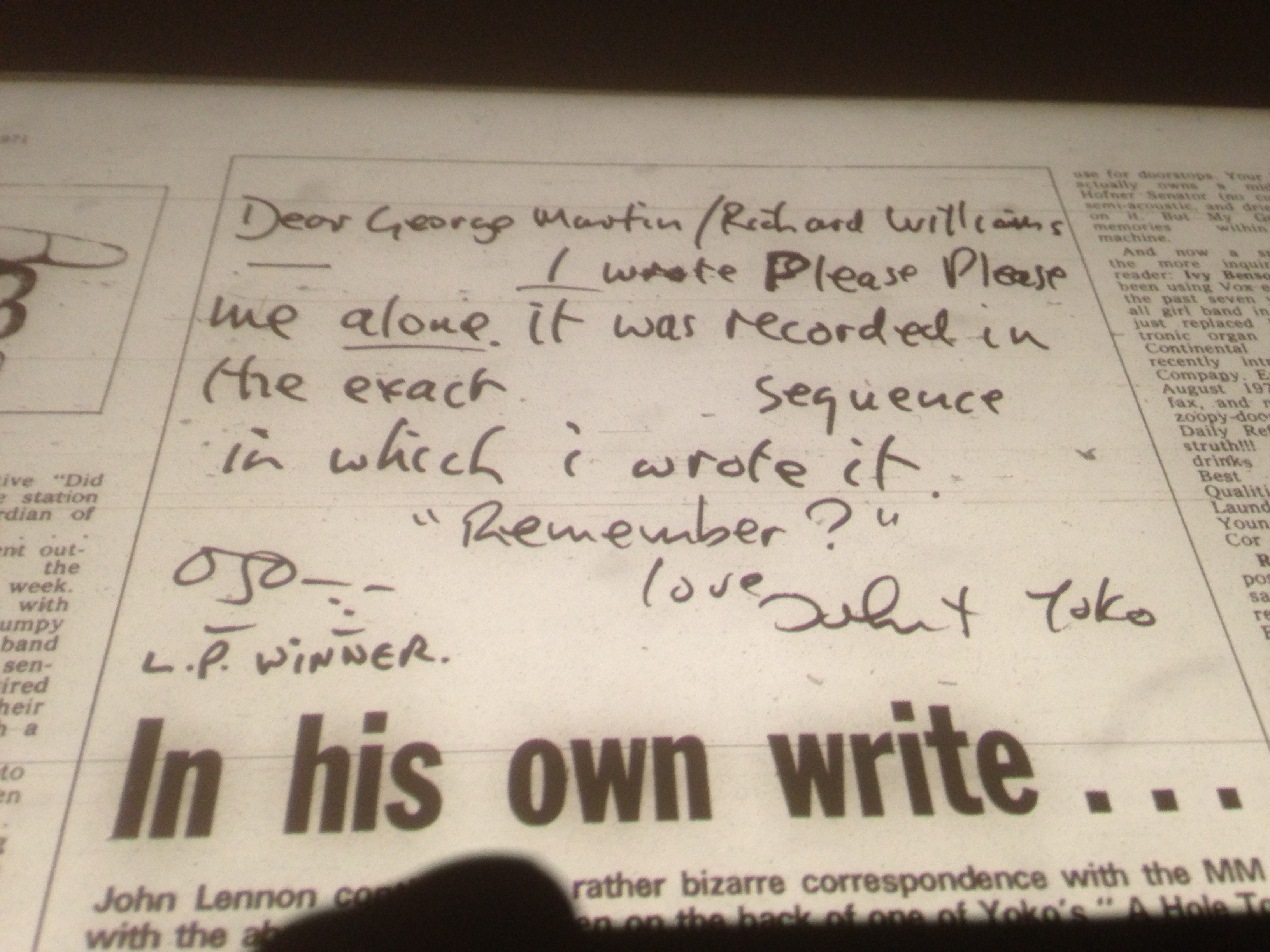
My contribution to the creation of Brian Eno’s Discreet Music was a tiny one, but I’m proud of it. Back in 1975 Eno was preparing the release of the first batch of four albums on his Obscure label, under the umbrella of Island Records, where I was in charge of A&R. Almost everything had been taken care of by the time he departed for a trip abroad (to New York, I think). I was left with a single task: to provide a title for a track on the album’s second side, the middle movement of a three-part suite based on Johann Pachelbel’s Canon in D. The titles for the first and third movements — “Fullness of Wind” and “Brutal Ardour” — had been chosen by Brian at random from the sleeve note to his favourite recording of the Pachelbel piece, by the conductor Jean-François Paillard on the Erato label, and he invited me to follow suit. My eye fell on the phrase “French Catalogues”. So there it is. Well, I told you it was tiny.

It was impossible to predict, 40 years ago, that Discreet Music would become so a significant a progenitor of what we hear around us today, or that it would eventually become the subject of a concert such as the one at the Barbican in London last night, when a nine-piece group directed by David Coulter and Leo Abrahams performed extended variations on both sides of the original album.

One third of the ensemble consisted of the members of the Necks: Chris Abrahams (piano), Lloyd Swanton (bass), and Tony Buck (drums). They were positioned on the left-hand side of the stage. On the extreme right were the great reeds player John Harle, the cellist Oliver Coates, and the violinist Emma Smith. In the middle, at the base of a deep V, were Coulter (vibraphone, musical saw and iPhone) and Leo Abrahams (guitar), with the desk containing the synthesiser and other hardware manipulated by the electronics specialist Benge (Ben Edwards) front and centre. Flanking the stage were a pair of large screens on which a selection of cards from the Oblique Strategies series devised by Eno and the late Peter Schmidt were projected, containing helpful counter-intuitive maxims and admonitions: “Repetition is a form of change”, “Abandon normal instruments”, “Disconnect from device”, and so on.

For the first half, devoted to an extended version of the piece titled “Discreet Music”, which was originally created by the composer with the modest means of a synthesiser, a sequencer, an echo unit and two tape recorders, a vertical screen above and behind the players showed the slowly changing images of Mistaken Memories of Medieval Manhattan, Eno’s 47-minute film of the New York skyline. Electronics opened this new treatment, outlining the two simple but rather haunting phrases — one ascending, the other descending — on which the piece is structured. Clarinet and bowed vibes took over, followed by gentle guitar, violin and cello, with Harle switching to bass clarinet. The Necks’ entry came about 20 minutes in: the first to join in was Swanton, playing sonorous arco phrases, then Buck, with a brush on his hi-hat, and finally Abrahams picking out liquid single notes. Over the course of the next 10 minutes, after the other instruments had fallen away, the performance evolved in a passage of full-strength Necks collective improvisation, their surges reaching a pitch of thunderous but beautifully controlled violence before receding as the other musicians rejoined for the finale. The arrangement both honoured the original and expanded it in several dimensions, investigating the flow and interplay of texture and line, producing something both intellectually absorbing and absolutely gorgeous. The ovation from a full house was entirely merited.

The stage lighting turned from blue to red for the Pachelbel piece, which first came to my attention when Eno used the Erato recording as the introductory music on an early Roxy Music tour. His refracted and discursive version on Discreet Music, arranged with the help of Gavin Bryars, was performed by the string players of the Cockpit Ensemble. Once again the expanded resources at the disposal of Coulter and Abrahams succeeded in opening out the work, allowing us glimpses of the Canon’s familiar phrases while introducing new elements: a duet for bowed saw and guitar, a poised solo piano interlude, some lovely clarinet/violin/cello counterpoint, and a double-trio passage for the two formations at opposite ends of the stage, eventually interrupted by harsh electronics that preceding the elegant closing diminuendo.

One thing that struck me about the evening was how the nine musicians, despite being strung out across the full width of the Barbican Hall stage, managed create such a powerful sense of intimacy. Aside from the individual phrases familiar from the original versions, it was often hard to tell where the new score ended and the improvising began. Everyone emerged with maximum credit, not least the man whose remarkable imagination and appetite for adventure had made it possible in the first place.

William Kentridge’s long march

William Kentridge 1 copy

Many hours after leaving the Marian Goodman Gallery this week, the sound of William Kentridge’s More Sweetly Play the Dance continued to fill my head. Kentridge is a visual artist, but in this piece — a film combining animation and live action projected across eight continuous large screens in the gallery’s first-floor space — music plays a particularly important role.

The work depicts a long procession, its composition reflecting the artist’s South African upbringing (his father was a lawyer who defended Nelson Mandela and represented Steve Biko’s family) and the time he has spent in Paris and Beijing. Skeletons, ballet dancers, invalids, priests, bandsmen, bearers of votive objects and other human flotsam and jetsam move through a blasted landscape scratched and washed in Kentridge’s Indian ink.

A kind of preparation for this has taken place in the rooms on the first floor, containing Kentridge’s striking works in ink on paper — some of it torn from Chinese newspapers, or facsimiles of the broadsheets published by the short-lived Paris Commune in 1871 — and by a smaller but wilder three-screen film made up of images reflecting the Commune, the Cultural Revolution and the anti-apartheid struggle.

More Sweetly Play the Dance combines visual echoes of the Long March, the toyi-toyi dances originated by Zimbabwean freedom fighters and later used in anti-apartheid uprisings, the funeral processions of New Orleans, the netherworld of Mexico’s Day of the Dead, and John Singer Sargent’s famous painting of gassed and blinded soldiers being led through the craters of the Western Front. And refugees, of course: refugees of all times and places, including our own.

The figures — limping, cavorting, striding — are accompanied by the sound of a brass band playing the sort of hymn tune familiar from the repertoires of Abdullah Ibrahim and Chris McGregor’s Blue Notes: a melody carried to Africa by Methodist missionaries in the 19th century, subsequently bent and enriched by the phrasing and intonation of musicians brought up in the Zulu and Xhosa cultures. The music is the work of Philip Miller, a South African composer who has worked on several of Kentridge’s earlier projects. For this one he takes the universal sound of the town brass band and adds a semi-synchronised overlay of calliope and accordion, as though all the sounds of a Saturday night in the pre-electronic age are being heard at once. Charles Ives would have loved it.

So did I. It does what art is supposed to do: combining the familiar and the strange, stirring the emotions, collapsing time, going beyond words. It’s one of the highlights of the year.

* William Kentridge: More Sweetly Play the Dance is at the Marian Goodman Gallery, 5-8 Lower John Street, London W1F 9DY, until October 24.

Remembering Paul Desmond

Paul Desmond Down Beat 2Fifty years ago this month, Paul Desmond was on the cover of Down Beat. The other day, when I was buying a new reissue of some of his early recordings, the man behind the counter told me his theory, which in essence was that if it hadn’t have been for Desmond, we’d never have heard of Dave Brubeck.

I had to agree with him, for two reasons. First, the graceful sound of Desmond’s alto saxophone was the first thing you heard when you heard the Brubeck Quartet. It was the identifier. Just as important, Desmond wrote “Take Five”, the group’s biggest hit, the one you heard on Sunday lunchtimes on Two-Way Family Favourites. Probably a lot of people assumed that it had come from Brubeck’s pen, the one that wrote two genuine jazz standards, “The Duke” and “In Your Own Sweet Way”. But its ingenuity was the altoist’s work.

The Fresh Sound album, Desmond: Here I Am, starts with five 1954 tracks with a quintet featuring the bassist Bob Bates and the drummer Joe Dodge from the early Brubeck group, and continues with four from the same year with the Bob Bates Singers, originally issued together as Desmond’s first solo album, on the Fantasy label; then come eight tracks recorded two years later with a quartet for the same label.

Interestingly, there is no piano to be heard on any of the three sessions. One could make a mildly cruel joke about the relief of being temporarily free from Brubeck’s heavy-handed accompaniment, but it would be neither fair nor entirely true. But the pianoless setting certainly suited Desmond: there’s an airiness appropriate to his sound.

Desmond was noted for his dry wit. In the Down Beat interview, talking to Dan Morgenstern, he discussed Brubeck’s most recent attempt to team the quartet with a symphony orchestra, in an extended piece called Elementals. “I kind of hope it stays the last,” he said. “That sort of thing is more gratifying to the composer; to perform it is a kind of struggle. It’s a little frustrating when you’re on stage with 80 symphony musicians and succeed in functioning just about as well as you ordinarily do, and it’s considered a great accomplishment — like tap dancing under water.”

He was a bit of a curmudgeon, in an amusing way. “Between the discotheques and the avant-garde and the folk scene, there isn’t much left,” he observed. But he had kind words for Charles Mingus — “He can be fascinating and very moving to listen to, as well as hitting you with something very difficult” — and his idea of a discotheque would be something that played the music of Muddy Waters, Count Basie and Mose Allison, which sounds pretty good to me.

There was never a sense of struggle or difficulty in Desmond’s music. He was even capable of rising above the kitschy sound of the Bates Singers (although not to the degree that he transcended Bob Prince’s workaday arrangements for strings and woodwind on the RCA album Desmond Blue a few years later). The 1956 quartet tracks, with Don Elliott switching between mellophone and trumpet, require no allowances to be made: these are gloriously lucid, lyrical inventions on standards and originals, the absence of strain and challenge more than offset by the calm, balanced inventiveness of the leader’s improvisations.

By 1965, however, the caravan of jazz was moving on. I remember feeling a surge of righteous anger, after handing over half a crown for this copy of the magazine, when I noticed that the editors had chosen to feature him on the cover rather than the second-billed Ornette Coleman. Desmond died of lung cancer in 1977, aged 52, and time has told the truth about him, which is that he was a player of genuine originality who couldn’t have played a banal phrase if he’d tried.

* Desmond: Here I Am is on the Fresh Sound label. Desmond Blue is available on a six-CD box called The Complete RCA Albums Collection, released by Sony Legacy and including his much admired collaborations with the guitarist Jim Hall.

A new view from the Necks

The Necks Vertigo 1Because it’s impossible to predict what strategy they will have adopted, the arrival of a new studio album from the Necks is always an event. With Vertigo, the Australian trio maintain the habit.

I loved their previous album, Open, for its transparent beauty. Others, such as AquaticDrive By and Silverwater, I’ve loved for quite different reasons. Vertigo doesn’t resemble any of its predecessors; it’s like going into a familiar house and finding a new room with a window that opens on to a view not seen before.

A single piece of music, 44 minutes in duration, it uses the resources and time at their disposal in Studios 301 in Alexandria, a suburb of Sydney. While their live sets are the product of a mixture of spontaneous urges and the 30-year relationship between the three musicians, the studio albums aim for something different (and yet, in its essence, the same).

There are no grooves in Vertigo, or even any pulses, unless you count the slow oscillation of something that sounds like a contrabass theremin, which briefly enters the proceedings at around the 18-minute mark. There are no riffs and nothing that sounds like a tune. There is no obvious drama.

Glimpses of anything that could be called the Necks’ “sound” are infrequent. Early on, Chris Abrahams does some nice things with incomplete descending arpeggios. Tony Buck makes the occasional clattery percussion intervention (and is probably responsible for the bits that sound like a guitar being picked above the bridge). Lloyd Swanton uses his bow to create layers of groaning bass drones just after the half-hour.

But that’s not the point. The sounds are the sounds. The exact source of this scraping or that plinking is immaterial: the assembly is what matters, and that’s something of which they are masters. The sonorities and textures slide into view and drift away, like the weather on a long road trip. It’s probably not the album you’d give someone as their first Necks record, but it couldn’t be by anyone else.

* Vertigo is released in the UK on the ReR Megacorp label. The photograph is by Holimage.