Crow Culture at the Vortex
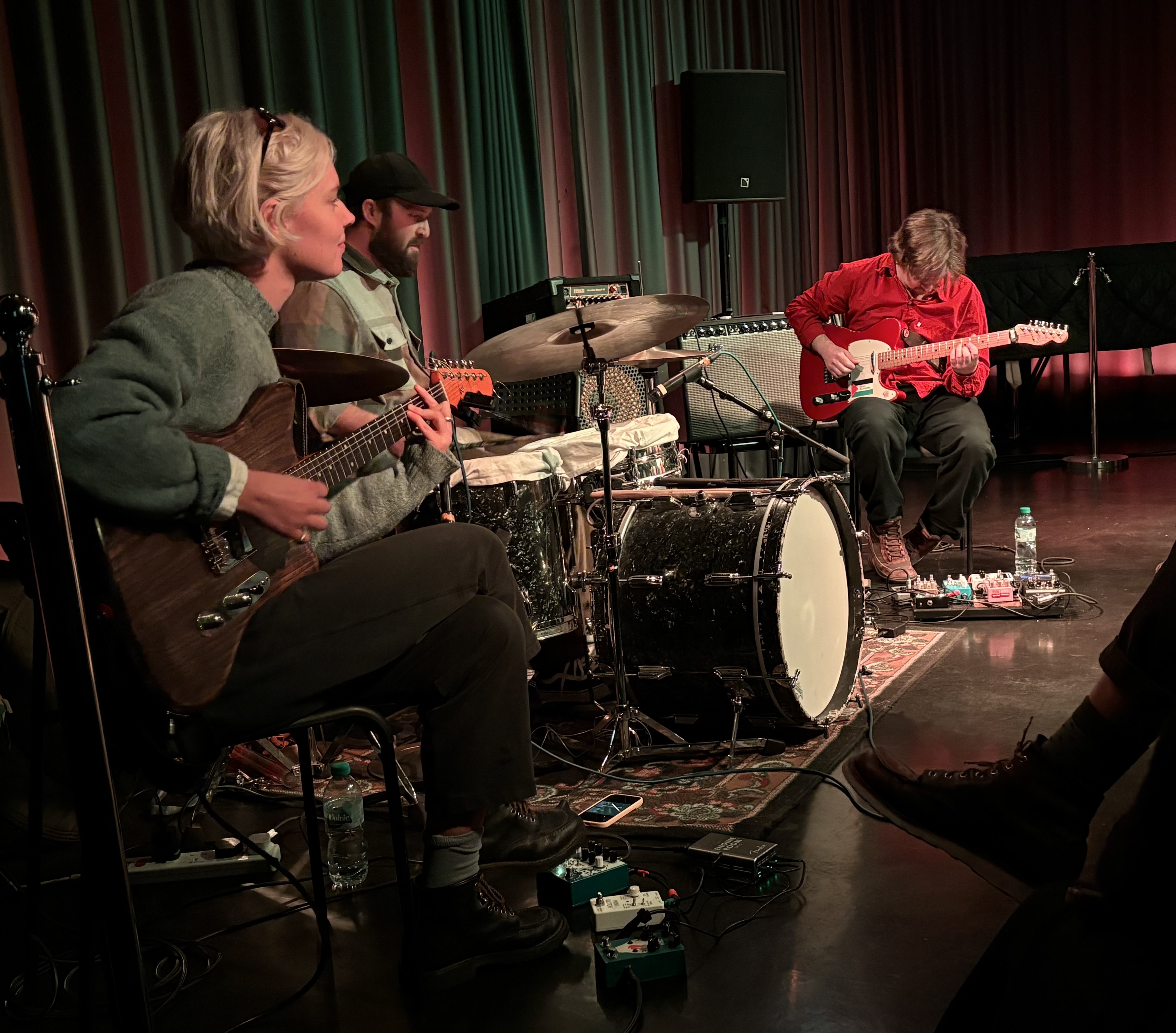
One of the more unusual features of the EFG London Jazz Festival is its annual embrace of all the city’s jazz venues. For 10 days, the clubs that do the heavy lifting for 52 weeks of the year on behalf of the music get to share the promotional glow of a major cultural event. So last night I went to the Vortex in Dalston to see an LJF-branded gig by Crow Culture, a newish group consisting of three British musicians: the guitarists Tara Cunningham and James Kitchman and the drummer Will Glaser.
For their two sets, the musicians were ranged against what is normally the side wall of the venue. This provided a greater degree of intimacy for a performance that had the informality of a front-room rehearsal — in the very best sense.
Although relatively young, the members of Crow Culture are familiar from other contexts. Together they play what might be called garage jazz, bringing their background in improvisation to bear on material from a variety of sources: compositions by Kitchman and Cunningham sit alongside the Habanera “L’amour est un oiseau rebelle” from Bizet’s Carmen and Angelo Badalamenti’s theme tune from Twin Peaks.
In terms of two-guitar bands, there were times when I was reminded of Tom Verlaine and the recently departed Richard Lloyd with Television, and of Lou Reed and Sterling Morrison in the early Velvet Underground. When Cunningham and Kitchman were hammering away at contrasting chorded riffs or interlacing arpeggios, particularly on a Kitchman original which started the second set, there was a definite Lower-East-Side-in-the-1970s vibe. In this mode, I loved the way they used a wide dynamic range to shape the contours of each piece, Glaser’s use of cloths to muffle his snare drum and floor tom permitting him to go at his kit with maximum attack when the moment demanded it.
But there was also often a sophistication that evoked the work of Mary Halvorson with Bill Frisell and even of Nels Cline and Julian Lage in the former’s quartet at the same club back in 2018. The Twin Peaks theme ebbed and flowed with a widescreen grandeur, rolling on Glaser’s mallets with undertones of the twang of surf music, ending in what is evidently one of their signature devices, a spontaneously devised fade to silence.
Together, they seem to have hit on a perfect blend of seriousness and wit, rawness and elegance, capable of drawing from the vocabulary of all sorts of modern guitar music, from Bo Diddley’s “Roadrunner” through Derek Bailey’s way of playing ballads to Sonny Sharrock’s blues-metal outbursts, and entrancing the audience from beginning to end.
The delicacy of which they are capable showed through best when Cunningham introduced a long exploration of the Bizet piece with the repeated ground bass later used in Ravel’s “Pièce en forme de Habanera” and later still nicked by Gil Evans for his “Las Vegas Tango”. Very gently she unfurled the melody, teasing it out in various registers, fingers and nails employed to give it a mellow warmth or a sharp, almost tinny edge, with little asides and surprising flourishes. Kitchman made subtle deployment of his looping and effects pedals while Glaser set aside his regular implements to use his hands on the snare drum. Its 10 or so minutes became a long moment of spellbound perfection.


sounds amazing. Are there recordings yet?
A forthcoming EP, apparently. I’ll let you know.