Robert Ryman at the Barbican
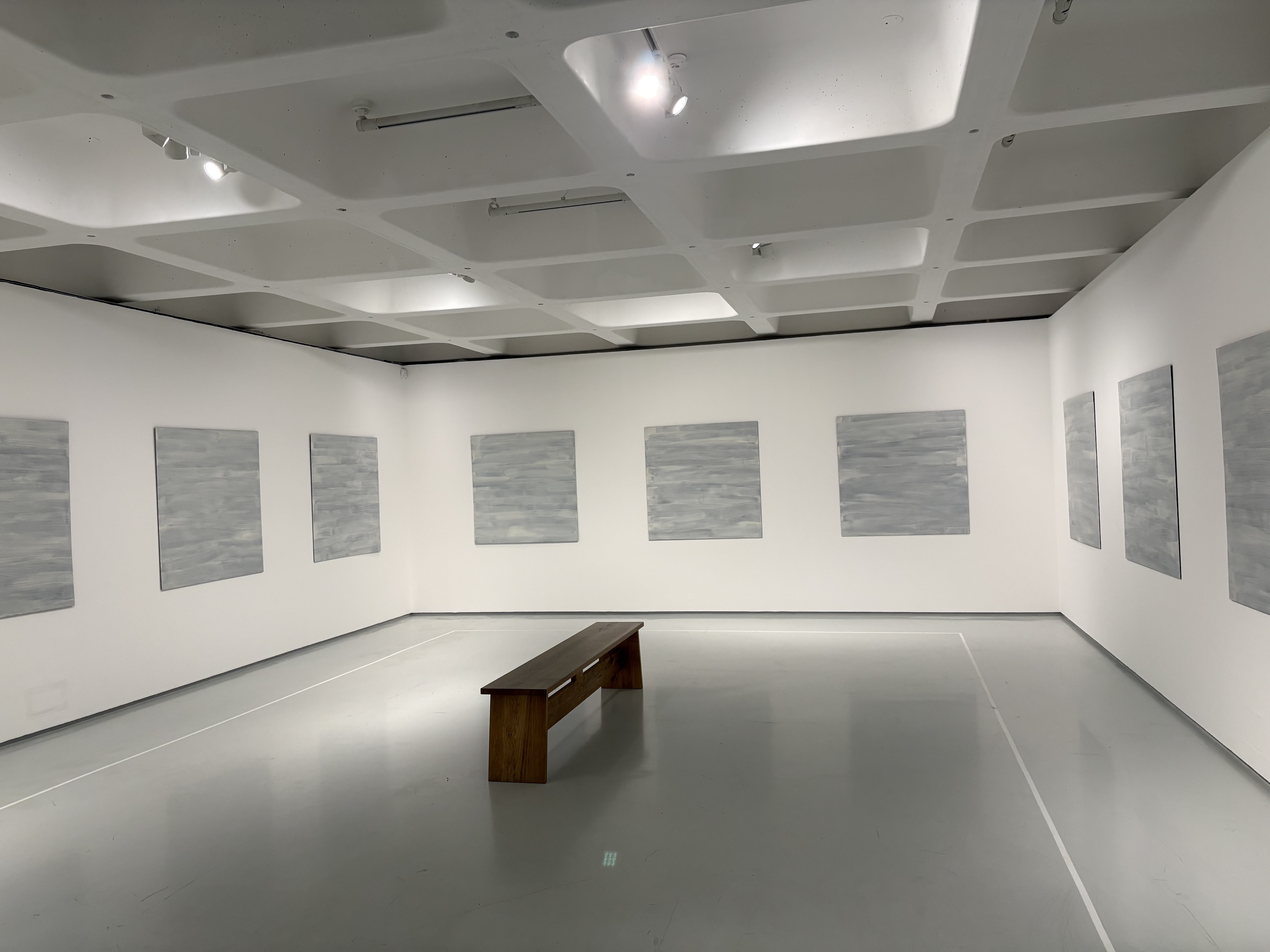
What sort of a jazz musician might Robert Ryman have become? If, that is, he had not started looking at the paintings while working as a guard at the Museum of Modern Art in New York in the mid-1950s, earning a wage to subsidise his studies with the great pianist Lennie Tristano.
“I was playing bebop… Charlie Parker, Zoot Sims,” he says during a filmed interview that closes the current exhibition of his work at the Barbican Gallery, the first of its kind to be shown in London for 30 years. “I think that had an influence on my painting because you learned your instrument and played within a structure. It seemed logical to look at painting that way.”
Ryman (1930-2019) became famous for his white paintings: white on white, seemingly the ultimate in minimalism, until you examine them closely, appreciating the variety of gesture within his self-imposed limits, and learn about the care he took to mix his materials, select his tools, and determine the framing and display. He took a long time over his processes, but in the interview — filmed for TV in 2007 — he says something else that indicates the influence of jazz: “It has to have a feeling like, it just happened.” Which is why Tristano put his students through a regime of intense discipline, in order to give them the basis for spontaneous creation.
I spent an hour and a half in the gallery yesterday on the way to Soweto Kinch’s concert with the London Symphony Orchestra in the Barbican Hall, part of the London Jazz Festival, and it was interesting to note that Kinch provides a short and thoughtful essay in the catalogue for the exhibition, underlining the parallels between Tristano’s philosophy and Ryman’s art. “At a time when jazz delighted in being inscrutable to the ‘unhip’, Ryman was codifying his own distinctive visual language,” he writes, “and I see his work as a kind of striving for improvisational purity, rigorously conforming to his own principles, creating worlds within worlds.”
Ryman tended not to go in for titling his works, but “One Down” is apparently named after a track on a trio album by the bop pianist Barry Harris, and the name of another, “Background Music”, is surely a reference to the ironic title of a composition by the saxophonist Warne Marsh, one of the most brilliant products of Tristano’s informal academy.
The Real Thing is a fine show, sympathetically curated to the extent of eliminating the clutter of wall-mounted captions, a decision that would surely have pleased the artist, instead offering an A4 guide that tells you everything you need to know and is pleasantly free from art-world jargon.
And it’s not all white. The room in the photograph above is hung with a suite of works titled “Standard”, painted in waves of blue-gray and gray-white industrial enamel on cold-rolled steel panels. They were made for Ryman’s first solo exhibition, at the Bianchini Gallery in New York in 1967, and he had to paint about 50 of them before he got 13 that he felt were right. Only one of them sold. The remaining dozen, now held by the Guggenheim, are here. To me they share a quality of deep contemplation with the works of Mark Rothko and Agnes Martin, pitched at a point somewhere between the two. I’ll be going back to that room before the show closes, to sit in silence and listen to the music they make.
* Robert Ryman: The Real Thing is at the Barbican Gallery until February 28.


