The coolest of cats
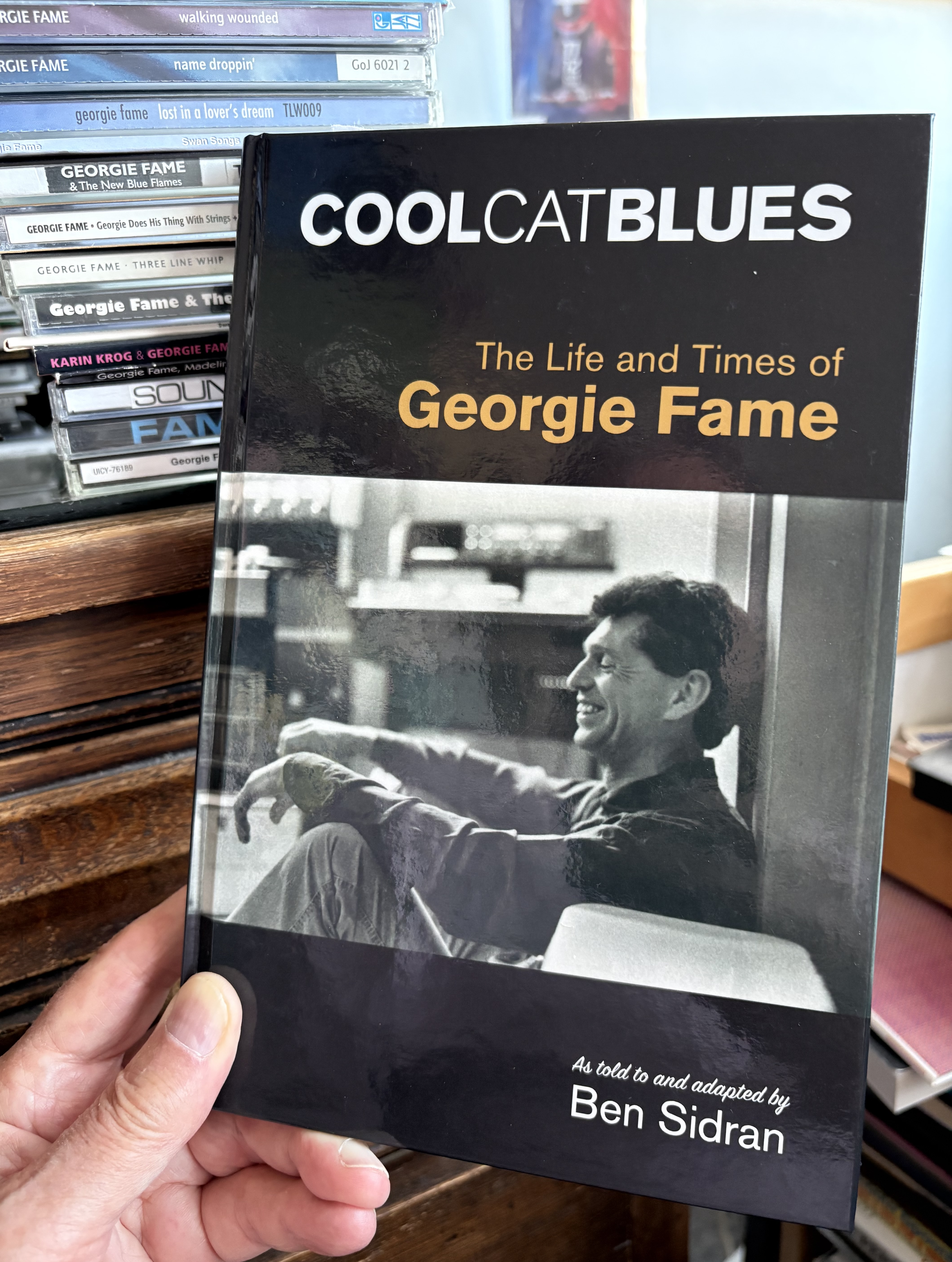
Georgie Fame’s career has been an affair of ups and downs, from the huge and unexpected success of “Yeh Yeh”, which knocked the Beatles off the No 1 spot in January 1965, to the medical problems — a fall from a ladder in 2019, breaking his hip and severing tendons in his right hand, followed in 2025 by a diagnosis of hydrocephalus, impairing his mobility — that have restricted his musical activities in recent years. He’s 83 now, and there probably won’t be any more gigs or records, so it seems all the more worthwhile to investigate a new biography, Cool Cat Blues, written by his friend and fellow singer-keyboardist Ben Sidran.
It’s a slender book, only 140-odd pages, but the story is well told, particularly that of his early childhood in the 1940s amid the mills and pits of Lancashire, and the warmth of a family in which music played a significant role. Then the Butlin’s and Larry Parnes years, during which Clive Powell became Georgie Fame and evolved from the pianist with Billy Fury and the Blue Flames to the singer and organist with his own Blue Flames, settling in London and taking up residence at the Flamingo Club, where the all-nighters with an audience of American servicemen and Caribbean immigrants provided the environment in which he could hone his distinctive musical character.
During that period, 1964-67, I took every opportunity to see the Blue Flames whenever they visited my home town, which was often. I loved their blend of R&B and jazz, influenced by Ray Charles’s small bands, the vocalese of Eddie Jefferson and King Pleasure, and Mose Allison’s vocal delivery and wry wit. And I loved Fame’s choice of sidemen with jazz instincts — has any British jazz saxophonist produced a better ballad solo than the effort by baritonist Johnny Marshall on “Moody’s Mood for Love”, from their second album, Fame at Last?
The book runs through the partnership with Alan Price, CBS’s attempts to turn him into a hipper Andy Williams, the surprisingly unsuccessful hook-up with Chris Blackwell and Island Records in the mid-’70s, his popularity in Sweden and his work with various big bands around the world, the creation of an Australian Blue Flames, the recordings produced by Sidran in New York for the Go Jazz label, Fame’s years as a star sideman with Van Morrison and Bill Wyman’s all-star Rhythm Kings, the integration into his band of his two sons, Tristan and James Powell, on guitar and drums respectively, and his decision, following the tragic death of his wife, Nico, in 1993 and the failure of a subsequent relationship, to move to Sweden, where he had many happy and fruitful years until moving back to England in 2018. He made his last London appearances at Ronnie Scott’s with Guy Barker’s big band in the autumn of 2022.
It’s a lot to get into a short book, and some might feel that much goes unmentioned. But this is, after all, Fame’s biography, not that, for instance, of the sidemen who always fascinated me — Mick Eve, Bill Eyden, Glenn Hughes, Cliff Barton, Tan Tan Thornton, Speedy Acquaye and so on. For that, and a detailed chart of their comings and goings, as well as a discography, you’d need to consult the German writer Uli Twelker’s much more compendious work, Georgie Fame: There’s Nothing Else to Do, published in 2014. Twelker also goes through his albums track by track, including the great Fame at Last and Sweet Things, which pass unmentioned in Cool Cat Blues. Sidran doesn’t mention the Blue Flames’ first recordings, two 45s issued on Rita and Benny Eisen’s tiny North London-based R&B label in 1963.
I’d have liked more on the evolution of Fame’s songwriting, which produced three fabulous ballads: the fondly lubricious “Eros Hotel”, his setting of Fran Landsman’s words, which made its debut on the album Right Now in 1979 and subsequently became a live favourite, and the entirely self-penned “Lost in a Lover’s Dream” and “A Declaration of Love”. In those songs, the cool cat revealed himself as a dyed-in-the-wool romantic. It would have been nice, too, if Sidran’s publisher had employed an editor who knew that it’s Tadd (not Tad) Dameron, Karl (not Carl) Jenkins, and “Buona (not Bona) Sera”, that James Brown led a revue (not a review), and that Bill Wyman’s real name is Bill Perks (not Perkins).
But the compensations for any deficiencies are many, not least in an entire chapter devoted to his decade with Van Morrison, gnomically titled “Ulster Logic” and as charmingly enlightening an insider portrait of the “difficult” Belfast genius as you’re likely to read, and in the judicious intimacy of the book’s overall tone — this is not a hagiography but a biography written by a friend, with the complicity of the subject, to whom it does proper honour.
* Cool Cat Blues: The Life and Times of Georgie Fame is published by Equinox: https://www.equinoxpub.com/projects/cool-cat-blues.


Ordered – thank you.
Saw him once in Melbourne with the Aussie Blue Flames (oh, the cultural cringe inherent in that name). He came on solo, carrying a glass of beer, sat down at the hammond and rocked the house with ‘Zulu, Zulu, Zulu . . .’
Sweet Georgie Fame
loved Mr Fame in the mid sixties and saw him often. I thought ( foolishly) that this along with Alexis Korner et al. was going to change British pop music forever into some jazz inspired genre – no mate. Wish him well. ❤️
Looks an interesting book Richard, will try and get hold of a copy…
48 years ago this week, in 1978, Georgie Fame & The Blue Flames played The Newport Jazz Festival at Ayresome Park Football Stadium in Middlesbrough. ‘The greatest gathering of jazz talent ever in Britain’, according to Jazz Circle News at the time. I was a lucky 23 year old working for Cleveland County Council. They who appeared to be spending the entire year’s events budget on an international jazz festival…and why not! I was employed as a steward and spoke to people over the weekend who came from all over the world to Middlesbrough.
George Melly; Bill Evans trio; Lionel Hampton all stars; Georgie Fame & the Blue Flames; Newport All Stars; Buddy Rich Orchestra; National Youth Jazz Orchestra; McCoy Tyner Quintet; Jonah Jones Quintet; Dizzy Gillespie Quartet; Chris Barber; American Festival All-Stars; Art Blakey & Jazz Messengers; Ella Fitzgerald; Marion Montgomery; Oscar Peterson; Freddie Hubbard Quintet.
Ella was chauffered to the gig in the chairman of the football club’s Rolls Royce. The gig got global news coverage as people danced on the pitch, including the police! There was also lots of spin off gigs at various local venues into the early hours….Georgie Fame and co. played at the Club Fiesta in Stockton….and there was a marvellous tale of a local chef who cooked a meal after the show for Ella, Dizzy & Oscar and was treated to a private jam session from them around the piano in the restaurant in the early hours. Good time had by all.
Regards
Barry Coppinger
Middlesbrough
Went on the Friday when Bill Evans played with Lee Konitz and Philly Joe Jones, difficult to imagine a more incongruous setting than the centre circle of Ayresome Park.
Didn’t seem to bother Hamp, with the great Panama Francis powering the band, he tore the place down
Hi Richard
Although sometimes regarded as too mainstream to be properly “cool”, it’s a measure of the respect and affection in the “biz” which musicians had for Georgie Fame that Blossom Dearie recorded her lovely “Sweet Georgie Fame” and he reciprocated with his song “Blossom”. Another aspect of Georgie’s character might be glimpse in an anecdote tromobonist Malcolm.Griffiths recounted to me that one member of Georgie’s band lost the gig after being heard imitating the band leader’s distinctive vocal style. This may, of course be apocraphyl.
John McCourt (jmccourtsr18@gmail.com)
Dear Richard Williams, Just been reading the latest “The Blue Moment”: Thank you very much for reviewing Ben Sidran’s Georgie Fame biography – and mentioning mine in the process! This is much appreciated – especially as it’s always been difficult to market the book in the UK. Should anybody in your vicinity be interested in my book, GEORGIE FAME: THERE’S NOTHING ELSE TO DO – LIFE & MUSIC, here’s a link to amazon.de https://www.amazon.de/Georgie-Fame-Theres-Nothing-Music/dp/3000467319?dib=eyJ2IjoiMSJ9.woSFaSZH9YvMaA0NPaDeWIScN-3iel5fhXuOf-0l1YNAIf7FJ4sBtNX530S55aDF3xFlswpjrFW0R4DkVeEK90dCLGYGuSJIQRpABdhNmPCYao866iEuKNLs_20lp55C.gXCLUI3Ul08V59KrevpuXt_3LzsJ1WmQ2rbP9hU8_hQ&dib_tag=se&qid=1784997740&refinements=p_27%3AUli+Twelker&s=books&sr=1-7 It’s the easiest way to get hold of it, (although I recently saw a copy in Foyles in Charing Cross Road). Thanks again for your interest and mention, Richard. Kind regards, swing on Uli Twelker