At Haruki Murakami’s jazz café
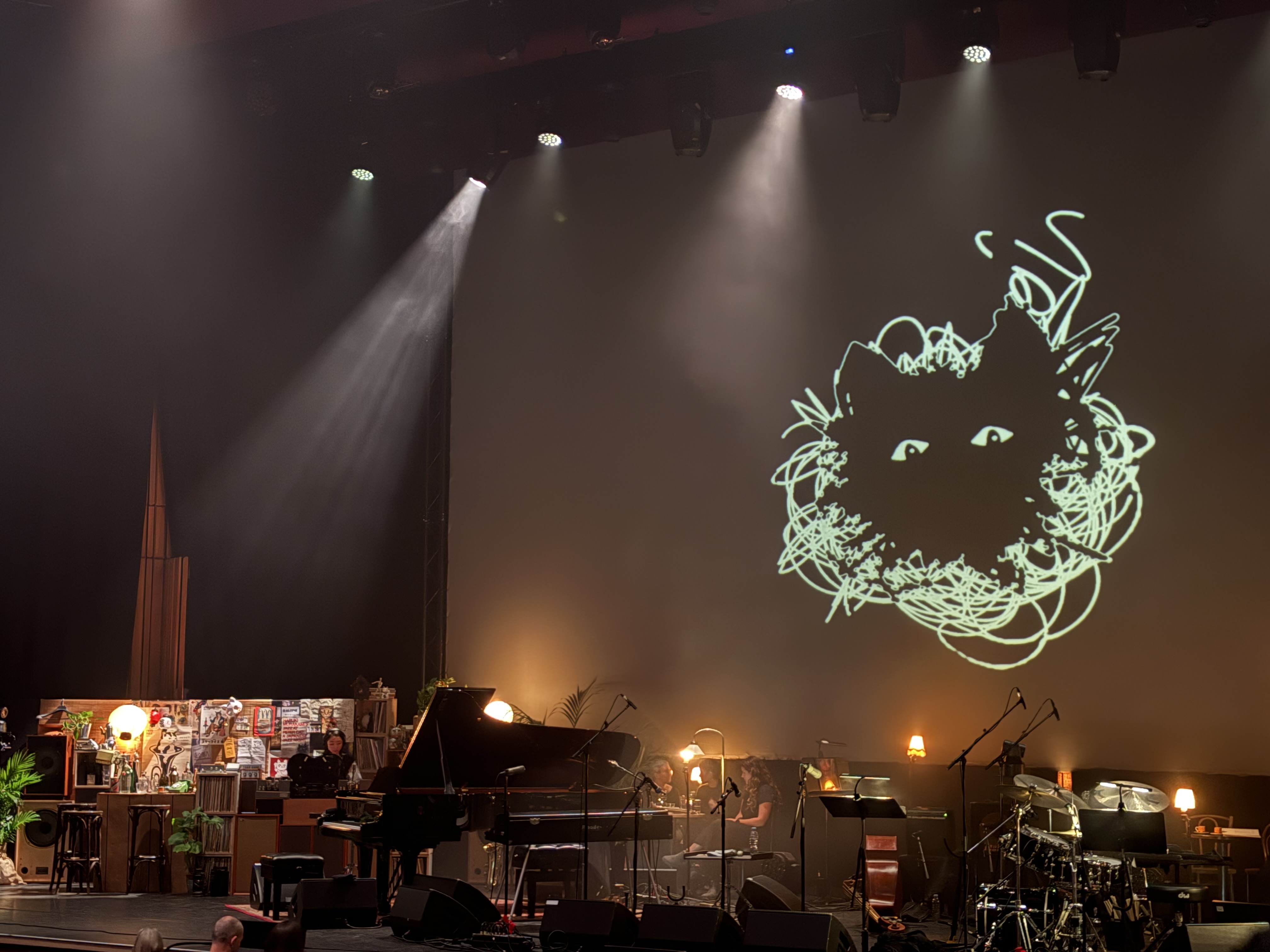
Music of all kinds permeates Haruki Murakami’s novels. The book that made him a star, Norwegian Wood, takes its title from a great Beatles song. Dance Dance Dance, one of its successors, reflects his love of the Beach Boys. But jazz played a special role in his life, given that from 1974 to 1981 — between graduating from university and achieving his first success in the literary world — he and his wife, Yoko, ran a jazz café in Tokyo, which he named after their cat.
Haruki Murakami’s Jazz at Peter Cat: A Japanese Jazz Experience is the title of a event given three performances at the Barbican Hall this weekend, presented as part of the EFG London Jazz Festival. On the left side of the stage was a reproduction of the bar; along the rear, in front of the backdrop, were tables at which a dozen or so people sat quietly with their drinks. In front of them, three groups from Japan — two trios and a quartet — succeeded each other over the course of two hours, interspersed with a little bit of pre-recorded narration.
Maybe it sounds hokey, a bit contrived. It wasn’t, thanks first to the care that had clearly gone into assembling the show and second to the quality of the musicians. First on was the trio of the pianist Junko Onishi, a former Berklee student and protegée of the late Jaki Byard. After beginning with a solo treatment of “Round Midnight”, over the course of an unbroken 25 minutes they delivered a masterclass in the art of the contemporary piano trio, Onishi’s post-Tyner virtuosity matched by the brilliance of her bassist and drummer as the group switched tempos and tangents with an ease that never felt glib.
They were succeeded by the soprano and alto saxophonist Sachi Hayasaka, leading a trio called TReS completed by her son, Rio Nagata, a gifted baritone saxophonist, and her partner, Toshiki Nagata, on double bass. Like Onishi, Hayasaka had obviously prepared her mini-programme with care: her set consisted of short pieces with an immediately beguiling sense of vigour, wit and a Mingus-like momentum. The broken bass string was probably not part of the planning, but the pantomime that involved bringing on another instrument only increased the audience’s engagement.
The third group was The Blend, originally a quintet combining veteran and younger musicians assembled several years ago by the bassist Yoshio Suzuki, an old friend of Murakami. Suzuki died in September, aged 80, leaving a request for the group to carry on without him. So here they were, now a quartet, with Keisuke Nakamura on trumpet, Kosuke Mine on tenor saxophone, Hakuei Kim on piano and Tamaya Honda on drums. As they worked their way through imaginative rearrangements of Benny Golson’s “Five Spot After Dark” and Bobby Timmons’ “Moanin'”, two of the sort of post-bop tunes that Murakami cherished, and a lovely ballad that I couldn’t identify, I was put in mind of what might have happened had Lee Morgan and Hank Mobley shared a stage with Keith Jarrett and Tony Williams. Pretty good, then.
For the finale, all 10 musicians gathered to attack “Norwegian Wood”, set to a subtle jazz-club version of the Bo Diddley beat, with a four-horn arrangement that could have been an outtake from Oliver Nelson’s classic The Blues and the Abstract Truth. A perfect conclusion to an ambitious and very successful presentation.
When I interviewed Murakami for the Guardian in 2003, my last question was about his huge collection of jazz LPs. If his house burned down, and he could only save three of them, which would he choose? “I give up,” he said, after some deliberation. “I couldn’t choose three. So I let it burn. Everything. I save the cat.”
* The UK-based J Jazz label has several interesting compilations of Japanese modern jazz. Tokyo Jazz Joints by Philip Arneill with James Catchpole, publishded by Kehrer Verlag, is a fine illustrated book about the sort of places epitomised by Murakami’s Peter Cat.


