Into the Shadows
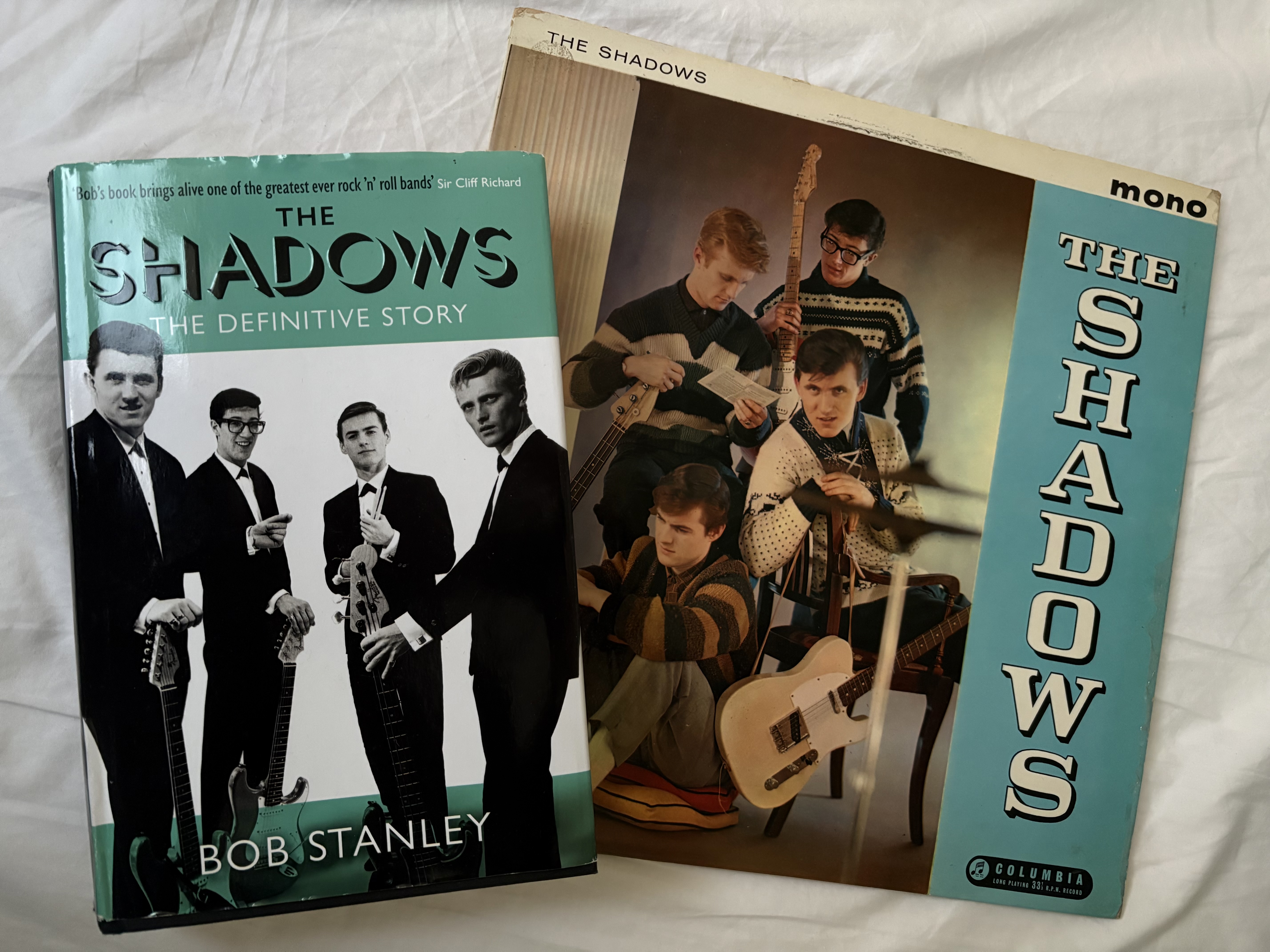
Bob Stanley may be too young to have found himself standing in front of a bedroom mirror soon after the release of “Apache” or “FBI”, practising the Shadows Walk with a tennis racket in place of a Fender Stratocaster. But his new book — The Shadows: The Definitive Story — shows that someone born in 1964 can still get the point of the four-piece instrumental group coming between Lonnie Donegan and the Beatles in the chronology of formative influences on British pop music in the second half of the last century.
Perhaps that slight distance is what enabled him to come up with something as interesting as the conclusion drawn from his comparison between the ages of Shadows and the Mop Tops. If your real-time teenage pop consciousness spanned the first hits of both groups, you’ll remember that they seemed to belong to completely different generations — musically, cuturally, attitudinally. In his preface, however, Stanley points out that they were, in fact, pretty much exact contemporaries, their members born in 1939 (Jet Harris), 1940 (Ringo Starr and John Lennon), 1941 (Hank B. Marvin and Bruce Welch), 1942 (Paul McCartney) and 1943 (Tony Meehan and George Harrison).
Their backgrounds, respectively in the north-east and the north-west, were also similar, as was their apprenticeship in local skiffle groups and their early fondness for Buddy Holly and the Crickets. But whereas the boys born Brian Rankin (Marvin) and Bruce Cripps (Welch) set off from their native Newcastle for London as teenagers, two guitarists making their way into the professional rock and roll world of the 2i’s and other Soho coffee bars before adding Harris on bass guitar and Meehan on drums to complete their line-up, and were still only 19 when “Apache” spent five weeks at No 1 in 1960, the Beatles had forged their identity away from the capital’s spotlight, in the clubs of Liverpool and Hamburg. By the time they recorded “Love Me Do”, all but Harrison were in their twenties.
That alone made me feel as though I’d got my money’s worth from the book. But of course there is a rich saga, beginning in the poverty of post-war Newcastle and going all the way to reunion tours. Stanley is good on something else he can’t have known at first hand: the sense of the exotic exuded not just by the titles of the Shadows’ hits — “Man of Mystery”, “Wonderful Land” and so on — but the shiver and twang and bold red body of the first Stratocaster in the UK, bought for Hank’s use by Cliff Richard when they were still the Drifters, his backing group.
Listening to the Shadows at the dawn of the ’60s, Stanley writes, transported British teenagers “still ground down by national service, bowing down to their elders, keeping up appearances and working on lathes at the age of 16” to “Dakota, or the High Sierra, or further beyond to Atlantis… if you got yourself a red Fender Stratocaster and learned how to play, you could be this free.” That was precisely the feeling, and it’s amusing to learn that, during a US tour, the members of the group insisted on visiting the Alamo, a place that in a sense represented the emotional centre of their music, whose echoes would be heard a few years later in Ennio Morricone’s spaghetti western soundtracks.
It wasn’t long, of course, before the Shadows became enmeshed in the showbiz world of panto in Stockton and duff films with Cliff. (I say “duff”, although if you were 13 or 14 when The Young Ones and Summer Holiday came out, they too seemed like an escape.) But on the way from the 2i’s to the Palladium they were aided and abetted by a host of interesting characters, each of whom has a place, greater or lesser, in the book’s narrative: the gifted songwriter Jerry Lordan, the guitarist Ian Samwell, the producer Norrie Paramor, the manager Peter Gormley, the mysterious beat poet Royston Ellis, and the Tin Pan Alley veteran Michael Carr, who provided them with “Man of Mystery” towards the end of a songwriting career that had also included “We’re Going to Hang Out the Washing on the Siegfried Line”.
Stanley confronts the dark side represented by the emotional damage done to Harris when his young wife had an affair with Cliff, by the unreliability that eventually drove a wedge between the brilliant young Meehan and his rest of the group, and by Welch’s obsessions with punctuality and his inability to tune his guitars accurately (eventually he paid John Rostill, Harris’s second replacement, £10 a week to do it for him). Welch and Marvin were as different from each other as Lennon and McCartney, the ultimate break-up of the group coming in the winter of 1968 in Eccles, a suburb of Manchester, during an engagement at a variety club called the Talk of the North.
I found a few things on which to disagree with Stanley. How could he describe 1960 as “the worst year in pop music since the dawn of rock ‘n’ roll”? I mean: “Will You Love Me Tomorrow”, “Stay”, “Walkin’ to New Orleans”, “Save the Last Dance for Me”, “Peter Gunn”, “Shop Around”, “Walk Don’t Run”? Give over. He dismisses Giorgio Gomelsky’s Marmalade as “a black hole of a record label”, ignoring its two classic releases: the Driscoll/Auger “This Wheel’s on Fire” and John McLaughlin’s Extrapolation.
But this is a very good book, well proportioned in its coverage of the earliest stirrings, the heyday, and the afterlives of its protagonists. It sent me back to the original copy of The Shadows, their first LP, which I’ve had since it came out in 1961, and which anticipated the trend for making albums that didn’t contain singles. It still shows their range and musicianship to good effect. Now, there’s the mirror. Where’s that tennis racket?
* Bob Stanley’s The Shadows: The Definitive Story is published by New Modern.


