Skip to content

Posts by Richard Williams

In memoriam

Cefalu 1

Manu Dibango. Cristina. Wallace Roney. Ellis Marsalis. Bucky Pizzarelli. Adam Schlesinger. Bill Withers*. Hal Willner. John Prine. The list will lengthen in the coming days, and one or two people have inquired very kindly about the possibility of Blue Moment tributes to some of these victims of the Covid-19 virus. At the moment I feel disinclined to deal with it in that way. I don’t want to turn this site into a parade of obituaries. I do, however, want to think about them.

Take John Prine. To be honest, I never followed his career closely, but he did provide me with one electrifying moment. It’s on Bonnie Raitt’s live recording of his great “Angel from Montgomery”. Raitt has set the scene when the guy who wrote the song comes in to sing the second verse. His voice is a dried-out husk. “When I was a young girl, I had me a cowboy / Weren’t much to look at, just a free ramblin’ man / But that was a long time, and no matter how I try / The years just flow by, like a broken-down dam.” Does something to me, anyway. Every time. You might feel the same.

* I should add that Bill Withers didn’t die of the coronavirus. But it seemed wrong to omit him.

Piano music

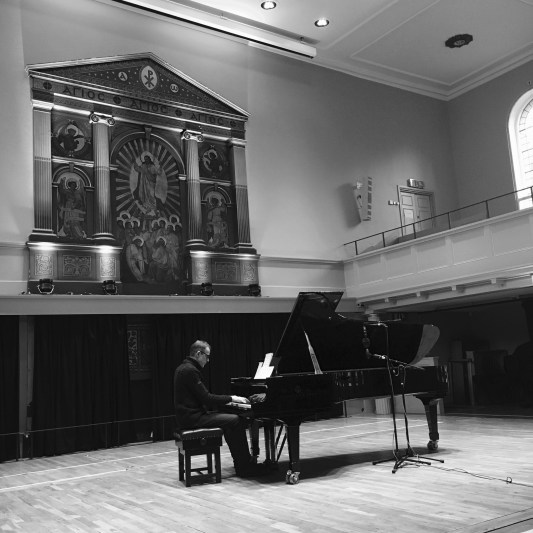
PJ piano St Georges 1

Most of the time, Pete Judge is a trumpeter. He’s based in Bristol and plays in three interesting bands: the quartet Get the Blessing, the trio Three Cane Whale and the duo Eyebrow, whose records I’m particularly fond of. He’s just released his second album of solo piano pieces, Piano 2. Here’s what he said in the brief liner note to its predecessor, a couple of years ago:

I come from a long line of piano players, though I’m not really one myself, having rebelled at an early age and inexplicably chosen the trumpet instead, but my favourite piece of furniture in my grandmother’s house was always the old upright piano in the front room, which later became my mum’s piano, and lived with her on the North Kent coast. Now it’s in Bristol, and these tunes were all composed on it, with the soft pedal permanently applied (initially for neighbourly reasons, and now just because that’s the sound that suits them). So this is a ‘piano’ album in both senses of the term.

Piano and Piano 2 were both recorded in St George’s, Bristol, a deconsecrated 1820s church reopened a few years ago as a concert space. I liked the first volume, but the second one I love.

It consists of 16 pieces, ranging in length between one and five minutes. Titles include “Darkening Hills”, “Wheatfield With Crows” and “Gurney’s Oak”. If you took that to suggest a rather literal English pastoralism, you’d be wrong. The music is non-generic — it’s not jazz, it’s not classical. It’s sturdy but also delicate. It’s melodic and austere at the same time. It’s inviting but not ingratiating. It takes its time. It’s not virtuosic at all, although Judge has a lovely touch. It’s satisfyingly well proportioned but not predictable. It’s quietly but firmly unsentimental. It has lots of things inside it — hymns, folk songs — but they’re metabolised so completely that the components aren’t visible.

I haven’t felt so close to a solo piano record since Keith Jarrett’s The Melody at Night, With You, the one he made when he was recovering from illness and wasn’t afraid to show his vulnerability. Piano 2 has a similar honesty. It’s not trying to wig you out or teach you something. It’s just there, like a friend. And at the moment it feels like the perfect music for the times we’re living through.

* The photograph of Pete Judge recording at St George’s is by Tim Allen. You can find Piano 2 on Bandcamp: https://petejudge.bandcamp.com/

A night at Fillmore East, 1970

brinsley_0033-1-640x390

You could fill Shea Stadium, never mind the Fillmore East, with all the people who claim they travelled from London to New York City by Boeing 707 and Cadillac motorcade to see Brinsley Schwarz on April 5, 1970. Fifty years later, it remains one of the most hilariously disreputable hypes in the history of popular music.

A bunch of chancers calling themselves Famepushers Ltd took an unknown group from Tunbridge Wells called Brinsley Schwarz (formerly known as Kippington Lodge), talked Bill Graham into giving them a support slot at the Fillmore East, and booked an Aer Lingus jet to carry 100-plus assorted media types — a mix of Fleet Street, music paper and underground press — and scenemakers (such as Jenny Fabian and Johnny Byrne, co-authors of the recently published roman-à-clef Groupie), to go and hear them.

Famously, everything went wrong. Scheduled to leave Heathrow at 10.30am and arrive at JFK at four in the afternoon, which would have given plenty of time to get to the gig, the 707 was three and a half hours late leaving London and made an emergency landing at Shannon, with no fluid in the Boeing’s braking system. I’ve never forgotten looking out of the window and seeing Irish fire engines and other emergency vehicles racing along the grass beside the runway as our pilot used every yard of tarmac and every pound of reverse thrust to bring us to a halt. Rectifying the problem took some time, and the flight didn’t touch down at its intended destination until 7pm. The band were due on stage at 8.

Somehow we were hustled through immigration without needing to show anything. We were taken by bus to the car park of the First National City Bank building on the periphery of the airport, where 25 black Cadillacs supplied by a company called Head Limousines were waiting in the dusk, along with their uniformed drivers and a police motorcycle escort, for a hectic dash that gave me my first glimpse of the Manhattan skyline on the way into the neon twilight of the city.

It was dark when the limos dropped us at the theatre’s entrance on 2nd Avenue, a block east of the Bowery. We rushed in and found some seats just as the Brinsleys took the stage. None of us — not Pete Frame from ZigZag, not Charlie Gillett from Record Mirror, not Geoffrey Cannon from the Guardian, not Jeremy Deedes of the Evening Standard, not Richard Neville from Oz, not Jonathon Green from Friends, not Keith Altham from the NME, not Mark Williams from IT, not Jonathan Demme, the London correspondent of Fusion, not the five winners of a Melody Maker competition and their partners, not my MM colleague Royston Eldridge and certainly not me — had prior knowledge of a note of their music. But, sadly, we were unanimous: their subdued country-rock was best described as nondescript. And, anxious as we all were not to be seen to have been seduced by the hype and the free trip, barely any of us had a kind word to say about them in print afterwards.

Some members of the trip, feeling the effects of the free booze and other stimulants taken on what had turned out to be a 15-hour journey, left immediately after the Brinsleys’ set to check in at the party’s designated midtown hotel — the Royal Manhattan on 8th Avenue — and find other ways of spending Saturday night in the Apple. Those of us who stayed were rewarded by an inspired performance from Van Morrison, featuring the band and mostly the songs from the recently released Moondance, and a pretty good one from Quicksilver Messenger Service, to whom Dino Valenti (the writer of “Get Together”) had recently been added as lead singer, delivering memorable versions of “What About Me” and “Fresh Air”. At which point we all headed off for a few hours’ sleep. All except Pete Frame, bless him, who stuck around for the midnight show and reported the next day that the Brinsleys’ second set was much more relaxed and enjoyable.

There was supposed to be a press conference with the band at the hotel the following morning. I remember people standing around drinking coffee, all vaguely embarrassed by what had transpired the night before. Charlie Gillett delivered the proofs of The Sound of the City, which he had been correcting on the flight over, to his US publisher and invited me to go downtown with him to the apartment of Robert Christgau, the self-styled dean of American rock critics, where we spent an hour or so. After that we went to Sam Goody’s, where I picked up two copies of the original US issue of The Velvet Underground and Nico, with unpeeled bananas, from a large pile in the cut-out section at just 99 cents apiece. And then we were taken to the airport for a comparatively uneventful overnight flight home, arriving in a rainy London at the end of an adventure destined to enter the annals of rock infamy. While the rest of us resumed our normal lives, it would take the Brinsleys a long time to recover from their sudden notoriety.

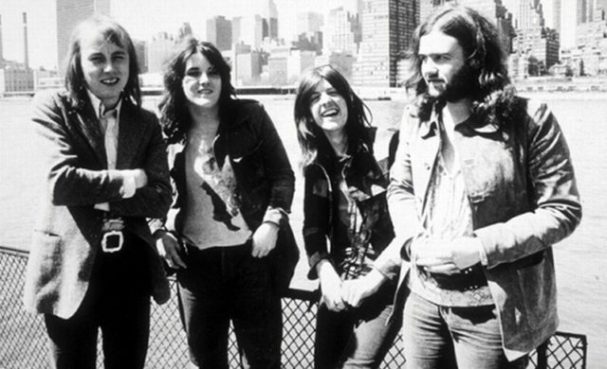
* The photograph shows (from left) keyboardist Bob Andrews, drummer Billy Rankin, singer/bassist Nick Lowe and guitarist Brinsley Schwarz. For an extensively researched look at the business background to the affair, I recommend the relevant chapters of Will Birch’s highly entertaining history of pub rock, No Sleep Till Canvey Island (Virgin Books, 2000), and the same author’s Nick Lowe biography, Cruel to Be Kind (Constable, 2019). Part of Van Morrison’s set that night turned up on YouTube a few years ago; it has since vanished, alas.

Mike Westbrook’s ‘Citadel / Room 315’

755007550004_1

One day in 1974 Mike Westbrook came into the Island offices in St Peter’s Square, Hammersmith, to play me a tape of a concert he’d given in Södertälje with the 16-piece Swedish Radio Jazz Group. He’d been commissioned to write an extended work for the ensemble, with John Surman as a featured soloist. He called the piece Citadel / Room 315.

I was keen, and we started to make plans. Then something got in the way, and it didn’t happen. So instead of releasing the live version, several months later Mike went into the studios with a band of UK-based musicians including Kenny Wheeler and Henry Lowther on trumpets and Malcolm Griffiths on trombone, as well as Surman, to record a version that was released the following year by RCA, who’d put up the money.

That recording is now rare, which makes it even better news that the Swedish concert is now being released for the first time, with Westbrook’s blessing, under the title Love and Understanding, borrowing the name of one of the suite’s 11 sections. Hearing it for the first time in 46 years, I was delighted to find it every bit as exceptional as I’d thought back then.

In a manner typical of Westbrook, it ranges through a variety of approaches and moods, from the meditative to the wildly exultant, engaging the emotions all the way. The long “Love and Understanding” might be described as an essay on boogaloo moods, evolving from a slinky funk to a streetwise strut, taking in the “Oh Happy Day” riff and brassy TV detective-series brass fanfares en route. “Pastorale” begins in the way its title suggests before mutating into solos over the “Grazing in the Grass” motif, played by Westbrook on electric piano — another kind of pastorality, I guess. From the gentler passages, Surman’s soprano on “Tender Love” is particularly exquisite.

What also distinguishes the recording is the quality of the Swedish musicians. The solos from Jan Allan and Bertil Lövgren (trumpets), Arne Domnérus (alto and clarinet), Lennart Åberg (soprano and tenor), Lars Olofsson (trombone), Rune Gustafsson (guitar), Bengt Hallberg (piano) and Georg Riedel (bass) is exceptional, as is the drumming of Egil Johansen. They don’t go in for the sort of free-for-all shout-ups to which Westbrook’s British bands were prone, but I can’t imagine anything more invigorating than Åberg’s soprano wailing over the last section of “Love and Understanding”, immediately followed by Allan’s beautifully control of diminuendo as the section ends, or Lövgren’s gloriously lyrical delivery throughout “Pastorale”. The acapella trio for Domnérus’s clarinet and the bass clarinets of Surman and Erik Nilsson that opens the long “Sleepwalker Awaking in Sunlight” is a complete joy, as is Gustaffson’s liquid bebop guitar solo which follows it.

This makes it even more extraordinary that the reason for the cancellation of the proposed Island release was that a couple of the Swedish musicians were unhappy with their solos, didn’t want them preserved for posterity, and wouldn’t sign clearance forms. Listen, and try to guess who they might have been. It’s impossible.

In all, then, this is definitely one to add to the list of the great recordings of Westbrook’s important extended works of the past half-century, from Celebration through Marching Song and Metropolis to On Duke’s Birthday and The Cortège and many more. And in this case, to say the least, better late than never.

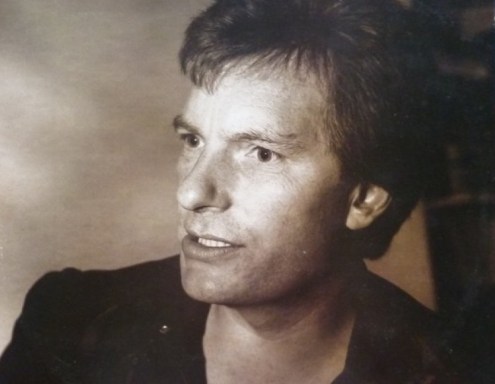
* Love and Understanding is released as a vinyl double album and a single CD the My Only Desire label (myonlydesirerecords.com). The photograph of Mike Westbrook is from the sleeve of the RCA version of Citadel and was taken by Eric Blum.

Wallace Roney 1960-2020

Wallace Roney copy

In terms of the richness of his tone and the fluidity and inventiveness of his phrasing, Wallace Roney — who has died at the age of 59, a victim of the Covid-19 virus — stood somewhere between Booker Little and Ambrose Akinmusire in the lineage of jazz trumpet. And it was a tribute to his prowess that in June 1991, when Miles Davis surprisingly accepted the Montreux Jazz Festival’s invitation to perform the music Gil Evans had written for him in the ’40s and ’50s with a 46-piece orchestra, it was Roney who was chosen to stand alongside the frail featured soloist, taking over his parts when necessary.

The photographs above are some of those I took during the brief rehearsals. Roney’s commitment to the task was as obvious as his feelings for Davis. The success of the concert was more emotional than substantial. The orchestra, conducted by Quincy Jones, was packed with great musicians and did a fine job, but Davis’s diminished powers were evident. Roney’s help was vital to ensure that the great man was not embarrassed, and in his own solos, such as that on “The Duke”, he managed to pay appropriate homage to the genius alongside him while retaining his own character. Eventually, too, Davis was able to gather the strength and confidence to do himself something close to justice, and you’d have to think Roney’s close support had something to do with that. Those of us in the audience were simply astonished and profoundly grateful to have been given the chance to hear much-loved music that we never imagined we’d hear Miles play live.

A few years earlier at the Royal Albert Hall I’d seen Roney taking the place of Freddie Hubbard in VSOP, as the near-reunion of Davis’s second great quintet was called, alongside Herbie Hancock, Ron Carter and Tony Williams. He shone there, too. But it was with Tony Williams’s own quintet in the late ’80s that he found what I think of as his perfect setting. With Bill Pierce on soprano and tenor saxophones, Mulgrew Miller on piano and Ira Coleman on double bass, playing Williams’s fine compositions (like “Geo Rose”) in a series of excellent albums for Blue Note, this group offered a perfect restatement of what might be called post-hard bop, pre-fusion values. When I saw them at the Jazz Café in London, I was thrilled not only to see and hear the great Williams not only playing acoustic music again but surrounding himself with proper heavyweights, of whom Wallace Roney was unquestionably one.

Bob Dylan’s ‘Murder Most Foul’

A combination of chopped-up newsreel and fever dream, “Murder Most Foul” is Bob Dylan’s most striking piece of work in years. This is the author of “Desolation Row” populating a 17-minute song with a lifetime of remembered cultural fragments, zooming out and panning back and forth from the single pivotal event of the Kennedy assassination, plucking references out of the heavy air.

The voice is sombre, the mood subdued, occasionally lit by flashes of the absurd. Images like frames from the Zapruder film — date, time, location, automobile, wound, wife — are gradually eased aside to make room for mordant couplets: “Hush little children, you’ll understand / The Beatles are comin’, they’re gonna hold your hand”, “I’m going to Woodstock, it’s the Aquarian Age / Then I’ll go to Altamont and sit near the stage”, “Tommy, can you hear me? I’m the Acid Queen / I’m riding in long black Lincoln limousine”, “What is the truth, where did it go? / Ask Oswald and Ruby, they oughta know.”

A mosaic of references emerges. “Wake up, Little Susie”. Ride the Pink Horse. Terry Malloy. Patsy Cline. It Happened One Night. Dealey Plaza. “Lucille”. Deep Ellum. Nightmare on Elm Street. “Take It To the Limit”. “Goin’ Down Slow”. Air Force One and Love Field. What’s New, Pussycat?.

Eventually Dylan calls on Wolfman Jack, the great radio DJ of the Sixties, to play one record after another: John Lee Hooker, Slim Harpo’s “Scratch My Back”, Dicky Betts, Stevie Nicks, even “Art Pepper, Thelonious Monk, Charlie Parker and all that junk / All of that junk and all of that jazz / Play something for the Birdman of Alcatraz.” “Play ‘Misty’ for me and ‘That Old Devil Moon’ / Play ‘Anything Goes’, and ‘Memphis in June’. ” “Play me that ‘Only the Good Die Young’ / Take me to the place Tom Dooley was hung.” “Play it for the reverend, play it for the pastor / Play it for the dog that’s got no master.”

Its template is “‘Cross the Green Mountain”, the eight-minute song Dylan wrote for the soundtrack of the 2003 movie Gods and Generals, in which he put himself inside the mind of a dying Confederate soldier. In turn, that song followed the pattern of “Sad Eyed Lady of the Lowlands”, verse succeeding verse like gentle waves seemingly without end. “Murder Most Foul” is a tempo-less ballad: its instrumental accompaniment — I’m guessing viola, acoustic piano, semi-submerged harmonium and bowed double bass — follows the cadences of Dylan’s speech, a slow rubato weave and ripple of sound almost imperceptibly shifting in intensity, joined after two minutes by a drummer playing freely with great subtlety.

Here’s how it ends: “Play ‘Love Me or Leave Me’ by the great Bud Powell / Play ‘The Blood-Stained Banner’, play ‘Murder Most Foul’.” Well.

Punkt postponed

Punkt 1

The news that this week’s Punkt festival in Birmingham has been postponed is no surprise. Live music of any sort in a public setting is going to be unavailable to most people for some time to come, but the loss of this two-day event will be keenly felt. As I discovered at its Norwegian home in Kristiansand last year, Punkt is a very special event, conceived by Jan Bang and Erik Honoré as a vehicle for the exploration of the possibilities of live remixing.

Among those due to perform in Birmingham were the trumpeter/singer Arve Henriksen, the guitarist Eivind Aarset, the singer Maja S. K. Ratkje, the saxophonist Trish Clowes and the drummer Mark Sanders. Also on the schedule was a live remix of The Height of the Reeds, the piece specially commissioned to accompany walks across the Humber Bridge during Hull’s year as Europe’s city of culture in 2017.

I can think of only one direct way of making up for the loss of the festival, and that’s by listening to new albums by some of the Punkt’s principal figures. Snow Catches on Her Eyelashes finds Aarset and Bang creating a series of beguiling soundscapes that feature contributions from the singer Sidsel Endresen, the trumpeter Nils Petter Molvaer, the pianist Hilde Norbakken, the percussionist Anders Engen and the bassist Audun Erlien, with Honoré making an appearance on synthesiser. Bang and Aarset specialise in making electronic music that never forfeits its humanity to science. “Before the Wedding”, featuring Norbakken, has a lyrical simplicity that is as lovely as anything you’ll hear this year.

Arve Henriksen’s The Timeless Nowhere is a box containing four vinyl LPs, each in its own sleeve, each recorded under different circumstances. Towards Language was recorded live at Kick Scene in Kristiansand during Punkt in 2017 with the basic quartet complete by Bang, Aarset and Honoré. Acousmograph is a series of overdubbed solo explorations for trumpet, vocal, keyboards and field recordings. The rapt tone poems of Captured Under Mountainsides make it a close cousin to Henriksen’s classic Places of Worship. And Cryosphere involves Bang in exquisite remixes of pieces from earlier projects.

There are many different strategies here. Henriksen’s music can morph from stateliness to pathos, from reflection to disquiet, sometimes layering contradictory states. But it feels all of a piece: a tapestry of beautiful moments woven together by a unique controlling sensibility of superlative aesthetic instincts.

Meanwhile, the chaos around us at the moment prompts all sorts of thoughts. One is that musicians are going to suffer badly from this enforced hiatus, and a way of continuing to support them is to buy their physical records. Another is this: what happens to music that was never played?

* Snow Catches on Her Eyelashes is on Jazzland Records. The Timeless Nowhere is on Rune Grammofon. The photograph — taken in Kristiansand’s cathedral, the Domkirken, last year — shows (from left) Jan Bang, Arve Henriksen, Eivind Aarset and Erik Honoré.

Tammi Terrell 1945-1970

Tammi Terrell

Fifty years ago, on March 16, 1970, Tammi Terrell died at the age of 24, following several operations for brain cancer. Her illness had become dramatically apparent on the night, two and a half years earlier, when she collapsed into the arms of her singing partner, Marvin Gaye, on stage at the Hampton-Sydney College in Virginia. Earlier in 1967 the teaming with Gaye had finally given her success: three consecutive Top 20 hits with “Ain’t No Mountain High Enough”, “Your Precious Love” and “If I Could Build My World Around You”. There would be others in the agonising months between that first collapse and her death, including “If This World Were Mine”, “Ain’t Nothing Like the Real Thing” and “You’re All I Need to Get By”.

Neither a diva nor a natural soul sister, Tammi Terrell was hard for the A&R and songwriting teams at Motown Records to place as a solo artist. She turned out to be a girlfriend, which is why her records with Gaye were so effective.

It’s also how she is remembered, which makes it interesting to listen to Come On and See Me: The Complete Solo Collections, a two-CD anthology compiled 10 years ago by Harry Weinger for the Hip-O Select label. Adding pre-Motown material and rare, unreleased and live tracks from her Hitsville USA days to her one solo album (titled Irresistible), the collection leaves the listener wondering why she never achieved success in her own right.

Born Thomasina Montgomery to a middle-class Philadelphia family, she won a talent contest at the age of 11. Four years later the New York producer Luther Dixon signed her to Scepter Records, whose headline artists included the Shirelles and Dionne Warwick. Scepter shared Motown’s habit of rotating the same backing track among different singers until a combination clicked. So it’s interesting to hear Tammy Montgomery — as she had become — singing to the same track of Dixon’s “If You See Bill” that would turn up on Warwick’s debut album two years later, and revoicing the Shirelles’ “Make the Night a Little Longer”, written by Gerry Goffin and Carole King. There’s also a version of Burt Bacharach and Bob Hilliard’s “Sinner’s Devotion” which virtually defines Scepter’s variation on the uptown soul sound.

In 1963 she joined James Brown’s touring company and recorded a couple of his songs, “I Cried” and “If You Don’t Think”, for his Try Me label. The association was ended, according to Daphne Brooks’ excellent sleeve note, when her family discovered that their daughter was in an abusive relationship with Brown. Back in New York she recorded four sides for Chess Records’ Checker subsidiary with the producer Bert Berns, including “If I Would Marry You”, a co-composition by the singer and the producer in which they attempt to reproduce the magic of Inez and Charlie Foxx’s “Mockingbird”. The anthology includes an unreleased version of the song in which Tammy is joined at the microphone by Jimmy Radcliffe (he of “Long After Tonight Is All Over”) in a pre-echo of her work with Gaye.

Tammy was performing at Detroit’s 20 Grand nightclub, a favourite of Motown artists and staff, when she was heard by Berry Gordy Jr, who promptly signed her up — maybe as a replacement for the recently departed Mary Wells, his first female star, perhaps glimpsing the potential to develop a similar girlish sweetness — and renamed her Tammi Terrell. She was put to work with the producer/songwriter team of the experienced Harvey Fuqua and the novice Johnny Bristol, but first two years with the label, 1965 and 1966, yielded only two singles: “I Can’t Believe That You Love Me” and “Come On and See Me”. Today it seems bizarre that neither was a hit — particularly the second of them, with its irresistible syncopated chorus and every other element of the classic mid-’60s Motown sound present and correct.

The 18 rare, unissued and unfinished studio tracks on the second disc contain plenty of further examples of Motown in its prime years, while demonstrating the efforts being made to establish an identity. On the driving “I Gotta Find a Way (To Get You Back)” the producer Norman Whitfield seems to be trying to cast her as the new Martha Reeves. She was even sent to Los Angeles to record “Oh How I’d Miss You” with Hal Davis and Frank Wilson and an unidentified male singer joining the chorus — another hint of things to come. A song called “Lone Lonely Town”, written and produced by Mickey Gentile and Mickey Stevenson, became a Northern Soul favourite when it escaped the vaults many years later. “Give In, You Just Can’t Win”, another Fuqua/Bristol effort, and “All I Do Is Think About You”, co-written (and later re-recorded) by Stevie Wonder, are such perfect Motown records that it’s hard to believe they didn’t make it past the label’s weekly quality control meeting.

Her time at Motown, however, was disrupted by an affair with David Ruffin, again accompanied by allegations of abuse. In Susan Whitall’s valuable oral history Women of Motown, Brenda Holloway remembered the woman she called her best friend at the label: “She was a very, very sad, sad little person who was looking for love, and she paid the price for the love she didn’t have. She was a beautiful woman, but she was looking for love and she paid the price. Maybe she felt guilty because of her looks. They feel guilty because they can get anyone they want. But once you get them, is this what you really want? After you find out about the person you’ve attracted, you can’t shake loose. And she just got attached to the wrong people. She was vulnerable because her heart was exposed.”

Before the hits with Gaye – written by Nick Ashford and Valerie Simpson — finally brought her into focus, Motown had certainly put some promotional muscle behind her solo career. The Hip-O Select set finishes with a recording made of part of her showcase appearance at the Roostertail, another popular Detroit night spot, on September 19, 1966. By opening with Lerner and Lowe’s “Almost Like Being in Love”, from the 1940s musical Brigadoon, she reminds us of Gordy’s desire to guide his female singers towards the middle of the road. A medley including “What a Difference a Day Makes”, “Runnin’ Out of Fools” and “Baby Love”, saluting Dinah Washington, Aretha Franklin and her labelmate Diana Ross, is also intended to show her versatility. But the live versions of her first two singles have the Motown road band and backing singers operating at full power behind a 21-year-old Tammi Terrell whose poised delivery suggests what she might have achieved, given time.
Bryanesque

Bryanesque

Only a month after writing about the release of Bryan Ferry’s 1974 Albert Hall concert, last night I found myself back in practically the exact same seat I occupied 46 years ago, watching Ferry, midway through the first of three concerts, step into a cone of light to deliver “Don’t Think Twice, It’s All Right” with just the guitars of Tom Vanstiphout (acoustic) and Chris Spedding (almost subliminal Telecaster) for company.

I thought about a recent conversation with my friend Caroline Boucher (once of Disc & Music Echo), who remarked on the extra-special quality of Ferry’s singing on his 2007 album of Dylan covers, Dylanesque. He’d recorded “Don’t Think Twice” five years earlier, on Frantic, accompanied by Colin Good’s piano. Last night’s version was very different: almost unbearably tender in execution and spirit, it formed a pair with the Dylan cover that followed it, “Make You Feel My Love” (which was on Dylanesque). When he launched the familiar roar of “Hard Rain” half an hour later, it was tempting to think of Ferry as the Bard of Hibbing’s most interesting interpreter.

“Don’t Think Twice” was the point at which the concert pivoted away from its opening sequence of a dozen non-hits into the drive towards the encores. Highlights of the first half for me were the unstoppable groove of “You Can Dance” (from Olympia), the slinkier seduction of “Your Painted Smile” (from Mamouna), and the glorious shifts from minor-key verse into the deceptively sunny Europop chorus of “Hiroshima” (from Frantic).

The second half was the formula beloved of Ferry’s wider audience: “Avalon” and “Dance Away”, “Love Is the Drug” and “Street Life”, “Hard Rain” and “The ‘In’ Crowd”, “Virginia Plain” — still a stunning piece of pop art, worthy of his mentor, Richard Hamilton — and “Editions of You”, all delivered with style and energy. Throughout, Ferry received exemplary support from his dozen musicians, notably Neil Jason on bass guitar, Luke Bullen on drums and Jorja Chalmers — Louise Brooks dressed as Catwoman — on various saxophones. If this was a last night out before the coronavirus shuts everything down, then it wasn’t a bad way to finish.

A happy birthday

Steve Beresford 1

The pianist Steve Beresford is celebrating his 70th birthday this weekend with three shows at Cafe Oto, mixing and matching friends and colleagues each night under the rubric PIANO TOYS MUSIC NOISE. The bill is a fine reflection of the generosity of spirit that has made Steve a key figure in the London scene for four and a half decades, whether as a collaborator with Derek Bailey, the Flying Lizards, John Zorn, Tristan Honsinger, Evan Parker, the Dedication Orchestra and countless others or in his role as a senior lecturer at the University of Westminster.

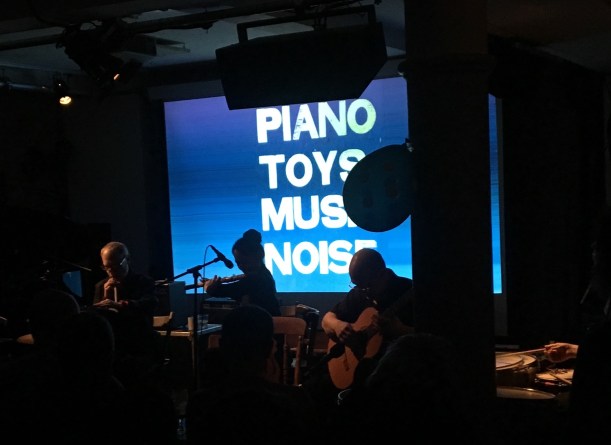
Last night I particularly enjoyed a half-hour set by a quartet of musicians (pictured above) who hadn’t played as a unit before. Douglas Benford played various instruments, including bowls and a miniature harmonium; Hyelim Kim played a taegum, a big-bore bamboo flute from Korea; Martin Vishnik played an acoustic guitar; and Crystabel Riley played a drum kit with no cymbals and two bass-drum pedals. It was the sort of collaboration that gives free improvisation a good name: all four musicians listening hard, giving each other space, alert to signs, not afraid to gives cues of their own. The playing was exquisite, making effective use of the silence, the breathy sounds and the bell tones that this music has absorbed from Far Eastern idioms (most obviously Buddhist rituals), grounded in Riley’s truly extraordinary contribution: an underscore of rumbling and tapping, permanently in movement without seeming restless or overbearing, always alert to shifts in the music’s density and trajectory and ready to orchestrate, with Vishnik’s help, a truly gorgeous ending.

Steve himself played first with the violinist Satoku Fukuda and later with David Toop and Peter Cusack, his old colleagues from Alterations. Tonight and tomorrow the programmes will include a performance of John Cage’s “Indeterminacy”, Steve’s duo with the violinist Mandhira De Saram, and the pianist Pat Thomas playing Ellington. Not a bad birthday party, all told.

* Details of tonight’s and tomorrow’s programmes on the venue’s website: http://www.cafeoto.co.uk/events/