‘A Ritual for John Coltrane’
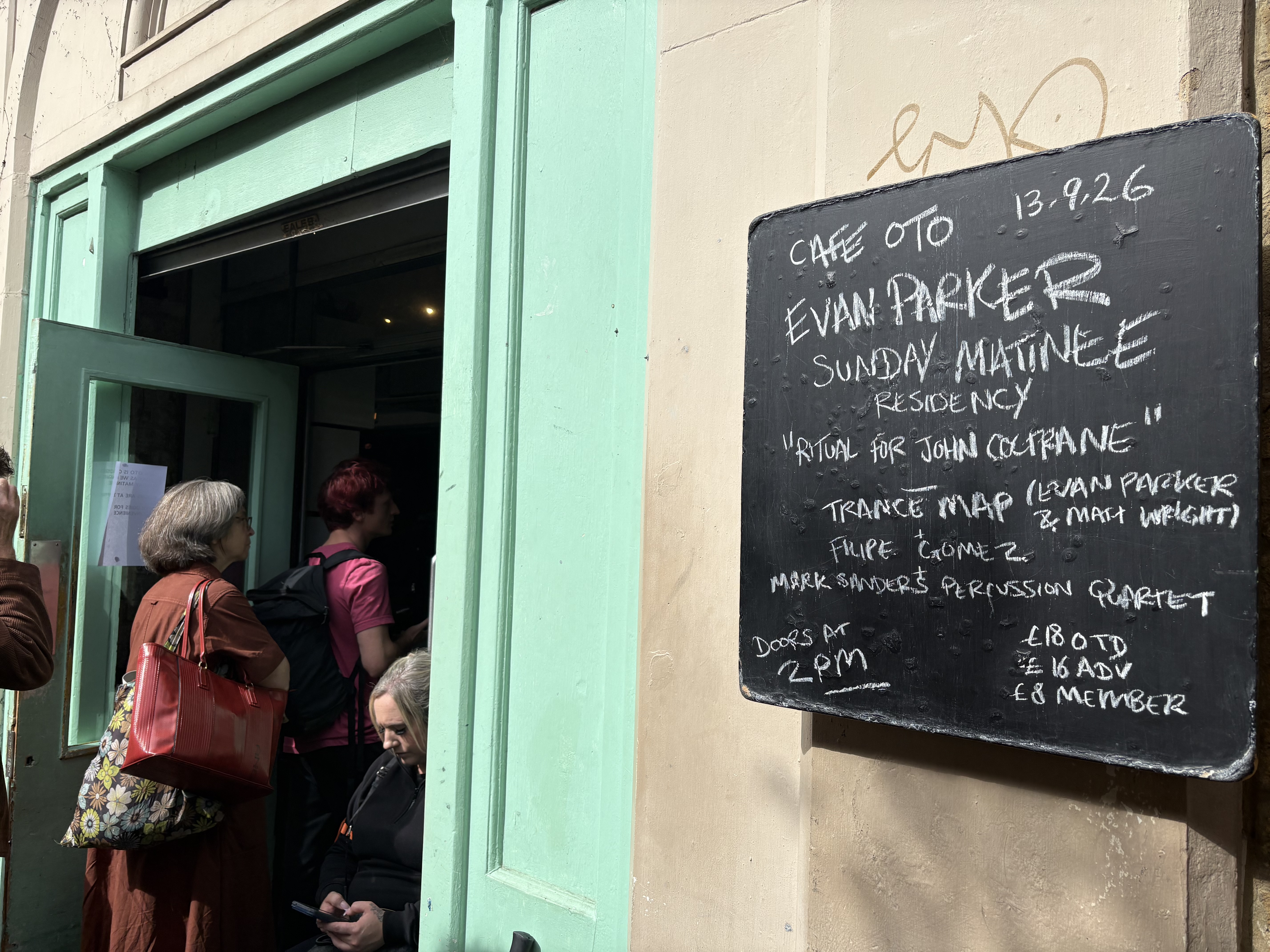
The centenary of John Coltrane’s birth in Hamlet, North Carolina falls later this month; many commemorative events will take place. Yesterday afternoon at Cafe Oto, in the first of four monthly Sunday matinee concerts, Evan Parker led something he titled ‘A Ritual for John Coltrane’, which turned out to be the sort of tribute that summons the spirit of the dedicatee without trying to mimic the substance.
I may have mentioned before that the first time I interviewed Evan, at his home in the early ’70s, I was impressed by a shelf of LPs with orange and black spines: Coltrane’s albums on Impulse, of course, in their original US editions. Over the years I learned more about his love of the great man’s work, and the inspirational effect it had on the development of his own playing.
Yesterday Evan sat at the centre of an expanded performance space, with his soprano saxophone and a suspended gong. He was flanked by Matt Wright, his partner in Trance Map, at a table with a laptop and a turntable, and by Filipe Gomes of Ramsgate’s Arco Barco studio, also with a laptop and other electronic devices. At the four corners of the space were a quartet of percussionists assembled by Mark Sanders, himself standing at an array of larger gongs, cymbals and small upturned bass drums, with Miles Levin, Jim Bashford and Tymek Jozwiak each seated at minimal kits of varying configurations.
After the room had fallen silent, Evan began proceedings by striking the gong. His strokes precipitated a very gradual accretion of sounds from the other players, creating an abstract tapestry of rustles, taps, pings and other noises, with the subtle infiltration of electronic sounds at its base. After many minutes of this, and a fade to a silence in which we heard Coltrane’s voice speaking about his desire for growth as a person, Evan picked up his soprano and began the first of several improvisations against the constantly shifting sound-quilt.
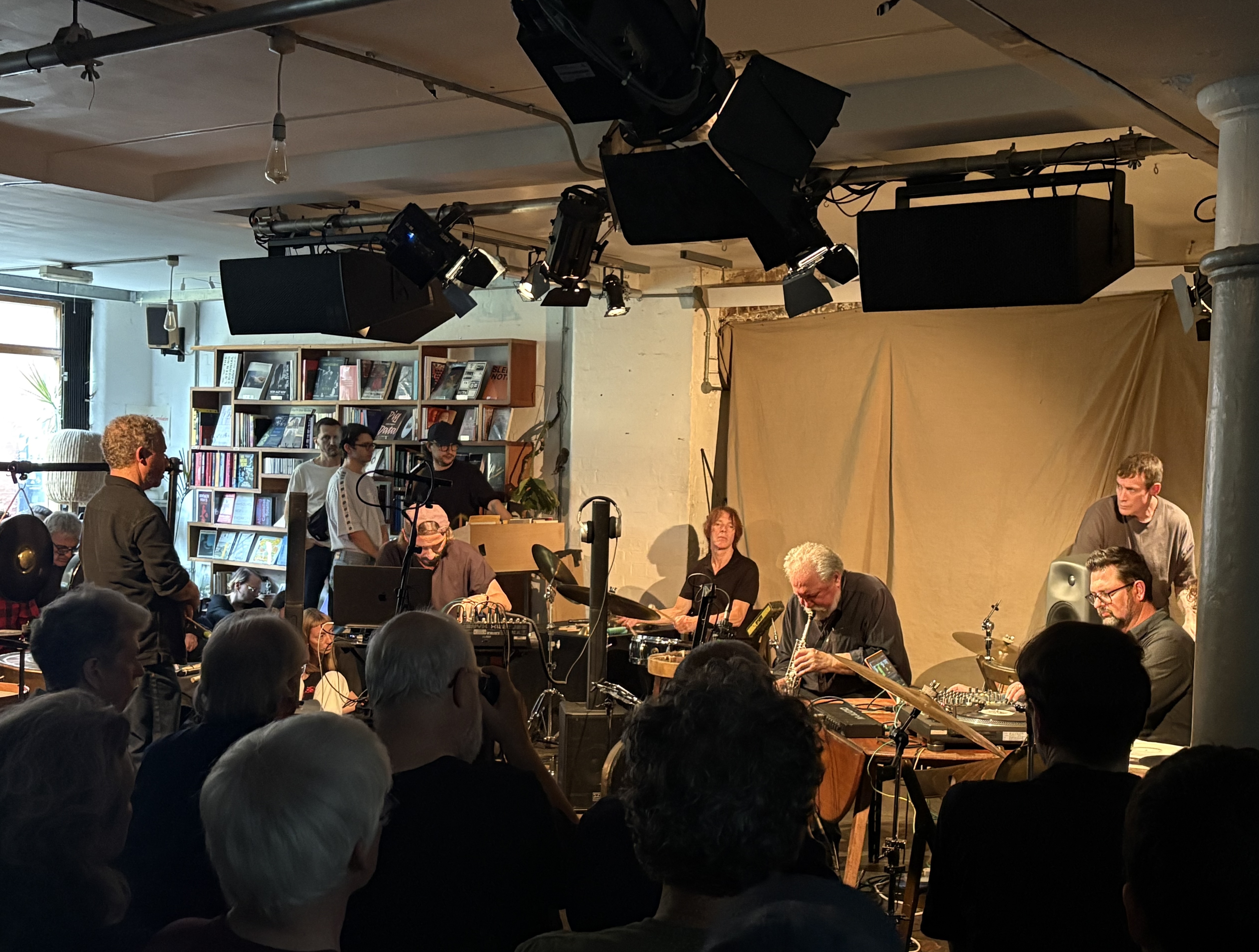
He is 82 now, more than twice as old as Coltrane was when he died in 1967. Yet his playing is still mesmerising in its unquenchable flow of invention, based on all the techniques of blowing and fingering developed over the decades and powered by circular breathing as well as a constantly active imagination. I suppose you could trace it back to Coltrane’s three-minute unaccompanied tenor cadenza on the version of “I Want to Talk About You” released on Live at Birdland in 1964 — staggering at the time, and still inspiring awe.
The use of the soprano saxophone recalled how Coltrane, once he had taken up the instrument, must have heard in it echoes of the double-reed rhiatas of the Sufi musicians of Jajouka and the shenai of South Asia. The tapestry of percussion effects, rising and falling in waves as the intensity surged, abated and then surged again, was a reminder of how, in his later years, Coltrane loved adding drummers to his ensemble — Rashied Ali, J. C. Moses, Algie DeWitt, Jumma Santos, Ray Appleton, Juno Lewis, Umar Ali, Joe Brazil, Babatunde Olatunji — in the attempt to realise the vision of a music that, as he once said, would start in the middle and move outwards in both directions.
As Evan and his colleagues made their way through a magnificent performance that lasted well over an hour before returning to silence, it was impossible not to hear in the saxophone’s flutters and skeins and multiphonics a direct evolution — entirely personal to Parker — of what Coltrane began more than 60 years ago. As I said, the best kind of tribute.
* ‘A Ritual for John Coltrane’ will be performed again this Friday evening, September 18, at Foyle’s Studio in the Midlands Arts Centre, Birmingham.


Sorry I am not sure if the comment I left for this – another great piece Richard – got registered. If so I was recommending an article that I found life-changing, as Coltrane fan since my teens, Kind of Blue and Giant Steps, the Impulse albums. https://oxfordamerican.org/magazine/issue-103-winter-2018/john-coltrane-s-spiritual-high-point John Coltrane’s Spiritual High Point oxfordamerican.org
>
Sounds like a wonderful and awesome (in the original sense of the word) performance!
Great review and good to have that reference to the unaccompanied tenor cadenza on I Want To Talk About You from the Live At Birdland album. I have revisited that album and can see the link to Evan Parker’s solo performances