John Tilbury, home and away
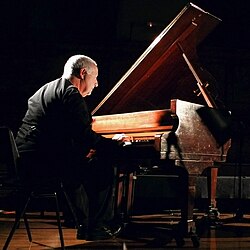
It isn’t often that I get to write about the noise of dust — which, in a form amplified by the Austrian soundartist Klaus Filip, turns out to be a sort of gentle crackling, used to accompany John Tilbury’s piano on a piece included in an elegant new boxed set called At Home. This beautifully designed little coffret features a mixture of recordings made at Tilbury’s house in Deal on the Kent coast and archive pieces dating back to 1970, when the pianist was already well established as a gifted interpreter of the compositions of Morton Feldman and John Cage and a collaborator with such adventurous spirits as Cornelius Cardew and other members of the improvising group AMM.
In the summer of 2022, Tilbury was to have taken part in the final appearance of AMM, held at Cafe Oto as part of the celebrations of the percussionist Eddie Prévost’s 80th birthday. Instead, health considerations led him to announce his retirement from public performance, meaning that his participation in the event was restricted, as I wrote here, to samples of his playing triggered by the guitarist Keith Rowe. That decision prompted Simon Reynell of the Another Timbre label to ask Tilbury if he would be prepared to collaborate on what became the contents of the box, selecting archive pieces and recording new ones. Over the course of 24 pieces and about 300 minutes, it provides a fine summary of what this master of keyboard minimalism has been up to when communing with his piano over the last six decades, with occasional assistance from partners.
Most of the music here is performed solo, but collaborators include the pianists Tania Chen, Sebastian Lexer, and (on Feldman’s Piece for Four Pianos), Philip Thomas, Mark Knoop and Catherine Laws. There are also the electronics of Rowe, on an improvisation recorded in a Leeds church in 2004, and Filip, on the piece from 2019 called “Dust and piano”.
The shortest standalone piece is Erika Fox’s “J.T. Bagatelle”, which fills its 1 minute and 55 seconds with elegant and unhurried figurations, composed earlier this year as a present for Tilbury’s 90th birthday and also commemorating their first encounter on their first day at the Royal College of Music in 1952. The longest, at 41:39, is “Sycamore”, a 2023 piece by John Lely, a former student of Tilbury, in which intervals — mostly minor seconds, it seems to me — are struck and allowed to resonate, sometimes overlapping; it’s like sitting by a pond and tossing in small pebbles two at a time, watching the effect of the ripples as they meet, merge and vanish — deadpan, but mesmerising.
The box’s first disc opens in the 14th century, with a concert recording of four pieces by Guillaume de Machaut arranged for the pianos of Tilbury and Chen by György Kurtág. Also represented are Feldman, Cardew, Howard Skempton, Christian Wolff, Christopher Hobbs, Michael Parons, Catherine Kontz and others. Several pieces are for the clavichord, which Tilbury acquired in 2015 and whose sound gives the music a slightly rickety ancient-to-the-future appeal.
There are also a couple of pieces in which Tilbury intones texts by Samuel Beckett. “What Is the Word”, Beckett’s final poem, written in 1988, was recorded to very dramatic effect with the organ in the chapel of King’s College, Cambridge, during a concert in 2015. The fathomless pessimism of the second, “Pour rien”, is very affectingly delivered agsinst a plain setting for clavichord by Mark R. Taylor. There is also “For Samuel Beckett”, a 28-minute improvisation for the pianos of Tilbury and Lexer, recorded during a London Musicians Co-op festival in 2005.
At the moment my favourite pieces from the set are Cardew’s “Volo Solo”, written in 1965, recorded around five years later in unknown circumstances, full of abrupt angles and quick contrasts, bristling with the excitement of the new, and Mark R. Taylor’s “Five Nocturnes” (2014-16), which are at the opposite end of the emotional scale in their deliberate but never heavy-handed lyricism. In all these we hear the wonderful touch and timing of a man who, amid what he calls “the new dark ages”, has described himself as “a small island of archaic conservation”. This is much more than that.
* John Tilbury’s At Home: Domestic and Archive Recordings is on the Anothet Timbre label: http://www.anothertimbre.com


Thank you! A jewel…
I donât know a great deal about John Tilbury but your piece reminded me of a concert I went to at Bishopsgate in 2012 featuring the pianist and Wadada Leo Smith. Hereâs an excerpt from the concert:
https://www.youtube.com/watch?v=bx7bDoY5Umg
[maxresdefault.jpg]
19 likes, 1 comment. “Ishmael Wadada Leo Smith & John Tilbury – Duo…
[https://www.youtube.com/favicon.ico]https://www.youtube.com/watch?v=bx7bDoY5Umg
improvDOThuhttps://www.youtube.com/watch?v=bx7bDoY5Umg
youtube.comhttps://www.youtube.com/watch?v=bx7bDoY5Umg
Best regards
Graham Roberts