Skip to content

Posts tagged ‘John Hiatt’

John Hiatt says goodbye (maybe)
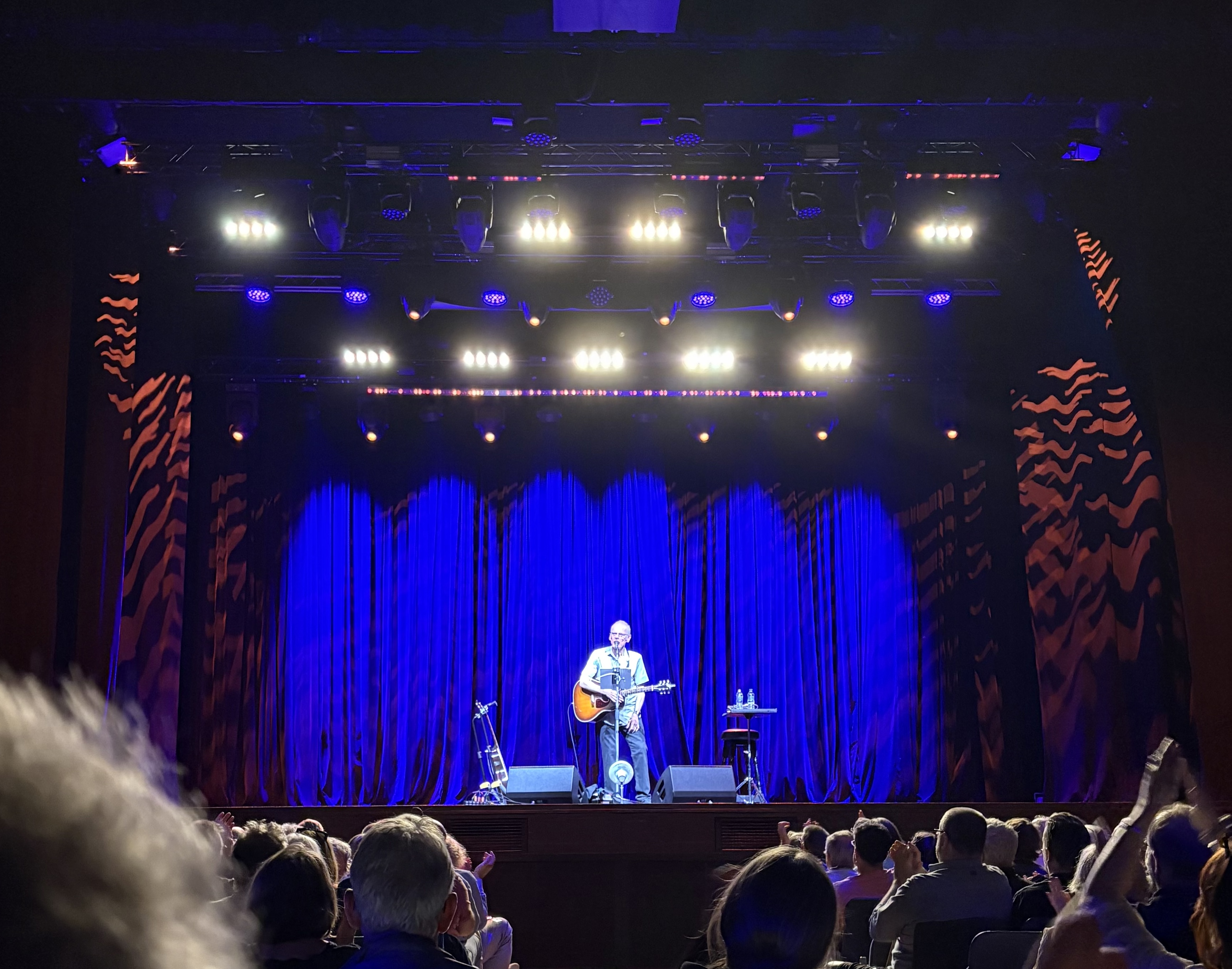
Last night’s gig at the O2’s Indigo was prominently billed, John Hiatt pointed out, as being part of his Farewell Tour. “If I come back next year,” he said, “what are we going to call it?” Or words to that effect.

I’m inclined to think that whoever thought up the title might have been correct. At 73, quite frankly, Hiatt doesn’t have much of a voice left. The straining to hit the higher notes wasn’t helped, early in the set, when his tuning gizmo misled him into tweaking his whole guitar a semitone high. It wasn’t until a dozen of the 20 songs had gone by that his use of a harmonica revealed the error. Somebody came up with a replacement gizmo, the tuning was corrected, and the last run of songs sounded more comfortable.

So perhaps he will be back, encouraged by the warmth of the response from those who had made the journey to the ghastly O2’s more intimate performance space and who feel an enormous fondness towards a man who may never have achieved the solo stardom many forecast as he went from label to label during his early years but who, despite all the many successful covers his songs have racked up, remains the best interpreter of songs that tend to stay in the heart.

Here we had a selection of compositions dating from 1987 to 2010, plus a brand-new one, the sentimental ballad “Weightless in My Arms”. His choice included the title tracks of the albums Slow Turning, Perfectly Good Guitar, Riding with the King, Crossing Muddy Waters, Master of Disaster and The Open Road. There were the big earners: “Thing Called Love”, “Have a Little Faith in Me” and “Tennessee Plates”, which Ridley Scott used in the soundtrack to Thelma & Louise. There were beauties like “Miles to Go”, “Real Fine Love”, “Long Time Comin'”, “Thunderbird”, “The River Knows Your Name”, “Lift Up Every Stone”, “Adios to California” and “Feels Like Rain”. There was a special welcome for “Memphis in the Meantime”, from Bring the Family, the 1987 album which, with accompaniment by Ry Cooder, Nick Lowe and Jim Keltner, really established his reputation.

I was particularly grateful for “Across the Borderline”, the song he wrote in 1982 with Cooder and Jim Dickinson for Tony Richardson’s film The Border. I remember him singing it at Hammersmith Odeon with Cooder, Lowe and Keltner in 1992, when they were known as Little Village, and the effect it had. It was covered in concert by Dylan and Springsteen, and I wrote a long piece about it at the time, which gave birth in the Independent on Sunday (thanks to Tim de Lisle, then the paper’s arts editor) to a much-imitated series called Lives of the Great Songs. It’s a song to rank with Woody Guthrie’s “Deportee (Plane Wreck at Los Gatos)” for its poignancy and enduring relevance.

Had this been a request show, what would I have asked for that Hiatt didn’t select from his reportoire of songs about cars, rivers and the mysteries of human heart? Oh, “Icy Blue Heart”, “Lipstick Sunset”, “Unoriginal Sin”. “The Way We Make a Broken Heart”. And “All the Lilacs in Ohio”, from his last album, Leftover Feelings, with the great Jerry Douglas.

If you were there last night without knowing anything about him, which seems unlikely, you might have been made uncomfortable by the frailty of the singing and the lengthy tuning difficulties. (But you might have enjoyed his joke about adopting Guy Clark’s approach to tuning, which involves selecting the one string that’s definitely out and tuning the rest to that.) Mostly I think, we were just grateful to see him, to hear those wonderful songs from the man who wrote them, and to say hello. Or goodbye. Or whatever it was.

Riding with John Hiatt

In his heyday, John Hiatt wrote songs about cars and girls with a fine wit and a firm grasp of rock and roll essentials. On the eve of the Grammy awards last Saturday night, the Americana Music Association organised a celebration of his career at the Troubadour in West Hollywood. I read about it in Bob Lefsetz’s newsletter, and wished very much that I’d been there.

The evening began with various luminaries performing a selection of Hiatt’s songs: Lyle Lovett (“Train to Birmingham”), Michael McDonald (“Have a Little Faith in Me”), Joe Bonamassa (“Perfectly Good Guitar”), Tom Morello (“The River Knows Your Name”), Cedric Burnside (“Icy Blue Heart”), Joe Henry (“The Way We Make a Broken Heart”), Hiatt’s daughter Lilly singing “You Must Go”, and various members of Little Feat — Bill Payne, Fred Tackett and Kenny Gradney — doing “Slow Turning”. Los Lobos presented one of their own songs, “Down by the Riverbed”, to the recording of which Hiatt had contributed vocals. Maggie Rose sang “Riding with the King”, one of the best of the many songs inspired by Elvis Presley.

Then Hiatt himself took the stage, singing “Memphis in the Meantime”, “Across the Borderline”, and — with Brandy Clark — “Thing Called Love”, the song that gave Bonnie Raitt a top 10 hit in 1989. I’m guessing that its inclusion on her five-million-selling Nick of Time probably earned its composer more than the rest of his copyrights put together.

When I first saw Hiatt, it was at the Apollo Victoria in 1980. He was a member of Ry Cooder’s Radio Silents, stepping into the spotlight to give a memorable rendering of O. V. Wright’s R&B drama “Eight Men and Four Women”. The next time was in 1992 with Little Village — a short-lived supergroup comprising Hiatt, Cooder, Nick Lowe and Jim Keltner — at Hammersmith Odeon, where their repertoire included “Don’t Think About Her When You’re Trying to Drive”, Hiatt and Cooder’s great heartbreak ballad.

In between times, he’d made a bunch of solo albums, of which the best received was 1987’s Bring the Family, which established the template for Little Village and included memorable songs: “Memphis in the Meantime”, “Have a Little Faith in Me” and “Lipstick Sunset”. It was the first of his four albums for A&M, and the second of them, Slow Turning, released in 1988, remains for me one of the very finest albums of that decade. Maybe it’s even one of the last great albums of classic guitar-led rock and roll with roots firmly planted in Chuck Berry and Hank Williams.

The album’s solid backing band includes the slide guitarist Sonny Landreth, and there isn’t a weak song among the dozen tracks. In the fast-moving “Tennessee Plates”, Hiatt joyfully channels Berry’s gift for storytelling and wry humour, while “Drive South” is the sort of song that makes you want to put the top down and step on the gas. “Trudy and Dave” is a great little story about a couple, their baby, a pistol and a laundromat. In “Georgia Rae”, he even gets away with serenading his infant daughter.

Best of all, “Icy Blue Heart” is a beautiful ballad with one of the great barroom lyrics: “She came on to him like a slow-movin’ cold front / His beer was warmer than the look in her eyes / She sat on a stool / He said, ‘What do you want?’ / She said, ‘Give me a love that don’t freeze up inside.'” But the singer knows all too well what will happen next, when he turns a heart “that’s been frozen for years / into a river of tears.” The metaphor is sustained through every line.

Hiatt has released 15 solo albums since Slow Turning. Some of them include fine songs, like “Perfectly Good Guitar” “Terms of My Surrender”, and “The Most Unoriginal Sin” (which opens thus: “What there was left of us / Was covered in dust and thick skin / A half-eaten apple / The whole Sistine Chapel / Painted on the head of a pin”), and fine musicians, including Doug Lancio, currently playing guitar in Bob Dylan’s touring band, and the brothers Luther and Cody Dickinson of the North Mississippi Allstars. On the most recent, Leftover Feelings, released in 2021, he shares the spotlight with the dobro genius Jerry Douglas.

His albums are always worth hearing, because he’s a fine craftsman steeped in the blues, country music and bluegrass. But Slow Turning is a pinnacle, one that never gets old.

* The photo of John Hiatt, taken by Jack Spencer, is from the cover of his album The Open Road, released on the New West label in 2010. There’s a nice piece on Hiatt by my old colleague Neil Morton here: https://www.herecomesthesong.com/post/2017/08/22/john-hiatt-the-goners-the-most-unoriginal-sin