The Miles Davis Prom
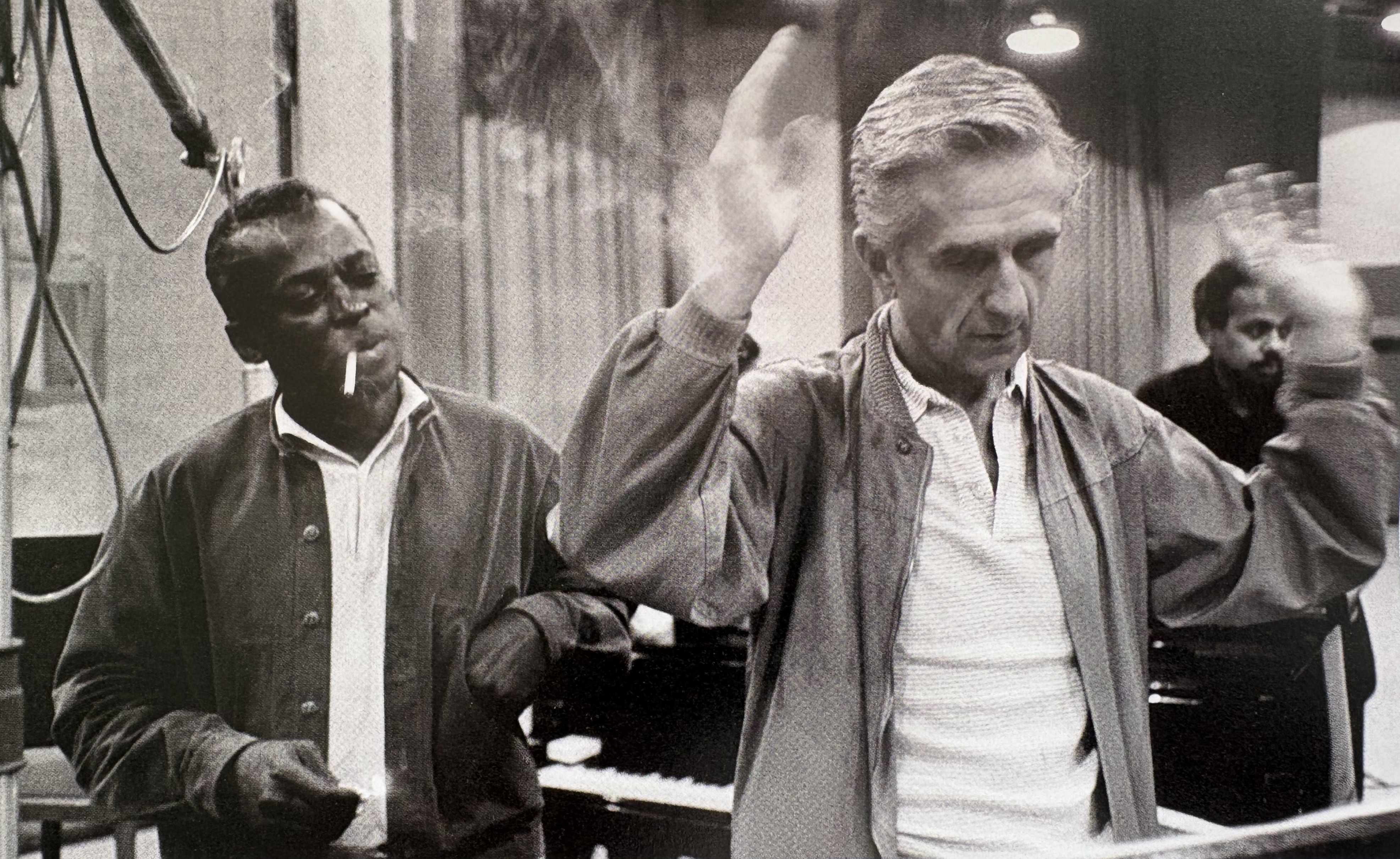
After a somewhat lacklustre first half and a similarly underwhelming resumption, last night’s Prom concert commemorating the centenary of the birth of Miles Davis finally took wing in a sold-out Royal Albert Hall with a sultry version of “Once Upon a Summertime”, Michel Legrand’s melody delivered with understated elegance by the great trumpeter Ambrose Akinmusire in front of the BBC Concert Orchestra, conducted by Miho Hazama.
Miles recorded the tune with Gil Evans in 1962 for Quiet Nights, which turned out to be his most disappointing album. He’d come across it through the singer and pianist Blossom Dearie, who in turn had found it during a stay in Paris in 1954. She was introduced to it through the sponsor of her trip, the record executive Eddie Barclay, who had co-written the original words with the lyricist Eddy Marnay. It was known as “La Valse des Lilas”. Back in the US, Johnny Mercer wrote an English lyric for her to sing. Whenever her friend Miles showed up to hear her in a night club, he’d tell her, “Play me my song.” Now, in a different century, it had a new role to play.
The idea of the Prom was that Hazama, a skilful and experienced conductor, composer and arranger, would take the work Davis and Evans accomplished together between the late ’40s and early ’60s and refashion it into something befitting the larger resources of the Concert Orchestra and Akinmusire’s quartet: a sort of concerto grosso setting.
Was that ever a good idea? It did, after all, answer a need. Only once — at Carnegie Hall in 1961 — did Davis and Evans get to perform a few of the charts, meaning that whenever the original arrangements are performed, they tend to be received with gratitude and reverence by those with a special love for Miles Ahead, Porgy & Bess and Sketches of Spain. I have a fond memory of a performance of the entire Porgy suite by the Royal Academy of Music alumni under Nick Smart at St John’s, Smith Square in 2019, and of a socially distanced recreation of the Concierto de Aranjuez by Ryan Truesdell’s Gil Evans Project in New York in 2020. On the evening before last night’s Prom, in a similar homage 6,000 miles away, Evans’s original scores were performed at the Hollywood Bowl by a band including Herbie Hancock and Ron Carter, two of Davis’s greatest alumni.
But to try and expand Evans’s carefully conceived and refined work, which made such revolutionary use of instrumental combinations and contrasts, might seem at best foolhardy. The addition of a full string section, in particular, carried significant risk, as it always does in jazz. Hazama had her work cut out.
The first half began with pieces from the Gershwin opera: “Bess, You Is My Woman Now”, “Summertime” and “I Loves You, Porgy”, plus Evans’s own “Gone”, While the new orchestrations were sometimes ingenious, the additions were often superfluous, occasionally verging on a bombast that would have been anathema to Evans. Moving on to other material, they meant that Hazema’s variations on “Boplicity” sacrificed much of the 1948 original’s cool agility and gained nothing from a quote from the James Bond theme. Her arrangement of “Blue in Green”, from Kind of Blue, was mostly notable for the space it created for a fine solo by the pianist Taylor Eigsti.
The late critic Max Harrison famously described Evans’s unique approach to existing material not as arrangement but as “recomposition”. As the first half ended with a medley of pieces from Manuel de Falla’s El Amor Brujo, from which Evans extracted “Will o’ the Wisp” for Sketches of Spain, it began to feel that recomposing a recomposition might not be such a great idea, even though Hazema slipped a few measures of the “Milestones” theme into the closing up-tempo section. There were moments when, as my companion said, it felt “a bit lounge”, and I could only agree.
That uneasy feeling re-ermerged after the interval, when the re-recomposition of Kurt Weil’s “My Ship” included one passage that sounded like a Disney soundtrack, albeit followed by a full-strength collective workout for Akinmusire’s stellar quartet, with the oustanding Eigsti (a late replacement for Sam Harris) on piano, Harish Raghavan on bass and Kendrick Scott on drums, temporarily freed from orchestral encumbrance — which, on an arrangement of the next tune, “Miles Ahead”, included a weird passage for Hollywood strings.
At that point I was wishing that the arranger’s job had been handed to Michael Gibbs or Maria Schneider. But then came a thoroughly decent “Once Upon a Summertime”, which settled things down. That seemed to encourage the quartet to take off on their own with an Akinmusire composition called “Henya”, recast from its original recording on the album Owl Song as a spellbinding ballad in slow 3/2 time, its constantly cycling harmonic contour and sense of infinite space drawing the best solos of the night, as well as magnificent distant rolling thunder from Scott.
On, then, to the great set-piece, Evans’s historic 17-minute recasting of the Adagio from Joaquin Rodrigo’s guitar concerto. And here, in the Concierto de Aranjuez. Hazema made better sense of the possibilities of the expanded instrumentation, creating a section in which Akinmusire improvised beautifully through and around sombre and carefully placed stop-time figures, and using the strings to give extra drive to the fantastic crescendo with which piece reaches its climax. No complaints there, and none for the vociferously demanded encore, Ahmad Jamal’s “New Rhumba”, in which Hazema faithfully reproduced the trombone section’s stabs — Evans’s subtle imitation of Red Garland’s comping in Miles’s first great quintet –behind Eigsti’s spirited solo.
In an interview in the concert programme, Akinmusire spoke of the challenge of playing Davis’s role. “I love this music so much that I’ll be thinking, what if Miles was sitting in a seat in the Royal Albert Hall? What would he expect, and what would make him walk away with a smile? I don’t think he’d want me to play like him.” The easy response is that Miles, the enemy of sentimental recreation, wouldn’t have been there at all. But Akinmusire, the most gifted jazz trumpeter of his generation, met the demand with skill and humility. His virtuosity allowed him to make allusions to the rounder tone of the flugelhorn Davis used on some of the recordings with Evans, and to find the sobbing tone that Kenneth Tynan, in his 1961 profile of Miles, quoted his young daughter describing as “like a little boy who’s locked out and wants to get in.”
It was hard to tell whether he was entirely comfortable in the role. There were a few fluffs, and not always did his own sense of space seem to match that of the arrangements. A long sequence of squeezed high notes in the de Falla piece, for instance, didn’t mean much. But as the evening went on, he was able to infiltrate more of himself into the necessary task of interpretation, occasionally doing what he often does in more natural circumstances, unloosing figurations that emerge from somewhere below the horn’s known lowest notes and spiral up via fantastical shapes to end in the uppermost register. And sometimes he found the pathos to match the careful diminuendos with which Hazema closed a few of the pieces.
Those were moments of genuine grace. In the end, despite doubts about how Davis himself would have viewed the project, and although it’s hard to accept that a satisfactory homage to Gil Evans would ever involve rewriting him, there were enough of those to carry away and remember with pleasure.
* The concert is on BBC4 tonight at 8pm. The audio will be available for the next 52 days on BBC Sounds: https://www.bbc.co.uk/sounds/play/m003029j The photograph of Miles Davis and Gil Evans was taken by Don Hunstein.


