Skip to content

Posts from the ‘Uncategorized’ Category

Summer books 1: Henry Threadgill

As a primer on how to grow up amid communities of creative musicians while asserting and developing your own individuality, Henry Threadgill’s Easily Slip into Another World is exemplary. It also happens to belong, in my view, in the very highest rank of autobiographies by jazz musicians.

One of the great contemporary composers and bandleaders, Threadgill grew up amid the blues, the jazz and the black church music of Chicago in the 1950s, but with an ear open to European classical music. He’s old enough to remember the impact of the lynching of Emmett Till in 1955. Hearing the recordings of Charlie Parker made him want to play the saxophone.

He may be the only Chicago musician of his era to benefit from not having studied under Captain Walter Dyett, the venerated director of music at DuSable High School on the city’s South Side. Threadgill was enrolled at Englewood High, where he played in the school’s concert band but was constantly in trouble. Knowing that Dyett had taught so many of the people he really admired, such as Gene Ammons, Johnny Griffin and Wilbur Ware, he applied for a transfer. Dyett looked at his disciplinary record and turned him down flat. When Englewood let him back in, he resolved to change his ways. I suppose the clearest proof of his success came in 2016, when he became the third jazz musician (after Wynton Marsalis in 1997 and Ornette Coleman in 2005) to receive the Pulitzer Prize for Music, for his composition In for a Penny, In for a Pound.

“Being rejected is the best thing that can happen to you, if you know how to think laterally,” he observes. “I ended up getting a much broader and deeper education.” The scope and volume of his work over the years is astonishing. Many musicians would have made an entire career merely out of the projects he undertook with dancers. Others would have invented the hubkaphone, as he did in 1970 after seeing a display of shiny chrome car hubcaps laid out on a stall in the famous Maxwell Street market, and settled for renown as the creator of the American version of the gamelan orchestra.

He could have pursued a life as an R&B musician, after touring with the Dells and the Chi-Lites in the ’70s, or in Latin music after working with the trumpeter Mario Bauzá in New York. He could even have stayed safely within the circle of Chicago’s AACM. Instead he formed one band after another, following the instinct to push things further. The trio Air, with the bassist Fred Hopkins and the drummer Steve McCall, was followed by many, many others, usually with unorthodox line-ups (e.g. four reeds and four double basses) and sometimes with strange names, such as X-75, Very Very Circus, Zooid and the 14 or 15 Kestra. (Oddly, his latest album, titled The Other One, is by something called the Henry Threadgill Ensemble.)

With the aid of the writer and academic Brent Hayes Edwards, Threadgill tells his story at a relaxed pace and with a depth of detail that is always compelling and never tiresome. The Vietnam section is a serious addition to the literature on that terrible war, from an unusual perspective: about drafted in 1966, thinking he’d done a smart thing by volunteering as a musician, a year later he was the Central; Highlands with his clarinet in one hand and a rifle in the other, encountering the Montagnards and experiencing the African American version of the horror and squalor familiar to some extent from Michael Herr’s Dispatches but here described with even greater clarity and revulsion. “I didn’t shed my war experiences when I got off that plane from Vietnam… Vietnam stayed with me, and it took me to some dark and twisted places even once I returned to Chicago.” But he had survived, and eventually the trauma receded.

Back in the world, his surreal encounter with Duke Ellington in 1971 — with the suggestion that he might have been momentarily lined up as the next Billy Strayhorn — is a Murakami short story in itself. His description of a gig with Cecil Taylor is both hilarious and enlightening: “I was completely befuddled. I was standing there wondering why what we were playing didn’t sound like the piece I remembered rehearsing.” Eventually he discovers, on the stand at Fat Tuesday’s, that “to play Cecil’s music, you had to get to a place where you could let the pieces reconfigure themselves as you went along. It was disconcerting in the moment, but the experience with Cecil impacted the way I came to think about my own bands. It’s important to keep your people a little bit off balance.”

The four pages on his grandfather, Luther Pierce, who often took him to the Maxwell Street market, explain something about Threadgill. Pierce worked in a steel mill but was also the family’s self-taught, trial-and-error electrician, cobbler, plumber, tailor, barber, carpenter, bedbug exterminator and medicine man. “He was resourceful — or reckless — to a degree I have never encountered in any other human being,” his grandson writes. “The most amazing thing about it was his nerve. I think he would have been capable of performing open-heart surgery on one of us had he considered it necessary. Whatever it took, he was ready to do it: nothing was out of bounds. And I suspect that a little of his spirit of radical experimentation rubbed off on me.”

His theory of intervallic harmony was developed for Zooid in the mid-’90s during a stay in Goa, reading about “maths and physics and astronomy and warfare, studying philosophical treatises, reading books about various musical systems.” It resembles George Russell’s Lydian chromatic concept or Ornette Coleman’s harmolodic theory in that it clearly takes a lot of preparation for his musicians to become conversant with the new language, and — although there are several pages of explanation — it’s impervious to casual comprehension. But you’ll probably know it when you hear it.

Simultaneously, while reading Ulysses, he came up with the idea of a 1/4 metre: “James Brown used to talk about getting back to the one. He’d cajole his band, talking about it, calling for it, demanding it — stretching things out to build anticipation. That’s funk in a nutshell: that tantalising expectation of the downbeat. Here it is — and here it is again. With Zooid, the question is almost the opposite: what if you never get off the one? Everything is always the one.”

I’ve quoted at length from the book simply in order to give an idea of the richness contained within its 385 pages. Let’s finish with a piece of typical Threadgill wisdom, fashioned by the tools of thought and experience: “If you look at a book on the history of Western classical music, there’s centuries of background you can read about. Black music in America is relatively young. It’s still just the beginning. And it’s too soon to get upset and start making grand declarations about what you like and don’t like in terms of the directions the music is taking. You don’t have to like it all. What you have to recognise is that it’s not the end of the line. In another hundred years, assuming we’re still here, imagine how much more artistic information will have accumulated from Black music. And it’s not going to be the twelve-bar blues from now until the end of time.”

* Easily Slip into Another World: A Life by Music by Henry Threadgill and Brent Hayes Edwards is published by Alfred A. Knopf. The Other One by the Henry Threadgill Ensemble is out now on the Pi label.

RIP Sinéad O’Connor

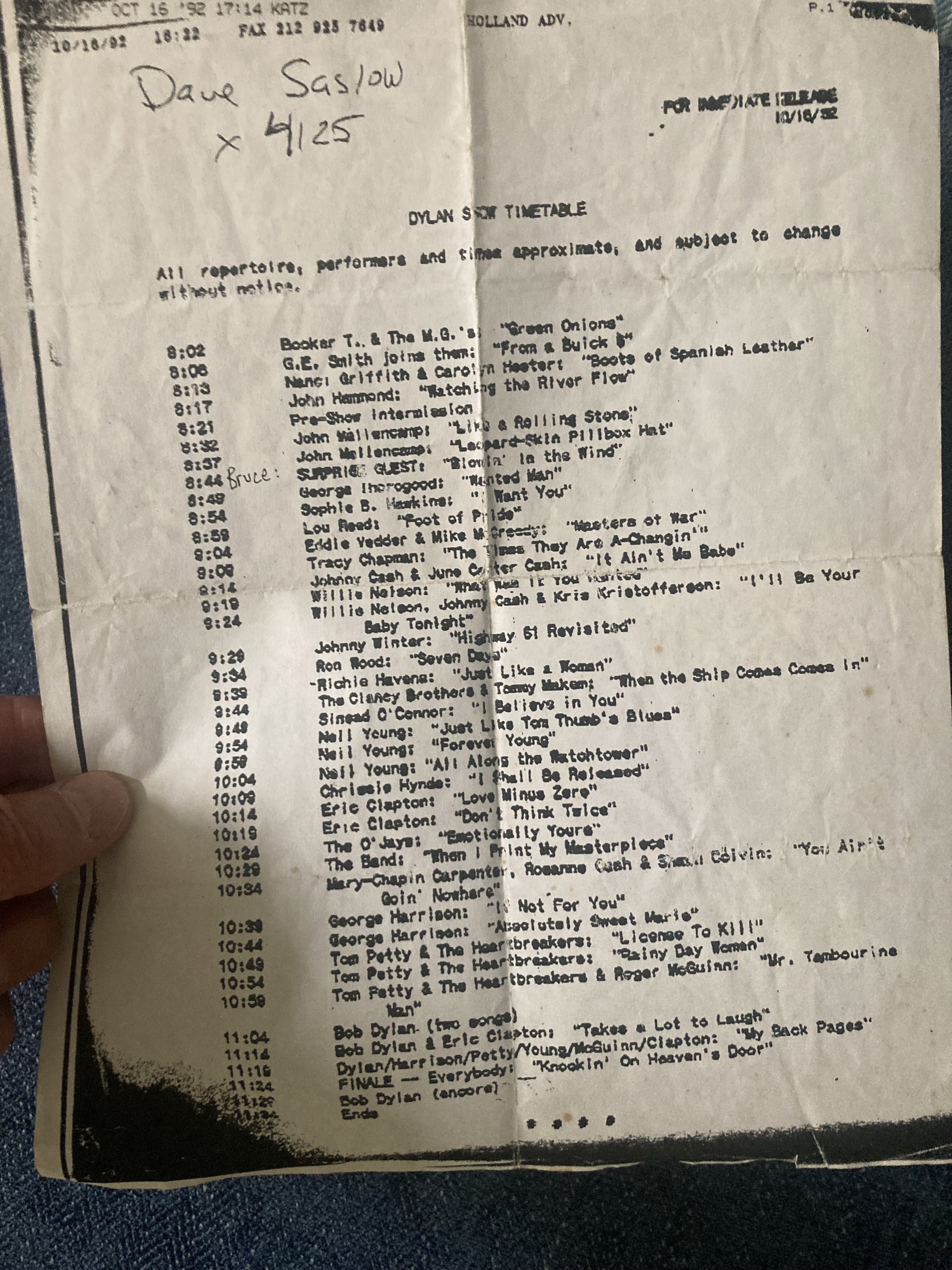
Document handed out to journalists covering the Bob Dylan 30th anniversary concert at Madison Square Garden, New York City, on 16 October 1992.

Adieu, Jane B.

The obituaries of Jane Birkin in this morning’s British newspapers mentioned all the obvious stuff — the BBC ban, the handbags — while neglecting to record two salient features of her career in the public eye. One was her extensive campaigning on behalf of many important causes (including the rights of immigrants and refugees, AIDS, abortion rights and climate change). The other was her music.

She became a singer through her association with Serge Gainsbourg, who gave her many good songs to sing, filled with his love of daft, clever puns and adroit double entendre. She remained faithful to them long after she and Gainsbourg had ceased to be a couple, and five years after his death in 1991 she made an album called Versions Jane, the title indicating its theme: a desire to find her own approaches to his songs.

Since her light, funny, deceptively fragile English-girl-in-Paris voice never changes, the settings are always the key, and for the album’s 15 songs she chose 15 different approaches. It opens with “Ces petits riens”, beautifully sung against animated pizzicato strings arranged by Jean-Claude Vannier. The joviality of “La gadoue” is animated by the sparky ska of Les Negresses Vertes, an accordion playing the role of rhythm guitar, with a cheeky interpolation of the melody from “Je t’aime — moi non plus”. The concert harp of Catherine Michel is the only accompaniment to the haunting “Dépression au-dessus du jardin”. The trio of the veterans Joachim Kühn (piano), Jean-François Jenny Clark (bass) and Daniel Humair (drums) give “Ce mortel ennui” a suave swing reminiscent of a Left Bank jazz club — Le Chat qui pêche, say — in the 1950s.

And on it goes. A full orchestra, arranged by Philippe Delettrez, billows beneath the mad verbal gymnastics of “Exercice en forme de Z”, with its buzzing bestiary of “chimpanzés, gazelles, lézards, zébus buses et grizzli d’Asie.” A slinky electro backing by Bruno Maman and the drummer Patrick Goraguer (son of Gainsbourg’s old musical director) adds a glide to “L’anamour”. The heavy rock of Daren et les Chaises detonates the demureness of “Elisa”. The Hammond organ of Eddy Louiss, once a member of Stan Getz’s European band, chugs beneath “Elaeudanla Téïtéïa”. Swelling strings and a rock rhythm section make a disquieting Euro-pop aria of “Aux enfants de la chance”, Gainsbourg’s warning against angel dust, magic mushrooms, freebasing and dragon-chasing. “Ford Mustang”, the story of a fashionable couple who die (or that’s how I interpret it) while kissing at the wheel of their big American car and crashing into those sturdy plane trees that used to line French routes departmentales, is recited against Boom Bass’s mosaic of samples: free jazz saxophones, random voices, piano, stabs of strings.

Birkin’s travels in pursuit of her various campaigns are recalled by “Couleur Café”, recorded in Dakar, featuring the drumming of the Senegalese griot Doudou N’Diaye Rose, and “Comment te dire adieu”, in which the contribution of the Orkestar Salijević, recorded in a Serbian village, results in a wonky brass band version that Tom Waits would enjoy.

Of the whole collection, the one that has always stuck with me most vividly is “Sorry Angel”. A lover’s ambiguous farewell, its words are half sung, half whispered against the layered guitars of Sonny Landreth, the noted bottleneck exponent in whose Louisiana studio the track was recorded. Floating in a gentle haze between boulevard and bayou, it’s a four-minute movie — and a highlight of the album that perhaps conveys best of any she made the range of her own creative thought.

I knew her a bit around this time and came to understand something of the extent to which she was admired and loved in her adopted country. One evening in Paris I got back to my modest hotel to find the woman at the desk beaming with unusual warmth as she gave me a piece of paper along with my room key. Mme Birkin had dropped by from her house around the corner a little while earlier and left a note about meeting the following day. As the receptionist handed it over, she practically curtsied.

Paul Simon in the waiting room

It’ll be interesting to see how much Paul Simon’s Seven Psalms means to anyone below a certain age, by which I mean the time when the buffers marking the end of the line start to become dimly visible. Simon, now 81, has clearly been reflecting on his own mortality and this new 33-minute strand of seven songs, edited together without breaks, offers his provisional conclusions.

Simon has no privileged knowledge to impart. No one does. Of all the countless billions of people born since homo sapiens emerged in Africa 300,000 years ago, not one has had a credible answer to the question: what happens after we die? Faith-based answers must be respected, but are just that: based on faith, not fact. Otherwise all we can do, all of us, is wait and wonder.

So for someone of my generation it’s interesting to see certain artists we grew up alongside choosing to address the matter, feeling they’re on the brink of finding out for themselves. When David Bowie and Leonard Cohen gave us Black Star and You Want It Darker, they appeared to know that these would be their last words, shared with the public just before they stepped out of this life.

Seven Psalms is Simon’s meditation on what he calls “the great migration”, and of course he can’t avoid the spiritual dimension. The opening sound is that of Harry Partch’s cloud-chamber bowls, a microtone apart, setting up a mood of both meditation and uncertainty before Simon’s distinctive acoustic guitar begins the first song, “The Lord”. It’s an incantation: “The Lord is my engineer / The Lord is the earth I ride on… The Lord is a meal for the poorest / A welcome door to the stranger… The Covid virus is the Lord / The Lord is the ocean rising / The Lord is a terrible swift sword… The Lord is my personal joke / My reflection in the window…”

The song reappears, in briefer form, between the third and fourth and the sixth and seventh songs, as the expression of a man who has no more idea than you or me of what the Lord might be, or if there is one at all, but feels the need to explore the subject and his own vacillation between scepticism and the urge to believe in a higher power, particularly as time gets more pressing.

In the gentle “Love Is Like a Braid”, the shadows of a judgment to come are creeping across the sunlit lawns of childhood innocence: “I lived a life of pleasant sorrows / Until the real deal came / Broke me like a twig in a winter gale / Called me by my name.” Country-blues fingerpicking and the quacking of a bass harmonica carry “My Professional Opinion”, his sardonic take on a world of divided opinions and no common ground: “I heard two cows in a conversation / One called the other one a name / In my professional opinion / All cows in the country must bear the blame.”

“Your Forgiveness” is a lovely song about wonder and doubt, its quasi-medieval tone enhanced by the use of the chalumeau, a precursor of the clarinet, and the theorbo, a 14-string lute used in Baroque music, plus viola and cello. “Trail of Volcanoes” refers briefly to the arc of his own career before coming to a bleak conclusion: “The pity is / The damage that’s done / Leaves so little time / For amends.”

“The Sacred Harp”, some of it sung in duet with his wife, Edie Brickell, is a fable about picking up a pair of hitch-hikers who seem to be on a different journey altogether. The closing “Wait” begins with a thought we might all share one day: “Wait / I’m not ready / I’m just packing my gear / Wait / My hand’s steady / My mind is still clear.”

I have no idea on how near Simon is to the “dreamless transition” in which he wants to believe. But here he shows, as he always has, that he can treat the weightiest of subjects with the lightest and deftest of touches.

* Paul Simon’s Seven Psalms is out now on Owl Records. Here is the official trailer. The photograph is an early publicity shot, taken by Murray Neitlich (thanks to Patrick Hineley for the attribution — see comments).

Songs of the Balkans

Its appeal somewhere between those of Le Mystère des Voix Bulgares, a leftfield favourite in the 1980s, and the collaboration between the saxophonist Jan Garbarek and the singers of the Hilliard Ensemble in the 1990s, Medna Roso is an album taken from a concert in a Cologne church in 2021 by PJEV, a quintet of female singers specialising in the traditional songs of Serbia, Kosovo, Croatia and Bosnia, with the alto saxophonist Hayden Chisholm and the organist Kit Downes.

Chisholm left his native New Zealand in the ’90s to explore the world of music: jazz at a conservatory in Cologne, Carnatic music in Chennai, and the music of the Balkans. I heard him at a festival in Berlin a few years ago, where I admired the distinctive personality of his playing, later enjoyed on a fine album called Breve which he made with the late pianist John Taylor and the bassist Matt Penman, released in 2015 on the Pirouet label.

Downes, of course, is the gifted English pianist known for his work with Empirical, ENEMY, Troyka and the cellist Lucy Railton, among others. His playing on church organs — which he studied at the Royal Academy of Music — has been heard on an album with the saxophonist Tom Challenger under the name Vyamanikal and on his ECM albums Obsidian and Dreamlife of Debris.

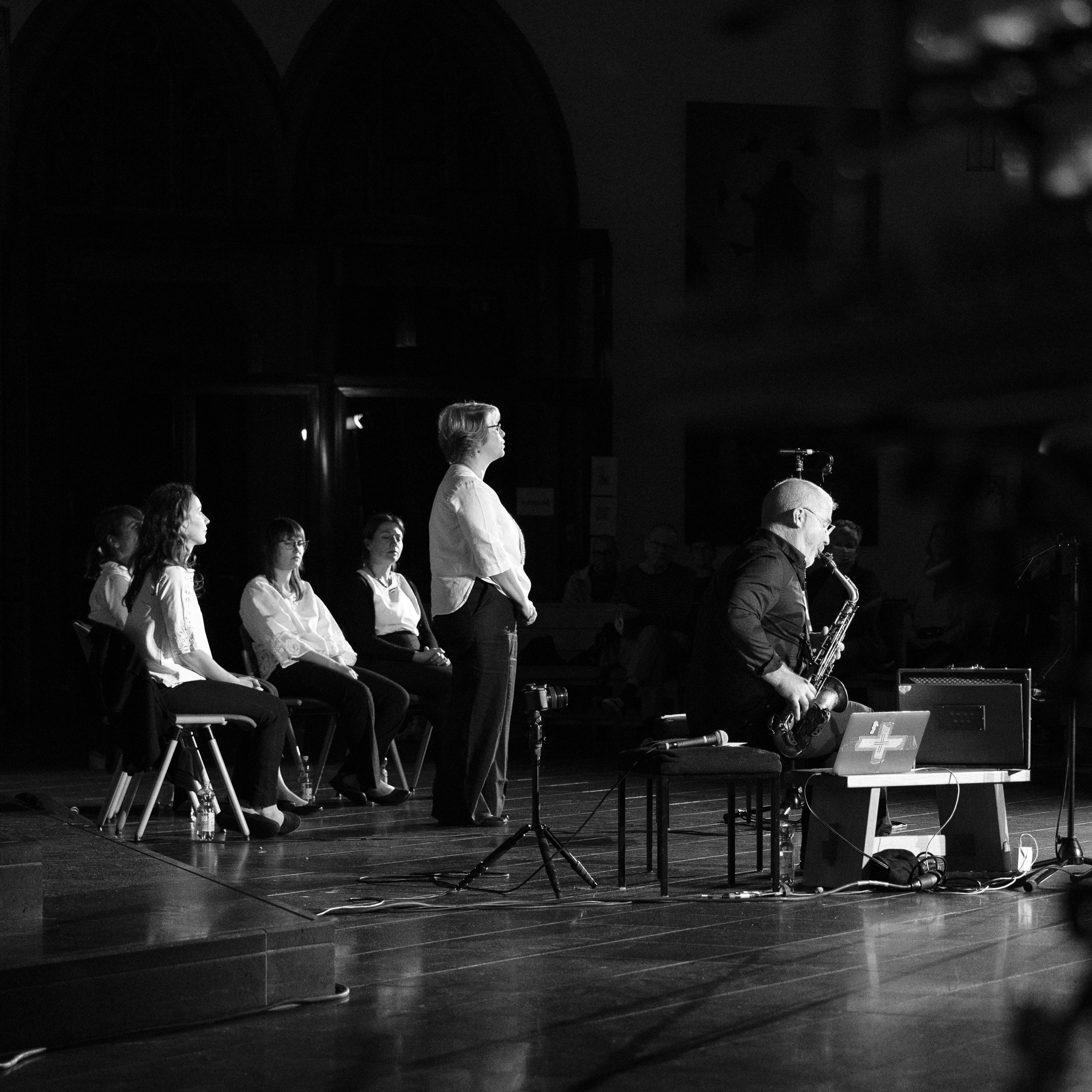
In collaboration with the singers Jovana Lukic, Zvezdana Ostojic, Gloria Lindeman, Lana Hosni and Julijana Lesic, the job of Downes and Chisholm (who also plays analogue synthesisers and shruti box and adds his own throat singing) is to create instrumental textures and interludes, counterpointing, underlining and separating the eight traditional songs that made up the programme for a concert held in St Agnes’ Church as part of Cologne’s JazzWeek.

The voices are plangent, not as lush as the Bulgarian choir, keening and ululating with an ardour and a harsher edge that seems to come from somewhere deep in human history. The songs are about life in mountain villages: families, lovers, the seasons changing (translations are provided in the accompanying booklet). Chisholm and Downes find ways of enhancing their inherent qualities, adding new dimensions and perspectives, providing connective tissue that swells and glows quite beautifully. In the eternal search for music suitable for quiet Sunday mornings, Medna Roso is a valuable discovery.

It’s also the third release on Red Hook, a label founded by the producer Sun Chung, the son of a classical conductor, who grew up in Europe and the US and studied at the New England Conservatory before spending several years at ECM, observing Manfred Eicher’s approach in the recording studio. His label’s debut, a final solo recording by the late pianist Masabumi Kikuchi, called Hanamichi, was one of the finest releases of 2021. Medna Roso will be on this year’s list, no doubt, and deserves a very wide hearing among those likely to respond to its special properties.

* The photograph of PJEV with Hayden Chisholm was taken by Niclas Weber during the concert in Cologne’s Agneskirche. The album is released on 5 May.

A not-so-dry January

Throughout the 31 days of January this year, the French pianist Johann Bourquenez took part in a project called Jamuary: each day of the month, participants created a short solo piece and published it online. It’s really an event for electronic musicians, but Bourquenez decided to present his pieces on the digital piano he uses at home. Now he’s put together 16 of these miniatures, ranging in length from 0:36 to 3:46, as a €3 package on Bandcamp.

I’ve liked his playing since I first heard Plaistow, the Swiss-based group in which he played for 10 years, at the 2014 London Jazz Festival. Their albums, including Citadelle and Titan, put them among a clutch of piano trios — alongside the Necks, Triosk and even GoGo Penguin — who were stretching the format. Now Bourquenez is pursuing solo projects.

Participants in Jamuary are given daily prompts. These might take the form of a key or a tempo, and they can be followed or not. Bourquenez’s pieces head in all sorts of directions, in a sense providing an exploded diagram of the elements that make up his own music. It’s a bit like what might happen if you filmed all the pieces played in a single day by the pianists using the instruments in the concourse of St Pancras International station and edited them into a 30-minute film.

There are pieces built on drones, repetition and strumming alongside standards — “Bye Bye Blackbird”, “Body and Soul”. There are rhythmic games (the lopsided tango “7 and 5”), charming fragments (“A Little Sad Waltz”) and a moment of sober reflection in his reading of Charlie Haden’s “Silence”, which you can hear above. Pure romance (“Diminished Epicness”) sits alongside astringent modernism (“Atmospheric Moumoune”).

And all for the price of a morning cappuccino. These are strange times.

* https://johannbourquenez.bandcamp.com/album/jamuary-2023

2022: the best bits

This was a year in which an overriding professional commitment prevented me from getting to many gigs before the autumn or seeing more than a handful of movies and exhibitions. I attended no theatre or dance performances and read no new poetry or contemporary fiction, although I did listen to a lot of CDs. But one thing I won’t forget. In the summer there were those three unreal days when the temperature in London hovered just shy of 40 degrees. A week or so later I ventured into the park a few minutes from where I live. It looked like a savannah, but a first sprinkling of rain had brought birds of many kinds to peck beneath the straw-coloured grass for emerging invertebrates. As I walked through the flocks, I picked up a feather. It may have belonged to a gull. I thought then, and I think now, that in addition to being as beautiful as anything imaginable, it’s a reminder to maintain some perspective on the state of this man-made world.

NEW ALBUMS

1 Steve Lehman and Sélébéyone: Xaybu — The Unseen (Pi)

2 Samora Pinderhughes: Grief (Stretch Music)

3 Gabriels: Angels & Queens (Parlophone)

4 Tom Skinner: Voices of Bishara (Brownswood)

5 Son Little: Like Neptune (Anti-)

6 Liun + The Science Fiction Orchestra: Lily of the Nile (Heartcore)

7 Mavis Staples/Levon Helm: Carry Me Home (Anti-)

8 Immanuel Wilkins: The 7th Hand (Blue Note)

9. Weyes Blood: And in the Darkness, Hearts Aglow (Sub Pop)

10 The Smile: A Light for Attracting Attention (XL)

11 Wolfert Brederode: Ruins and Remains (ECM)

12 Mary Halvorson: Amaryllis/Belladonna (Nonesuch)

13 Cécile McLorin Salvant: Ghost Song (nonesuch)

14 Geir Sundstøl: The Studio Intim Sessions Vol 1 (Hubro)

15 The Weather Station: How Is It That I Should Look at the Stars (Fat Possum)

16 Charles Lloyd: Chapel (Blue Note)

17 Olie Brice Trio/Octet: Fire Hills (West Hill)

18 Dai Fujikura/Jan Bang: The Bow Maker (Punkt Editions)

19 Binker Golding: Dream Like a Dogwood Wild Boy (Gearbox)

20 Moor Mother: Jazz Codes (Anti-)

21 Jasper Høiby’s Planet B: What It Means To Be Human (Edition)

22 Bonnie Raitt: Just Like That (Redwing)

23 Barre Phillips/György Kurtág Jr: Face à face (ECM)

24 Miguel Zenón: Música de las Américas (Miel Music)

25 The Henrys: Shrug (bandcamp)

26 Lisbeth Quartet: Release (Intakt)

27 Jon Balke: Hafla (ECM)

28 Sebastian Gahler: Two Moons (JazzSick)

29 Yasuhiro Kohno Trio +1: Song of Island (BBE)

30 Ingrid Laubrock/Andy Milne: Fragile (Intakt)

ARCHIVE / REISSUE

1 Cecil Taylor: Return Concert (Oblivion)

2 Dusty Springfield: Dusty Sings Soul (Ace)

3 Elton Dean Quartet: On Italian Roads (British Progressive Jazz)

4 Charles Mingus: The Lost Album from Ronnie Scott’s (Resonance)

5 Astor Piazzolla: The American Clavé Recordings (Nonesuch)

6 Mike Westbrook: London Bridge/Live in Zurich 1990 (Westbrook Jazz)

7 Lou Reed: Words & Music/May 1965 (Light in the Attic)

8 Centipede: Septober Energy (Esoteric)

9 Blue Notes for Mongezi (Ogun)

10 Clowns Exit Laughing: The Jimmy Webb Songbook (Ace)

LIVE PERFORMANCE

1 Bob Dylan (Motorpoint Arena, Nottingham, October)

2 Tom Skinner (Church of Sound, September)

3 Binker Golding (Purcell Room, November)

4 Roxy Music (O2, October)

5 AMM (Café Oto, July)

6 Van Der Graaf Generator (Palladium, February)

7 Westbrook Blake (St James’s Church, Piccadilly, November)

8 Mike Gibbs (Vortex, November)

9 Olie Brice (Café Oto, September)

10 John Cumming Memorial (Barbican, July)

FILMS

1 Both Sides of the Blade (Avec amour et acharnement) (dir. Claire Denis)

2 Living (dir. Oliver Hermanus)

3 In the Court of the Crimson King (dir. Toby Amies)

BOOKS

1 Philip Watson: Beautiful Dreamer: Bill Frisell, the Guitarist Who Changed the Sound of American Music (Faber & Faber)

2 Richard Koloda: Holy Ghost: The Life and Death of Free Jazz Pioneer Albert Ayler (Jawbone)

3 Margaret Kennedy: Where Stands a Wingèd Sentry (Handheld Classics)

4 Jeremy Wilson: Beryl: In Search of Britain’s Greatest Athlete (Profile)

5 Robert Sellers: Marquee: The Story of the World’s Greatest Music Venue (Paradise Road)

6 Felix Hartlaub: Clouds over Paris (Pushkin Press)

7 Paul Hayward: England: The Biography 1872-2022 (Simon & Schuster)

8 David Belbin: Don’t Mention the Night (Five Leaves)

9 Patti Smith: A Book of Days (Bloomsbury)

10 Paul Gorman: Totally Wired: The Highs and Lows of the Music Press (Thames & Hudson)

‘The Philosophy of Modern Song’

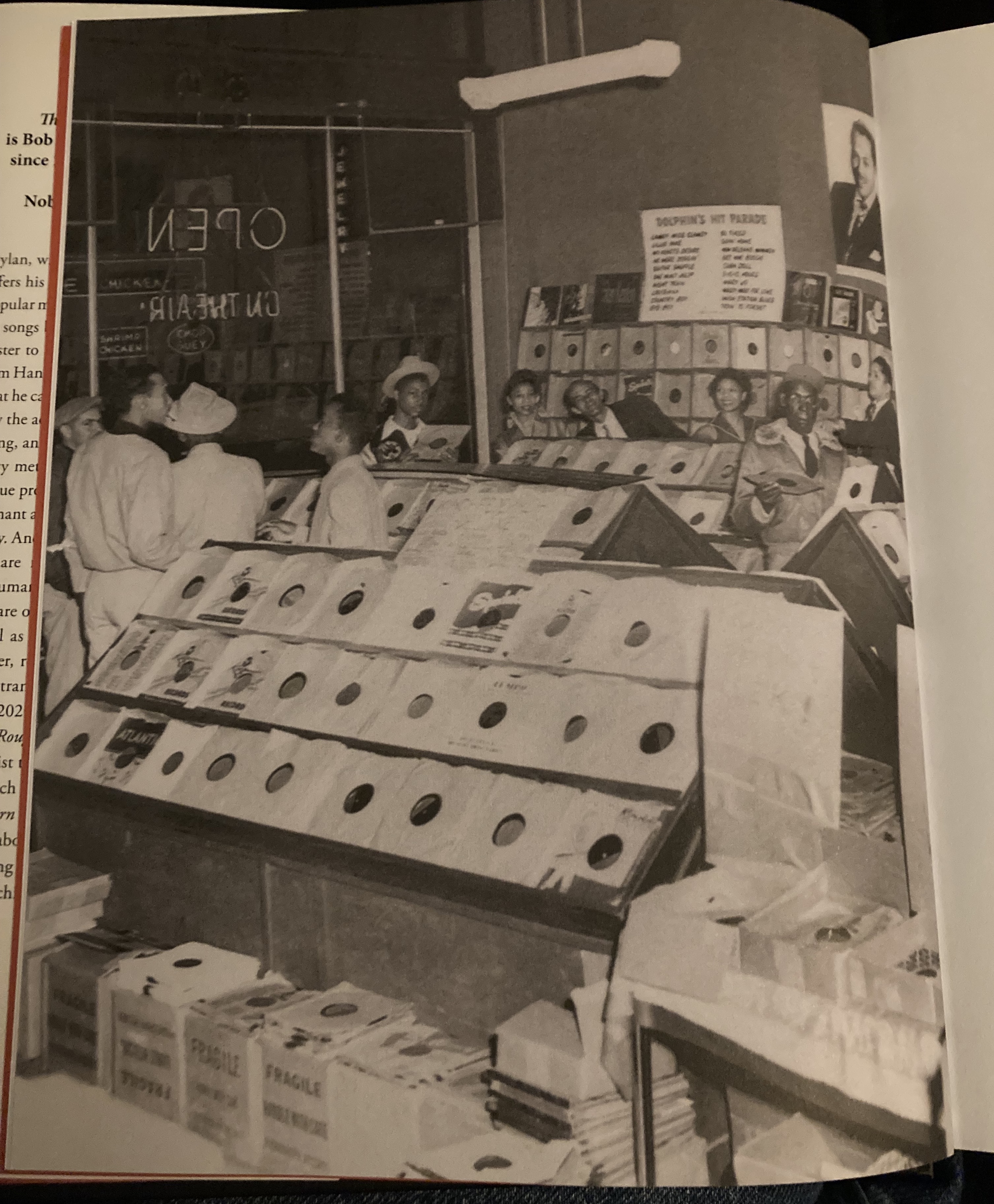
The second photograph you see when you open Bob Dylan’s The Philosophy of Modern Song is one of the reasons I don’t entirely resent having paid the £35 the book costs. It shows a group of customers in a record shop, surrounded by boxes and displays of 78rpm discs. There’s no caption, but there’s a clue in a poster on the wall saying “Dolphin’s Hit Parade”, followed by a list of songs. So this is Dolphin’s of Hollywood, the record shop opened by the black entrepreneur John Dolphin in South Central Los Angeles in 1948. Its frontage was on Vernon Avenue, near the corner with Central Avenue – the main stem of black LA in that era, thanks to nearby night spots like the Club Alabam, the Turban Room, the Downbeat, Elks Hall and Jack’s Basket Room. Dolphin’s opening hours — 24 hours a day, including Sundays — were pioneering, as was a buy-one-get-one-free deal. The titles on the poster — deciphered with the aid of a magnifying glass — tell you that this is the spring of 1952, which is when “Lawdy Miss Clawdy” by the Lloyd Price Orchestra was released on the Specialty label, along with “One Mint Julep” by the Clovers (Atlantic), “Night Train” by the saxophonist Jimmy Forrest (United) and “My Heart’s Desire” by the vocal duo Jimmie Lee and Artis with Jay Franks and his Rockets of Rhythm (Modern)*.

John Dolphin had originally tried to open a business in Hollywood, but was denied the opportunity on the grounds of his colour. So, locating instead in the heart of the black community, he gave the shop a semi-ironic title, soon adding a record label of his own, called Recorded in Hollywood, whose output included early recordings by the Hollywood Flames and Jesse Belvin. His business, and others in the neighborhood, were so successful that they began to attract white customers, which in turn brought threats from white competitors to such a degree that in 1954 he organised a protest against their campaign of intimidation. In 1958 he was shot dead in his office by a disappointed singer named Percy Ivy, in the presence of two soon-to-be-famous white teenagers, Sandy Nelson and Bruce Johnston, who had been trying to get him interested in their music. In the photograph, John Dolphin is the man in the dark suit under the picture of Billy Eckstine.

None of this information is to be found in the book, in which Dylan discusses 66 other songs. You’ve probably already read about it (I recommend Dwight Garner in the New York Times or Craig Brown in Private Eye), so I’m not going to try and review it properly. It’s easy to describe. Most of his choices get two chunks of prose: first, an outpouring of feelings and images provoked by the recording in question, followed by a historical note, all illustrated by a selection of images that range from the relevant to the tangential or allusive. Jimmy Reed’s “Big Boss Man”, for instance, gets a description of the boss class (“You’re the famous Chieftain, the enormous tight fisted penny pincher who treats all the workers like errand boys”) followed by a short description of Reed’s music (“You put him with Jimmie Rodgers and Thelonious Monk, two other musicians whose work never sounds crowded no matter how many players are there” and “He plays the harmonica through a neck rack. And you can’t do much with a harmonica in a neck rack” — really? Bob should go back and listen to his own live recordings from 1965 and ’66. Or maybe he’s putting us on). There are pictures of Reed, of Brando in The Godfather, and Elvis Presley — unmentioned in the text — with Colonel Tom Parker, who is pretending to play an acoustic 12-string guitar and is presumably there to represent boss men in general.

The criteria by which Dylan chose the songs are never made clear. Many are from his childhood in the pre-rock era. Others seem to have been plucked at random. As many have already pointed out, in some bafflement, only a tiny handful are by women. But the specifics don’t seem to be important: they are there to give Dylan the chance to vent. Where people with synaesthesia experience music as colour, Dylan seems to experience a song as a set of feelings that may or may not be triggered by anything explicit in the song itself, arising instead from his own imagination, his memories, fears, fantasies. Or perhaps that’s quite wrong. Perhaps he’s just making it up, and why not? At any rate, while working your way through one laboured exegesis after another, you may find yourself thinking that he’d be better employed fashioning them into songs of his own.

Soon after I started reading The Philosophy of Modern Song, I found I wasn’t enjoying it very much. It isn’t anywhere near the standard of his brilliant sleeve note for World Gone Wrong in 1993 or the considered thoughts on music expressed in several interviews in recent years. It didn’t seem to be telling me anything original or important. As for a “philosophy of modern song”, the closest he gets to that is his claim that a song’s true value resides in the listener’s response to it, which I guess is the book’s raison d’être, or at least its excuse. So I thought I’d try it from another angle. On the basis of having loved his Theme Time Radio Hour programmes largely because of the sound of his voice, I spent another few quid on the audiobook, only to discover that most of the reading is done by famous actors, from Jeff Bridges to Sissy Spacek. Why would I want to hear that? When Dylan does appear, his voice sounds weirdly remote, losing all the warmth and intimacy of the radio series. And there are times, to be blunt, when he sounds like he’s reading someone else’s research. So I’ve given up on that, too, at least for now.

Whatever the contentious origins of its component parts, Chronicles Vol 1 was a proper book, the product of craft and concentration. Which The Philosophy of Modern Song definitely isn’t. It’s inessential, a coffee-table book to be given as a Christmas present. Clearly he didn’t fancy writing Chronicles Vol 2 — perhaps, who can tell, because he knows that’s what we want.

* Correction: In the original post, “My Heart’s Desire” was credited to the Wheels, whose recording was not released until 1956. The recording by Jimmie Lee and Artis was released on the LA-based Modern label in early 1952.

* Bob Dylan’s The Philosophy of Modern Song is published by Simon & Schuster. The audio version is available from audible.co.uk. The copyright in the photograph above is owned by the Michael Ochs Archive via Getty Images.

Bringing it all back home

Last night I was on my way to see Bob Dylan in concert in my home town for the first time, at a venue a few hundred yards from where, almost 60 years earlier, my girlfriend and I had listened to Freewheelin’ all the way through, squeezed together in a record-shop listening booth, before buying it, taking it to her parents’ house, and listening to it all the way through again. And then again.

Walking through Nottingham to reach the Motorpoint Arena, as the refurbished ice stadium is now known, I saw a chip shop in the Lace Market, formerly a coffee bar called the Jules et Jim, where three schoolfriends — Ian Taylor, Jeff Minson and I, a sort of Peter, Paul and Peter — had sung “Blowin’ in the Wind” in 1963. On Stanford Street I passed the site of Dungeon Club, the basement where — at the height of Bobmania in early 1965 — the harmonica player of the R&B group I was then in performed a solo mini-set of Dylan songs that attracted a lot more enthusiasm than our normal Jimmy Reed and Howlin’ Wolf repertoire.

It was also in the spring of 1965 that I first saw Dylan in person, at Sheffield’s City Hall on the first date of what would turn out to be his last solo acoustic tour. Since then I’ve seen him as often as I can — many times in London but also in Birmingham, Paris, Rome, New York and Philadelphia. Precious memories include a heart-stopping “It’s Alright, Ma” in Sheffield, a staggering “Like a Rolling Stone” at Earls Court, a blistering thrash-metal “Barbara Allen” at the NEC, a sweet duet on “Dark Eyes” with Patti Smith in Philly, and a gorgeous “Forgetful Heart” at the Albert Hall. In the week leading up the Nottingham concert I saw him twice at the Palladium, giving the first show a five-star review in the Guardian and then enjoying the second one even more.

But when I say that last night in Nottingham felt like the best concert I’ve ever seen from him, I’d ask you to accept that hometown nostalgia had nothing to do with it. Until a surprise right at the end, he played the set I’d heard twice at the Palladium. But in a place at least three times larger, with none of the inherent warmth and intimacy of the historic London theatre, he sang the same songs — nine from Rough and Rowdy Ways, seven older compositions of his own and “That Old Black Magic” — with an intensity and verve that gave them a different kind of life.

His singing was good in London, but in Nottingham it was astounding. Every line was nailed with phrasing that was always adventurous but never eccentric. I don’t think it was a change of emphasis in the sound mix: it was all in the vigour and projection of his delivery. As a result, songs like “Black Rider”, “My Own Version of You”, “Key West” and “I’ve Made Up My Mind to Give Myself to You” had a new confidence and richness, with a heightened sense of tension and release. The arrangements took on a different life, too. The Arlen/Mercer standard was brought off with a crisp panache. The twin surf guitar interludes on “Gotta Serve Somebody” were hair-raising. The three-movement version of “I’ll Be Your Baby Tonight” — first out of tempo, then Latin, then barrelhouse — was a delight. The rearrangements of “To Be Alone With You” and “Every Grain of Sand” glistened.

His piano-playing also seemed better integrated. The upright he’s using on this tour is adjusted to sound high and bright, almost like a tack piano, with a tone so close to that of the two guitars of Doug Lancio and Bob Britt that they’re sometimes indistinguishable. But during both Palladium shows there were moments when he crossed the line from playful to wilful, as if he were trying to lead the songs astray, occasionally sticking a major-key note into a minor-key song, or doing that thing he sometimes used to do on electric guitar of working out a short symmetrical phrase and then stubbornly repeating it over and over again with the chords changing under him. It crossed my mind that he might be trying to turn himself into the Thelonious Monk of folk-rock piano, looking for the notes in the cracks, the notes between the notes. But in Nottingham, with the exception of “Most Likely You’ll Go Your Way”, there was little of that; instead everything he played was directly relevant to what the band was doing and where the song was heading.

Where the concert was heading was towards the unforgettable moment, after the band had taken their bow, when they returned for the only encore of the tour so far. “I don’t know if many of you know, but Jerry Lee has gone,” Dylan said, “and we’re gonna play this song, one of his. Jerry Lee will live for ever, we all know that.” The song, an exquisite choice, was “I Can’t Seem to Say Goodbye”, a country ballad by Don Robertson, recorded by Lewis in 1963. After one chorus, delivered with quiet elegance, they were gone. But what a memory they left. Maybe even the best of all.

Thirty years of Later…

There must be a lot of people out there who had their first encounter with a favourite artist through seeing them on Later…with Jools Holland. On Saturday night the programme celebrated its 30th anniversary by beginning its latest series on BBC2 with a typical bill: a guitar-based popular rhythm combo from Sheffield (the 1975, pictured above), a cutting-edge female performer from Rotherham (Self-Esteem), a rediscovered 82-year-old soul singer and his fine band from Portland, Oregon (Ural Thomas and the Pain), a Spanish-American solo singer-songwriter (Victoria Canal) and a deeply unclassifiable London-based trio playing challenging and highly contemporary instrumental music (The Comet Is Coming). Each of them will have attracted new admirers as a result of this brisk 50-minute programme filmed in the round on the floor of the Alexandra Palace Theatre.

When Later… first appeared, I felt straight away that it was almost exactly the show I’d always wanted The Old Grey Whistle Test to be during my year as its first presenter, and which it only occasionally became (examples: the performance of Curtis Mayfield and his band, John Martyn’s first solo appearance, and the 10 minutes when Dr John sat at an upright piano and ran through the history of New Orleans piano). It was about musicians of varying backgrounds and styles playing live — and even better, in the Later… format, listening to each other’s performances while waiting for their own turn. It was also my strong feeling that such a show needed a more extrovert presenter, and in Jools Holland it found one — and one who, moreover, could sit down at the piano and occasionally accompany a guest, as he did last night when Ural Thomas sang “Stand By Me”.

He isn’t to everyone’s taste — the “Hootenanny!” thing on his New Year’s Eve specials has been known to drive me from the room — but the show wouldn’t have survived through three decades without his ebullient personality to sell it. He was chosen back in 1992 by Mark Cooper, the programme’s founding producer and presiding spirit, whose broad but discriminating taste in music has probably been the single most important factor in the maintenance of the show’s quality. Over the years the production has become more polished, at the expense of a certain spontaneity, but last night’s line-up showed a continuing desire to present the experimental and adventurous alongside the familiar and safe.

Now Cooper — who began his career as a music journalist in the pages of Record Mirror, Q and Mojo and was BBC Studios’ Head of Music from 1999 to 2019 — has written a book about the show chronicling, as its subtitle promises, “30 years of music, magic and mayhem”. It’s a 400-page narrative rich in anecdotes and interspersed with reflections contributed by some of those who made memorable appearances, including Alicia Keyes, Richard Thompson, Ed Sheeran, St Vincent, Nick Cave and Baaba Maal. Thompson is particularly good value on being able to listen to Al Green from a distance of about 10 feet, on being able to tell Little Jimmy Scott how much he loved his music, and on backing Norma Waterson in a band including Martin Carthy, Eliza Carthy, Danny Thompson and Dave Mattacks. Keyes describes her first appearance in 2001, soon after the release of her debut album, as one of the great musical moments of her life: “The circle raises your game. You walk into the studio different, knowing you’re going to be among musicians who are being themselves and not trying to do what somebody else is doing.”

Open the book almost anywhere and you’ll get a good story, or even just a line reminding you that a single episode in 2008 could incorporate Solange, Stereophonics, Eli Paperboy Reed and a chat with Ray Davies. The section on Lou Reed’s appearances in 2000, 2003 and 2011 is beautifully remembered and observed; the author had first attended one of Reed’s concerts in 1972 and interviewed him for a magazine in 1992, which can’t have harmed his ability to provide the artist with a comfortable setting and a sympathetic atmosphere. He was less prepared for the arrival of Solomon Burke in the Later… studio in 2002, never having seen him live. Burke turned up in a wheelchair before settling his enormous bulk into a golden throne and proceeding, with the help of Holland’s Rhythm & Blues Orchestra, to wreck the house.

Later… is about respecting the elders, giving a platform to the new, and having fun with music. “There’s nothing like it in the world,” Baaba Maal says, and he may be right. Mark Cooper’s book — in which he properly shares credit with the many other people, such as his co-producer Alison Howe and the director Janet Fraser-Crook — is an entertaining and instructive guide to how it happened and to the small miracle of its survival.

* Mark Cooper’s Later… with Jools Holland is published by William Collins.