Skip to content

Posts from the ‘Jazz’ Category

Ishiguro, long ago

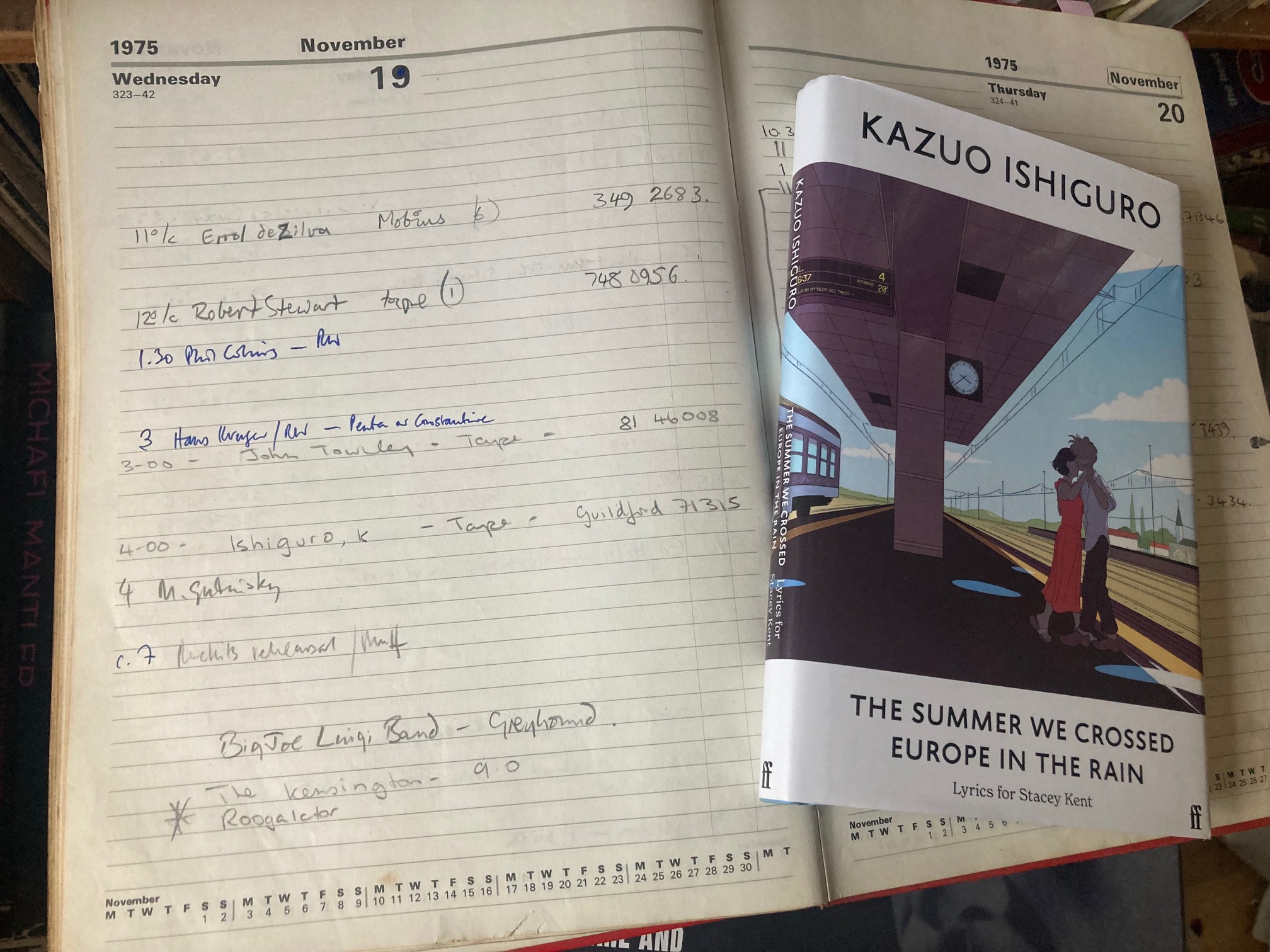
A typical day in the A&R department at Island Records’ London headquarters in November 1975. Four or five people coming in to play their demo tapes to me or my assistant, Howard Thompson, in the semi-basement office in a beautiful stucco house in St Peter’s Square, W6. A lunchtime meeting with Phil Collins, a familiar face from the early days of Brand X, before they went off to sign with Charisma. The early evening rehearsal of a band called the Rockits, evidently a Muff Winwood project. And a note to go and see the still-unsigned Roogalator, with their great American guitarist Danny Adler, at the Kensington pub near the Olympia exhibition halls.

At four o’clock that day there was an appointment with “Ishiguro, K”, bringing a tape for us to hear, evidently from Guildford. Sadly, I have no clear memory of the man or his songs. What I do know is that he would go on publish the first of his eight novels, A Pale View of Hills, in 1982, win the Whitbread Prize for An Artist of the Floating World in 1986, the Booker Prize for The Remains of the Day in 1989, and the Nobel Prize in literature in 2017, all of this topped by a knighthood in 2018. So I think one could say that, just a couple of weeks past his 21st birthday and a couple of months into the first year of his undergraduate studies at the University of Kent, Kazuo Ishiguro negotiated what is nowadays known as a sliding-doors moment with some success.

I found that diary entry a couple of years ago, while looking for something else. It came back into my mind while reading the introduction to The Summer We Crossed Europe in the Rain, a book of Ishiguro’s lyrics, written over the last couple of decades for the London-based American jazz singer Stacey Kent.

“I’ve built a reputation as a writer of stories, but I started out writing songs,” he writes, before going on to describe an apprenticeship influenced by Leonard Cohen, Joni Mitchell, Bob Dylan, Robert Johnson, Jimmy Webb, Tom Jobim, Hank Williams, Hoagy Carmichael, Cole Porter and many others. He failed in his original ambition to become a successful singer-songwriter, but what’s interesting is the degree to which he believes his eventual mastery of writing fiction was shaped by his early efforts with music, which led him to think that the trick was not to prioritise getting a grip on his readers but rather to find a way of engaging their interest at a different and perhaps more lasting level.

“A song lasts only a few minutes,” he writes. “Its impact can’t afford to reside just in what happens during the moment of direct contact. A song lives or dies by its ability to infiltrate the listener’s emotions and memory, and, like a parasite, take up long-term residence, ready to come to the fore in moments of joy, grief, exhilaration, heartbrteak, whatever. No one aspires to write a song that catches the attention only while it’s being heard, then gets forgotten. That’s not how songs work.”

What he identifies is “something in the unresolved, incomplete quality of so many well-loved songs that’s significant here. In the world of prose fiction, there’s a strong impulse to achieve completeness; to tie every knot, answer every question, to leave no loose ends hanging. By contrast, in the world of songs, there’s a much lower bar when it comes to literal sense-making. The tiny amount of words available, the internal logic of the melody, the emotional content imposed by chords and chord sequences mean that the ability of a song to connect had little to do with, say, convincing psychological back stories or even the clear readability of the songs unfolding before us. It occurs to me that good songs may haunt the mind not despite their incompleteness, but because of it…”

The whole thing is worth reading, as are the 16 lyrics reproduced in the book, beautifully illustrated by the Italian artist Bianca Bagnarelli in a bande dessinée style. If the occasional specificity of places and film references recalls Clive James’s efforts in a similar direction (mentions of Casablanca and Indochine, Les Invalides, “some tango in Macao”, “Gabin / Hooded eyes / A slow Gitanes / Weary deserter on the run”), the subtlety of the emotional engagement is closer to that of Fran Landesman, the writer of “The Ballad of the Sad Young Men” and “Spring Can Really Hang You Up the Most”. Ishiguro’s lyrics are sophisticated without being smart, precise but leaving intriguing gaps; they bear reading on the page, and their effect — like that of his mature prose — can linger in the mind.

As I said, I have no real memory of what happened on that Wednesday in 1975 when “Ishiguro, K” came by. It can’t have had any effect on his destiny. But I hope we were nice to him.

* Kazuo Ishiguro’s The Summer We Crossed Europe in the Rain is published by Faber & Faber. Stacey Kent’s albums Breakfast on the Morning Tram and The Changing Lights, which contained some of the early fruits of their collaboration, set to music by Kent’s husband, the saxophonist and flautist Jim Tomlinson, were released in 2007 and 2013 respectively on the Blue Note label.

New sounds in the Round

Mejedi Owusu (left) with his quintet at Jazz in the Round

There’s been a bit of a kerfuffle at London’s music conservatoires in recent days over an email from a teacher claiming that white students in the jazz departments are disadvantaged by the preferences given to fellow students who are black. The teacher in question — and I won’t name him — is an eminent white musician in his sixties. He claims, in passing, that his own career has been hindered by discrimination in favour of black musicians, and it would not be hard to imagine that this sense of grievance may lie at the heart of his more general complaints.

These include the suggestions that because so few black students study classical music, a disproportionate number are allowed into the jazz courses in order to meet overall equality and diversity quotas within the institutions, and that white bandleaders employ black musicians at the expense of superior white candidates simply because their presence helps them get gigs and grants.

Anyway, his classes at Trinity Laban, the Guildhall and the Royal Academy of Music have been boycotted and he is currently at home on sick leave. While his supporters have been disparaging the students as woke snowflakes and getting up a petition to demand his reinstatement, his critics have set up a counter-petition calling for his permanent removal.

My view is that what he had to say in the email is nonsense, and dangerous nonsense at that. Towards him personally, I’m old enough to feel a kind of sorrow tinging the hot anger with which his students have understandably responded. No doubt he thinks that he was smply being honest. But there had to be a better, wiser alternative to creating divisions where none should exist.

The success and visibility of young musicians of colour coming through the conservatoires and Tomorrow’s Warriors and similar schemes around the country in the last few years, working alongside their white contemporaries while bringing a new audience to the music, has been the healthiest collective phenomenon I can remember in six decades of listening to British jazz. Black musicians over-represented in jazz? About time, is all I can say.

As if to prove the point, last night’s edition of Jazz in the Round at the Cockpit Theatre in North London was opened, as is the custom at the monthly series, by a group of young musicians. This was a quintet let by the trumpeter Mejedi Owusu, who is 18 years old and a student at Trinity Laban. The line-up was completed by others from his cohort: Will Coode on alto and tenor saxophones, Chris Outhwaite on piano, Kielan Sheard on bass and Sacha Harlan on drums. They played three Owusu originals, and as they tore into the first of them, a jet-propelled piece titled “Paranoia”, every ear in the place was pinned back. For a minute the scalding trumpet-and-alto unisons allowed us to feel what it must have been like to be ringside at Birdland in the early 50s.

The second piece was a likeable composition called “Dark Eyes”, in the style of those Blue Note boogaloo pieces that Alfred Lion used to get Lee Morgan or Hank Mobley to write and record in the hope of getting jukebox exposure. The final piece was a ballad called “Affliction of the Innocent”, written a couple of years ago in the double shadow of the Covid-19 death toll and the murder of George Floyd, following the tradition of such elegant hard-bop threnodies as Benny Golson’s “I Remember Clifford” and Freddie Hubbard’s “Lament for Booker”.

One thing the set confirmed is that it is usually harder, at least for relatively inexperienced musicians, to play a slow tune than a fast one. That comes with maturity. Owusu and his colleagues are at the beginning of their careers, with plenty of time for growth. You just hope that, when they emerge into the professional world, there’ll be work for them all — as well as for sixty-something teachers who may yet prove capable of learning from the voices of their students.

The artwork of British jazz

Who could have imagined, as the music and those who made it were fighting for their existence, the three-figure sums that British jazz albums from the ’60s and ’70s would be fetching in a new century? To some, Richard Morton Jack’s Labyrinth: British Jazz on Record 1960-75, a large-format book containing threequarter-size reproductions of the front and back sleeves of 161 albums, plus another 140 at a smaller scale, will be a catalogue of longing and desire.

Look! Original copies (cond: VG) of Joe Harriott’s Abstract and David Mack’s 12-tone New Directions on Columbia, of Poetry and Jazz in Concert on Argo, of Mike Westbrook’s Celebration on Deram, of The People Band on Transatlantic, Bob Downes’s Open Music on Philips and Ric Colbeck’s The Sun Is Coming Up on Fontana! The first LPs by Howard Riley on the Opportunity label and Back Door on the Blakey imprint! The SME’s debut on Eyemark! Mike Taylor’s Pendulum! The only recording of the Chitinous Ensemble, directed by Paul Buckmaster! Guy Warren of Ghana! Lots of Michael Garrick, Graham Collier, Gordon Beck, Tony Oxley, Tubby Hayes, Stan Tracey, Keith Tippett, Alan Skidmore, Rendell & Carr, Ray Russell… all the way to the Nottingham Jazz Orchestra’s Festival Suite, released on Doug Dobell’s Swift label.

Richard Morton Jack gives a brief commentary on each album, with quotes from reviews, and there’s an introduction by Tony Reeves, probably most famous as the bass player with Jon Hiseman’s Colosseum, who describes how he, a Lewisham schoolboy, found his way into the scene as a player and a producer, with Neil Ardley’s New Jazz Orchestra, whose Western Reunion and Le Déjeuner sur l’herbe are featured, and others.

What a time it was — although, as I said, it was always a struggle for those trying to make a living in jazz clubs up and down the country, despite the efforts of intrepid A&R men/producers like Denis Preston, Terry Brown, Peter Eden and Giorgio Gomelsky to persuade Decca, EMI, Philips, Pye, Polydor and CBS to record this adventurous music.

Labyrinth finds a different and very enjoyable way of telling the story, exploiting the artwork and the information contained within 12 x 12 album jackets, back in the days of helpful sleeve notes. And if I had the choice of all these albums, but could keep only one? It would probably be the Blue Notes’ Very Urgent, their first recording after landing in the UK from South Africa. Produced by Joe Boyd at Sound Techniques and issued on Polydor under Chris McGregor’s name, it’s as exhilarating today as it was back in 1968, and its long-term influence is still to be felt, even in the work of young musicians then unborn.

* Richard Morton Jack’s Labyrinth: British Jazz on Record 1960-75 is published by Lansdowne Books (£60)

Songs for a mother

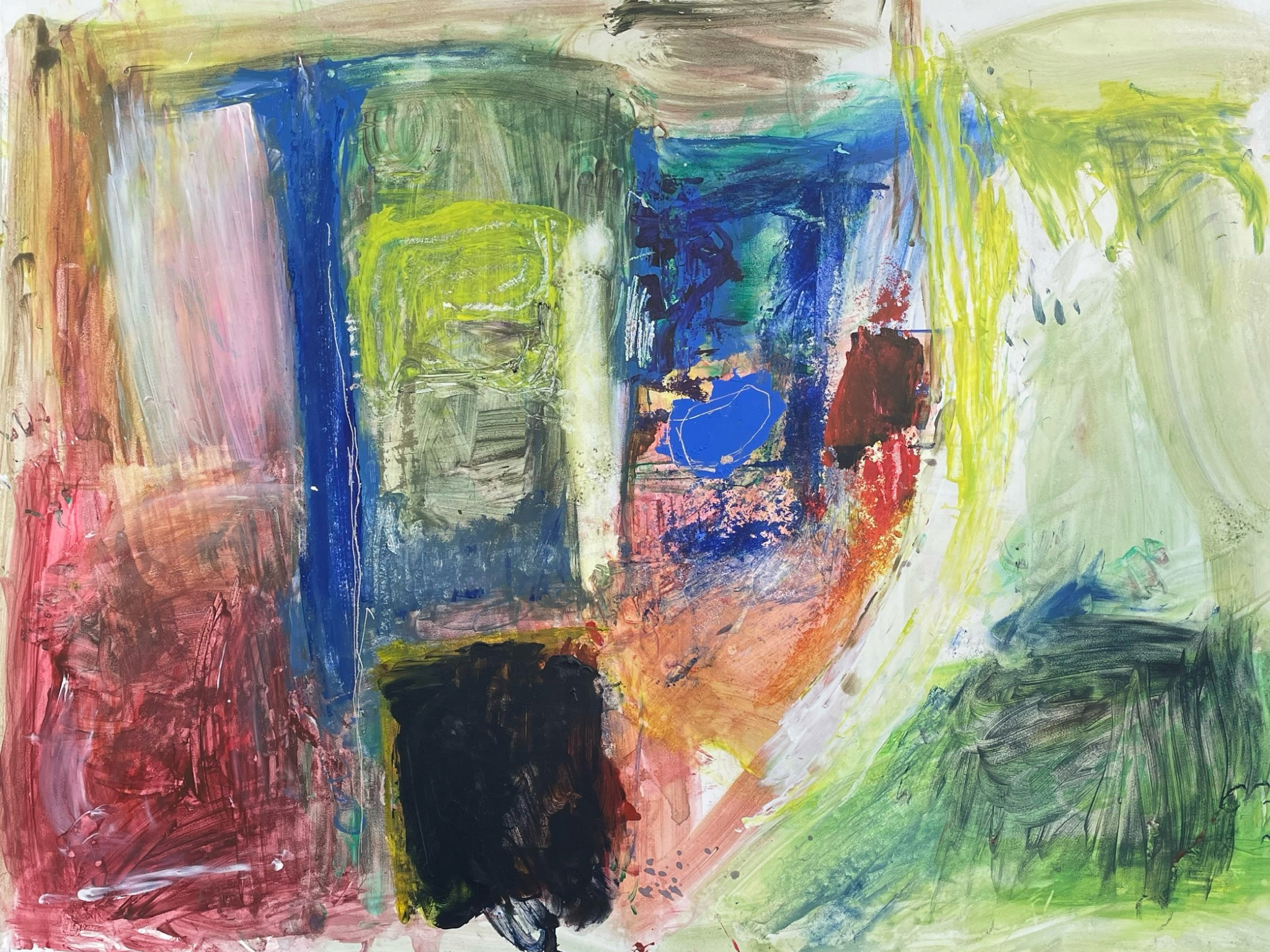
When the painter Penny Marrows was given a diagnosis of terminal cancer in March 2023, her son, the London-based composer and guitarist Billy Marrows, began writing pieces for her. Some of them were recorded and played to her before her death five months later, aged 72. In the aftermath Billy carried on writing and recording, and compiled the pieces in an album, Penelope, for which one of his mother’s paintings provides the cover (you can see it above).

One good reason for buying the album is that the proceeds will go to World Child Cancer, a charity providing help in countries that don’t have the benefit of the sort of organisations that cared for Billy’s mother, such as the NHS and Macmillan Cancer Support. But the music is reason enough.

The aggregation of musicians heard on the album is known as Grande Família. Five of the pieces, interspersed throughout the running order, are for solo guitar or baritone guitar. One is a duo for guitar and viola (Teresa Macedo Ferreira). Another is a trio for guitar, piano (Angus Bayley) and clarinet (Gustavo Clayton Marucci). The remaining three are by a 12-piece chamber-jazz ensemble including trumpet, trombone, French horn, flute, clarinets, saxophones and viola.

I’ve been playing the album a lot over the last few days, and it’s made a friend of me. The solo guitar pieces are pitched somewhere between Bill Frisell (a refined backporch sensibility) and Mary Halvorson (the sparing and subtle use of effects, and a sense that a surprise isn’t far away). The solo version of “Shenandoah” (the only non-original) which provides the album’s coda is lovely; when I do my “Shenandoah” mixtape, it’ll go nicely between Frisell’s interpretation (with Ry Cooder on Good Dog, Happy Man) and Bob Dylan’s (one of the saving graces of Down in the Groove).

The most striking of the ensemble pieces is “L’Heroïsme”, which features the tenor saxophone of Tom Ridout and the trumpet of Mike Soper. You can see them playing it here. But what I really like about the album is how its 10 separate pieces, for all their variety of means and approach, behave as though they belong together, like a family.

* Penelope by Billy Marrows + Grande Família is available as a CD and download. Details here: http://www.billymarrows.com. They’ll be playing at the Pizza Express in Soho on 13 May. Penny Marrows’ painting is used by kind permission.

‘Rhapsody in Blue’ at 100

The first public performance of George Gershwin’s “Rhapsody in Blue” was given 100 years ago this week, on 12 February 1924, at the Aeolian Hall on West 43rd Street in New York City, by Paul Whiteman and his Concert Orchestra, with Gershwin himself at the piano. Whiteman had commissioned the piece from its composer specially for the evening, which was billed as ‘An Experiment in Modern Music’.

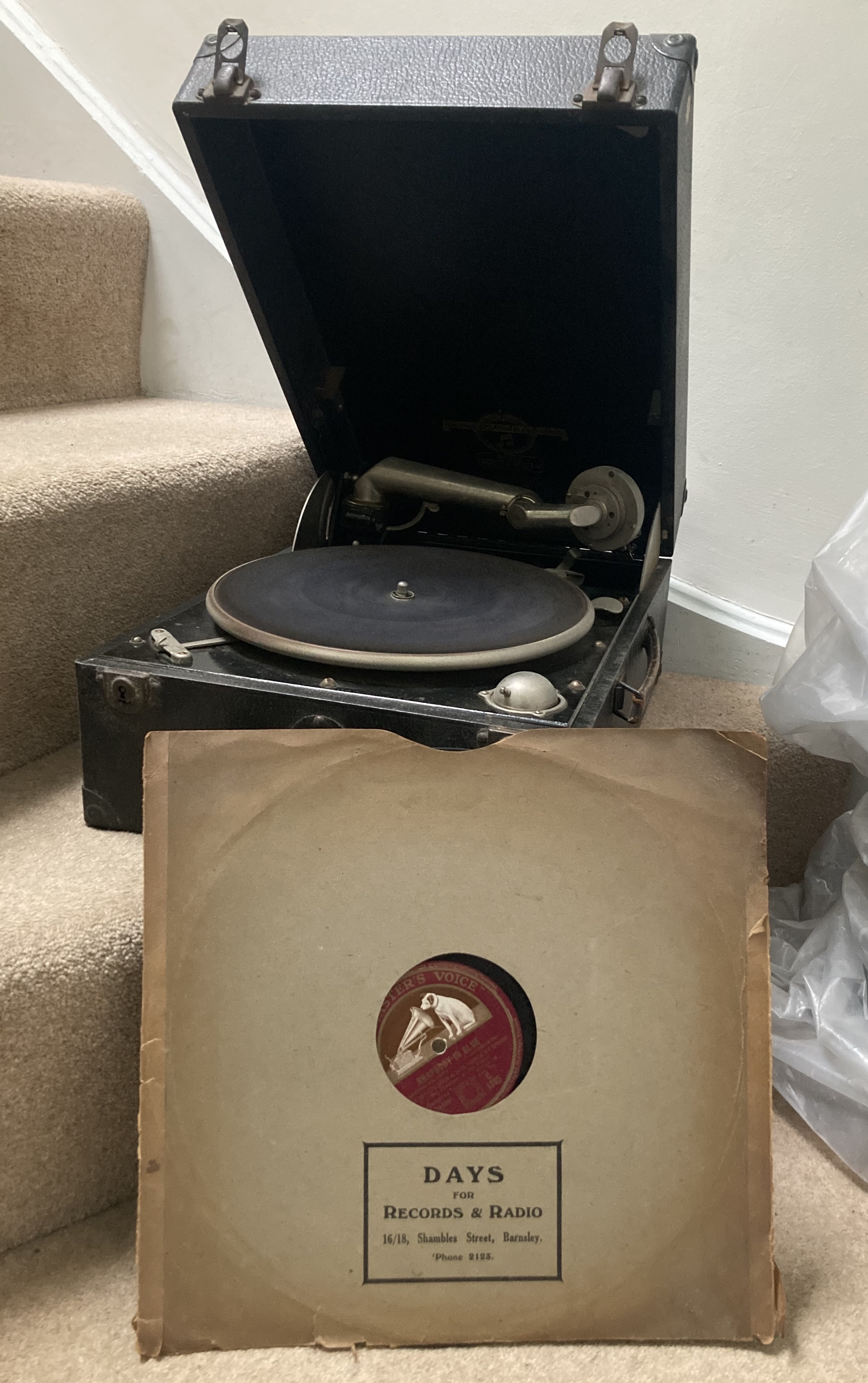
I first heard “Rhapsody in Blue” in childhood, played by the same Whiteman/Gershwin combination, on the 12-inch 78rpm record you see above, which my mother would have bought from a record shop in Barnsley, South Yorkshire, in the 1930s. Nine minutes long, it’s split over both sides of the disc. The gramophone — a Columbia Viva-Tonal Grafonola — is the one on which she played it, along with her other 78s.

To mark the centenary, the pianist Ethan Iverson started a lively debate the other day with a piece for the New York Times in which he examined the artistic impact, then and now, of what he called “a naive and corny” attempt to blend the superficial characteristics of jazz with European classical music. If “Rhapsody in Blue” is a masterpiece, he wrote, it’s surely “the worst masterpiece”: an uncomfortable compromise that blocked off the progress of what would later be called the Third Stream, and with which we are both “blessed and stuck”.

Thanks to my mother’s influence, I view it from a slightly different angle. For me, in childhood, it became a gateway drug. I loved the spectacular clarinet introduction, and the shifting melodies and the hints of syncopation, but more than anything I responded to the tonality that reflected its title, expressed in the exotic flattened thirds and sevenths of the blues scale.

It didn’t take very long before I was following a path that led to Louis Armstrong, Duke Ellington, Charlie Parker, Thelonious Monk, Miles Davis, Charles Mingus, John Coltrane, Ornette Coleman and Cecil Taylor, right up to the Vijay Iyers, Matana Robertses and Tyshawn Soreys of today’s jazz. Pretty soon I’d worked out that an ounce of Ellington was worth a ton of Gershwin’s instrumental music*, but I retain a respectful gratitude to “Rhapsody in Blue” and its role as a gateway, just as I do to The Glenn Miller Story and “Take Five”.

A few weeks after the world première Gershwin’s piece, F. Scott Fitzgerald and his young family would set off for France, where he spent the summer knocking the early draft of his third novel into shape. When The Great Gatsby was published the following April, it contained a vivid scene in which the society guests at one of Jay Gatsby’s Long Island parties were entertained by a band described by the author as “no thin five-piece affair, but a whole pitful of oboes and trombones and saxophones and viols and cornets and piccolos, and high and low drums.”

The bandleader — who is unnamed, but it’s easy to imagine him as Paul Whiteman, with his tuxedo, bow-tie and little moustache — makes an announcement. “At the request of Mr Gatsby,” he says, “we are going to play for you Mr Vladimir Tostoff’s latest work, which attracted so much attention at Carnegie Hall last May.” The piece is known, he adds, as “Vladimir Tostoff’s Jazz History of the World”. I’ve always idly wondered what it would sound like, but I imagine Mr George Gershwin’s “Rhapsody in Blue”, with its bustling bass saxophone eruptions and flamboyantly choked cymbal splashes, is as close as we’ll get.

* A few people have picked me up on this statement, and I tend to agree with them. I was trying to make a specific point, rather clumsily. George Gershwin was a genius songwriter, as any fule kno.

At Peggy’s Skylight

Some jazz clubs are intimidating to the first-time visitor, and maybe that’s how they’re supposed to be. Not all of them, though. I’d been meaning to visit Peggy’s Skylight in Nottingham for ages, and on Saturday afternoon I walked in there for the first time and felt right at home.

A Saturday afternoon might seem an odd time to visit a jazz club. But I’d just got off the train from London, with a couple of hours to spare in my old home town before the start of the football match I’d come up to see, so I walked from the station to George Street, just off Hockley, a narrow but always busy street on the edge of the historic Lace Market.

Peggy’s Skylight occupies the double-frontage of a nice old building. The club was opened in 2018 by Rachel Foster and Paul Deats, and it’s named after Charles Mingus’s “Peggy’s Blue Skylight”; you can see a visual reference above the bandstand in the photo. The Mingus track was recorded in 1961 and featured Roland Kirk, who in 1964 played a concert one street away from where Peggy’s now stands, at the Co-operative Arts Centre on Broad Street (I wrote about it here and here).

On Saturday afternoons Peggy’s has an Unplugged session, with free admission. Deats was playing piano when I walked in. He was sharing the stage with a seriously good local tenor saxophonist, Ben Martin, and they were playing “My One and Only Love”, one of my favourite ballads. The room was full, and I was lucky that they could find me a seat. People of several generations were eating, drinking, chatting and occasionally checking their phones while Martin and Deats produced accomplished, unflashy, nicely proportioned duets that were soon putting me in mind of how Hank Mobley and Tommy Flanagan might have sounded together.

At this session, the music had a different vibe. It was part of a social setting, absorbed in a way that didn’t devalue it at all. If you wanted to listen to as good version of “Alone Together” as you’re likely to find this side of Jo Stafford, or a lively “On the Sunny Side of the Street”, you could do happily do so, joining the warm applause at the end of each tune. But the voices from the tables around you were part of the environment. It wasn’t like that oaf guffawing for posterity over Scott LaFaro’s final notes on the Bill Evans Trio’s sublime version of “Milestones” at the Village Vanguard in 1961. Here, the ambient sounds were perfectly natural and unobtrusive.

Normally I don’t like eating while I listen to music, and I’m not much interested in food anyway. But I was hungry and it seemed fine to enjoy an excellent pan of eggs with harissa while keeping my ears open. (Deats is also a chef, and Peggy’s menu has a North African and Middle Eastern tilt.)

Last year the club’s partners were required to resist plans to sell the building by the local council, which owns the freehold and has recently become one of several around England to announce its own bankruptcy. The day before I walked in had brought news the reduction of the city’s entire culture budget to zero. Nottingham Playhouse, opened with great pride 60 years ago almost to the month and whose artistic directors included John Neville and Richard Eyre, will see its council subsidy, which stood at an annual £430,000 a decade ago, reduced from last year’s £60,000 to £0.

This is mostly due, of course, to the severe reduction, during 14 years of Tory misrule, in the government funding on which local authorities depend. The present generation of Conservative Party politicians seems to regard the arts as something that might open minds and encourage independent thought, and therefore to be stamped on.

On the train from London I’d been reading a depressing piece in the FT about the boom in giant high-tech music arenas — the sort of place where you might go to see Taylor Swift or U2 — being built around the country, paralleled by a crisis affecting small-scale venues, almost one in six of which closed or stopped scheduling music during 2023. That made a first visit to Peggy’s Skylight seem even more precious.

* The very nice new album by the guitarist John Etheridge and his organ trio was recorded live at Peggy’s Skylight. It’s called Blue Spirits, it’s on the DYAD label and appropriately enough it concludes with Etheridge’s solo treatment of a favourite Mingus tune, “Goodbye Pork Pie Hat”. Forthcoming attractions at the club include the saxophonist Tony Kofi and the trombonist Dennis Rollins. Full programme: peggysskylight.co.uk

Son of a drum

Vinnie Sperrazza grew up in Utica, New York as the son and great-grandson of drummers. He’s played the drums all his life, while thinking about drums and drumming and drummers. We’ll get to his own playing in a minute, but what first alerted me to his existence were his Substack posts, which appear under the heading of “Chronicles”. They’re not always about drumming, but they’re always interesting. And the ones that are about drumming contain the most perceptive and eloquent writing about drummers that I’ve ever read.

Sperrazza doesn’t describe the art of a drummer with the kind of literary eloquence with which the New Yorker‘s Whitney Balliett could bring, say, a solo piece by Papa Jo Jones to life on the page. (But then Balliett once claimed that Max Roach didn’t swing.) Sperrazza finds different but equally compelling ways to tell you what a Roach, a Gerald Cleaver, a Billy Hart or an Ed Blackwell is doing, and perhaps why, and certainly how it affects the surrounding music.

When I had a cup of coffee with Sperrazza during in London before Christmas, he was keen to hear my memories of seeing Tony Williams, who is his special subject, and about whom he writes with great insight. I was able to tell him about things he’s too young to have seen for himself, like Lifetime’s gigs at Ungano’s and the Marquee, a later edition of the band in Berlin, VSOP at the Grosvenor House and the Albert Hall, the quartet with Herbie Hancock, Ron Carter and Wynton Marsalis in Nice, and Tony’s own great quintet — the one with Wallace Roney, Bill Pierce and Mulgrew Miller — in Camden.

Most of all, I think he liked me describing the unforgettable experience of listening to Tony tuning his drums during the soundcheck for the gig in the Grosvenor House ballroom, for a gig that, believe it or not, was part of the 1977 Columbia Records international sales convention. That music is still in my ears.

Before we parted, he gave me a copy of Sunday, the third album in 10 years by his quartet, which is called Vinnie Sperrazza Apocryphal and also includes Loren Stillman on soprano and tenor saxophones, Brandon Seabrook on guitar, mandolin and banjo, and Eivind Opsvik on double bass — all great players from the contemporary New York scene. Frankly, I didn’t much mind whether I was going to like it or not, because I admire his writing so much and enjoyed his company. But when I put it on, it had me entranced.

The eight pieces making up the album are intended, he says, to depict “the moods and actions of one man in NYC on a random Sunday.” It’s probably typical of Sperrazza that the opening track doesn’t feature him at all: just Stillman’s affectingly human tenor tone, Seabrook’s pinched harmonics and distortions and Opsvik’s rich arco playing in an enticing prologue full of hints of what’s to come. But then the drums have the second track more or less to themselves, creating a subtly shaded, carefully developed, bombast-free soliloquy that Max or Papa Jo would surely applaud.

All four musicians then come together on a low-down, behind-the-beat groove with a blues feeling given its spice by Seabrook’s spacey and increasingly asymmetrical guitar chords, which fade away to the ticking of Sperrazza’s rimshots. Banjo colours the next piece, a solemn chink above shivering bass and sombre drums, shadowing Stillman’s lyrical ruminations, before Seabrook cuts loose with a jittering, jabbing solo.

And those four pieces are just the half of it. Like them, each of the remaining four creates its own microclimate, exploiting the available resources with a sense of variety and wit. When Stillman switches to soprano, something about the open rhythm reminds me of John Coltrane with Steve Davis and Elvin Jones on Coltrane Plays the Blues. There’s a joyful guitar feature with an 8/8 backbeat, not entirely unlike the early Lifetime. The banjo reappears for a quiet piece that could reasonably be described as giving Americana a good name.

It made me think of The President, Wayne Horvitz’s old band, as does a lot of this album, in its ability to to make sure that every track has its own little story to tell, while presenting music that, without compromising its spirit of inquiry, is extremely easy to like.

* Sunday by Vinnie Sperrazza Apocryphal is on the Loyal Label: https://vinniesperrazzaapocryphal.bandcamp.com/album/sunday His Substack archive is here: https://substack.com/@vinniesperrazza

Semper Max

Max Roach, a vital link in the chain of jazz drummers that stretches from Baby Dodds to Tyshawn Sorey, was born in North Carolina a hundred years ago today, on January 10, 1924. After moving with his family to New York at the age of four, he played the bugle and the drums in gospel ensembles in Brooklyn. He was still a teenager when he depped for Sonny Greer in the Duke Ellington Orchestra. At 21 he played on the Charlie Parker session that produced the eternally breathtaking “Ko Ko”. After that he was on many of Parker’s celebrated recordings, including “Parker’s Mood” in 1948 and the Massey Hall concert in 1953.

Roach was the one who took Kenny Clarke’s proto-bebop drumming to the next stage, freeing the left hand and the right foot from the obligation of symmetry, enabling them to respond to what a soloist was doing in the moment: enhancing, encouraging, propelling, providing a spontaneous commentary. Just what Parker needed.

All that was in my head — along with his presence in Miles Davis’s historic nonet at the Royal Roost in 1948, his subsequent quintets with the trumpeters Clifford Brown and Booker Little in the ’50s, and the sequence of albums including We Insist: Freedom Now Suite and Percussion Bitter Sweet that he recorded during the civil rights era in the ’60s — when I went to interview him in his hotel during the 1971 Montreux Jazz Festival.

By then he was an elder, and that was how he seemed to me: a man of wisdom, elegance and sophistication, with something reserved and almost austere about him, someone who had been through the fires of the creative life and come out having cast aside all non-essentials, with his humanity intact. He talked freely and eloquently, and said many interesting things. But I what I remember chiefly is just the feeling of being in his presence, in a room with the embodiment of so much history.

At Montreux he was playing with a student orchestra, so I asked him about his history with big bands. “The first big band I played with was Dizzy Gillespie’s,” he said, “which had Charlie Parker, Fats Navarro and Miles Davis, who were very young, Freddie Webster, Kenny Dorham — fantastic trumpet section — Dexter Gordon, Gene Ammons, Leo Parker, Bud Powell…”

Then he corrected himself. “No, the first big band I played with was Duke’s. I remember now. That was at the Paramount Theatre in New York. I was still in school and I played with them for four or five days because Sonny Greer got sick. It was during the war and the reason I played with them was Billie Holiday’s brother-in-law, Jimmy Monroe’s brother Clark, whose protégé I was — he made sure I got in the union and he knew all these people, so when he found that Duke Ellington needed a drummer, he called me for it.”

Clark Monroe’s Uptown House, on West 134th Street in Harlem, was one of the cradles of the bop revolution. By 1942, Roach was the house drummer. Parker played there that year, so perhaps it was where they first met. I wish I’d asked him. I wish I’d asked him a whole lot of things.

I did get him to talk about Clifford Brown. “In my music I’m inspired by human values,” he said, “because I believe that human beings are supposed to live together. As artists, we feed on the past. All the things that we hear today are really extensions of things that were laid down by people who came before — and of course I’ve been fortunate enough to have been associated with many, many great musicians. One that was a turning point in my own career was Clifford.

“The association was one that was full not only of friendship and love for each other as human beings but as musicians we both spent as much time as we could involved in music as a craft. I noticed particularly that Clifford was a human being, number one, which I guess was the reason he could get so much beauty out of playing the way he did at such an early age. To sound so mature before he was 25…

“I can say this: during our whole relationship he was a very dedicated musician and an extremely responsible person as a leader, as young as he was. He was almost 24 hours immersed in music, every aspect of it, from the piano to the drums to his trumpet, and the thing we can all learn from that is that the more time you put in sincerely, the more that you will get out of it in a shorter space of time.”

Luckily, Max was granted a longer span. I was fortunate enough to see him play on a handful occasions, notably in New York in 1972 with M’Boom, his percussion ensemble, and at the Bracknell Jazz Festival about 10 years later with his regular quartet. What was striking was how he played with his back straight and shoulders still, most of the work done by his wrists. He was as crisp and precise as any jazz drummer I’ve ever seen, but without forfeiting a sense of surprise or the inner relaxation vital to swing. Carrying the joy and the responsibility of the music’s history, he was everything you’d imagined him to be.

* The image above is grabbed from a BBC recording of the Max Roach quartet with Abbey Lincoln in London in 1964, performing “Triptych: Prayer/Protest/Peace” from We Insist! The Freedom Now Suite. It’s on YouTube.

Dalston rhapsodies

There seemed to be an unusually high percentage of people in a sold-out Vortex last night wearing the sort of minimalist beanie hat long associated with Django Bates, who was there to give a rare solo piano recital. Bates talked about his brothers being present, and a son, so maybe it’s clan thing and they were all family. Anyhow, the rest of us could share a joyful evening in which the seriousness of the music was counterpointed by the impish humour of the 63-year-old pianist and composer.

He began with some new pieces. “A Flurry in the Desert” was a rhapsody in blues in E-flat, followed by “Sophie in Detail”, a rhapsodic ballad, both demonstrating a facility and an imagination in exalted balance. The multi-sectioned “Dancy Dancy” contained a Brazilian-tinged part with a la-la vocal and some lovely right-hand lines near the end that reminded me of Wynton Kelly. “Ballo”, dedicated to the saxophonist Iain Ballamy, his old friend from Loose Tubes days, had the quality common to many of Bates’s compositions, at least when performed solo: even when perfectly formed, they give the illusion of being created from scratch in real time, by spontaneous magic.

“Yard Games” was like that, although pivoting around a three-note figure constantly shifting shape and register. So was the older “For the Nurses”, written before the arrival of Covid, which had its melody doubled by whistling. (“It’s not a sentimental piece,” he said. “It’s not a sentimental profession. I imagine it’s bloody hard work.”) Something called, I think, “The Teachings of Dewey Redman” featured a high-velocity single-note boppish line played by both hands, a couple of octaves apart. The encore was another older piece, “Horses in the Rain”, a meditation on stoicism with a lyric by its original interpreter, the Norwegian singer Sidsel Endresen.

Before that, he’d produced the biggest surprise of the set: a couple of choruses of “Bridge Over Troubled Water” dedicated to “anyone with a weirdly unhealthy obsession with Rwanda”. Taking Larry Knechtel’s piano part from the original S&G recording and adding his own depth, weight, shaded voicings and exquisite timing, it was about as perfect as anything could be.

Sounds from silence

Gerald Clayton, Charles Lloyd and Marvin Sewell at the Barbican 17/11/23

Charles Lloyd’s set with his Ocean Trio at the Barbican on Friday felt like a voyage into the core of jazz. Together they created music full of warmth, humanity, experience and spontaneity, ranging from the gently probing lyricism of Lloyd’s tenor saxophone, flute and tarogato through Marvin Sewell’s stunning essay in Delta blues bottleneck guitar to the brilliant pianist Gerald Clayton’s ability to reinvigorate familiar gospel and Broadway material, enriching it with his own personality.

Lloyd is 85 now, and he wears those years with a hard-won but lightly born combination of wisdom and innocence. This is a man born in Memphis, Tennessee, of African, Cherokee, Mongolian and Irish ancestry, whose employers, friends, collaborators and sidemen have included B. B. King, Howlin’ Wolf, Booker Little, Eric Dolphy, Chico Hamilton, Cannonball Adderley, Keith Jarrett, the Beach Boys, Brad Mehldau, Billy Higgins, Jason Moran, Bill Frisell and Lucinda Williams. Even now, his sense of creative adventure remains undimmed. And what you still feel at one of his concerts, even after he has delivered the benediction concluding with “Om shanti shanti shanti”, is that he can’t bear to stop now.

In one way or another, all music emerges from silence. As part of the 2023 EFG London Jazz Festival, Lloyd’s group was preceded on to the Barbican stage by another trio, that of the tenor saxophonist and composer Mette Henriette Martedatter Rølvåg, whose first album appeared on the ECM label in 2015. On Friday she, the pianist Johan Lindvall and the cellist Judith Hamann played pieces from its follow-up, Drifting, released last year. Maybe none of the company’s releases comes closer than Mette Henriette’s music to the ideal expressed in ECM’s famous early slogan: “The most beautiful sound next to silence.”

This was quiet, patient music constructed from slow lines and careful tonal combinations, but none the less intense for an absence of overt drama. Early in her career, Mette Henriette was being told that she sounded like various prominent free-jazz saxophonists before she had even heard of them, although really she sounds like no one but herself. This was the second time I’ve seen her in concert, and on both occasions she demonstrated through her music as well as her poised presence a marked ability to cast a spell over an audience who may not have known much, if anything, about her in advance.

There was no shortage of drama in the short duo set played by the pianist Pat Thomas and the drummer Tyshawn Sorey at Café Oto on Saturday night: half an hour of relentless dynamic and textural contrasts followed by a spirited encore of “A Night in Tunisia” that lasted barely a minute, so short that it didn’t even reach the middle eight. The intensity with which ideas were investigated and compressed made it seem quite enough to satisfy any listener.

Thomas belongs to the school of jazz pianism that proceeds from Ellington through Monk, Elmo Hope, Herbie Nichols and Andrew Hill, splintering off via Cecil Taylor to Alex von Schlippenbach, Misha Mengelberg and Alexander Hawkins. He’s a player of great intellectual weight but also of emotional power, and his partnership with the extraordinary Sorey produced great dividends.

I once heard Sorey hit a very large gong with unimaginable force and precision, producing a sound of such volume that I feared it was going to bring down the walls of the Haus der Berliner Festspiele. Although some of the climaxes he devised with Thomas were quite ferocious, there was no such threat to the fabric of Café Oto. His command of the dynamic spectrum is such that at one moment, when the dialogue was at its most refined, almost transparent, he spent several seconds waving his wire brushes above his drums and cymbals, striking nothing at all. In the silence, I’ll swear you could hear him playing the air.