Skip to content

Posts from the ‘Jazz’ Category

A stroll in the park

Although Wadada Leo Smith and Amina Claudine Myers are both longtime members of Chicago’s Association for the Advancement of Creative Musicians, they had never recorded together before going into the studio to make Central Park’s Mosaics of Reservoir, Lake, Paths and Gardens. Both are originally from the South — Wadada from Mississippi, Amina from Arkansas — but here they are in a suite of duets for trumpet and keyboards whose title refers to Manhattan’s 843-acre green space.

All but one of the pieces were written by Wadada, who likes to tie his compositions to specific sources of inspiration. In the past, these have included Rosa Parks, Thelonious Monk, Emmett Till, Billie Holiday, Martin Luther King and America’s national parks. His six pieces on Central Park find the two musicians conjuring solemn meditations, perhaps informed by the knowledge that part of the vast acreage was seized by compulsory purchase from the inhabitants of Seneca Village, a largely black settlement on what is now the Upper West Side, with a population of just over 200 (some of them Native Americans and Irish immigrants) in about 50 houses when it was taken and razed in 1857.

Individual sections are named after the Conservatory Garden — formal gardens located near 105th street — and two water features: the Harlem Meer, a man-made lake in the north-eastern corner, created at the confluence of three streams, and the Jacqueline Kennedy Onassis Reservoir, a little further south, between 86th and 96th Streets. Two others are titled “Albert Ayler — A Meditation in Light” and “Imagine — A Mosaic for John Lennon”. Ayler lived mostly in Harlem between 1963 and his death in 1970. Lennon died outside the Dakota building, where he and Yoko Ono lived, on Central Park West.

There’s nothing programmatic about these pieces, nothing to provide an explicit reminder of Jackie O, Ayler, Lennon or large expanses of water, although I suppose “Central Park at Sunset”, the sixth piece, could be described as a tone poem, at a push. But there is a sense of weight and contemplation to them all, and a powerful continuity of mood. These are veterans — both are 82 — but their playing is poised, firm, probing and heartfelt. Variations are provided by Wadada’s occasional use of a mute and Amina’s switch to a Hammond B3 on the Jackie dedication. And at the midpoint of the album she gets five minutes to herself for a solo called “When Was”, the piano ringing with echoes of hymns and ragtime airs until she gathers them up and and shakes them out in a terse, pounding finale.

From Louis Armstrong with Earl Hines through Ruby Braff with Ellis Larkins to Arve Henriksen with Harmen Fraanje, trumpet and piano duets are a precious jazz tradition. This, from two of the elders, is a very special one.

* Central Park’s Mosaics of Reservoir, Lake, Paths and Gardens is on the Red Hook label. The composite photo of Wadada Leo Smith and Amina Claudine Myers is by Luke Marantz.

Croeso y Cafe Oto

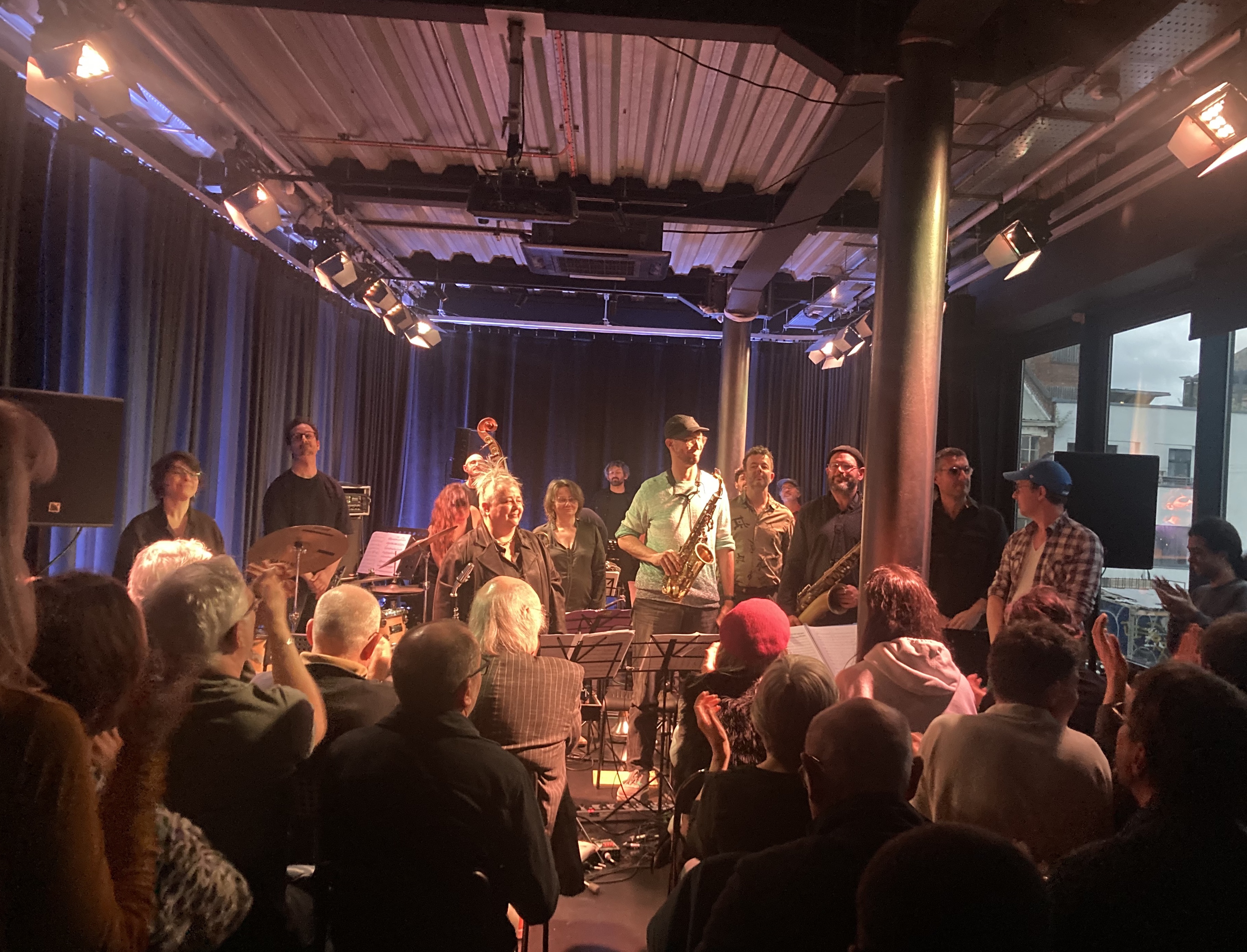
Cafe Oto, 8/6/24. From left: Melvin Gibbs, Eadyth Crawford, Mark O’Connor, Tomos Williams, Mared Williams and Nguyen Le

A welcome in Welsh from the trumpeter, composer and bandleader Tomos Williams prefaced the performance in Dalston of the third part of his Cwmwl Tystion series: Empathy, to follow the live recordings of Witness (released in 2021) and Riot! (2023) made during earlier tours. In all three, Williams blends the language of contemporary jazz with stories from the last 200 years of Welsh history.

For each part, he deployed different resources: the harp of Rhodri Davies and the voice of Francesca Simmons on Witness, the saxophone of Soweto Kinch and the vibes of Orphy Robinson on Riot!. For Empathy, he retained the voice of Eadyth Crawford and the drums of Mark O’Connor and added the Vietnamese guitarist Nguyen Le, the American bass guitarist Melvin Gibbs and a second voice, that of Mared Williams.

The two non-Welsh guests, both virtuosos of effects-enhanced stringed instruments, played powerful roles in setting the tone and trajectory of the music chosen and written to accompany pieces inspired by Paul Robeson’s recital to the mining families of Aberpennar (Mountain Ash) in 1938, the eviction of the villagers of Mynydd Epynt in Powys by the Ministry of Defence in 1940, the Aberfan disaster of 1966 and the miners’ strike of 1984. All these were accompanied by Simon Proffitt’s back-projected visuals.

Gibbs, once a member of Defunkt, has few equals in turning a five-string bass guitarist into an electronic orchestra. Le is one of the most adept of post-Hendrix guitarists. They found a willing accomplice in the powerful and dextrous O’Connor. At times I was reminded of Miles Davis’s Tutu period, of Jon Hassell’s Fourth World Music, and of Terje Rypdal at his wildest. One late passage raised the volume to death-metal levels.

That made the use of the two voices, sometimes combined in folk-like materials, even more valuable as a contrast, along with the sudden and very moving insertion, during the Aberfan passage, of the pre-recorded sound of a pipe organ and a chapel choir, and Williams’s use of Donald Byrd’s “Cristo Redentor” as a healing balm towards the conclusion. Earlier, the trumpeter had excelled in a tightly muted solo over a lovely habanera rhythm.

After six concerts at various venues around Wales in the preceding days, this visit to Llundain represented the tour’s finale: the final performance of this particular work by this particular band. As they laid down their instruments and stepped back from microphones, the sense of exhilaration had a special resonance.

* Parts one and two of Cwmwl Tystion are available on the Ty Cerdd label.

Artistry in algorithm

This morning’s newspaper headlines included one suggesting that artificial intelligence will play a significant role in the UK’s coming general election. My first response was that, given the mess humans have made of selecting the last four prime ministers, maybe the machines should be given a chance.

Music, though — well, that’s something else. Who, for example, wants the unique voice of Steve Marriott, 30-plus years dead, sliced and diced by AI algorithms and applied to songs he never sang, apparently with the endorsement of his widow?

But there are other applications of this slightly terrifying technology that may have a different and more benign outcome. At the Vortex last night, two sold-out houses heard France’s Orchestra National de Jazz play the compositions of Steve Lehman and Frédéric Maurin, specially written to make use of AI software developed by Jérôme Nika, a researcher at the celebrated IRCAM — the Institute for Research and Co-ordination in Acoustics/Music, founded in Paris by Pierre Boulez in 1977, at the request of Georges Pompidou, and now housed in the centre bearing the former president’s name.

The music was recorded last year as a live performance in the Tonstudio Bauer in Ludwigsburg and released as an album titled Ex Machina. It comes with extensive sleeve notes which I’ve read twice without really coming close to an idea of what the software actually does. But I do know that Lehman, who played the alto saxophone parts on the album and in London, and Maurin, the orchestra’s director and conductor, also based their compositions on prolonged study of the movement known as spectral music, in which such post-Messaien composers as Gérard Grisey and Tristan Murail experimented with creating microtonal ambiances.

I found the album interesting but not, on early hearings, as stimulating as Lehman’s work with his great octet or in his multilingual rap group, Sélébéyone. At the Vortex, however, where they were stopping off en route to performing tonight at Southampton University’s AI Arts Festival in Winchester, the music exploded into three dimensions and full colour, retaining all its complexity and subtlety while grabbing the audience and refusing to let them go until the final shimmer of a quarter-tone vibraphone had faded to silence.

Much of this had to do with the vigour of the playing, which ensured that the compositions never sounded dry or academic. Textures vibrated, rhythms were sprung. The shifting syncopations and abrupt stop-time figures had the excitement of James Brown’s band meeting Sun Ra in some distant galaxy.

The individual playing was uniformly brilliant in its response to the material. As well as Lehman’s serpentine, sweet-and-sour alto and the vibraphone of his octet colleague Chris Dingman (the only other American in the band), powerful impressions were left by improvisations from the bass trombone of Christiane Bopp, the tenor saxophone of Julian Soro, the clarinet of Cathérine Delaunay, the flute of Fanny Ménégoz, the baritone saxophone of Fabien Debellefontaine, and the trumpets of Fabien Norbert and Olivier Laisney. But what really fired the orchestra was the rhythm team: the deep power and agility of the double bassist, Sarah Murcia, in collaboration with the magnificent drive and awe-inspiring precision of the drummer, Rafaël Koerner. Thanks to them, the music never flagged.

It made me recall the last time I heard a largeish ensemble playing music that took the composition/improvisation dialogue in such a stimulating new direction. That was in 2016, when I first heard the White Desert Orchestra, led by the French composer/pianist Eve Risser — a graduate of the Orchestre National de Jazz. Obviously not a coincidence.

* Ex Machina by Steve Lehman and the Orchestra National de Jazz is on the Pi Recordings label.

The sound of style

John Simons, who turns 85 this Friday, remembers being 17 years old in 1956 and going to see Stan Kenton at the Albert Hall. He recalls the tall, imposing figure of the bandleader, and the thrilling sound of the music, one piece in particular: “‘Concerto to End All Concertos’!”

He also remembers that one of the band’s musicians had been sent home before they’d played a note on the hugely successful 53-date UK tour. It was the tenor saxophonist Spencer Sinatra, who’d been caught trying to score drugs soon after their arrival in London. Kenton packed him straight off back to the USA, along with his apparently blameless roommate, the baritone player Jack Nimitz. Simons claims that his memory for names isn’t so good any more, but he remembers the British replacements who were called in: Don Rendell and Harry Klein.

Perhaps less surprisingly, he also remembers how beautifully dressed the musicians were and the item of clothing he himself bought for the occasion: “It was a trenchcoat. Six guineas from Millet’s.” For John Simons, jazz and fashion have always been woven together.

A decent clothes shop that plays good music adds something to one of life’s pleasures. In Simons’ shop on Chiltern Street in Marylebone, the music is always good because it’s going to be something that refers in some way to the modern jazz on which the proprietor got seriously hooked as a young man in the 1950s. He’s not in the shop very often these days. His sons run it now, but they keep it on the Ivy League path he and his early partners established many years ago: button-down shirts, loafers, nice raincoats, soft-shouldered corduroy jackets, knitted ties. And the music, of course.

He was born into a tailoring family in 1939 and left school to study shop design and window dressing at St Martin’s School of Art. He was working at Cecil Gee in Shaftesbury Avenue when he was offered a job with Hope Brothers, whose stores included Burberry’s on Regent Street. Before long he and a friend started a business of their own, with a stall off Petticoat Lane and then a little shop called Clothesville next to Hackney Empire. He could design something, send it over to a tailor, and expect to have it back for sale the next day.

In the summer of 1964 he opened the Ivy Shop in Richmond, two doors up from L’Auberge, the café where the mod fans of the Stones and the Yardbirds would meet. His next venture was the Squire on Brewer Street in Soho. Then came the Village Gate, with branches on the King’s Road and Old Compton Street, named after the celebrated Greenwich Village jazz club, which he’d visited on a trip to New York. “I wrote to the owner of the Village Gate, Art D’Lugoff, for permission. He said, ‘As long as it’s not a jazz club, be my guest.'”

At the start of the 1980s he started a shop called J. Simons in Covent Garden, which became a haven for those to whom, in the words of Robert Elms, the classic modernist wardrobe represents “the only youth culture uniform that doesn’t look ridiculous in retrospect.” When the lease ran out he looked around before, in 2011, opening the current shop in a district which, as with Covent Garden, he has played a part in reshaping.

When I asked him to name some musicians whose work he really loves, he mentioned the Clifford Brown-Max Roach quintet, Chet Baker’s singing, the MJQ and Billie Holiday. And Thelonious Monk. “At the youth club I went to,” he said, “people danced to Monk. Can you believe that?”

Passion / Compassion

Back in the early 1970s, Santana were my favourite live band. I saw the original line-up — more or less as heard at Woodstock — at the Albert Hall in 1970 and twice the following year, at Hammersmith Odeon and the Olympia in Paris. They were thrilling, and surrounded by a sense of excitement; before the show in Paris, I remember Mick Jagger and Bianca Pérez-Mora Macias sweeping through the backstage bar, a week ahead of their wedding.

Then the music changed, and they became even better. Carlos Santana and Michael Shrieve had been listening to John Coltrane and Elvin Jones and to Miles Davis’s Sketches of Spain and Bitches Brew. Santana’s fourth album, Caravanserai, brimmed over with the effect of those influences, starting with an unaccompanied solo by the saxophonist Hadley Caliman and culminating in the ecstatic nine-minute “Every Step of the Way”, a Shrieve composition. Clive Davis, the president of their record company, called it “career suicide”. At the Wembley Empire Pool in November 1972, just after the album’s release, an expanded line-up rose to a different level, musically and spiritually.

After Wembley they went off to play some concerts in Europe before returning towards the end of the month for dates in Manchester, Newcastle and Bournemouth. On Thursday, November 23 they had a day off in London, and, being American, arranged a small Thanksgiving Day dinner in the private room of a restaurant on Davies Street in Mayfair. I’d raved about Caravanserai in the Melody Maker, so they were kind enough to invite me to join them for what turned out to be a very pleasant evening.

While they were in London I interviewed Shrieve, who talked eloquently and passionately about the changes they’d made in the music, and about the jazz influences inspiring them. He spoke of his admiration for Elvin, Roy Haynes, Philly Joe Jones and Tony Williams and of studying their playing with his friend Lennie White, who had just joined Chick Corea’s Return to Forever. And he said something that struck me when I read the piece again the other day: “What’s so beautiful about the band, apart from the popularity which we know we’re fortunate to have and which we’re grateful for, is that right now it’s the perfect situation to be open. Specially at our age, because we realise that there’s still a lot of time.” Fifty years later, it’s clear the time hasn’t been wasted.

I loved Shrieve’s playing from the start, the way he meshed perfectly with the percussionists José “Chepito” Areas, Mike Carabello, Armando Peraza, Coke Escovedo and James Mingo Lewis. Since then I’ve followed his career mostly from a distance, although we reconnected when I was at Island Records in the mid-70s and he and Steve Winwood were part of Stomu Yamash’ta’s Go project, and then when the label signed Automatic Man, a rock band he was in with the singer/keyboards player Bayeté (Todd Cochran) and the guitarist Pat Thrall, and whose 1976 single “My Pearl” sounds today like a presentiment of Prince. Of his solo albums, I’ve always loved Stiletto, released in 1989 on RCA’s Novus imprint, in which he and a band including the trumpeter Mark Isham and the guitarists David Torn and Andy Summers created a very fine version of Gil Evans’s “Las Vegas Tango”.

If you have a copy of Lotus, the live triple album recorded in Osaka during the Caravanserai tour, you’ll know the 10-minute drum solo called “Kyoto” that shows what a superlative drummer he had already become, at the age of 23. It has none of the bombast of his rock contemporaries and much of the fluency of his jazz heroes. It’s music.

His new album, recorded over a period of years, is called Drums of Compassion — a reference to the hugely popular album titled Drums of Passion recorded in 1959 by the great Nigerian drummer Michael Babatunde Olatunji, who died at his home in Northern California 2003, aged 75, but whose voice is the one you hear first and again from time to time on an album that has been long in the making. Shrieve says that the title is also an acknowledgement of the Dalai Lama’s call for a Time of Compassion.

Of course, percussion instruments play an important role in this music. But the whole thing, although its 39 minutes are sub-divided into nine pieces, some with different composers, is like a lush, constantly shifting sound painting in which other instruments — guitar, saxophone, oud, electronic keyboards — emerge with utterances that seem less like solos than simply part of the fabric.

Shrieve can put together a multi-faceted track (“The Call of Michael Olantunji”) including himself, Jack DeJohnette, Airto Moreira and Zakir Hussain on various percussion instruments without making it sound for a second like an old-fashioned drum battle or a display of egos and techniques, even when Shrieve’s orchestral tom-toms come to the fore. The percussionists’ work is blended into the overall picture, here creating an armature for Olantunji’s voice and Trey Gunn’s guitar.

Shrieve can make the space for one performer alone on the eponymous “The Euphoric Pandeiro of Airto Moreira” (chanting and Brazilian percussion) and “Zakir Hussain” (tablas). He shares another track, the sultry, drifting “Oracle”, in a duet with another Brazilian, the electronic musician Amon Tobin. The ambience swirls and drifts without relaxing its subtle grip.

A steamy tone poem titled “On the Path to the Healing Waters” features the tenor saxophone of Skerik (Eric Walton), a Seattle-based musician who has played with Wayne Horvitz and Charlie Hunter, and who here plays a Wayne Shorter-ish less-is-more role. And I’m particularly happy to lose myself inside “The Breath of Human Kindness”, five minutes of one-chord jam in which the oud of Tarik Banzi makes its single eloquent appearance, a voice from ancient Al-Andalus amid the glistening keyboards of Pete Lockett and Michael Stegner, paced by Farko Dosumov’s stealthy bass guitar riff.

There’s a rare combination of majesty and humility at work in this music, something that speaks of the deep and lasting impact of Coltrane’s influence on Shrieve’s instincts and decisions. More than half a century after Caravanserai, this is an album for listeners who followed Shrieve and Santana on that journey into a wider world, one where frontiers and prejudices dissolve.

* Michael Shrieve’s Drums of Compassion is out now on the 7D Media label and available via Bandcamp: https://michaelshrieve7d.bandcamp.com/album/drums-of-compassion

Bill Frisell in Bristol, Brussels, Orvieto…

At the end of Bill Frisell’s concert in Bristol last night, my son (who had bought the tickets as a belated birthday present) asked me which of all the times I’d seen him live was my favourite. That took some thinking, but eventually I told him that it was probably a solo concert at Cadogan Hall in London half a dozen years ago. Although perhaps not the most spectacular, it seemed to capture so much of the essence of an extraordinary musician.

But Frisell is one of those players who put his essence into every note, whatever the context and the demands it makes. At last night’s gig in the beautiful St George’s, a repurposed 200-year-old neoclassical church, he was joined by the bassist Thomas Morgan and the drummer Rudy Royston, long-time partners with whom he has a rapport that may be well grooved but never precludes the element of quiet surprise.

Their two unbroken 45-minute sets were intimate conversations that flowed from theme to theme with a beautiful sense of dovetailing, full of subtle allusions that looked both backwards and forwards, maintaining a gentle but persuasive continuity.

Some of the themes I recognised were Frisell favourites: a gorgeous “Lush Life” (including the prefatory verse); the loping “Lookout for Hope”, with its light reggae inflection; the staccato flourishes of Thelonious Monk’s “Evidence”; Bacharach and David’s “What the World Needs Now Is Love”, with a lovely moment in which Frisell simply stroked out the chords; and, as an encore and parting benediction, a quietly glowing “When You Wish Upon a Star”, written for the 1940 Disney film Pinocchio, a song that he once said “has been in my bloodstream for as long as I can remember.”

The trio is also present throughout his new album, Orchestras, which combines one disc recorded live at two halls in Belgium with the Brussels Philharmonic and another captured at a theatre in Orvieto with the Umbria Jazz Orchestra. Both ensembles are arranged by the great Michael Gibbs, now 86 years years old, who pours all his decades of knowledge and wisdom into providing inspiring settings for the guitarist.

If Nelson Riddle had been a jazz arranger on the level of a Gil Evans, he might have come up with the subtly shaded orchestrations Gibbs delivers for the full symphony outfit on his own “Nocturne Vulgaire” and “Sweet Rain”, Ron Carter’s “Doom” and several of the guitarist’s own compositions, including “Electricity”, “Throughout” and “Richter 858 No 7”, from his album of pieces inspired by the German artist. Strings, brass and woodwind are everywhere deployed with subtle grace.

On the second disc, Gibbs uses the 11-piece Umbria ensemble — six brass, four reeds and a lone cellist — to bring out the shades in Frisell’s music that evoke an America of bayous, of prairies, of woodsmoke rising from remote farmsteads. It’s much more of a jazz sound, like an expanded version of the three-horn sextet with which the guitarist made the gorgeous Blues Dream album — a particular favourite of mine — in 2001.

Thanks to Gibbs, everything on both discs has combines an almost weightless elegance with deep soulfulness, something the arranger absorbed from his reverence for Gil Evans. You can hear it perfectly on “Strange Meeting”, with echoes of Evans’s fondness for the Spanish tinge in its luscious sway and Moorish blues tonality, drawing the very best from Frisell, to whose vast discography this is a recommended addition.

* Bill Frisell’s Orchestras is out now on the Blue Note label, as two CDs or three LPs.

The sound of London

It’s been exciting to watch the blossoming of a new young UK jazz scene in recent years, and now it’s possible to welcome a historical survey of its emergence. André Marmot’s Unapologetic Expression, published this month, is an insider’s explanation of why and how it happened, by whom and to whom. This is history almost in real time, with the con trails still visible in the sky

Marmot is a musician who has worked for the last few years as agent, promoter and label owner. Perhaps that makes him an unusual person to write such a work. But it also gives him access to the people on the scene, justifying the subtitle: “The Inside Story of the UK Jazz Explosion”. More important, he can really write. Not in a fancy way, but with a clarity of thought and a simple elegance of expression that make it a pleasure to turn from page to page.

It’s a story of the music’s evolution in London; there are a few mentions of Soweto Kinch and GoGo Penguin, but none of Xhosa Cole or Nat Birchall. And its focus excludes the parallel world of free improvisation, the descendants of the SME and AMM. But at least we know where we are, and where the author is coming from.

The narrative takes in United Vibrations, Steez, Brainchild, Total Refreshment Centre, Steam Down, Brownswood and We Out Here, Jazz Re:freshed, Church of Sound, Tomorrow’s Warriors and more. The soundtrack might be Moses Boyd’s “Rye Lane Shuffle” and Yussef Kamaal’s Black Faces. One of the key events might be the appearance of Boyd, Shabaka Hutchings and Theon Cross at South by Southwest in Austin, Texas in 2017, when it became obvious that this scene could gain traction with listeners beyond Peckham and Dalston.

It’s quite a political book, in the sense that Marmot is not afraid to spend time criticising the effect of government policy on the arts and on young jazz musicians in particular, and propounding his belief (impeccable in my eyes) that jazz is essentially a black music in which others are welcome to take part. He puts his arguments concisely and chooses his supporting voices well.

For this is, in large part, an oral history. And whatever the perspective he’s examining — there are chapters called “Jazz Ownership and Appropriation”, “Jazz and Postcolonial London” and “New Industry Models and the End of Musical Tribalism” — he allows the musicians themselves to have their unmediated say. It’s no surprise that people like Sheila Maurice-Grey, Dave Okumu, Poppy Ajudha, Jason Yarde and Emma-Jean Thackray turn out to have interesting opinions.

If those chapter headings make the book sound academic, it isn’t. It’s anything but. It’s as full of life and energy, as sparky and challenging, as the music itself. It might even convert some of those who look with scepticism on audiences — some of whose members perhaps don’t know Lester Young from Coleman Hawkins and may never have heard “West End Blues” or “Parker’s Mood” — dancing and cheering as these musicians play for people who look, think and live like themselves.

But in order to exalt the new, it’s not necessary to denigrate the past, and there are some passages here that may annoy jazz fans of former generations. It’s easy to pour scorn on views expressed in earlier times, which is what Marmot does here with, for example, an autobiography from 1998 in which John Dankworth — who did much to popularise the music in Britain in the past-war decades — claimed that jazz “since its beginnings… [has been] an instrument of goodwill and peaceful and gradual change rather than anything really revolutionary.” I tend towards Marmot’s view rather than Dankworth’s, but I’d caution him that the passage of time can distort as well as clarify.

In between sessions of reading his book, I was listening to two new British jazz albums. The first is the latest from Empirical, who receive only a single slighting mention for their “dressed-up-for-the-wedding, jazz-cliché” look, which he compares unfavourably with the dressed-down, funky-Peckham vibe of Binker Golding and Moses Boyd on the cover of their 2015 debut album. I think it’s a ridiculous criticism, as irrelevant as dissing the MJQ for wearing tuxedos, and — like the Dankworth swipe — unworthy of what is otherwise a valuable piece of work.

Empirical’s Wonder Is the Beginning features the basic quartet with guests Jason Rebello on piano and Alex Hitchock on tenor saxophone. Most of the knotty but engaging tunes are written by Tom Farmer, the bassist, with one apiece from Nat Facey, the alto saxophonist, and Lewis Wright, the vibes player. Anyone who has ever enjoyed their work will find plenty to digest here, in a well established groove that enters the room occupied by Andrew Hill, Bobby Hutcherson and Eric Dolphy in their Blue Note period and pushes the walls out slightly. The addition of the guests enriches the range of tone and gesture without disturbing the group’s fine balance.

Cassie Kinoshi belongs firmly in the generation promoted by Marmot, and is among those providing the author with interesting opinions on his chosen topics. Her latest album finds an 11-piece version of her group Seed operating in partnership with the London Contemporary Orchestra and the turntablist NikNak on a 22-minute, six-part suite called Gratitude (from which the album takes its title), recorded at the Purcell Room in March 2023, and in a 10-piece formation performing a five-minute piece called “Smoke in the Sun” at Total Refreshment Centre in 2021.

This isn’t a long album, then, but it gets a lot of substance into its half-hour duration, thanks to Kinoshi’s fast-developing gift for deploying the instrumental resources at her command. Her music is astringent in its sound and strong in its movements. The strings and woodwind, for instance, carry as much weight as the brass, reeds and rhythm: there’s no danger of anything sounding effete or chamber music-y here. The double bass of Rio Kai and the drums of Patrick Gabriel-Boyle provide both line-ups with a loose-limbed swing.

There is plenty of space in the music, and a great deal of variety. When she clears a space for a soloist, she does it very adroitly: the guitarist Shirley Tetteh, the trumpeters Jack Banjo Courtney and Joseph Oti-Akenteng, and eventually herself, with an improvisation that really soars, leading the sixth and final movement to a dramatic but graceful conclusion. Nothing sounds pasted-in or anything less than organic.

Both these albums, and André Marmot’s book, tell a very encouraging story about the condition of British jazz: not just about the skill and originality of its practitioners, but about their continuing ability to find, expand and stay close to their audience.

* André Marmot’s Unapologetic Expression is published by Faber & Faber. Empirical’s Wonder Is the Beginning is on Whirlwind Records. Gratitude by Cassie Kinoshi’s Seed with NikNak and the London Contemporary Orchestra is on International Anthem.

Matana Roberts at the Roundhouse

Note: After this piece was first posted, Matana pointed out to me that her pronouns are “they/them”. I’ve rewritten it to take account of that preference.

Matana Roberts did a lot of talking at the Roundhouse last night. A lot more talking than playing, in fact. Alone on the stage, opening the show for Lonnie Holley with an hour-long set, they restricted the saxophone — a soprano, rather than her usual alto — to the occasional short phrase or two, often prefaced with the words “This is an improvisation.” We heard a handsome tone on the straight horn, and an ardent delivery, but nothing was allowed to build or cohere into a greater scheme.

Instead we were addressed with verbal riffs on a variety of topics, from the general reaction to the artist’s wild new hair to what a border control officer said about their tattoos. They spoke of a photo of a recent protest in which students had barricaded their doors and windows in the manner taught in “active shooter” drills. “I’m from the Mid-West,” Matana said. “We only had tornado drills.”

That provoked their observations on protest songs, during which we were encouraged to hum a single tonic note in accompaniment as they sang “Wade in the Water” in a pleasant, unemphatic voice. Eventually we were persuaded to join in “I Shall Not Be Moved”.

There was also a story to tell about being invited to play at the Whitney Museum on the day in 2015 when Michelle Obama, a fellow Chicagoan, was opening a new wing. Matana was invited to perform on the roof while the First Lady was doing the ribbon-cutting thing, so that the music would cascade down. The surprise discovery up there was the presence of a detachment of snipers.

“They were surrounding me,” Matana remembered. “Three of them. And they were kind of happy-go-lucky. They wanted to show me their guns. ‘I don’t want to see your guns!'” The ceremony over, Michelle Obama was taken away in an armoured vehicle.

“That was really a symbol of America today,” Matana observed, before returning to the business of singing and playing and musing, trying to summon the better spirits of our troubled world.

Sounds for summer

Tall enough to be unmissable in any environment, and with a truly remarkable fashion sense, Shabaka Hutchings had presence from day one of his career. To me, as an observer, that was the concert at the Royal Festival Hall in June 2009 at which he was one of several UK guests with Charlie Haden’s Liberation Music Orchestra (others included Robert Wyatt, Jason Yarde, John Parricelli and Andy Grappy). He had just one solo but when he stepped forward, the sounds coming from his tenor saxophone commanded everyone’s attention.

Since then, we’ve heard him with Sons of Kemet, The Comet Is Coming, the Ancestors and Louis Moholo-Moholo’s Five Blokes, and in a reinterpretation of Coltrane’s A Love Supreme at the Church of Sound a few weeks ago which I was very sorry to miss. And now he has enough presence to allow him to drop his surname and become just Shabaka.

He’s also dropped the saxophone, which is more of a surprise, in order to study the flute — specifically the Japanese shakuhachi and other iterations, including the Andean quena and the Slavic svirel. His new album — titled Perceive Its Beauty, Acknowledge Its Grace — is evidence of this turn of interest.

It’s a radical departure from anything he’s given us before. A series of sketches deploys varying personnel, including the pianists Nduduzo Makhathini and Jason Moran, the guitarist Dave Okumu, the singer Lianne La Havas, Moses Sumney, Laraaji and ESKA, the harpists Brandee Younger and Charles Overton, the drummers Marcus Gilmore and Nasheet Waits, the speakers Saul Williams, Miguel Atwood-Ferguson and Anum Iyupo, the rapper Elucid, the percussionist Carlos Niño and the bassists Esperanza Spalding and Tom Herbert.

That’s an impressive line-up, but as you listen to the album you’re never really thinking of individuals or their virtuosity. In that sense it’s a quite different experience from that of listening to a “jazz album”. But neither is it a kind of New Age tapestry of sound, slipping by without disturbance, merely a bit of aural decoration.

It has an overall charm and moments of great and singular beauty, too, such as the shakuhachi improvisation against Overton’s harp and the celestial layered voices of Sumney on “Insecurities”, La Havas’s vocal reverie on “Kiss Me Before I Forget”, or Spalding’s springy bass behind Elucid’s rap on “Body to Inhabit”, but it also has depth, and not just in the occasional verbal passages, which are carefully integrated into the quilt of sound. The overall impression is what counts, and somehow that goes beyond words.

The album contains one snatch of tenor saxophone, on a track called “Breathing”, in which Rajni Swaminathan’s mridangam — a Carnatic double-ended hand drum — backs first Shabaka’s treated and looped flutes, then his clarinet, and finally his saxophone, which briefly erupts in a gentle squall with an intonation recalling the great Ethiopian tenorist Getatchew Mekuria.

That little hint of Ethiopian music sent me to a new release in the name of Emahoy Tsege Mariam Gebru, who died this time last year at the age of 99. Born in Addis Ababa, she studied violin in Switzerland as a child, worked as a civil servant and sang for Haile Selassie, was imprisoned by the Italian occupiers during the Second World War, and spent a post-war decade as a nun in a hilltop monastery. The arrival of a new regime forced her to flee to Jerusalem, where she spent the rest of her life in an Ethiopian Orthodox convent and composed music for piano, organ, and various ensembles while running a foundation to encourage music education among children in her native land and elsewhere.

Like Mekuria, she had a volume of the producer Francis Falceto’s Ethiopiques series devoted to her music in 2006, and in the last couple of years there have been more albums on the Mississippi label. The latest is called Souvenirs, a collection of her songs apparently recorded between 1977 and 1985. It’s a primitive recording: the piano sounds like a poorly maintained upright and her voice was probably recorded on the same microphone, in a room that was almost certainly not a recording studio. But that does nothing to diminish the appeal of these songs, with titles such as “Where Is the Highway of Thought?” and “Like the Sun Shines on Meadows”, whose vocal melodies are doubled by the pianist’s right hand against left-hand figurations assembled from scraps of blues and rhumba and gospel tunes.

What’s so appealing, almost mesmerising, about this music? I think it’s the combination of transparent simplicity (and sincerity) with the unexpected guile of the rhythmic undertow, which is always playing appealing tricks on the western ear. There’s something about the distinctive melodic shapes and phrase lengths that is special to this kind of Ethiopian music, springing from some deeper root.

Something else to add pleasure to this summer is After a Pause, the new album of acoustic duo music by two brilliant Welsh musicians, the guitarist Toby Hay and the bassist and cellist Aidan Thorne. I got interested in Hay when he was filming himself outdoors playing ragas during the first Covid-19 lockdown in 2020 and putting the results on YouTube, and wrote a bit more about him when he released some duets recorded in an old chapel with his fellow guitarist David Ian Roberts later that same spring.

I try to avoid talking about what musicians are doing in terms of the work of other musicians, but I suppose a simple — and, I hope, enticing — way of describing the scope of these duets is to imagine what Davy Graham and Danny Thompson might have got up to if they were both in their prime in the 2020s and were able to spend three days together in a studio with no distractions, enhancing their compositions and improvisations with a sparing but highly effective use of overdubbing and electronics.

After living with this album for a few weeks, I’ve come to appreciate not just its surface beauty but the way it reveals more of itself and its spiritual essence the closer you listen. The 12-string arpeggios and bowed bass of the opener are a call to the attention that is never wasted as the music blooms and glows through 10 shortish but unhurried pieces, trajectories shifting and densities varying considerably from bare-bones to near-orchestral (on “Burden” or “Eclipse”) but mood sustained. The brief solo piano coda is a lovely way to finish.

A light shines through these three albums. I’ve a feeling they’re going to be among the summer’s best companions.

* Shabaka’s Perceive Its Beauty, Acknowledge Its Grace is on the Impulse! label. Emahoy Tsege Mariam Gebru’s Souvenirs is on Mississippi Records. Toby Hay and Aidan Thorne’s After a Pause is on Cambrian Records. Links here:

https://spibaig.bandcamp.com/album/perceive-its-beauty-acknowledge-its-grace

https://emahoytsegemariamgebru.bandcamp.com/album/souvenirs

https://cambrianrecords.bandcamp.com/

The Necks at Cafe Oto

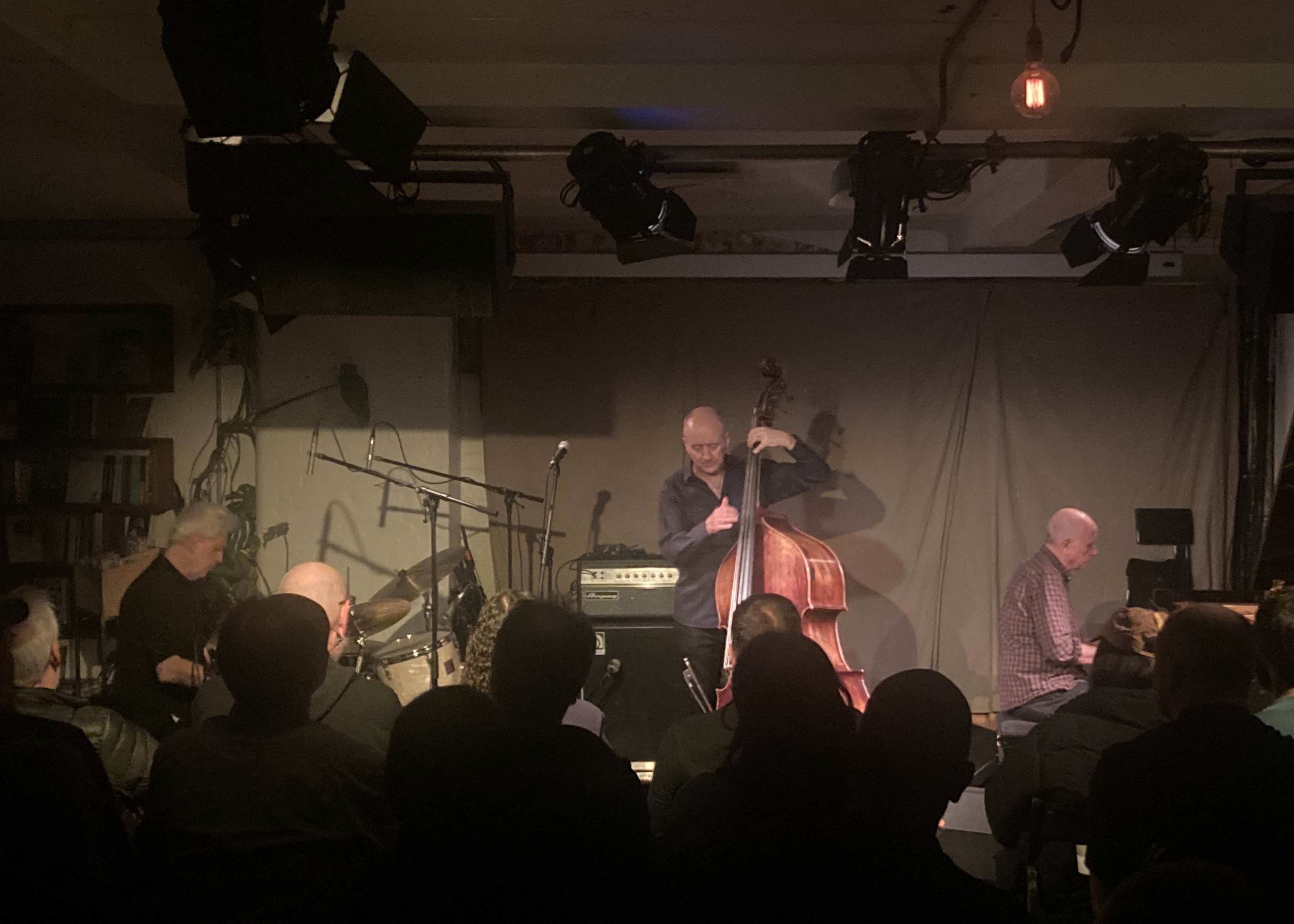
“We’ve never really been an emotional band,” Lloyd Swanton observed drily after the first set on the last of the Necks’ four nights at Cafe Oto in London this week, “but it seems to be creeping in.”

I’d been trying to tell him, somewhat incoherently, how moved I’d been by what they’d just played, and in particular how it seemed to express something about the current state of the world. His reflexive response indicated that what he and his colleagues in the Australian trio do is principally about the notes, about the process of three musicians improvising together with no preset material and certainly with no programmatic content in mind. Which is not to say that listening to them isn’t an emotional experience. It is, almost invariably, but the emotions they generate are usually non-specific.

To me, at least, it seemed that there was something different about Thursday’s first set. It started out normally enough, after they and the audience had settled, with one member — Swanton, on this occasion — breaking the silence. As he plucked an isolated note on his double bass, repeating it and echoing it an octave down, sometimes switching to his bow, and initially with long pauses, Tony Buck joined in with mallets gently rolling around his tom-toms and cymbals, followed by Chris Abrahams picking out pensive Moorish figures in the middle-upper octaves of the piano.

For a while, not much seemed to be happening. No surprise there, necessarily. Later Buck said that he’d worried it had started out “a bit washy”. But in 20 years of attending their performances I’ve learnt to wait, to show the kind of patience as a listener that they show as players, in the knowledge that the surprise will come. In fact, they are the proof that the sound of surprise can emerge slowly, by gradual accretion.

This time the process of accretion led to something extraordinary. As the playing of all three grew busier, the textures thickened, the spaces closed and the volume increased, all of it occurring almost imperceptibly, you began to feel that you were hearing things: bells, cries, gunfire. It was an illusion. They weren’t there, and neither was anyone trying to produce them. But somehow they were present — for me, anyway — in the harmonics reflecting off the piano lid, the scrabbling and keening of the bass, and the hard crack of the bass drum against the overlapping splashes of the cymbals.

Eventually it reached a pitch of intensity that was sustained for maybe 15 minutes before being gradually wound down through a collective diminuendo into silence once again. And in those 15 minutes I couldn’t help replaying the images we’ve been seeing on the TV news every night for months — images of buildings, streets, whole cities lying in ruins, of the dead being counted and the living in flight, the sort of total war we may stupidly have believed was safely consigned to a distant past.

That’s not, I’m sure, what the members of the Necks were thinking of while they were summoning the music into being. It’s more the sort of thing the pianist Vijay Iyer had in mind when, with the bassist Linda May Han Oh and the drummer Tyshawn Sorey, he recorded a new trio album whose title, Compassion, explicitly indicates its theme. “Music is always about, animated by, and giving expression to the world around us: people, relations, circumstances, revelations,” Iyer writes in the sleeve note, describing the responsibility, as he sees it, of making art in a time of suffering.

I’ve heard the Necks play music unafraid of ugliness before (a hair-raising triple-forte set at Café Oto in 2013 stands out in the memory), but never anything in which the kind of responses they normally evoke — including but not restricted to euphoria and elevation — were so strikingly replaced by this very different kind of transcendence, a sustained howl expressing something beyond words yet somehow very specific.

So that was the fifth of the six sets I heard them play this week, and the sixth was, as usual, quite different. Abrahams opened it with a reversion to the sort of thing that provokes the use of adjectives like “luminous” and “lambent”. But again there was a surprise when the piece evolved into an essay in the use of asynchronous rhythms, a field they’ve opened up in recent years, in which each one establishes his own pulse or metre and, without forfeiting closeness of listening to the others, maintains it as the piece develops. At its best, it leads to a kind of higher interplay — and this was the practice at its very best, creating a rhythmic maelstrom that activated a very different response in the audience.

All a long way from the sort of passive music for Zen meditation with which they are sometimes erroneously associated, and irrefutable evidence of their commitment, now extending well into its fourth decade, to a constant self-regeneration of which we are the fortunate beneficiaries.

* The Necks continue their European tour at Peggy’s Skylight in Nottingham on Monday (already sold out) and the Tung Auditorium in Liverpool on Tuesday, April 8 and 9 respectively. Their most recent album, Travel, was released in 2022 on the Northern Spy label. Compassion, by Vijay Iyer, Linda May Han Oh and Tyshawn Sorey, was released earlier this year by ECM.