Skip to content

Posts from the ‘Jazz’ Category

Val Wilmer: ‘Blue Moments, Black Sounds’

Val Wilmer is one of the most remarkable people I know, and you’ll know that too if you’ve seen her photographs. Whether it’s Muddy Waters playing cards with Brownie McGhee backstage at the Fairfield Halls in 1964, Archie Shepp sitting beneath a Jimi Hendrix poster in his New York apartment, or a joyful couple whose names we’ll never know at a blues dance in Bentonia, Mississippi half a century ago, she finds the essence of the human spirit.

Those three images are among the several dozen included in Blue Moments, Black Sounds, an exhibition of her photographs which opened this week. It’s on until the end of November at a very nice little gallery in Queen’s Park, North London, which specialises in music photography and where you can also go to get your own pictures framed.

I was particularly moved by the only photograph in the show that has an extended caption, written by Wilmer, in which she tells of going to see Louis Armstrong at Earl’s Court in 1956, when she was a 14-year-old schoolgirl. When Armstrong and the All Stars left the country, catching a plane to Ghana, she and her brother went to see them off at the airport. She took her mother’s Box Brownie camera, asked Louis if she could take his photograph, and got a lovely shot that put her, as she says, “on my way to a lifetime of learning.”

Then she adds something interesting and important: “Through getting to know the musicians, I learnt the importance of positive representation.” That doesn’t mean she learnt how to take PR photographs. It means she learnt to appreciate the importance of immersing herself in the world of her subjects, in order to portray them with greater sensitivity to their lives and to the art that came from it, and to realise that pictures of Ornette Coleman playing pool with Anthony Braxton or members of the Count Basie orchestra snoozing on the band bus can actually tell us more than photos of them on stage.

Those photographs, like most of the ones in the new show, could only have been taken by someone possessing not just painstakingly acquired technical skills but a deep sympathy with the music and the lives of those who make it, and with the courage and humility to take her own place in their world, and to find her unique vantage point.

* Val Wilmer’s Blue Moments, Black Sounds is at the WWW (Worldly, Wicked & Wise) Gallery, 81 Salusbury Road, London NW6 6NH until 30 November: wwwgallery@yahoo.com. Deep Blues 1960-1988, a pamphlet of Wilmer’s photographs from the world of the blues, edited by Craig Atkinson, has just been published by Café Royal Books: caferoyalbooks.com. Wilmer’s As Serious As Your Life: Black Music and the Free Jazz Revolution 1957-1977 is published by Serpent’s Tail.
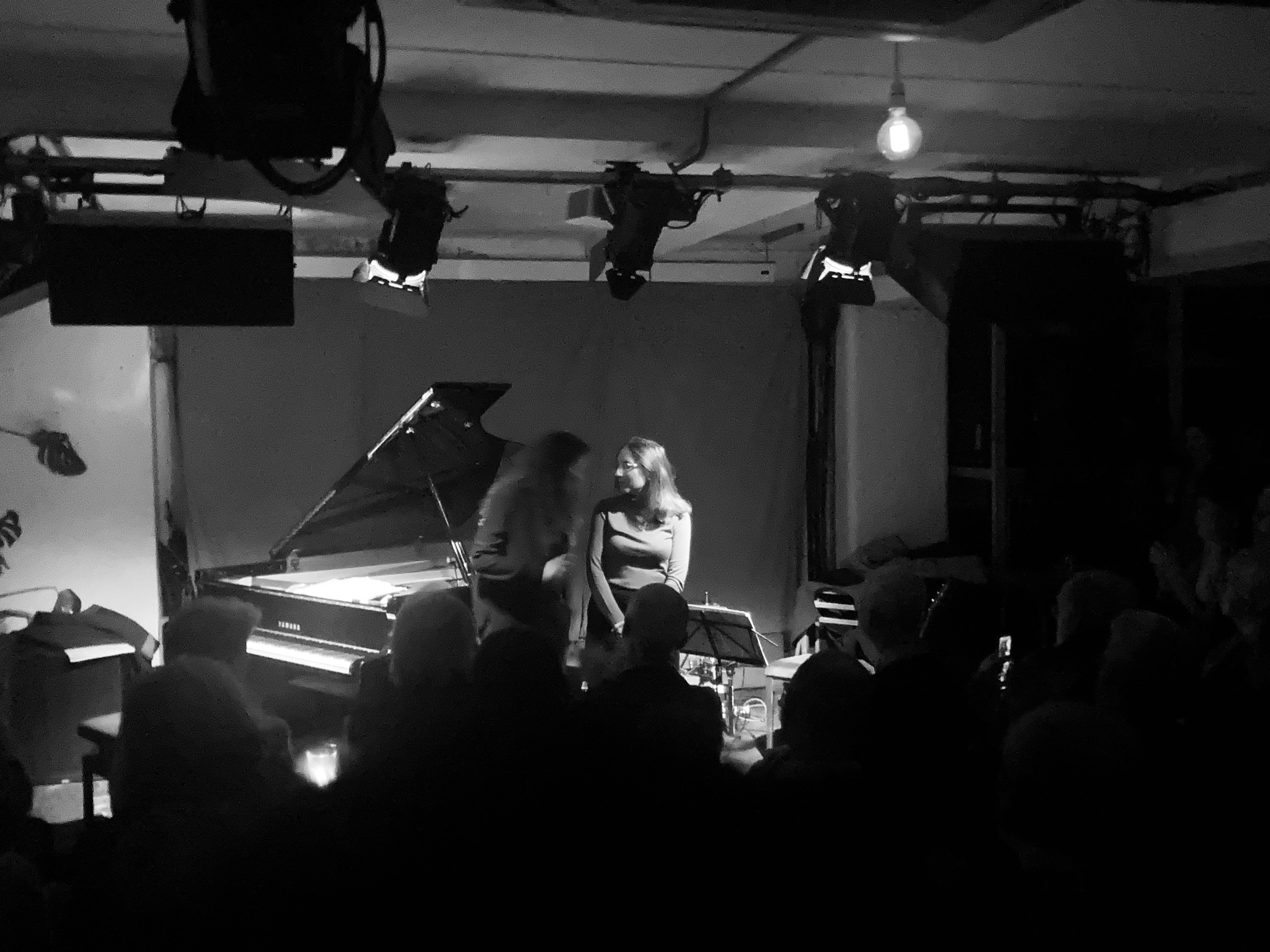
Sylvie Courvoisier x 2

Sylvie Courvoisier and Mary Halvorson at Café Oto 30 October 2023

One way and another, Sylvie Courvoiser’s new album, Chimaera, contains the most sheerly beautiful music I’ve heard this year. Inspired by the paintings and drawings of Odilon Redon (1840-1916), these pieces recall the words of the French artist about his own work: “They place us, as does music, in the ambiguous realm of the undetermined.” Without getting remotely literal about it, Courvoisier finds ways of creating a music parallel to such works as “Partout des prunelles flamboient (Everywhere eyeballs are ablaze)” and “Le pavout rouge (The red poppy)”, summoning dream-like textures that swirl and mingle, float and evaporate, creating pictures of their own.

Courvoisier, the Swiss-born pianist and composer, has lived in Brooklyn for the past 25 years, becoming an important figure in the New York downtown scene. Her band for the new album unites her partners in her regular trio, the bassist Drew Gress and the drummer and vibraphone-player Kenny Wollesen, with the trumpeters Wadada Leo Smith and Nate Wooley and the Austrian guitarist Christian Fennesz, who brings along his array of electronic tools. The broad palette of instrumental colours is used with immense care and subtlety, and with a sense of spatial resolution that invites the listener’s engagement.

She was at Café Oto in London last night with another regular partner, the guitarist Mary Halvorson, to present music based on their most recent album together, Searching for the Disappeared Hour. As piano-guitar duos go, this was neither Bill Evans with Jim Hall nor Cecil Taylor with Derek Bailey, although it contained elements of both those rare partnerships: the elegance of detail of the first and the fearless extended vocabularies of the second. This was music characterised by exactitude and generosity, making its own unique world, in which dizzyingly rapid written passages, never gratuitous, opened out into spellbinding improvised solo passages.

* Sylvie Courvoisier’s Chimaera is on the Intakt label. Couvoisier and Mary Halvorson’s Searching for the Disappeared Hour is on Pyroclastic Records.

Our Island Story

To those who found Chris Blackwell’s 2022 autobiography, The Islander, long on charm but, shall we say, short on detail, The Island Book of Records Vol 1 1959-68 will be the answer to their prayers. Here is the story of the UK’s most charismatic independent label during its formative years, in which the foundations were laid for the company that would later become the home of King Crimson and ELP, the Wailers and Bob Marley, Roxy Music, Bryan Ferry and Brian Eno, Sandy Denny, Sparks, John Martyn, U2 and Grace Jones before Blackwell sold it to Polygram in 1989.

Comprehensively compiled and meticulously edited by Neil Storey, who worked in the label’s press office (and was more recently responsible for the Hidden Masters archive box sets devoted to Chris Wood and Jess Roden), the book’s large square format — handsomely designed by Jayne Gould — enables LP covers to be reproduced at their original size. The scale also allows the enormous amount of information to breathe amid the mass of photographs, press cuttings, record labels and other paraphernalia and ephemera, plus masses of oral history from figures both famous and unknown to the general public but significant to the way the label was run, all deployed to inform and entertain.

After Storey’s discursive and amusing introduction, it begins by describing Blackwell’s origins in Jamaica and the UK, including a Daily Mirror clipping from 1933 showing a picture of his mother on her way to Buckingham Palace be presented as a debutante to King George V and Queen Mary, and his own Harrow School house photo from 1954. Island’s first release, the cocktail pianist Lance Haywood’s At the Half Moon Hotel, Montego Bay, from 1959, is accompanied by quotes from Blackwell, the guitarist Ernest Ranglin, the drummer Clarence “Tootsie” Bear, and the daughter of the hotel’s director, who invited Blackwell — then a water-ski instructor — to listen to the trio performing in the lounge, an encounter on which history hinged.

That’s the degree of depth the reader can expect, whether the subject is Jackie Edwards, Millie Small, Traffic, Jimmy Cliff, Spooky Tooth and the nascent Fairport Convention or the American artists — Ike & Tina Turner, James Brown, Inez & Charlie Foxx, J. B. Lenoir, Billy Preston, Jimmy McGriff, the pre-Spector Righteous Brothers and Huey “Piano” Smith — released on the Sue label by Guy Stevens, the DJ at the Scene club in Ham Yard whose vision was recognised and given free rein by Blackwell, to the lasting benefit of me and many other ’60s teenagers.

The more obscure bands — Wynder K. Frog, Art, Nirvana, the Spontaneous Music Ensemble — are covered in full, as are the projects undertaken to pay the bills while providing a laugh along the way: That Affair (about the Christine Keeler scandal), Music to Strip By (with a lace G-string stuck on to the cover), For Adults Only (comedy) and Big Theo (Johnson)’s Bawdy British Ballads. The company’s first gold disc was apparently secured by Why Was He Born So Beautiful by the Jock Strapp Ensemble, the first of several volumes of rugby songs, at least one of which was recorded at Sound Techniques by the engineer John Wood, who would later record Nick Drake and the other Witchseason artists at the same Chelsea studio.

The making of all these is illuminated by the people who were there, not just the artists but those who were playing important roles in the background, whether by working in the Basing Street office — where everyone sat at round tables, erasing a sense of explicit hierarchy — or by going around the country selling the records, or simply by being Blackwell’s friends. How they all made it up as they went along, and how the founder encouraged and allowed it to happen, is an object lesson in human and cultural dynamics.

“I’m not a collector,” Blackwell says. “I was always looking forward.” Island maintained no real-time archive during his era (which, of course, made Storey’s task of research more demanding and almost certainly more entertaining). When I worked in A&R there, in the mid-’70s, someone told me one morning that the Richmond branch of the Blackwell-owned One Stop Records was closing that evening and that the basement contained a cache of the company’s old 45s. They were going to be chucked out and did I want to do something about them? Collectors had better close their eyes at the next bit: I drove straight down there, found boxes and boxes of mint Sue and white-label Island singles from the ’60s, sorted out two of each — one for the company, one for my office — and sent the rest to be melted down. I have no idea what happened to the ones I saved after I left in 1976. Everyone was looking forward, which is the right way to run a record company.

* The Island Book of Records Vol 1 1959-68, edited by Neil Storey, is published by Manchester University Press (£85).

Nina & Monk, etc

If you happen to be in Paris this week, you might wander along to the little bookshop and gallery of Robert Delpire, tucked away on a street beside the church of Saint-Germain-des-Prés, to see a small show of photographs taken by the Baroness Pannonica de Koenigswater.

Nica, as she was known, took snapshots of many great jazz musicians during her encounters with them in the 1950s and ’60s. To them — the pianists Thelonious Monk and Barry Harris in particular, but many others, too — she was a friend, patron and benefactor, which means that her photographs, taken in dressing rooms and hotel rooms and kitchens, have a rare intimacy and candour.

The photo above, of Thelonious Monk and Nina Simone, is one of about a dozen of the original Polaroids framed and mounted on the walls of the gallery. Many more — of Hank Mobley, Sonny Clark, Coleman Hawkins, Oscar Pettiford, Billy Higgins, Paul Chambers and others — are included in a new book called Dans l’oeil de Nica (Through Nica’s Eye).

Her photos have the tonal richness and warmth characteristic of Polaroids. They were also badly stored for decades and are presented as found, many of them in a semi-distressed condition that inevitably enhances their romantic allure.

The new book is a follow-up to Three Wishes, published in English by Abrams Image in 2006, in which Nica’s photos were accompanied by the answers given to her by dozens of musicians when she asked them the question implied in the title. Many of them are very personal, others poignant, viz. Eric Dolphy: “1: To continue playing music all my life. 2: A home and a car in New York. That’s all!”

* The exhibition is at Delpire & Co, 13 Rue de l’Abbaye, Paris 6, until Saturday 28 October (Wed-Sat 12-6pm). Dans l’oeil de Nica is published by Buchet/Chastel (€44). Nica’s remarkable story is well told in The Baroness, a biography by her niece Hannah Rothschild, published by Virago in 2013.

Carla Bley 1936-2023

Carla Bley during one of the recording sessions for ‘Escalator Over the Hill’

It seems so true to Carla Bley’s nature, such a characteristically mordant mixture of the sad and the funny, that her last album should have been called Life Goes On. Carla, who was one of jazz’s greatest composers and arrangers, died this week, aged 87. The four pieces recorded in 2019 and making up the short suite that gave the album its name are titled as follows: “Life Goes On” / “On” / “And On” / “And Then One Day”.

And then one day Carla was gone, her death making us think of the music she leaves behind, all of it suffused by her unique personality. In my case, I’m most grateful for the five studio albums she made Charlie Haden’s Liberation Music Orchestra, starting in 1970 with its eponymous debut album, continuing with Ballad for the Fallen (1983), Dream Keeper (1990) and Not in Our Name (2005), and ending with Time/Life in 2016, all of them keeping the precious flame of resistance alight. Carla had grown up listening to her father play the organ in church, and the LMO often brought out her wonderful way of orchestrating hymns and anthems, from Hanns Eisler’s “Song of the United Front” to “Nkosi Sikelel’i Afrika” and Samuel Barber’s “Adagio”, acknowledging the beauty of their aspirations while spiking that beauty with the knowledge of human frailty.

And then there is Escalator Over the Hill, the triple vinyl LP box set released in 1971, the crazily ambitious and magnificently enigmatic “chronotransduction” on with she collaborated with the poet Paul Haines, enlisting a huge cast, perhaps the most extraordinary ever assembled for a single composition. The performers went from Don Cherry, Roswell Rudd and Gato Barbieri through Jack Bruce, Paul Jones and John McLaughlin to Viva, Linda Ronstadt and her own four-year-old daughter Karen, recorded against the odds over a long period of time in several locations, using several levels of technology, subsidised by money begged and borrowed to complete it before its release on JCOA Records, the independent label set up with her then husband, the trumpeter and composer Michael Mantler.

In my copy of Escalator there’s a five-page letter written by Carla to me on yellow legal-pad paper in pencil — “We’re up at our farm in Maine for a rest and we don’t even have running water and electricity, much less typewriters and stationery” — early in 1972, soon after its release. She’d heard from Jack Bruce that the Melody Maker had made it jazz album of the year, or something like that, and she wanted to tell me about how it was now being distributed in the UK as part of a reciprocal arrangement with the saxophonist Evan Parker and the Incus label. Within months she and Mantler would set up the New Music Distribution Service, whose initial foreign partners included Incus and ECM, and which lasted until 1990, having helped disseminate the music of Laurie Anderson, Julius Hemphill, John Adams, David Murray, John Zorn and many others.

The letter is a reminder of Carla’s persistence in championing not just the value of creativity but the rights of the creator and the right to be heard. Others will write about how, as a teenager, she hitched a lift from California to New York to hear Miles Davis and took a job as a cigarette girl at Birdland, and about the enduring qualities of songs like “Sing Me Softly of the Blues”, “Vashkar”, “Ida Lupino” and “Lawns”, and how A Genuine Tong Funeral, the suite she wrote for Gary Burton in 1967, represented the first full exposure of her gifts as well as her sense of humour, beginning as it did with a sequence titled “The End”.

I last saw her at the Cadogan Hall in 2016, an almost spectral figure in black at the side of the stage, sitting down at the piano but also standing to listen as her music was played by the members of the Liberation Music Orchestra during the London Jazz Festival, two years after Charlie Haden’s death. It filled the audience’s hearts and moved me to tears, as she could.

Terry Riley in Japan

In the early weeks of 2020, at the outset of a world tour, Terry Riley was in Japan when the Covid-19 epidemic began. The tour was cancelled. He was 85 years old, and his wife — the mother of their three children — had died five years earlier. In his words: “As I had no particular place to go, I decided to stay for a while.” He’s still there.

Before long he was recording in a friend’s studio. That’s not unexpected. What might be surprising is the nature of the resulting album, which consists mostly of solo piano interpretations of Broadway songs with a couple of original pieces, one of them featuring a synthesiser.

Before he became celebrated as the composer of In C, A Rainbow in Curved Air, Cadenza on the Night Plain and Salome Dances for Peace, and as the creator of beguiling extended organ improvisations given titles like Persian Surgery Dervishes and Shri Camel, Riley played the piano in San Francisco bars. When I was writing the book from which this blog takes its name, I talked to him about his experience of visiting the city’s jazz clubs — particularly the Blackhawk — to hear Miles Davis and John Coltrane. Jazz was an important part of his own evolving music. The nature of this new album, he says in the sleeve note, was suggested by friends and family members who had heard him warming up for his solo concerts by improvising on standards.

The album, called STANDARDSAND: Kobuchizawa Sessions #1, begins with “Isn’t It Romantic”, “Blue Room” and “The Best Thing for You (Would Be Me)”. These all very poised and charming mainstream-modern treatments of well known items from the American Songbook. Riley’s touch is sure, his conception that of a somewhat less introspective Bill Evans but his lines nevertheless probing and sometimes surprising. In particular, “Blue Room” is beautifully interpreted. Then comes “Round Midnight”, in which he treats Monk’s great ballad with proper respect and evident fondness while discreetly finding one or two little extensions and decorations that perhaps no one has thought of before among the many thousands of versions of a tune currently celebrating its 80th anniversary.

“Ballad for Sara and Tadashi”, a discursive original, is given in two versions. The first is for solo piano, and follows seamlessly on from the standards. After a six-minute piece for synthesiser titled “Pasha Rag”, which works its way towards a light-hearted reminder that ragtime piano was among Riley’s early accomplishments, “Ballad of Sara and Tadashi” returns with the synth adding an electro shadow-texture to his pensive melodic lines.

There’s a return to Broadway with “Yesterday”, eight minutes of variations on Jerome Kern’s melody swimming in some sort of light electronic reverb against synth backwashes, and Jimmy Van Heusen’s “It Could Happen to You”, the tolling of isolated chords introducing an unadorned treatment somewhere between pensive and sombre, and for me the most satisfying thing here. The album ends with a 43-second miniature in which voices apparently singing some sort of ritual chant fading in and out before they’ve even had time to register properly. A little jeu d’ésprit, maybe, to close one of the more surprising additions to the long and varied discography of one of the most extraordinary musicians of our times.

* Terry Riley’s STANDARDSAND: Kobuchizawa Sessions #1 is released in Japan on Star/Rainbow Records. The uncredited photograph is from the booklet with the album.

The great-grandmother’s tale

The series of audio collages that Matana Roberts calls Coin Coin, now reaching its fifth chapter (of a projected 12) with the release of In the Garden, may one day come to be seen as a kind of Bayeux Tapestry of Black American life: an extended narrative portrayal of the struggles, the pain, the joy, the successes and reverses of the successive generations which Roberts, through her own family’s post-emancipation history, can touch and bring back to imagined life.

Each chapter has a theme and here is how, in her sleeve note, she introduces the latest:

There is something quite rancid going on in America right now, more so than any time I have seen… a growing cohort of ghoul-like humans who seem to think that your body does not belong to you. We have seen some of this before, and we eradicated some of the issues. It wasn’t perfect how we did it, but we did it. And yet, like a never-ending train wreck, here we are again.

She is referring to last year’s decision of the US Supreme Court, stacked with conservatives during the Trump administration, to reverse the decision in the case of Roe vs Wade, made in 1973 and guaranteeing every woman’s constitutional right to an abortion. That was a landmark case, won after a long campaign, and its reversal was equally significant in what it said about the prevailing social tides.

She continues: “The lack of access to safe and legal abortion services disproportionately affects marginalised and low-income communities, who often lack the resources and support to obtain safe reproductive health care. Reproductive health care includes abortion. The issue specifically of black folks’ mortality concerning abortion is a complex and sensitive one.” They are, she says, three or four times more likely to die from pregnancy-related causes than their white counterparts.

As usual, Roberts tell stories of women, apparently drawn from her family’s history, affected by those tides: stories of survival in response to oppression, sometimes tragic. This one is based on the story of an ancestor, three generations back, who “perished at a young age, leaving her growing children motherless”. She did not have to die, Roberts says, but “the negative consequences of her death have reverberated down through generations in my family line, in the same way that a similar resounding might happen to someone else’s ancestral line generations from today.”

Her brilliance as a musician is to find the tones and blends that underscore, reflect and amplify these stories, carrying the sounds of both the past and the present in their combinations of reeds, fiddle, tin whistles, percussion, electronics and voices. The turbulent, swirling horns of the mid-’60s “fire music” (including the composer’s own eloquent alto saxophone), the tintinnabulating “little instruments” of the Art Ensemble of Chicago and Corey Smythe’s piano are blended with a simulacrum of the fife-and-drum bands of the 19th century to create an orchestral language that functions as a backdrop to her recitations while richly endowed with the capacity to move to the forefront when required.

Roberts inhabits her ancestor’s story, her voice and the music a palimpsest through which the outlines of history emerge. She is a superb narrator, wry and vigorous, and her alto saxophone solos are a match for her recitations in emotional impact. “At least I know through the eyes of my great-granddaughter [that] I am seen and I have been heard,” she concludes, channeling proudly, and suddenly, in Eliot’s phrase, “all time is eternally present.”

* Matana Roberts’s Coin Coin Chapter Five: In the Garden is released on the Constellation label, available along with its predecessors at https://matana-roberts.bandcamp.com/album/coin-coin-chapter-five-in-the-garden

Miles à l’Olympia

Miles Davis arrived in Paris on the morning of November 30, 1957 for a tour booked by a local promoter, Marcel Romano. He was met at the airport by the singer and actress Juliette Gréco, whose lover he had become during his first visit to France, in 1949, and by the young film director Louis Malle, who wanted him to provide music for the soundtrack to his film Ascenseur pour l’échafaud.

That same night the tour began at the historic Olympia music hall on the Boulevard des Capucines, with Miles at the head of a band completed by the 20-year-old Franco-American tenor saxophone prodigy Barney Wilen, the great American drummer Kenny Clarke, and two excellent French musicians, the pianist René Urtreger and the bassist Pierre Michelot. They performed, as Urtreger told his biographer, Agnès Desarthe, “sans répétition” — without rehearsal.

The soundtrack was recorded on December 4, with the same quintet; it was a turning point in Miles’s music, representing a move away from the standard ballads-and-blues repertoire towards pieces of indeterminate length based on minimal harmonic information rather than closed-loop chord sequences, played live in fragments as Davis watched the film being projected on to a screen in the studio.

Meanwhile, however, the material was more conventional when the band played at the Olympia and at another concert in Amsterdam’s Concertgebouw a few days later, followed by a return to Paris for three weeks at the Club Saint-Germain, apparently arranged when Romano failed to secure the concert bookings across Europe for which he had been hoping. After a concert in Brussels on December 20, Miles flew back to New York, where he began putting together the sextet that would record Milestones early in the new year.

The Amsterdam concert was recorded for radio broadcast, and has been bootlegged several times, most recently on a CD on the Lone Hill label, with lamentably anachronistic packaging and a rather brittle, toppy sound. No complete recording of the Olympia concert was known to exist until, after Romano’s death, his nephew and heir found a set of reel-to-reel tapes among his possessions. He sold them to Jordi Pujol, the Barcelona-based specialist in historical reissues, who commissioned the audio engineer Marc Doutrepont to restore and master them. Doutrepont has achieved a sound as good as the best live recordings of the time: true, clear, warm and perfectly balanced.

Davis and Clarke were old friends and colleagues, and the trumpeter had played with Urtreger and Michelot during his second trip to Europe with the Birdland All Stars, 12 months earlier. Wilen was new to him, but the whole band sounds at ease from the start of their first appearance as a unit. They play a dozen pieces: “Solar”, “Four”, “What’s New”, “No Moe”, “Lady Bird”, “Tune Up”, “I’ll Remember April”, “Bags’ Groove”, “‘Round Midnight”, “Now’s the Time”, “Walkin'” and “The Theme”.

The American writer and musician Mike Zwerin, a steel baron’s son who had played trombone with Davis’s nonet at the Royal Roost in 1948 (aged 18!), was in the audience at the Olympia. Much later Zwerin wrote that the concert had begun with “Walkin'” and that — “in an entrance worthy of Nijinsky” — Miles appeared on stage only midway through that opening tune, to wild applause. No sign of any such thing here.

Miles’s tone and attack were at their most exquisite at this time, between the sessions for Miles Ahead and Milestones, the alertness of his mind ensuring that the poignancy of his sound never became self-indulgent. His solo on “Four” is the sort of thing, like his improvisations on the studio versions of “Milestones” and “So What”, that could be transcribed and studied for the details of its nuanced perfection. He takes “What’s New” as a solo ballad feature, producing elegant variations that can be listened to over and over again.

Wilen, precociously poised and inventive, gets Tadd Dameron’s “Lady Bird”, “I’ll Remember April” and a bouncy “Now’s the Time” to himself with the rhythm section. They are respectively the fifth, seventh and tenth tracks on the album, making me wonder if this is the same order as the actual set list. Would Miles have left the stage and returned so often? Given that he had only stepped off a transatlantic flight a few hours earlier, perhaps so.

Other joys include the trumpeter’s intense blues playing on “Bags’ Groove” and his relaxed exchanges with the immaculate Clarke on Sonny Rollins’s “No Moe”. A couple of fluffed phrases at the start of “Walkin'” are rare blemishes on a a release whose artistic value is the equal of its historical interest. If you love Miles, don’t miss this.

* The Miles Davis Quintet’s In Concert at the Olympia Paris 1957 is on Fresh Sound Records. The uncredited photo is from the booklet accompanying the album. If you want to know why the soundtrack to the Louis Malle movie — released in the UK as Lift to the Scaffold — was such a significant moment in Davis’s career, you might like to read the book after which this blog is named: The Blue Moment: Miles Davis’s Kind of Blue and the Remaking of Modern Music (Faber & Faber).

Mike Westbrook’s Band of Bands

From left: Mike Westbrook, Kate Westbrook, Karen Street, Pete Whyman, Chris Biscoe, Marcus Vergette (out of shot: Coach York)

You might have noticed, Mike Westbrook said as the second of today’s two lunchtime sets at the Pizza Express drew to a close, that a lot of this music we’ve been playing has something to do with the blues. And then he quoted Duke Ellington: “When times get tough, I write another blues.” That, Westbrook said, is what he found himself doing rather a lot these days. And then he and the new septet he calls his Band of Bands played “Gas, Dust, Stone”, which he described as “a blues for the planet”.

Its slowly wandering theme, first sung by Kate Westbrook and then voiced for the alto saxophones of Chris Biscoe and Pete Whyman and the accordion of Karen Street, reminded me at times of Ellington’s world-weary “4:30 Blues” before the mood switched, charging into the 12/8 of Charles Mingus’s “Wednesday Night Prayer Meeting”, powered by Marcus Vergette’s bass and Coach York’s drums, with a beautiful Street solo.

Westbrook, who is 87, formed his first band in Plymouth in 1958, and the Band of Bands celebrates longevity. Mike and Kate have been working, writing and performing together for 50 years. Biscoe first joined them 40 years ago, to create the Westbrook Trio. Street and Whyman have been with them on various projects for 30 years. Vergette and York, the newcomers, were called to the colours a mere 20 years ago, and are now the heartbeat of the Uncommon Orchestra.

The septet is both an expansion of the trio and a reduction of the big band, capable of handling everything from the fast bebop of the opening “Glad Day”, one of Westbrook’s pieces inspired by William Blake, through a brilliantly recast version of Billy Strayhorn’s “Johnny Come Lately” to the slow-rolling gospel cadences of “Blues for Terenzi” and the open spaces of “Unsigned Panorama”, with marvellous unaccompanied solos by Whyman (on clarinet) and Street.

Several songs from Fine ‘n’ Yellow, their 2010 song cycle, made an impression. Throughout “Yellow Dog”, York maintained a pulse (on his beautifully clear Murat Diril ride cymbal) three times that of the rest of the band, allowing Biscoe to float in his typically expressive solo between the drummer’s tempo, the much slower one being paced by Vergette, and the unstated one in between. “My Lover’s Coat”, finely sung, seemed to have “Blue Monk” in its bones.

If there were frequent reminders of how thoroughly Westbrook has metabolised his love of Ellington, Mingus and Monk, there was also evidence of a new enthusiasm for the songs of Frederick Hollander, a German composer of film music. Born Friedrich Hollaender in London in 1896 and brought up in Berlin, he wrote for Max Reinhardt’s theatre productions, accompanied artists in the Weimar-era cabarets, and wrote the music for Josef von Sternberg’s The Blue Angel, including “Falling in Love Again”, delivered by the film’s star, Marlene Dietrich. Leaving Germany when the Nazis took power, he arrived in Hollywood in 1934, anglicised his name, and had written for more than 100 films before his return to Germany in 1956, where he died in 1976.

One of those Hollywood films was A Foreign Affair, a 1948 comedy-drama set in post-war Berlin, directed by Billy Wilder and again starring Dietrich. Kate Westbrook delivered two of Hollander’s songs from that film, both concerned with the perils of emotional and sexual transactions: the sardonic “Black Market”, a Weill-esque piece on which she departed from the text to display her command of vocal effects, and “Illusions”, a gorgeous ballad on which she was exquisitely supported by Street and Biscoe.

Pointing out to the audience that this was the first public appearance of the Band of Bands, Westbrook expressed the hope that there would many more. An album devoted to the music of Frederick Hollander might not be such a bad next step*.

* See a comment below.

Fire of London

The flight of Mike Osborne’s alto saxophone was like that of the swift: its entire existence was spent on the wing, soaring high or swooping in shallow dives, twisting back on itself before arcing again towards the heavens, as if desperate to avoid contact with the ground.

Something remarkable was happening in London in the early ’70s, at places like the 100 Club, the Phoenix in Cavendish Square, the Plough in Stockwell, and Peanuts, a regular session run by Osborne at a place near Liverpool Street station. A few dozen young musicians, most of whom had emerged late in the previous decade as sidemen in the bands of Mike Westbrook, Chris McGregor, Graham Collier and John Stevens, were now playing together in shifting combinations. The economics of jazz dictated a preference for small groups, and one of the most remarkable was Osborne’s trio, completed by two South African emigrés, Harry Miller on bass and Louis Moholo on drums.

What I remember from that scene is the absolute lack of pretension. There was no interest in surfaces or self-presentation. The musicians appeared before the audience wearing the clothes they’d arrived in. There wasn’t much in the way of introducing or explaining — but neither was there the kind of self-conscious detachment that even someone as natural as the bassist Dave Holland, once a member of that London scene, felt compelled to adopt on stage when he crossed the Atlantic and joined Miles Davis.

On the bandstand, the Mike Osborne Trio was typical of its time and milieu in that there was only one priority: to burn. Strategies learnt from Coltrane, Coleman and Ayler were bent to their own ends, creating a platform for their own individual voices. Osborne loved Ornette and Jackie McLean, his fellow altoists (I remember a copy of the latter’s great Blue Note LP Destination…Out! propped beside the record player in his flat when I interviewed him in 1970), but he became one of the era’s great originals on his instrument.

Sadly, his own era didn’t last long. In 1959 he arrived from Hereford as an 18-year-old to study at the Guildhall in London. Fifteen years later he suffered a breakdown at the end of a six-week gig at the Paris Opéra, where he had played onstage for a ballet alongside the other two members of the group SOS, his fellow saxophonists Alan Skidmore and John Surman. Prolonged treatment meant that there would be only sporadic gigs until 1982, when he returned to Hereford, his playing days at an end. He died of cancer in 2007, aged 65.

His discography is not huge, but it is of extraordinary quality, whether in sessions with Westbrook, SOS, the one-off quartet of the trumpeter Ric Colbeck, Surman’s octet, the big bands of Kenny Wheeler and John Warren, Miller’s Isipingo, McGregor’s Brotherhood of Breath, or a duo with Stan Tracey. And now there’s a wonderful addition in the shape of a session said to have been recorded (surprisingly well) at the 100 Club in December 1970, where Ossie, Harry and Louis were joined by Skidmore to make a fire-breathing quartet of ferocious intensity but immaculate balance.

As I remember him, Ossie always played with his eyes closed, everything else shut out. His tone is at its most beautiful on this session, whether making an assembly of staccato phrases or, more frequently, sliding through faster-than-light near-glissandi that never lose coherence or a sense of proportion. At this stage of his life, his emotions had located the perfect musical register. No wonder, after he had dropped out of SOS, Surman and Skidmore found him impossible to replace, and the group’s own short life was over.

On a winter’s night in an Oxford Street basement in 1970, Skidmore, Miller and Moholo matched him every step of the way, and Starting Fires is a very appropriate title for an album containing 40 minutes of music that never lacks light and shade but is driven by its unwavering sense of purpose. Short, epigrammatic themes appear and then dissolve, giving shape to the performance. Near the beginning and again towards the end, the two horns improvise together quite brilliantly, twining and tangling with complete commitment. It’s life-and-death stuff, which is how so much of this music felt at the time, and never more so than when Mike Osborne was on the stand.

* Mike Osborne’s Starting Fires: Live at the 100 Club 1970 is out now on the British Progressive Jazz label. I don’t know who took the photograph. My Guardian obituary of Osborne is here.