Beach Boys: After ‘Smile’
 If you wanted to isolate an individual moment that summed up the curious position of the Beach Boys vis à vis the changing modes of youth culture in 1967, you might come up with the one in “Darlin'”, a single released in that pivotal year, when Carl Wilson sings a phrase written by Mike Love which lands precisely in the space between a letterman’s sweater and a paisley kaftan, between the disappearing culture and the emerging one: “You’re so doggone outtasight…”
After reading his autobiography — Good Vibrations: My Life As a Beach Boy — last year, I had quite a lot more sympathy for Love, although I’m still not sure that I’d want to be in a band with him. While disclaiming responsibility for torpedoing the Smile project, he made an interesting point: “Brian … had tried to take the modular format that he used for ‘Good Vibrations’ and apply it to an entire album, creating a nearly infinite number of ways that it could be assembled. Everything was interchangeable with everything else…”
That was part of the appeal for those of us who were excited by the rapid evolution the Beach Boys underwent in 1965-67. Brian Wilson seemed to be rewriting the rules of pop songwriting, moving away from the standard AABA and 12- or 32-bar forms. There’s plenty of evidence on 1967: Sunshine Tomorrow, a new 2CD compilation of material centred around Wild Honey, the album released that year as a kind of recovery project from the controversy surrounding Smile and Smiley Smile, the latter being the album that emerged from the ashes of the former.
Intended as a kind of palate-cleanser for the band and their fans, Wild Honey was inspired by soul music. Most of the lead singing was done by Carl Wilson, whose voice turned out to have a kind of ardent purity that suited the material — particularly the two great singles: the title track and the wonderful “Darlin'”. The source of the inspiration is most clearly expressed in a better than respectable version of Stevie Wonder’s “I Was Made to Love Her”.
The compilation opens with a new stereo mix of the complete album by Mark Linett and Alan Boyd. The original stereo vinyl release was one of those fake affairs so common in the days when the mono version was the one that got priority and the stereo was an afterthought (the same thing happened with Sgt Pepper, of course). The Wild Honey remix is interesting but, like hearing stereo remasters of Motown recordings, it isolates elements that were originally intended to be merged. “Darlin'” is a particularly good example: we were never supposed to hear the horn parts so clearly, and the track loses something of its focus and drive as a result.
Still, it’s great to be reminded of the sheer originality of tracks like the whimsical “I’d Love Just Once to See You” (with its brilliantly funny and unexpected pay-off), the dark, driving “Here Comes the Night” and the gorgeous “Country Air”. And there’s a lavish helping of out-takes and session fragments from all of the tracks, plus the odd reject, all of which illuminate Brian’s working method. “Darlin'” has always been a great track to sing along to, and here’s an exposed rhythm track so that you, too, can be the Beach Boys’ lead singer. There are also some Smiley Smile fragments and out-takes, including an alternative mix of “Fall Breaks and Back to Winter”, the loveliest of Brian’s miniature tone poems.
Most of the rest of the album consists of live recordings — including 14 tracks cut at Wally Heider’s Hollywood studio. The idea was to add canned audience applause before releasing the result under the title Lei’d in Hawaii, before someone thought better of it. Of course it’s interesting to hear them running through the hits and the covers of “The Game of Love”, “The Letter” and “With a Little Help from My Friends” in such a setting, with live vocals and no overdubs. There are also three tracks from an actual concert in Honolulu, with Brian replacing Bruce Johnston, who had been recruited when he came off the road, and a terrifically impressive rehearsal take of “Heroes and Villains”, plus three tracks from their US tour later in the year, with Johnston restored and Brian out. (“If you have anything for nostalgia, you’d better take it now,” Love advises a Washington DC audience before they launch into the ineffably gloopy “Graduation Day”.)
The whole thing ends with two total treats. The first is a voice-and-piano recording of “Surf’s Up” made in November 1967, during the final Wild Honey sessions, with restarts and adjustments, lasting just over five minutes. It also exposes the special sound of the doctored grand piano in Brian and Marilyn Wilson’s house at 10452 Bellagio Road in Bel Air, where most of these tracks were recorded: a 9ft instrument made by the Chickering company of Boston, Massachusetts, which Brian had detuned in order to make it “ring more”. It’s the characteristic sound of all the Beach Boys’ 1967 music, which is virtually devoid of electric guitars but full of swimmy organs and that strangely resonant, half-submerged piano. And Brian sings beautifully, as he does on the final track, an acappella version of “Surfer Girl”. Who could ask for more?

 John Coltrane died in a Long Island hospital 50 years ago today. The singularly beautiful photograph above is by the great Roy DeCarava and was included in his wonderful book, The Sound I Saw. It was taken in 1960, and the figure dimly visible in the background is Elvin Jones.
 One of the things I love about Haruki Murakami’s fiction is the way he uses music to enrich the narrative: all kinds of music, from Haydn to the Beach Boys via Brenda Lee and Sly Stone. But jazz is his main thing, and my favourite example is probably the appearance in South of the Border, West of the Sun of Duke Ellington’s “The Star Crossed Lovers”, the gorgeous saxophone duet for Johnny Hodges’ alto and Paul Gonsalves’ tenor from Such Sweet Thunder, Duke’s 1957 suite on Shakespearean themes.
 In 1964, while just about everybody else was still learning how to be a musician, Steve Winwood made his first national appearances seemingly fully formed in every way: already, at 16 years old, a great blue-eyed soul singer, a lethal exponent of the Hammond organ and a fluent blues-rock guitarist. That precocity was both his great gift and, in a way, his handicap: he had less ground to cover in his adult years, and perhaps it made him less ambitious.
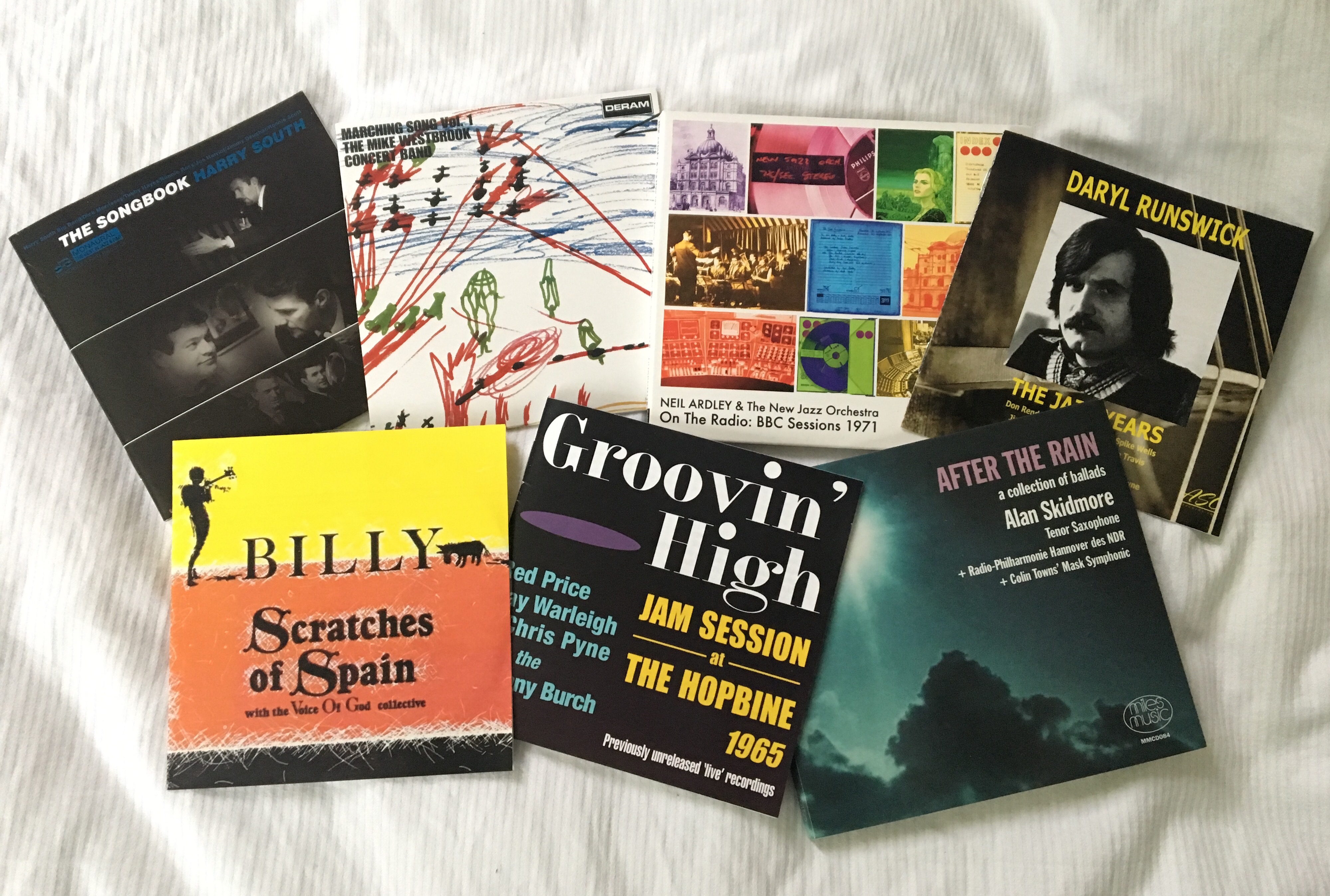 The first instalment of this two-part series dealt with new releases. This one looks at recent reissues and archive discoveries from the second half of the last century.
 The title of this two-part series is a homage to John Muir, a friend of 40-odd years ago. As a BBC radio producer, Muir saved John Peel’s career at the corporation in 1968 by giving him a Radio 1 show called Night Ride. He also booked Roxy Music for their first broadcast on Sounds of the Seventies, and supervised a series titled Jazz in Britain, devoted to the emerging generation of John Stevens, John Surman, Tony Oxley, Trevor Watts, Howard Riley and so on. John died recently, aged 80. I thought of him as being the best kind of BBC person: calm, civilised, culturally literate and unobtrusively fearless. Here are eight new albums by artists he would certainly have booked for a series of Jazz in Britain in 2017. Together they demonstrate that we are experiencing a new golden age of British jazz.
 Donald Trump’s attempt to turn the United States back into the country once shaped by Richard Nixon and J. Edgar Hoover took another step today when he signed a document reversing Barack Obama’s rapprochement with Cuba. There’s probably not much most of us can do about that, except maybe book a holiday there to replace the Americans who will no longer be able to travel to the island so easily, but it’s a good excuse to mention the reissue in expanded form of Introducing… Rubén González, one of the finest albums to come out of the Buena Vista Social Club phenomenon 20 years ago.
 In the Rialto Theatre, Montreux, with only their technicians and a TV crew for company, the Rolling Stones were rehearsing for the Exile on Main St tour. It was May 1972, and the first date in Canada was a fortnight away. The small theatre on the shore of Lac Leman was the kind of setting that always showed them to best advantage, far from the stadiums in which they became a rock and roll circus act. The rhythm section locked in as played “Tumbling Dice”, “Shake Your Hips” and various boogie jams. In those surroundings even a sceptic (which I was) could have listened to them all night.

