Skip to content

Posts from the ‘Uncategorized’ Category

Other sounds 3: The Henrys

The instrument in the photograph is a harmonium, sometimes known as a reed organ, or pump organ. Its earliest ancestor was invented by Gabriel-Joseph Grenié in France at the start of the 19th century. It has a sound I love, and this particular example is heard a lot throughout the new album by the Henrys, the Canadian band convened by the guitarist Don Rooke.

No single sound dominates Secular Hymns & Border Songs, although Rooke’s 1920 Weissenborn guitar and Michael White’s plaintive trumpet are prominent voices, but the gentle wheeze of the harmonium underlies it all, even when it isn’t actually present, like the layers of undercoat Mark Rothko applied to his canvases before beginning to paint his blocks of colour, sometimes allowing a little of the background to bleed out at the edge of the finished work.

I’ve been trying to think about how this music sounds. Handmade would be one word. Acoustic, too, in the sense that you’re unusually aware that these gentle, sometimes fugitive sounds are made by vibrations in the air. The listener notes the intimacy but also the feeling of uncrowded space. Most of all, I like the sense that it feels assembled — like something made by a skilled carpenter, working by eye and experience with familiar tools.

Rooke’s slide guitar is the first thing you hear on the opening track, “Garland”. Its tentative phrases barely disturb the air before others join in: Leanna Rutt’s cello, White’s trumpet, Maggie Keogh’s wordless voice, Andrew Downing’s double bass and John Sheard’s harmonium. That’s the basic ensemble, and collectively it has a lovely unfinished, almost skeletal quality: like something produced by a random bunch of musicians left over from a rehearsal by a much larger group, continuing to explore a common store of tunes because their bus home isn’t due for another hour, and because they like it.

There are 11 tracks, and each has its own character, but they move from one to another without significant breaks or changes of attack, just a pause for a breath, so that the whole thing sounds like a single semi-improvised composition. Occasionally, as when you reach “Fairground”, the fifth track, the ensemble coalesces on a melody that rises out of the surrounding mist, and the effect is gorgeous. Same thing on “Parish” (the one that sounds most like a hymn) and “Cortège” (the one that seems to exist most obviously on a border between cultures).

The informality of the music disguises the effort and skill that went into its creation, which is as it should be. As modern music goes, some would probably think it understated almost to a fault. But in the modern world, how could that possibly be a fault?

* The Henrys’ Secular Hymns & Border Songs is released on November 1, available via https://thehenrys.bandcamp.com/album/secular-hymns-and-border-songs

Other sounds 2: Vazesh

The Persian tar is a cousin of the lute, the saz and the oud, a long-necked instrument with three double courses of strings — sort of like half a 12-string guitar, another relative — and an unusual double bowl made of mulberry wood with a membrane of stretched lambskin. Perhaps you already knew that, but I didn’t until I encountered the playing of the Iranian-born tar virtuoso Hamed Sadeghi in Vazesh, a trio in which he’s joined by two Aussies, the saxophonist and clarinetist Jeremy Rose and the bassist Lloyd Swanton.

Their first album, released in 2021, was a live recording at Sydney Opera House and won awards. Its successor, Tapestry, was recorded during a single night of improvisation at an arts centre in Annandale, a suburb of Sydney. Just under an hour long, Tapestry seems to be an unbroken performance, although on the sleeve it’s divided into 14 tracks, each jointly credited and given a single-word title that might be the result of a game in which the three members contributed their favourite words: “Lilac”, “Pagoda”, “Calabash”, “Demitasse”, “Musk” and so on.

It’s a beautiful and unclassifiable record. The individual sounds are exquisite — the tar strummed and plucked with a tiny hint of twang, the reeds (bass clarinet, soprano and tenor saxophones) elegant, the double bass resonant (Swanton, of course, is also one-third of the Necks). But the point is the sense of conversation, ebbing and flowing without rhetoric or exhibition meditative but never passive. When musicians from different cultures can do this together, with so much ease and naturalness, maybe we’re not in such a terrible state after all.

* Vazesh’s Tapestry is released on October 25 on the Earshift Music label: https://vazesh.bandcamp.com/album/tapestry

Autumn books 1: Joe Boyd

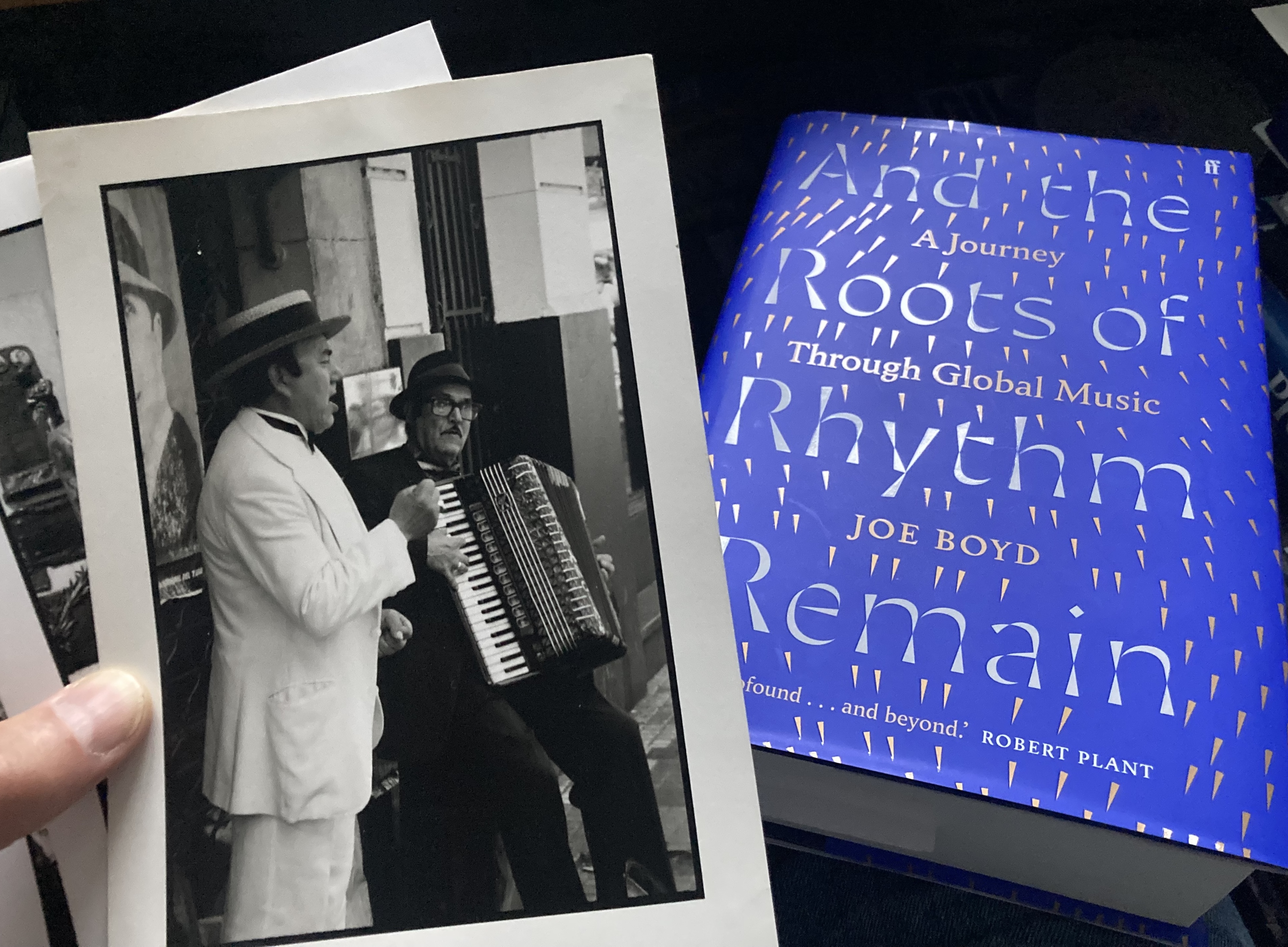
“Tango comes from the mud,” Brian Eno told an audience at Foyle’s bookshop the other night. He was conducting a public conversation with the author of And the Roots of Rhythm Remain, an 850-page examination of the forms of popular music with which Joe Boyd has engaged in Cuba, Jamaica, Brazil, Argentina, Bulgaria, Senegal, Albania and elsewhere during his six decades as a successful record producer and enlightened facilitator of musical projects.

For many years now it’s been rumoured that Boyd was writing a history of “world music”, a tale perhaps beginning with his presence at the famous meeting at a London pub in 1987 during which that rubric was invented, with the best of intentions and outcomes, as a way of persuading open-minded listeners to pay as much attention to music from other cultures as they did to their own western idioms. The result is much more interesting than a simple history; its eventual subtitle, “A Journey through Global Music”, conveys a much more accurate impression of what Boyd has taken on.

The quote about tango coming from the mud is to be found on page 483, where it’s identified as an Argentine saying. It was clever of Eno to spot it, because it says something larger about pretty much all the music Boyd considers here. How and when it happened, who made it happen, and to whom it happened are all part of his investigations, whether the music under consideration is Tropicália or townships jazz, Django Reinhardt or Béla Bartók.

I’m still working my way through the book, which will take a while even though Boyd writes in the easy, fluent, open-minded, anecdotal style familiar from White Bicycles, the relatively slender book about his adventures in the ’60s underground, published in 2005 to justified acclaim. Vast as his new one might seem, it’s worth reading with full attention, lest you miss some vital socio-cultural connection or valuable information on the roles played by, for example, the Ghanaian drummer Tony Allen, the Sudanese oud-player Abdel Aziz El Mubarak, Rodney Neyra of Havana’s Tropicana nightclub or the ballet impresario Sergei Diaghilev. (I didn’t know, for instance, that, according to Boyd, the names samba, rumba, mambo, tango and cha-cha all have their roots in Ki-Kongo, one of the languages of the Kongo people living in what are now the Republic of Congo, the Democratic Republic of Congo, Angola and Gabon.) Boyd’s enviable skill is to bring the reader an astonishing level of historical detail while wearing his research lightly and enlivening the narrative with exactly the right seasoning of his own views.

After buying the book at the Foyle’s event and getting it signed, I took it home and went straight to the chapter about tango. I like tango very much, although I once spent an evening in a bar in San Telmo, a Buenos Aires quarter then about to make the jump from funky to gentrified, proving to everyone’s satisfaction that I’ll never be able to dance it. I share Boyd’s enthusiasm for the singer Carlos Gardel to such an extent that I once visited the great man’s tomb in the cemetery of Chacarita in Buenos Aires, observing the ritual of leaving flowers at the base of his statue and placing a lit cigarette in the space left by the sculptor between the index and middle fingers of his raised right hand, because that’s how Gardel always sang until his untimely death in an air crash in 1935.

The photo above is one I took in 1994 on a sidewalk in Rosario, Argentina’s third largest city, the birthplace of Che Guevara and Lionel Messi. I was struck by the elegance and dignity of the street singer and his accordionist, who were serenading appreciative shoppers and other passers-by with a selection of songs made famous by Gardel.

Boyd traces the idiom’s origins in the bars and bordellos of Buenos Aires, examining its sources and tracking its destiny. He doesn’t share my fondness for the late composer and bandoneon virtuoso Astor Piazzolla, who became, he believes, “for tango what John Lewis and the MJQ were to jazz, ‘elevating’ it from the dancefloor and giving it concert-hall respectability.” He’s both right (in the comparison) and wrong (in the implicit criticism). Nobody who went, as I did, to see Piazzolla and his astonishing quintet for three out of their five nights in the intimate environment of the Almeida Theatre in London during the summer of 1985 could accuse them of forfeiting the sensual charms of tango in a pursuit of respectability. For a lot of worthwhile music with roots “in the mud”, the need to get people dancing is no longer a priority. But it’s a good and worthwhile argument to have, and I expect there’ll be many more as I work my way through what is shaping up to be not just an exceptionally enjoyable book but perhaps also an important one.

* Joe Boyd’s And the Roots of Rhythm Remain: A Journey Through Global Music is published by Faber & Faber (£30)

Passion / Compassion

Back in the early 1970s, Santana were my favourite live band. I saw the original line-up — more or less as heard at Woodstock — at the Albert Hall in 1970 and twice the following year, at Hammersmith Odeon and the Olympia in Paris. They were thrilling, and surrounded by a sense of excitement; before the show in Paris, I remember Mick Jagger and Bianca Pérez-Mora Macias sweeping through the backstage bar, a week ahead of their wedding.

Then the music changed, and they became even better. Carlos Santana and Michael Shrieve had been listening to John Coltrane and Elvin Jones and to Miles Davis’s Sketches of Spain and Bitches Brew. Santana’s fourth album, Caravanserai, brimmed over with the effect of those influences, starting with an unaccompanied solo by the saxophonist Hadley Caliman and culminating in the ecstatic nine-minute “Every Step of the Way”, a Shrieve composition. Clive Davis, the president of their record company, called it “career suicide”. At the Wembley Empire Pool in November 1972, just after the album’s release, an expanded line-up rose to a different level, musically and spiritually.

After Wembley they went off to play some concerts in Europe before returning towards the end of the month for dates in Manchester, Newcastle and Bournemouth. On Thursday, November 23 they had a day off in London, and, being American, arranged a small Thanksgiving Day dinner in the private room of a restaurant on Davies Street in Mayfair. I’d raved about Caravanserai in the Melody Maker, so they were kind enough to invite me to join them for what turned out to be a very pleasant evening.

While they were in London I interviewed Shrieve, who talked eloquently and passionately about the changes they’d made in the music, and about the jazz influences inspiring them. He spoke of his admiration for Elvin, Roy Haynes, Philly Joe Jones and Tony Williams and of studying their playing with his friend Lennie White, who had just joined Chick Corea’s Return to Forever. And he said something that struck me when I read the piece again the other day: “What’s so beautiful about the band, apart from the popularity which we know we’re fortunate to have and which we’re grateful for, is that right now it’s the perfect situation to be open. Specially at our age, because we realise that there’s still a lot of time.” Fifty years later, it’s clear the time hasn’t been wasted.

I loved Shrieve’s playing from the start, the way he meshed perfectly with the percussionists José “Chepito” Areas, Mike Carabello, Armando Peraza, Coke Escovedo and James Mingo Lewis. Since then I’ve followed his career mostly from a distance, although we reconnected when I was at Island Records in the mid-70s and he and Steve Winwood were part of Stomu Yamash’ta’s Go project, and then when the label signed Automatic Man, a rock band he was in with the singer/keyboards player Bayeté (Todd Cochran) and the guitarist Pat Thrall, and whose 1976 single “My Pearl” sounds today like a presentiment of Prince. Of his solo albums, I’ve always loved Stiletto, released in 1989 on RCA’s Novus imprint, in which he and a band including the trumpeter Mark Isham and the guitarists David Torn and Andy Summers created a very fine version of Gil Evans’s “Las Vegas Tango”.

If you have a copy of Lotus, the live triple album recorded in Osaka during the Caravanserai tour, you’ll know the 10-minute drum solo called “Kyoto” that shows what a superlative drummer he had already become, at the age of 23. It has none of the bombast of his rock contemporaries and much of the fluency of his jazz heroes. It’s music.

His new album, recorded over a period of years, is called Drums of Compassion — a reference to the hugely popular album titled Drums of Passion recorded in 1959 by the great Nigerian drummer Michael Babatunde Olatunji, who died at his home in Northern California 2003, aged 75, but whose voice is the one you hear first and again from time to time on an album that has been long in the making. Shrieve says that the title is also an acknowledgement of the Dalai Lama’s call for a Time of Compassion.

Of course, percussion instruments play an important role in this music. But the whole thing, although its 39 minutes are sub-divided into nine pieces, some with different composers, is like a lush, constantly shifting sound painting in which other instruments — guitar, saxophone, oud, electronic keyboards — emerge with utterances that seem less like solos than simply part of the fabric.

Shrieve can put together a multi-faceted track (“The Call of Michael Olantunji”) including himself, Jack DeJohnette, Airto Moreira and Zakir Hussain on various percussion instruments without making it sound for a second like an old-fashioned drum battle or a display of egos and techniques, even when Shrieve’s orchestral tom-toms come to the fore. The percussionists’ work is blended into the overall picture, here creating an armature for Olantunji’s voice and Trey Gunn’s guitar.

Shrieve can make the space for one performer alone on the eponymous “The Euphoric Pandeiro of Airto Moreira” (chanting and Brazilian percussion) and “Zakir Hussain” (tablas). He shares another track, the sultry, drifting “Oracle”, in a duet with another Brazilian, the electronic musician Amon Tobin. The ambience swirls and drifts without relaxing its subtle grip.

A steamy tone poem titled “On the Path to the Healing Waters” features the tenor saxophone of Skerik (Eric Walton), a Seattle-based musician who has played with Wayne Horvitz and Charlie Hunter, and who here plays a Wayne Shorter-ish less-is-more role. And I’m particularly happy to lose myself inside “The Breath of Human Kindness”, five minutes of one-chord jam in which the oud of Tarik Banzi makes its single eloquent appearance, a voice from ancient Al-Andalus amid the glistening keyboards of Pete Lockett and Michael Stegner, paced by Farko Dosumov’s stealthy bass guitar riff.

There’s a rare combination of majesty and humility at work in this music, something that speaks of the deep and lasting impact of Coltrane’s influence on Shrieve’s instincts and decisions. More than half a century after Caravanserai, this is an album for listeners who followed Shrieve and Santana on that journey into a wider world, one where frontiers and prejudices dissolve.

* Michael Shrieve’s Drums of Compassion is out now on the 7D Media label and available via Bandcamp: https://michaelshrieve7d.bandcamp.com/album/drums-of-compassion

The sound of London

It’s been exciting to watch the blossoming of a new young UK jazz scene in recent years, and now it’s possible to welcome a historical survey of its emergence. André Marmot’s Unapologetic Expression, published this month, is an insider’s explanation of why and how it happened, by whom and to whom. This is history almost in real time, with the con trails still visible in the sky

Marmot is a musician who has worked for the last few years as agent, promoter and label owner. Perhaps that makes him an unusual person to write such a work. But it also gives him access to the people on the scene, justifying the subtitle: “The Inside Story of the UK Jazz Explosion”. More important, he can really write. Not in a fancy way, but with a clarity of thought and a simple elegance of expression that make it a pleasure to turn from page to page.

It’s a story of the music’s evolution in London; there are a few mentions of Soweto Kinch and GoGo Penguin, but none of Xhosa Cole or Nat Birchall. And its focus excludes the parallel world of free improvisation, the descendants of the SME and AMM. But at least we know where we are, and where the author is coming from.

The narrative takes in United Vibrations, Steez, Brainchild, Total Refreshment Centre, Steam Down, Brownswood and We Out Here, Jazz Re:freshed, Church of Sound, Tomorrow’s Warriors and more. The soundtrack might be Moses Boyd’s “Rye Lane Shuffle” and Yussef Kamaal’s Black Faces. One of the key events might be the appearance of Boyd, Shabaka Hutchings and Theon Cross at South by Southwest in Austin, Texas in 2017, when it became obvious that this scene could gain traction with listeners beyond Peckham and Dalston.

It’s quite a political book, in the sense that Marmot is not afraid to spend time criticising the effect of government policy on the arts and on young jazz musicians in particular, and propounding his belief (impeccable in my eyes) that jazz is essentially a black music in which others are welcome to take part. He puts his arguments concisely and chooses his supporting voices well.

For this is, in large part, an oral history. And whatever the perspective he’s examining — there are chapters called “Jazz Ownership and Appropriation”, “Jazz and Postcolonial London” and “New Industry Models and the End of Musical Tribalism” — he allows the musicians themselves to have their unmediated say. It’s no surprise that people like Sheila Maurice-Grey, Dave Okumu, Poppy Ajudha, Jason Yarde and Emma-Jean Thackray turn out to have interesting opinions.

If those chapter headings make the book sound academic, it isn’t. It’s anything but. It’s as full of life and energy, as sparky and challenging, as the music itself. It might even convert some of those who look with scepticism on audiences — some of whose members perhaps don’t know Lester Young from Coleman Hawkins and may never have heard “West End Blues” or “Parker’s Mood” — dancing and cheering as these musicians play for people who look, think and live like themselves.

But in order to exalt the new, it’s not necessary to denigrate the past, and there are some passages here that may annoy jazz fans of former generations. It’s easy to pour scorn on views expressed in earlier times, which is what Marmot does here with, for example, an autobiography from 1998 in which John Dankworth — who did much to popularise the music in Britain in the past-war decades — claimed that jazz “since its beginnings… [has been] an instrument of goodwill and peaceful and gradual change rather than anything really revolutionary.” I tend towards Marmot’s view rather than Dankworth’s, but I’d caution him that the passage of time can distort as well as clarify.

In between sessions of reading his book, I was listening to two new British jazz albums. The first is the latest from Empirical, who receive only a single slighting mention for their “dressed-up-for-the-wedding, jazz-cliché” look, which he compares unfavourably with the dressed-down, funky-Peckham vibe of Binker Golding and Moses Boyd on the cover of their 2015 debut album. I think it’s a ridiculous criticism, as irrelevant as dissing the MJQ for wearing tuxedos, and — like the Dankworth swipe — unworthy of what is otherwise a valuable piece of work.

Empirical’s Wonder Is the Beginning features the basic quartet with guests Jason Rebello on piano and Alex Hitchock on tenor saxophone. Most of the knotty but engaging tunes are written by Tom Farmer, the bassist, with one apiece from Nat Facey, the alto saxophonist, and Lewis Wright, the vibes player. Anyone who has ever enjoyed their work will find plenty to digest here, in a well established groove that enters the room occupied by Andrew Hill, Bobby Hutcherson and Eric Dolphy in their Blue Note period and pushes the walls out slightly. The addition of the guests enriches the range of tone and gesture without disturbing the group’s fine balance.

Cassie Kinoshi belongs firmly in the generation promoted by Marmot, and is among those providing the author with interesting opinions on his chosen topics. Her latest album finds an 11-piece version of her group Seed operating in partnership with the London Contemporary Orchestra and the turntablist NikNak on a 22-minute, six-part suite called Gratitude (from which the album takes its title), recorded at the Purcell Room in March 2023, and in a 10-piece formation performing a five-minute piece called “Smoke in the Sun” at Total Refreshment Centre in 2021.

This isn’t a long album, then, but it gets a lot of substance into its half-hour duration, thanks to Kinoshi’s fast-developing gift for deploying the instrumental resources at her command. Her music is astringent in its sound and strong in its movements. The strings and woodwind, for instance, carry as much weight as the brass, reeds and rhythm: there’s no danger of anything sounding effete or chamber music-y here. The double bass of Rio Kai and the drums of Patrick Gabriel-Boyle provide both line-ups with a loose-limbed swing.

There is plenty of space in the music, and a great deal of variety. When she clears a space for a soloist, she does it very adroitly: the guitarist Shirley Tetteh, the trumpeters Jack Banjo Courtney and Joseph Oti-Akenteng, and eventually herself, with an improvisation that really soars, leading the sixth and final movement to a dramatic but graceful conclusion. Nothing sounds pasted-in or anything less than organic.

Both these albums, and André Marmot’s book, tell a very encouraging story about the condition of British jazz: not just about the skill and originality of its practitioners, but about their continuing ability to find, expand and stay close to their audience.

* André Marmot’s Unapologetic Expression is published by Faber & Faber. Empirical’s Wonder Is the Beginning is on Whirlwind Records. Gratitude by Cassie Kinoshi’s Seed with NikNak and the London Contemporary Orchestra is on International Anthem.

Chan Romero 1941-2024

There was a time when Chan Romero’s “The Hippy Hippy Shake” was a song you had know. It was to the Beat Boom as “I Got My Mojo Workin'” was to the R&B scene. When Paul McCartney got hold of a copy and started singing it with his then-unknown group at the Star Club in Hamburg and the Cellar Club in Liverpool, it caught on fast. And when the Swinging Blue Jeans, another Liverpool group, recorded it in 1963, they took it to the top of the UK charts.

Like “I Got My Mojo Workin'”, it was basically a 12-bar blues — as was “Hound Dog”, the song that, when the 15-year-old Romero saw Elvis Presley singing it on the Ed Sullivan Show on his family’s black and white TV at home in Billings, Montana in 1956, introduced him to his destiny. “It just took me over,” he remembered. “I said, this is what I want to do.”

Romero, who has died aged 82, was born in Billings to a father of Spanish and Apache heritage and a mother of mixed Mexican, Cherokee and Irish descent. His mother sang and his brothers played guitars. He followed their example, and began writing songs. During his summer holiday from Billings Senior High School, he hitchhiked to East Los Angeles to stay with some relatives. A cousin drove him to Specialty Records in Hollywood, where the A&R man, Sonny Bono, liked his song “My Little Ruby” and told him to come back when he’d polished it up.

Back in Billings, Romero auditioned for a local DJ, Don “The Weird Beard” Redfield, who became his manager and sent a demo to Bob Keane at Del-Fi Records in Hollywood. Keane had recorded the Chicano singer Richie Valens, enjoying hits with “Donna” and “La Bamba”. It seemed a good match and Keane promptly signed Romero.

When Valens was killed at 19 years of age, along with Buddy Holly and the Big Bopper, in the February 1959 air crash in Iowa, Romero must have seemed his logical heir. Indeed, Keane introduced him to Valens’s grieving parents, with whom he later often stayed at their home in Pacoima, East LA.

“The Hippy Hippy Shake” was his first release on Keane’s label. It didn’t make much impact in the US, but it went down well in Canada and Australia. In the UK it was released on EMI’s Columbia label. “My Little Ruby” was the B-side of the the follow-up, “I Don’t Care Now”, and that was pretty much that, although Romero toured with his backing band, the Bell Tones, and found himself turning away girls. “I haven’t got a girlfriend,” he told the Billings Gazette, “because I can’t tell if a girl likes me for myself or because I’m a singer.”

The original version of “The Hippy Hippy Shake” has everything you’d want from a rock and roll record in 1959: the urgent teenage voice, the twangy guitar, the rackety drums, all wrapped up inside a minute and 45 seconds. Thank you, Chan Romero, for your moment in history.

Sounds for summer

Tall enough to be unmissable in any environment, and with a truly remarkable fashion sense, Shabaka Hutchings had presence from day one of his career. To me, as an observer, that was the concert at the Royal Festival Hall in June 2009 at which he was one of several UK guests with Charlie Haden’s Liberation Music Orchestra (others included Robert Wyatt, Jason Yarde, John Parricelli and Andy Grappy). He had just one solo but when he stepped forward, the sounds coming from his tenor saxophone commanded everyone’s attention.

Since then, we’ve heard him with Sons of Kemet, The Comet Is Coming, the Ancestors and Louis Moholo-Moholo’s Five Blokes, and in a reinterpretation of Coltrane’s A Love Supreme at the Church of Sound a few weeks ago which I was very sorry to miss. And now he has enough presence to allow him to drop his surname and become just Shabaka.

He’s also dropped the saxophone, which is more of a surprise, in order to study the flute — specifically the Japanese shakuhachi and other iterations, including the Andean quena and the Slavic svirel. His new album — titled Perceive Its Beauty, Acknowledge Its Grace — is evidence of this turn of interest.

It’s a radical departure from anything he’s given us before. A series of sketches deploys varying personnel, including the pianists Nduduzo Makhathini and Jason Moran, the guitarist Dave Okumu, the singer Lianne La Havas, Moses Sumney, Laraaji and ESKA, the harpists Brandee Younger and Charles Overton, the drummers Marcus Gilmore and Nasheet Waits, the speakers Saul Williams, Miguel Atwood-Ferguson and Anum Iyupo, the rapper Elucid, the percussionist Carlos Niño and the bassists Esperanza Spalding and Tom Herbert.

That’s an impressive line-up, but as you listen to the album you’re never really thinking of individuals or their virtuosity. In that sense it’s a quite different experience from that of listening to a “jazz album”. But neither is it a kind of New Age tapestry of sound, slipping by without disturbance, merely a bit of aural decoration.

It has an overall charm and moments of great and singular beauty, too, such as the shakuhachi improvisation against Overton’s harp and the celestial layered voices of Sumney on “Insecurities”, La Havas’s vocal reverie on “Kiss Me Before I Forget”, or Spalding’s springy bass behind Elucid’s rap on “Body to Inhabit”, but it also has depth, and not just in the occasional verbal passages, which are carefully integrated into the quilt of sound. The overall impression is what counts, and somehow that goes beyond words.

The album contains one snatch of tenor saxophone, on a track called “Breathing”, in which Rajni Swaminathan’s mridangam — a Carnatic double-ended hand drum — backs first Shabaka’s treated and looped flutes, then his clarinet, and finally his saxophone, which briefly erupts in a gentle squall with an intonation recalling the great Ethiopian tenorist Getatchew Mekuria.

That little hint of Ethiopian music sent me to a new release in the name of Emahoy Tsege Mariam Gebru, who died this time last year at the age of 99. Born in Addis Ababa, she studied violin in Switzerland as a child, worked as a civil servant and sang for Haile Selassie, was imprisoned by the Italian occupiers during the Second World War, and spent a post-war decade as a nun in a hilltop monastery. The arrival of a new regime forced her to flee to Jerusalem, where she spent the rest of her life in an Ethiopian Orthodox convent and composed music for piano, organ, and various ensembles while running a foundation to encourage music education among children in her native land and elsewhere.

Like Mekuria, she had a volume of the producer Francis Falceto’s Ethiopiques series devoted to her music in 2006, and in the last couple of years there have been more albums on the Mississippi label. The latest is called Souvenirs, a collection of her songs apparently recorded between 1977 and 1985. It’s a primitive recording: the piano sounds like a poorly maintained upright and her voice was probably recorded on the same microphone, in a room that was almost certainly not a recording studio. But that does nothing to diminish the appeal of these songs, with titles such as “Where Is the Highway of Thought?” and “Like the Sun Shines on Meadows”, whose vocal melodies are doubled by the pianist’s right hand against left-hand figurations assembled from scraps of blues and rhumba and gospel tunes.

What’s so appealing, almost mesmerising, about this music? I think it’s the combination of transparent simplicity (and sincerity) with the unexpected guile of the rhythmic undertow, which is always playing appealing tricks on the western ear. There’s something about the distinctive melodic shapes and phrase lengths that is special to this kind of Ethiopian music, springing from some deeper root.

Something else to add pleasure to this summer is After a Pause, the new album of acoustic duo music by two brilliant Welsh musicians, the guitarist Toby Hay and the bassist and cellist Aidan Thorne. I got interested in Hay when he was filming himself outdoors playing ragas during the first Covid-19 lockdown in 2020 and putting the results on YouTube, and wrote a bit more about him when he released some duets recorded in an old chapel with his fellow guitarist David Ian Roberts later that same spring.

I try to avoid talking about what musicians are doing in terms of the work of other musicians, but I suppose a simple — and, I hope, enticing — way of describing the scope of these duets is to imagine what Davy Graham and Danny Thompson might have got up to if they were both in their prime in the 2020s and were able to spend three days together in a studio with no distractions, enhancing their compositions and improvisations with a sparing but highly effective use of overdubbing and electronics.

After living with this album for a few weeks, I’ve come to appreciate not just its surface beauty but the way it reveals more of itself and its spiritual essence the closer you listen. The 12-string arpeggios and bowed bass of the opener are a call to the attention that is never wasted as the music blooms and glows through 10 shortish but unhurried pieces, trajectories shifting and densities varying considerably from bare-bones to near-orchestral (on “Burden” or “Eclipse”) but mood sustained. The brief solo piano coda is a lovely way to finish.

A light shines through these three albums. I’ve a feeling they’re going to be among the summer’s best companions.

* Shabaka’s Perceive Its Beauty, Acknowledge Its Grace is on the Impulse! label. Emahoy Tsege Mariam Gebru’s Souvenirs is on Mississippi Records. Toby Hay and Aidan Thorne’s After a Pause is on Cambrian Records. Links here:

https://spibaig.bandcamp.com/album/perceive-its-beauty-acknowledge-its-grace

https://emahoytsegemariamgebru.bandcamp.com/album/souvenirs

https://cambrianrecords.bandcamp.com/

The Necks at Cafe Oto

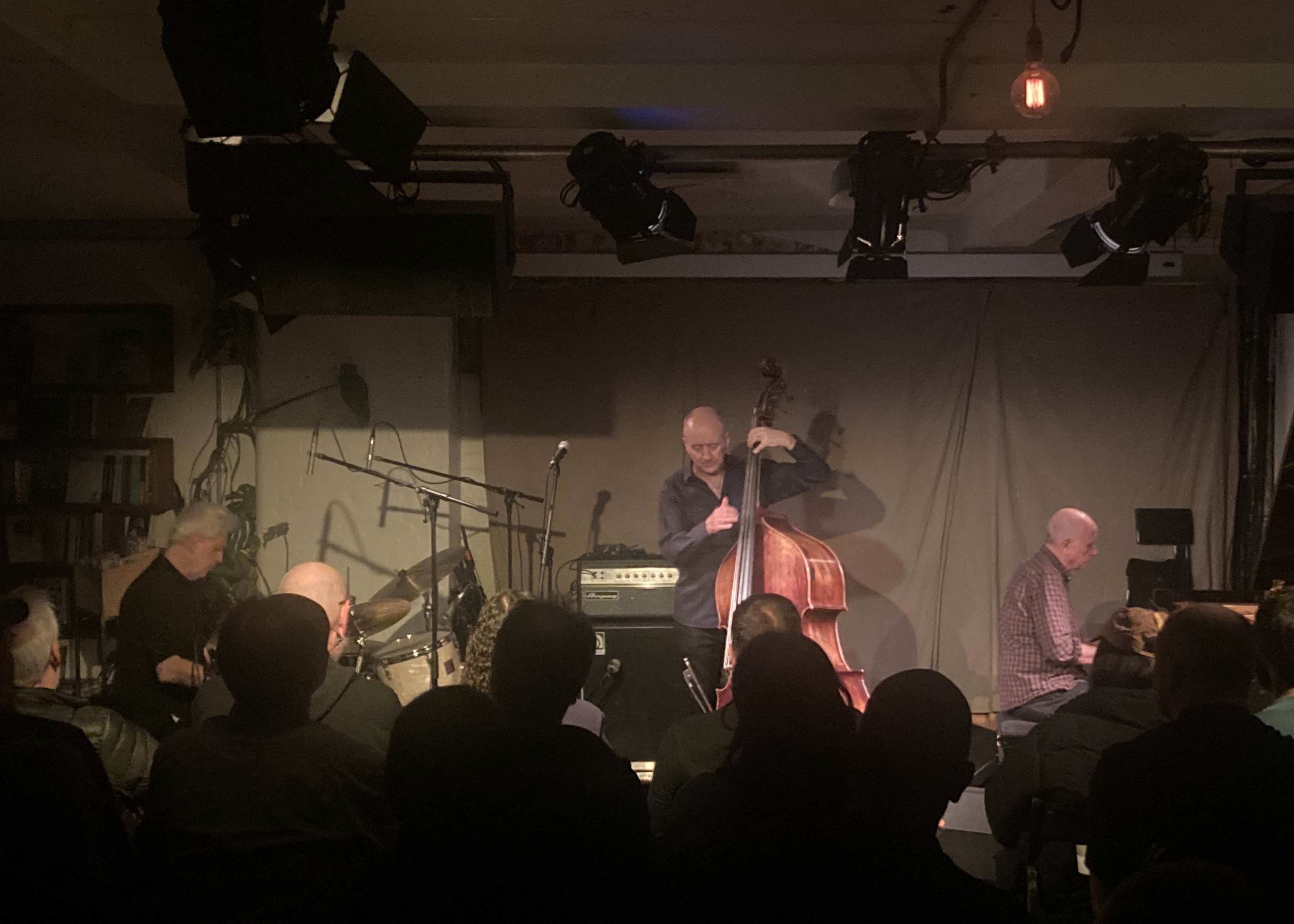
“We’ve never really been an emotional band,” Lloyd Swanton observed drily after the first set on the last of the Necks’ four nights at Cafe Oto in London this week, “but it seems to be creeping in.”

I’d been trying to tell him, somewhat incoherently, how moved I’d been by what they’d just played, and in particular how it seemed to express something about the current state of the world. His reflexive response indicated that what he and his colleagues in the Australian trio do is principally about the notes, about the process of three musicians improvising together with no preset material and certainly with no programmatic content in mind. Which is not to say that listening to them isn’t an emotional experience. It is, almost invariably, but the emotions they generate are usually non-specific.

To me, at least, it seemed that there was something different about Thursday’s first set. It started out normally enough, after they and the audience had settled, with one member — Swanton, on this occasion — breaking the silence. As he plucked an isolated note on his double bass, repeating it and echoing it an octave down, sometimes switching to his bow, and initially with long pauses, Tony Buck joined in with mallets gently rolling around his tom-toms and cymbals, followed by Chris Abrahams picking out pensive Moorish figures in the middle-upper octaves of the piano.

For a while, not much seemed to be happening. No surprise there, necessarily. Later Buck said that he’d worried it had started out “a bit washy”. But in 20 years of attending their performances I’ve learnt to wait, to show the kind of patience as a listener that they show as players, in the knowledge that the surprise will come. In fact, they are the proof that the sound of surprise can emerge slowly, by gradual accretion.

This time the process of accretion led to something extraordinary. As the playing of all three grew busier, the textures thickened, the spaces closed and the volume increased, all of it occurring almost imperceptibly, you began to feel that you were hearing things: bells, cries, gunfire. It was an illusion. They weren’t there, and neither was anyone trying to produce them. But somehow they were present — for me, anyway — in the harmonics reflecting off the piano lid, the scrabbling and keening of the bass, and the hard crack of the bass drum against the overlapping splashes of the cymbals.

Eventually it reached a pitch of intensity that was sustained for maybe 15 minutes before being gradually wound down through a collective diminuendo into silence once again. And in those 15 minutes I couldn’t help replaying the images we’ve been seeing on the TV news every night for months — images of buildings, streets, whole cities lying in ruins, of the dead being counted and the living in flight, the sort of total war we may stupidly have believed was safely consigned to a distant past.

That’s not, I’m sure, what the members of the Necks were thinking of while they were summoning the music into being. It’s more the sort of thing the pianist Vijay Iyer had in mind when, with the bassist Linda May Han Oh and the drummer Tyshawn Sorey, he recorded a new trio album whose title, Compassion, explicitly indicates its theme. “Music is always about, animated by, and giving expression to the world around us: people, relations, circumstances, revelations,” Iyer writes in the sleeve note, describing the responsibility, as he sees it, of making art in a time of suffering.

I’ve heard the Necks play music unafraid of ugliness before (a hair-raising triple-forte set at Café Oto in 2013 stands out in the memory), but never anything in which the kind of responses they normally evoke — including but not restricted to euphoria and elevation — were so strikingly replaced by this very different kind of transcendence, a sustained howl expressing something beyond words yet somehow very specific.

So that was the fifth of the six sets I heard them play this week, and the sixth was, as usual, quite different. Abrahams opened it with a reversion to the sort of thing that provokes the use of adjectives like “luminous” and “lambent”. But again there was a surprise when the piece evolved into an essay in the use of asynchronous rhythms, a field they’ve opened up in recent years, in which each one establishes his own pulse or metre and, without forfeiting closeness of listening to the others, maintains it as the piece develops. At its best, it leads to a kind of higher interplay — and this was the practice at its very best, creating a rhythmic maelstrom that activated a very different response in the audience.

All a long way from the sort of passive music for Zen meditation with which they are sometimes erroneously associated, and irrefutable evidence of their commitment, now extending well into its fourth decade, to a constant self-regeneration of which we are the fortunate beneficiaries.

* The Necks continue their European tour at Peggy’s Skylight in Nottingham on Monday (already sold out) and the Tung Auditorium in Liverpool on Tuesday, April 8 and 9 respectively. Their most recent album, Travel, was released in 2022 on the Northern Spy label. Compassion, by Vijay Iyer, Linda May Han Oh and Tyshawn Sorey, was released earlier this year by ECM.

Oh, Yoko

The first time I met Yoko Ono, at the Apple HQ in Savile Row in September 1969, I was impressed by her obvious engagement. She and John Lennon were doing a day of interviews, and I got my couple of hours on behalf of the Melody Maker. At that stage she was being treated by the media as a bit of a sour joke. The film she’d made of people’s bottoms got her in the papers, and her relationship with Lennon rendered her, in the eyes of many, what we would nowadays call toxic. Not only did she look weird, she thought weird. But at that first meeting, it was impossible to ignore the way the two of them shared the burden of the interview as equal voices.

The second time, two years later, was just after they’d moved to New York and temporarily sequestered themselves in a suite in the St Regis Hotel on East 55th Street. I spent a few days with them in the hotel, at the Record Plant studio a dozen blocks south, and on a trip to the West Village during their hunt for a permanent address. And that time I could see, much closer up, what it was that he liked so much about her: she was funny, and physical, and assertive, and full of life and ideas — all the characteristics that are currently on very clear display at Tate Modern in Yoko Ono: Music of the Mind, an exhibition of her life’s work.

The wittiest T-shirt around just now carries the message JOHN LENNON BROKE UP FLUXUS — a play on the belief that Yoko destroyed the Beatles. Her work while a member of Fluxus, the informal avant-garde art movement founded in New York by her friend George Maciunas in 1961, also involving La Monte Young, John Cage, Joseph Beuys, Nam June Paik, Jonas Mekas and many others in events often held in her downtown loft, is to me the most interesting part of the show, occupying several rooms.

It features documentation of the notorious Cut Piece of 1964, in which she sat on a chair in the Carnegie Recital Hall while members of the audience cut off her clothes, and Bag Piece of the same year, which I saw her re-enact with Lennon at the ICA in London in 1969, and Ono’s Sales List of 1965, in which she offered such items as a blank tape labelled “Sound tape of snow falling at dawn”, a Light House constructed from light, and custom-made underwear, including “special defects underwear for men — designed to accentuate your special defects: in cotton $10, in vicuna $175.”

Like a lot of people wandering through the rooms, I found myself smiling a lot, and occasionally laughing out loud at something like a 1962 work called Audience Piece to La Monte Young, in which the 20 performers simply lined up across the stage and stared at the audience until the audience left, and Smoke Piece of 1964: “Smoke everything you can / Including your pubic hair.”

The exhibition shows off her imagination and her indefatigability, as well as the way she was influenced by pre-existing Japanese culture (Zen koans, haiku, kabuki theatre) and the experience of living, as a child evacuated from her family home in Tokyo, through the final stages of World War Two.

On the morning I spent there, the show was full of women and small children who were having a good time with the all-white chess set, the wall-hung board into which visitors are invited to hammer a nail, and the room called Add Colour (Refugee Boat), whose walls, floor and eponymous centrepiece are covered in blue graffiti. In the final room, many people had accepted another of her invitations: to write something about their mothers on a small piece of paper and tape it to the wall.

I thought of Yoko’s own mother, a descendant of an aristocratic family forced — in the absence of her captured husband — to scuffle for her family’s existence amid the postwar ruins before, reunited, they left to resume a comfortable existence in the US. And, too, of the scar tissue of Lennon’s “Mother” (“You left me, but I never left you…”), written after he and Yoko had undergone a course of Arthur Janov’s Primal Therapy. That’s something else they were mocked for, along with the bottoms movie and the riddles and the naked cover of Two Virgins and the Bed Peace event in Amsterdam.

Ah, peace. Remember that? WAR IS OVER!, they announced in 1969 via the medium of billboards plus a concert at at the Lyceum. All we are saying is GIVE PEACE A CHANCE. Send a bag of ACORNS FOR PEACE to world leaders. You can mock all that, too, if you want, but it wouldn’t really seem right in 2024.

I don’t mean to sound patronising when I say that I was surprised by how much the exhibition made me think, even when those thoughts were not necessarily the sort that can be followed to a conclusion. The first thing to do with a mind is open it.

* Yoko Ono: Music of the Mind, curated by Julia Bingham and Patrizia Dander, is at Tate Modern until 1 September. There’s an illustrated book of the same name to accompany the exhibition, its selection of short essays including a good one on Yoko’s relationship to sound and silence by David Toop (Tate, £32).

The history of Les Cousins

Named after a 1959 Claude Chabrol film, Les Cousins operated as a folk club from 1964 to 1972, having taken over a basement in Soho run by John Jack as the Skiffle Cellar during the 1950s. On the ground floor was the restaurant of Loukas and Margaret Matheou, immigrants from Cyprus. Les Cousins, down a steep staircase, was run by their son, Andy. On stage at 49 Greek Street every night of the week he presented singers and musicians whose work would create a platform for the folk-rock and singer-songwriter movements of the late 1960s and early ’70s.

There were other important folk venues in London, notably Bunjie’s, just the other side of Charing Cross Road, and the Troubadour in Earl’s Court. But the Cousins had a special place in history, very well memorialised in a new three-CD box from the Cherry Red label, compiled and annotated by Ian A. Anderson, the singer, guitarist and editor of fRoots magazine.

It is, as you’d expect, a splendidly varied selection, starting and ending with big names — Bert Jansch and the Strawbs — and containing both even bigger ones (Paul Simon, Al Stewart, Ralph McTell, Nick Drake, Roy Harper and Cat Stevens) as well as many more of those whose reputations never really escaped the folk world, like the brilliant guitarists Davy Graham, Mike Cooper, John James, Sam Mitchell and Dave Evans.

So far I’ve mentioned only male performers, but the Cousins was a place where women shone: not just Shirley Collins, Sandy Denny, Bridget St John and Maddy Prior but Dorris Henderson, Jo Ann Kelly, Beverley Kutner (later Martyn) and Nadia Cattouse. And, of course, the sublime Anne Briggs. They’re all here, represented among the 72 tracks licensed from labels such as Topic, Island, Transatlantic, Village Thing and Harvest.

There are the traditionalists: Bert Lloyd singing “Jack Orion”, the Watersons delivering “The Holmfirth Anthem”, and Dave and Toni Arthur’s “A Maiden Came from London Town”. And there are the influential Americans: Jackson C. Frank (“Milk and Honey”), Dave Van Ronk (“Baby, Let Me Lay It On You”), and Tim Hardin (“If I Were a Carpenter”).

You can hear the music going off in all sorts of directions, with weirder stuff coming from the Third Ear Band, Kevin Ayers, the Incredible String Band and Dr Strangely Strange. Ron Geesin’s “Two Fifteen String Guitars for Nice People” is in a class of brilliant weirdness all by itself.

The well produced brochure includes facsimiles of a couple of pages from Andy Mattheou’s diary in April 1965, listing the people he’s booked: Sandy Denny for £3 on a Wednesday night, Davy Graham for £15 on the Saturday, Van Morrison for £3 on a Tuesday, the American guitarist Sandy Bull on a Friday for £10 against half the door takings. Sandy Bull! How I wish I’d been there for that.

The programme isn’t predictable. There’s no “Scarborough Fair”, no “May You Never”, no “She Moved Through the Fair”. The sequencing is thoughtful: tracks from John Martyn and Duffy Power follow immediately after those by their respective mentors, Hamish Imlach and Alexis Korner. I’d only quibble with the inclusion of a small handful of songs — including Drake’s “Northern Sky” and Beverley’s “Get the One I Want To” — where the presence of orchestral arrangements takes them away from the mood of a basement folk club.

If I had to pick some personal favourites, the first would be would be the dazzling violin and guitar of Dave Swarbrick and Martin Carthy on “Byker Hill” and the second would be the magical guitar interplay of Jansch and John Renbourn on “Soho”. The third would be the intense voice and bottleneck guitar of Sam Mitchell’s “Leaf Without a Tree”: a hellhound stalking the lanes of Soho, half a century ago.

* Les Cousins: The Soundtrack of Soho’s Legendary Folk & Blues Club is out now on the Cherry Red label. The image is the club’s logo, the wagon wheel a reference to a feature of its décor.