The mundane and the sublime
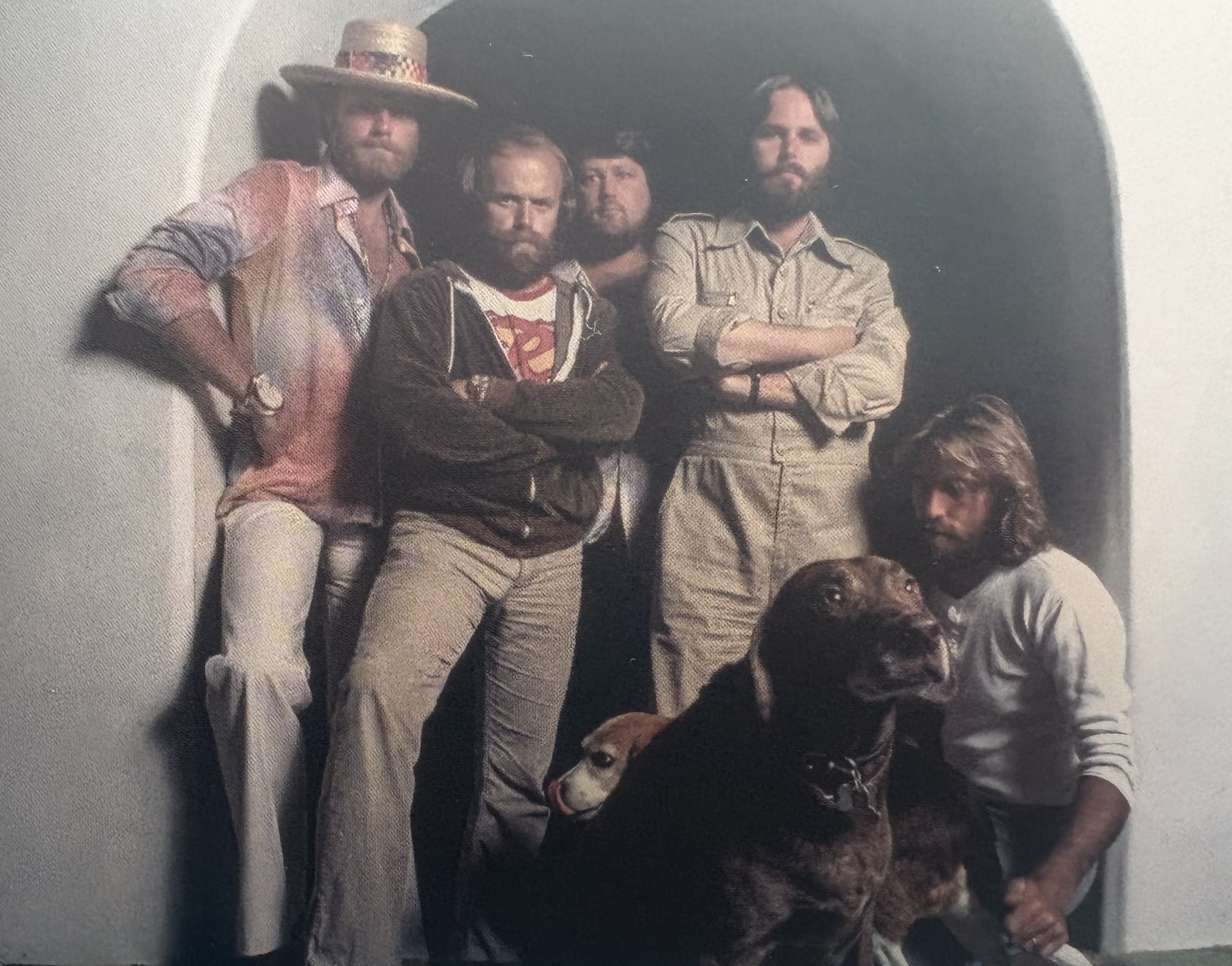
It’s hard to imagine a Beach Boys fan — a real Beach Boys fan, that is — who doesn’t have a warm place in his or her heart for 15 Big Ones and The Beach Boys Love You, the two widely ignored and often derided albums they recorded and released in 1976 and ’77 respectively in their new Brother Records studio in Santa Monica. The superficial view took them as acts of desperation following years in which only greatest-hits albums like Spirit of America and Endless Summer kept their name alive.
The first was an album of mostly covers, the second an attempt to haul Brian Wilson back into a role front and centre of the group’s activities in the studio. Both were recorded in an atmosphere of uncertainty over what they needed to do in order to reassert themselves as a creative and commercial force.
Neither album had a lot of polish, certainly not at the level of Surf’s Up or Holland, their studio predecessors. And there were certainly few vestiges of the rapt introspection of Pet Sounds or the fascinating brainstorms of Smiley Smile. Instead, 15 Big Ones and Love You came from a place between Little Deuce Coupe and Beach Boys’ Party! — only made by guys a decade older, with all the tensions the intervening years had introduced.
I liked both albums a lot, for all their rough edges, and play them often. The doo-wop/R&B covers on 15 Big Ones — the Five Satins’ “In the Still of the Night”, the Six Teens’ “A Casual Look” and Little Willie John’s “Talk to Me” — are in the class of their earlier versions of the Students’ “I’m So Young” and Bobby Freeman’s “Do You Want to Dance”. The originals on Love You — “Let Us Go On This Way”, “The Night Was So Young”, the lovelorn “I’ll Bet He’s Nice”, the witty “Johnny Carson”, the duet between Brian and his first wife on “Let’s Put Our Hearts Together” — match the quality of those on, say, Sunflower.
A new three-CD package called We Gotta Groove: The Brother Studio Years collects outtakes from 15 Big Ones, the original masters and outtakes from Love You, various cassette demos made by Brian, plus tracks recorded later in for Adult/Child, an aborted album planned by Brian as a sort of tribute to the Four Freshmen, one of his original inspirations.
Most of the Love You outtakes and alternate mixes are scarcely worth the trouble: they include a cover of “Ruby Baby” that can’t live with the Drifters, Dion or Donald Fagen, a charming-but-silly two-minute ditty called “Marilyn Rovell” dedicated to Brian’s aforementioned first wife, and an attempt to create a one-man “You’ve Lost That Lovin’ Feeling”, with Brian doing all the singing and all the playing, from drums and jingle bells to Minimoog bass and electric harpsichord. A vocals-only mix of “The Night Was So Young” exposes the beauty of Carl Wilson’s lead. “We Gotta Groove” is a very tedious track, and making it the title of the album is an idea so bad it must have come from Mike Love, who sings lead on the song. As for the 15 Big Ones outtakes, the versions of “Mony Mony”, “Running Bear”, “On Broadway”, “Sea Cruise” and others were correctly omitted from the final release.
The handful of Adult/Child tracks are curiosities and nothing more. The arrangements are by Dick Reynolds, who orchestrated the Four Freshmen albums that Brian enjoyed in his youth and who contributed charts to the Beach Boys’s 1964 Christmas album. The first of these tracks, “Live Is For the Living”, an upbeat Brian original, is almost a parody of a lounge singer’s mannerisms. A version of “Deep Purple” has nothing to recommend it. Two lovely Brian ballads, “It’s Over Now” and “Still I Dream of It”, fare worse than in their solo demo versions. As a project, it was a mistake — and it’s useful to have the proof that this was not another long-buried masterpiece.
But here’s the good news: Brian’s cassette demos for Adult/Child and Love You are something else altogether. It’s very moving to hear him at the piano singing “It’s Over Now”, “Let’s Put Our Hearts Together”, “I’ll Bet He’s Nice” and “Still I Dream of It”, all ballads, and each of which he wrote without the aid of a lyricist — no Roger Christian or Tony Asher or Van Dyke Parks. They’re almost heartbreaking in that he sounds so alone, but they’re also hugely affirming of the extraordinary creativity of his songwriting, which finds the perfect spot between Broadway-era chromatic invention and pure pop chord changes.
As brilliant an arranger and producer as he was, as innovative an assembler of choral resources and previously unheard instrumental combinations, his genius is evident even in these completely stripped-down, unadorned performances. In many of these songs (as when “Still I Dream of It” opens with the singer feeling peckish at the end of a long day before evolving quite naturally into a meditation on the eternal), he could somehow find a link between the mundane and the sublime. It’s a process that began with “Surfer Girl”, and never really stopped.
* Not wanting a version of We Gotta Groove (released by Capitol Records) that involved two CDs and a vinyl LP in a 12×12 package, I spent 40-odd quid on a Japanese three-CD release. A warning: the downside is that the accompanying booklet is scaled down, and the useful sleeve essay and very interesting recording details are therefore in minuscule type. The uncredited photograph is taken from the brochure.


Really good.
‘The Moonglows, the Penguins, the Orioles, the Five Satins…’
That’s a Paul Simon lyric isn’t it? Or almost. Hearts and Bones?
it is!
You’ve piqued my curiosity. I haven’t listened to the Beach Boys for years.