Miles at 100
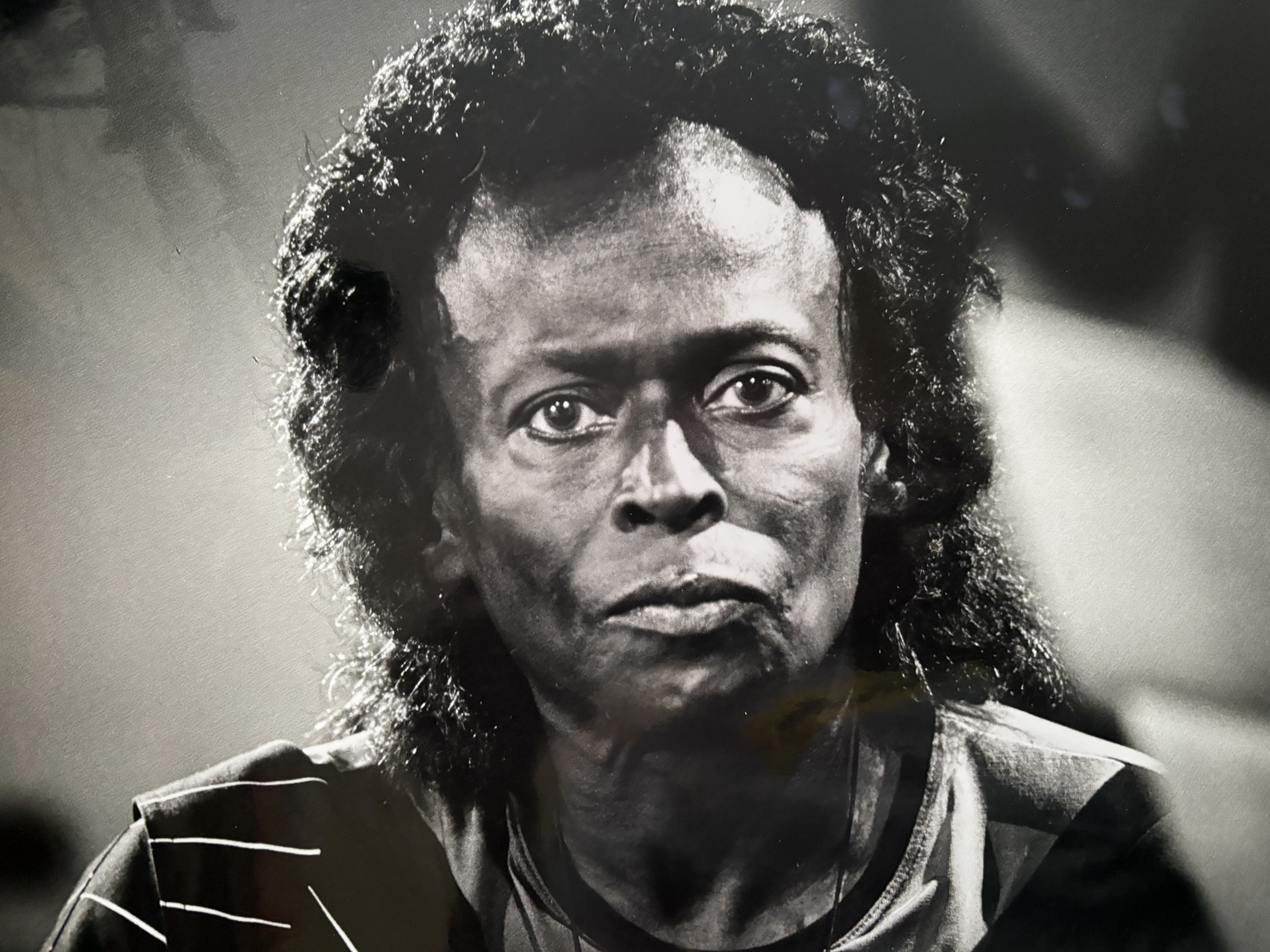
There’s so much Miles Davis around just now, in celebration of today’s centenary of his birth on May 26, 1926. There are stage plays (I went to one in Southwark, starring the trumpeter Jay Phelps), orchestral concerts at the Cheltenham Jazz Festival and the BBC Proms starring Guy Barker and Ambrose Akimusire respectively, tribute albums like A Supreme Blue by Nicholas Payton and Butcher Brown, and audiophile editions of landmarks such as Birth of the Cool and the soundtrack to Lous Malle’s Ascenseur pur l’echafaud. And there’s Radio Three’s composer of the week slot, presented by Kate Molleson, which began very promisingly on Monday. Good. He deserves it all.
I’ve written a lot about him in the past (including a couple of books), and although I want to mark this occasion, I don’t really have anything new to add to the debate. So here’s an unpublished photo I took of him at Montreux on July 7, 1991, during rehearsals for the following day’s concert, when he played Gil Evans’s historic charts in front of a specially assembled large ensemble conducted by Quincy Jones.
He didn’t look strong and his playing was fragile, but the spirit was still there in his eyes and his manner. He wanted to make it good, of course, particularly after overcoming his lifelong aversion to looking in the rear-view mirror. Just under three months later, in a hospital in Santa Monica, he died from a combination of factors, including bronchial pneumonia and a cerebral haemorrhage. He was 65.
I fell in love with his music when I heard “Milestones” — the one with Cannonball Adderley, John Coltrane, Red Garland, Paul Chambers and Philly Joe Jones — at my school’s jazz society in, I think, 1960. An older boy had brought it on a UK Fontana EP for us to absorb while clustered around the gramophone. Pretty soon I came to think of what it contains in five minutes and 42 seconds as a rare example of perfection in art, and I’ve never seen a reason to resile from that opinion. The one little trumpet fluff on the bridge of the final theme statement is the dropped stitch in the Persian rug, included by the weaver in acknowledgment that true perfection belongs only to Allah.
Well, I don’t really know about that. But if I could take only one piece of music with me, whether on the next road trip or the final voyage to eternity, that would still be it.


That’s a wonderful photograph, Richard. Thanks for posting.
Terrific. A lovely tribute to the fierce, radical beauty of Miles. Dropped stitch and all.
Even though you have written so much about Miles, you still managed to write something fitting.
For me, it isn’t Milestones, as much as I agree with you about it. Let me explain..
Since I first listened, lying in the dark, to Miles Davis’ Columbia lp Greatest Hits sometime around 1983, and was blown away by Miles’ arrangement of Monk’s ‘Round Midnight, he has been the one artist more than any, not just music but everything, whose craft and art has by some way mesmerised me, grooved me, stone cold knocked me out more than any other artist; painter, actor, sculptor, you name it. And I am not alone by any means in being moved by his music, his energy, his style, and let us not forget, the musicians he chose to work with and to inspire him. Happy Birthday, Miles.
👌 🪡 🎺 🙏
But what a day for Sonny to go! As ever, perfect timing…!
Thank you so much Richard, your writing on Miles has done much to illuminate the music of this remarkable man. On the 100th anniversary of Miles’ birth we also mourn the passing of the wonderful Sonny Rollins who has died aged 95
Bang on the money as ever. Milestones was my entry level drug too. Thanks Richard.
Thank you for this quite moving photograph, Richard.
What a great picture RW. Gives Barrie a run for his money.
School Jazz Societies – how vital back then, how missing now ??
We asked the History teacher if he would chaperone us through the formation of our SJS, thinking he seemed the most likely to be vaguely interested, and he turned up at the first meeting, asking if we had anything by J.C. Higginbotham & His Six Hicks?!
Obviously knew his stuff, a great place to start with the great trombonist
The influence is indisputable, as was his abuse of women. He also appropriated authorship of Blue in Green from Bill Evans, later acknowledged by Davis’ family.
Nice to see a personal and up close photo of him from those days. He certainly wasn’t at the apex of his career, but he had some great moments like the Milestone days etc. I got to see him later in his career and he always played with his back to the audience in those days. Was it contempt or was he hiding behind that facade of total cool? Who knows, but what a master of the art and it is so karmic that Sonny, one of his few equals, would pass so close to Miles’ centennial. RIP to the two masters.
art lecturer and the man who sold me my first saxophone played it for me. I was totally spellbound. It was everything I was looking for in jazz. Cool, sophisticated and effortlessly swinging. I must have listened to it thousands of times and it’s as exciting as the first time. Almost.
Great photo
Thanks, Richard. A great photo of a truly great musician. My early teenage years were illuminated by In a Silent Way (and as a follower of the British jazz scene of the time it seemed all the better that John McLaughlin and Dave Holland were partakers in Miles and Teo Macero’s great experiment). And Tutu still sounds like the pathfinder for all the (post)modern technojazz which has followed it. Innovation all the way.
Your words about the tune Milestones being perfection are sublime.
Thank You.