A Northern Soul film
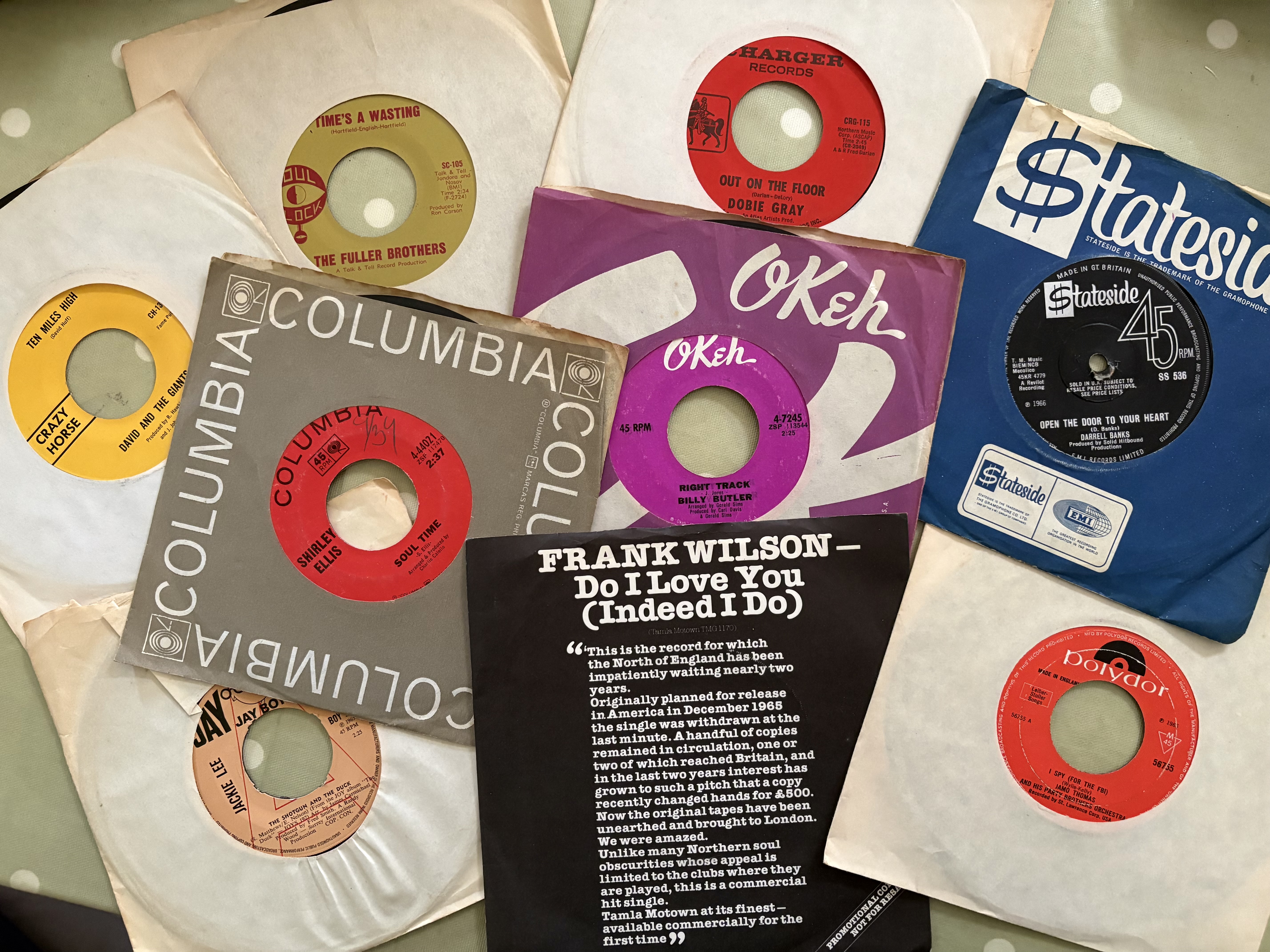
When I left Nottingham for London just before the end of the ’60s, Northern Soul was still in its embryonic stage. We’d danced to “I Can’t Help Myself”, “This Old Heart of Mine”, “You Don’t Know Like I Know”, “Helpless” and “Knock on Wood”, but something different was about to emerge from that club culture. On a visit back home in, I think, 1972, my friend David Milton — who had a shop in Derby called R. E. Cords — told me what it had become, after Dave Godin had given it a name in his Blues & Soul column. At Brian Selby’s Selectadisc, on long-gone Arkwright Street, I bought the Fuller Brothers’ “Time’s A Wasting” on Soul Clock and a bootleg of David and the Giants’ “Ten Miles High”.
I’d pretty much stopped dancing by then, but although I was always at arm’s length from Northern Soul (no visits to the Torch in Stoke on Trent, Blackpool Mecca or Wigan Casino), it always exerted an emotional pull on me: geographical, tribal and musical. It reminds me of the wonderful Welsh word hiraeth: the longing for a home you may never have known.
Northern Soul: Still Burning is a new 90-minute documentary film written and directed by Alan Byron, on show in cinemas this week. Against a constantly changing background of appropriate music, it consists mostly of talking heads — the disc jockeys (Richard Searling, Russ Winstanley. Ian Levine, Kev Roberts), the participants and the observers, including the journalist Paul Mason, who was both, the designer Wayne Hemingway, the documentary maker Tony Palmer, whose 1977 Granada TV film provides priceless footage from Wigan in 1977, and Elaine Constantine, whose feature film Northern Soul (starring Steve Coogan and Lisa Stansfield) came out in 2015 and also provides clips. From the contemporary scene, we hear from Ady Croasdell, who deejays all-nighters at London’s 100 Club, and two young chaps running Northern Soul nights in Deptford. And there’s Tony Blackburn, whose story of how he became an accidental Northern Soul star is the film’s comic highlight.
But the principal concentration is on evoking the emergence 50 years ago of a social and cultural phenomenon in northern and midlands towns already feeling the blight of post-industrial decline through the closure of steel works, woollen mills and coal mines. The music itself is barely discussed: we don’t hear much about the (mostly) African Americans who made it, or why, or what effect its belated rccognition in the UK might have had on them. Or, come to that, what it meant in musical terms (it would have been nice to have someone talking about the importance of vibes and baritone sax on so many of the records). No mention of the Northern Soul Prom of 2023, and the mixed reactions it provoked. Maybe all that is for another time.
You do get a sense, though, of how the combination of factors — summarised by Paul Mason as the music, the dancing, the fashion, and the drugs — so profoundly illuminated apparently ordinary young lives, and of how that feeling refuses to fade. Among the surviving witnesses, a woman named Marie Gillespie provides the most touching testimony; decades later, the meaning of it still shines in her eyes. It made me think how so many of the finest Northern Soul favourites — or even the lesser ones, the smudged copies of “Uptight” and “Reach Out, I’ll Be There” — add a potent hint of sadness and yearning to the relentless beat, and of how those complex emotions found a response in the dancers.
There’s no better example of that than the “three before eight” — Tobi Legend’s “Time Will Pass You By”, Jimmy Radcliffe’s “Long After Tonight Is All Over” and Dean Parrish’s “I’m on My Way” — traditionally played at the end of a Wigan Casino all-nighter. What feelings there are in those records: a urgent plea not to waste your life, a pledge of lasting faith, a shout of belief in the value of persistence despite the odds. On the Casino’s last night, in 1981, Richard Searling played the sequence three times before the doors of the old ballroom opened and the dancers met the morning light for the final time, their hearts full.
* For what it’s worth, here’s a baker’s dozen of my favourites, with no apologies for a complete lack of originality: 1 Frank Wilson: “Do I Love You (Deed I Do)” 2 Rita and the Tiaras: “Gone With the Wind Is My Love” 3 Billy Butler: “Right Track” 4 Ad Libs: “Nothing Worse Than Being Alone” 6 Tobi Legend: “Time Will Pass You By” 6 Shirley Ellis: “Soul Time” 7 Doni Burdick: “Bari Track” 8 Fuller Brothers: “Time’s A Wasting” 9 The Crow: “Your Autumn of Tomorrow” 10 The Tomangoes: “I Really Love You” 11 Frankie and the Classicals: “What Shall I Do” 12 Jackie Lee: “The Shotgun and the Duck” 13 David and the Giants: “Ten Miles High”


This is a beautiful review. Thank you.
A fabulous list with five songs I was completely unaware of. I have flu and am fighting the urge to dance…that is how good the tunes are.
My friend Hector Heathcote, was the first employee of R.E. Cords in Derby (he’d worked at Selectadisc prior to that). He has great taste in soul music, both northern and southern. He later moved to London, was the resident DJ at the Wag in the 1980s, was (Blow Monkeys’) Dr. Robert’s flatmate in Brixton and ended up working in the studio with Robert on some of the BM post-house music tracks. The below is from an interview i did with him ten years ago.
How long were you at Selectadisc for?
Two and a half to three years. I ran the mail order and worked in the shop. But then Dave Milton, he gave me a lift to work every day, he said he was opening a shop in Derby and would I be interested in running it? I bit his hand off. That was the start of a really good relationship because Dave had a massive effect on me, my musical taste and other things. I owe him a lot. He had really good taste in everything.
What was he into?
Soul. He was from the original Mod generation that spread out from London up north so by 65 you had things happening in Derby and Leicester. There was a club in Derby called Clouds/Cleos that was opened by Dave’s brother in 65. So he had a grounding in soul. He liked southern soul a lot. I used to dismiss it because it was slow but I soon learnt.
Stuff like Hi, Stax, Sound Stage 7?
Yeah he liked Joe Simon, but he liked really quirky ones as well. Our favourite was a Roshell Anderson one that Dave Godin wrote about in one of his columns one week. It’s still in the all-time top five. Know What You’re Doing When You Leave. It’s just got such an idiosyncratic voice. The closest to someone like Durando. The other side is awesome, sounds like a 50s tune. Jesse Boone & The Astros No Particular One. Deep soul heaven. We had that in common. He liked quirky stuff.
I knew Hector a bit — probably introduced by Dave (whose enthusiasm for Roshell Anderson I remembert well). The last time I saw him, he was working in the Record & Tape Exchange at Notting Hill Gate. I hope he’s alive and well.
Northern Soul came late to the dance , before that there was northern soul , born at the Twisted Wheel in Manchester ( at least according to the people there in 1965) and spreading out across the Manchester suburbs and into South East Lancashire. Reached me at the Birdcage in Ashton-Under-Lyne in 1970 on Thursday nights when 16 year old’s were let in. A diet of obscure Tamla , James Brown and the beginnings of deep mining of American Soul obscurities.
Left out an important ingredient of the Birdcage experience , ska , especially Prince Buster.
That was all happening in Nottingham, too, at the Dungeon and the Beachcomber from 1964 on. “Candy” by the Astors, “Never Say No to Your Baby” by the Hit Pack, etc. And in Sheffield at the Mojo. But it wasn’t codified in the way Northern Soul became at the start of the ’70s.
I’m the same age as you, Richard, and 2 questions always came to mind when, in the early 70s, I first heard about Northern Soul and the music its fans were into:
1. what took them so long?, and
2. what were they listening to and dancing to when records you mention like Uptight and Reach Out, I’ll Be There actually first came out 6 or 7 years earlier?
I loved that stuff and. like you, still do, but by 1972 things had moved on and Northern Soul often sounded like music from another age.
There’s quite a few misconceptions here, in the blog and in the comments. Soul was always popular among mods and hip kids in any half-decent clubs – south and north. The beginning of what would become Northern Soul – which actually started 1968 -1969 at the Wheel and a few other clubs (Northants/Beds in my case) was when some DJs stopped playing new release records and started to go back to old releases that hadn’t been played at the time or B sides of ones that had. In some cases they were only a couple of years old but were very hard to find and were being played out for the first time in most cases. Most DJs moved with the times and incorporated the funkier tunes but a stubborn few wanted to hear more of what they loved – but new titles and artists.
Of the five examples Richard gives – “I Can’t Help Myself”, “This Old Heart of Mine”, “You Don’t Know Like I Know”, “Helpless” and “Knock on Wood”, the first two were played out as new releases and too well known for the rare soul or Old Soul scene as I knew it and the Stax pairing was the wrong rhythm – only ‘Helpless’ had the right beat and the rarity value that it carried on through to our scene. So that wasn’t an embryonic stage it was current soul music.
Import- only records like Leon Haywood ‘Baby Reconsider’, J J Barnes ‘Please Let Me In’ and Jackie Lee ‘Do The Temptation Walk’ would kick start the serious collecting of U S only releases and digging deeper would eventually reveal tens of thousands of brilliant records that had been missed the first time around – for many reasons but mainly because so many were made they couldn’t all get played at the time
As for the film, the footage about my silly prank – getting Wigan to play Tony Blackburn – was ten or more years old from a previous documentary, I didn’t know they were rehashing it. I and my contemporaries weren’t consulted despite running all-nighters for 40 + years and they are still going strong. Apparently there’s hardly any reference to the scene since Wigan closed (it has thrived and continues to find wonderful unheard soul recordings), just a nod to some of the new clubs run by younger fans who have had some level of success, mainly in cyber-space. I don’t need to hear the same old Wigan Casino story again; it’s been done many times.
Saw the film last night Ady and did enjoy it as did the the others in our group. However, agree 100% there is way too much emphasis on Wigan Casino in the history of Northern Soul.
Thanks for the perspective in your comments, unbelievable that you and your contemporaries weren’t consulted for what would have been considerable and valuable input.
My formative years were spent in Bournemouth and the soundtrack in the mid to late ’60’s at local night spots was predominately Soul. Many of the more obscure records popular on the dance floor at the time had a 2nd life when they were absorbed into the Northern Soul scene.
I spent a year or so working on Bournemouth buses in the late ’60’s and there I encountered Ted Carroll, somebody you know well. We would often go ‘crate digging’ in local exchange and mart shops and Ted would frequently strike gold for little outlay. The high point of these record hunts was a trip to London to visit Dave Godin’s ‘Soul City’ which was truly a mecca for the Soul enthusiast.
that’s great personal history, hopefully you caught Zoot a few times and maybe the Peddlers. Ted’s still at it in a shop in Stamford Lincs. He’s quite active on Facebook. Glad you enjoyed the film; the music’s still inspiring, I’ve stopped sulking now
Quite entitled to a mini sulk regarding the exclusion, despite being in it! Great Tony Blackburn story, most of the audience last night cracked up.
I have been in touch with Ted and visited him in Stamford a year or so ago and will return some time this summer. Despite his ‘retirement’, he remains record dealer and collector.
Zoot and the Big Roll Band were popular locally and often played Bournemouth Pavillion, confused the hell out of us soul fans when he showed up as Dantalian’s Chariot tho’.
He did return to his RnB roots though when he headlined a fund raising concert in1997 for AFC Bournemouth who were about to depart the Football League. Local soul band ‘The Agency’ who were also on the bill backed him. Played mostly standards but an excellent set.
Northern Soul was just Soul to this London based (now Kent) woman in her youth. When it became popular “down south” as they used to say, for a short time we did the steps. Then as Funk became more popular, we watched Soul Train, copied and incorporated the moves. We danced Upstairs at Ronnie Scott’s and other West End clubs. I still say it was just Soul.