Larry Young rediscovered
 When a friend asked me this week to name the most memorable gig I’ve ever attended, I could answer him in a heartbeat: the Tony Williams Lifetime at the Marquee on October 6, 1970. Nothing has ever felt more like the future exploding in the audience’s ears.
The organist Larry Young was a part of that band, along with John McLaughlin on guitar, Jack Bruce on bass guitar and Williams on drums. Earlier in the year I’d heard them at Ungano’s, a New York club, without Bruce but with Miles Davis leaning against the bar in a tan suede patchwork suit, listening intently, his silver Lamborghini Miura parked at the kerb outside on West 70th Street.
In such places, i.e. clubs with a capacity of around 200, Lifetime were mercilessly volcanic. And Young, the least-known member of the band, was a vital component of a sound that surged and howled and crashed off the walls.
This was no real surprise to those who’d heard his run of Blue Note albums, which started in 1965 with the release of Into Somethin’, on which he was joined by Sam Rivers (tenor), Grant Green (guitar) and Elvin Jones (drums). It’s one of those great recordings, like Jackie McLean’s One Step Beyond, Grachan Moncur III’s Some Other Stuff, Andrew Hill’s Point of Departure and Sam Rivers’ Fuchsia Swing Song, with which the label made a bridge between hard bop and the avant-garde, creating an inside-outside music that satisfied all kinds of demands.
Young came up in R&B bands, and it might have been expected that he would simply follow the example of Jimmy Smith, Jack McDuff, Jimmy McGriff, John Patton, Freddie Roach, Baby Face Willette and all the other Hammond exponents whose playing was strongly influenced by the organ’s traditional role in gospel music. Young’s playing was soulful, certainly, but he steered absolutely clear of cliché. His chosen tone was rounder and softer than that preferred by most of his peers, although it lacked nothing in attack; his nimbleness around the B3 keyboard was unexampled, enabling him to absorb the influence of the new music, and he could more than hold his own alongside McLaughlin and Williams at their most ferocious (listen to “Spectrum” from the first Lifetime album, Emergency!, which is much better than its reputation might suggest, and where, before Bruce’s arrival, he is still using his pedals to supply the bass line).
Miles Davis had included him in the Bitches Brew sessions in 1969, and he had jammed with Hendrix the same year (a track released on Nine to the Universe) shortly before joining Williams’s project. I last saw him in a revamped version of Lifetime at the Berlin Jazz Festival in 1971, with Ted Dunbar on guitar and Juni Booth on bass: a much less overwhelming proposition.
By that time he had renamed himself Khalid Yasin. He died in 1978, in slightly mysterious circumstances. Complaining of stomach pains, he checked himself into a hospital, but died there, apparently of untreated pneumonia. He was 37 years old and had just signed a contract with Warner Brothers.
Any new evidence of his talent, then, is to be welcomed, and the 2-CD set titled Larry Young in Paris is a real gift. Recorded in sessions for the ORTF radio network in 1965, the majority of the tracks at the station’s studios but others at the Locomotive night club, it presents him in generally favourable circumstances, with sidemen including the trumpeter Woody Shaw, the tenorist Nathan Davis and the drummers Billy Brooks and Franco Manzecchi.
The music is hard-swinging post-bop spiced with a strong Coltrane influence, signalled by the titles of two compositions: Davis’s “Trane of Thought” and Young’s “Talkin’ About J.C.” (which he had recorded the previous year on Grant Green’s Talkin’ About). More conventional than anything Lifetime attempted, these 105 minutes of music nevertheless offer an extended view of his brilliant melodic imagination and the great sense of swing evident in his comping for the other soloists. Wayne Shorter’s “Black Nile” and Shaw’s “Zoltan” (which also appeared in a studio version on Young’s Unity) are among the tracks that inspire burning solos from Shaw and Davis. You can hear the music’s gathering sense of adventure starting to strain the seams of the players’ Italian suits.
Issued by Resonance Records with a well edited booklet featuring a great deal of valuable material from the sons of Young and Shaw, plus interviews with Dr Lonnie Smith and Bill Laswell, some background on the Paris scene, and photography by Francis Wolff and Jean-Pierre Leloir, this is a really wonderful discovery.
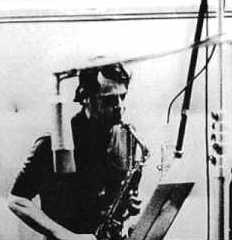
* The photograph of Larry Young was taken outside the ORTF studios by Francis Wolff.
 Matana Roberts was reminiscing about the first time she played with the great bassist Henry Grimes. It was during the New York blackout of 2004, when she was scheduled to appear at the Jazz Gallery with a group including Grimes and the pianist Vijay Iyer. She had been travelling on the L train from her home in Queens, and it had just emerged from the tunnel under the East River when all power vanished across the length and breadth of the city.
 The fact that Mette Henriette, a young Norwegian saxophonist and composer, has made her recording debut with a double CD might seem to align her with the current phenomenon of “muchness” recently identified by the New York Times‘s Ben Ratliff in his
 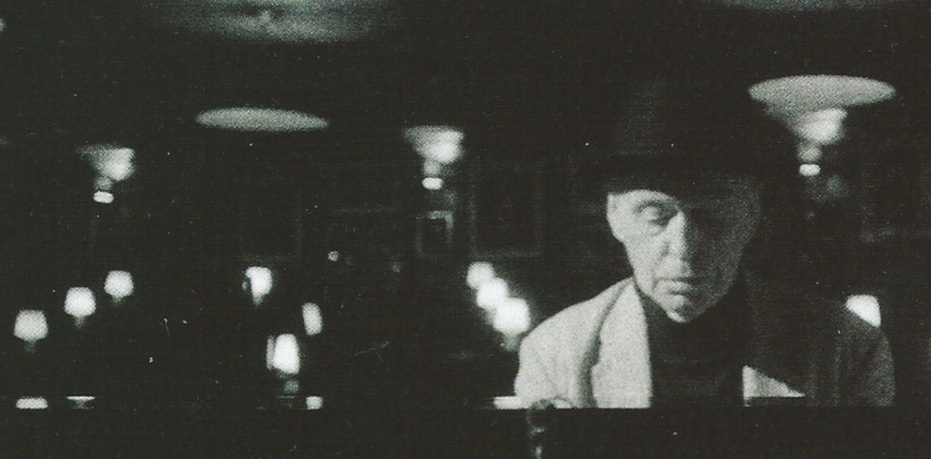 Can it really be true that, as Georgie Fame intimates, we should take the title of his new album seriously? Swan Songs is credited to “Georgie Fame and the Last Blue Flames”. It is, he says, his final recording. “In the twilight of a long career / When dementia’s all I have to fear / If I ever get to lose these blues / I’ve learned to put my life to better use,” he sings, and the compositions with which he fills the album seem designed to provide both a summary and a valediction.
 I heard Sonny Rollins play his sax on the Williamsburg Bridge once and only once live one afternoon so many years ago I can’t recall the walkway’s colour back then. Definitely not the pale red of my tongue when I wag it at myself each morning in the mirror, the walkway’s colour today at the intersection of Delancey and Clinton Streets where I enter it by passing through monumental stone portals, then under a framework of steel girders that span the 118-foot width of the bridge and display steel letters announcing its name. Iron fences painted cotton-candy pink guard the walkway’s flanks, and just beyond their shoulder-high rails much taller barriers of heavier-gauge steel chicken wire bolted to sturdy steel posts guard the fences. Steel crossbeams, spaced four yards or so apart, form a kind of serial roof over the walkway, too high by about a foot for me to jump up and touch, even on my best days playing hoop…