Skip to content

Posts from the ‘Jazz’ Category

Georgie Fame’s Swan Songs

Georgie Fame Swan SongCan it really be true that, as Georgie Fame intimates, we should take the title of his new album seriously? Swan Songs is credited to “Georgie Fame and the Last Blue Flames”. It is, he says, his final recording. “In the twilight of a long career / When dementia’s all I have to fear / If I ever get to lose these blues / I’ve learned to put my life to better use,” he sings, and the compositions with which he fills the album seem designed to provide both a summary and a valediction.

He sounds like he’s saying goodbye, at the age of 72, with a reasonably light heart. “I did my time with Van the Man / ‘Cos that’s the kind of fool I am,” he tells us in the same song, “The Diary Blues”. The album opens with a fragment of brass band music, which is how he started in his Lancashire youth, and a Caribbean-styled song reminds us of the days of “Humpty Dumpty” and “Dr Kitch”. He pays tribute to the late arranger and composer Steve Gray, a friend with whom he wrote a musical called Singer, in a song called “Gray’s March”, and to his mentor, Mose Allison, in the witty “Mose Knows”.

There’s a lesson in hip phrasing in the way Fame delivers these lines at a rapid tempo, every stressed, stretched and syncopated syllable adding to or adjusting the momentum on the fly: “He’s a country boy / Made his home in the city / At once bold and coy / Sometimes sombre, always witty / And his canny observations put to melody / Were meant to be heard by folks like you and me / A man so wise, indeed a sage / Who never fails to surprise when he walks on stage / You can raise the roof, you can tear it down / Don’t be square, just be there when Mose Allison’s in town…”

The 12 tracks — 10 of them written by Fame — canter through most of the familiar modes, from shuffle to swing, with space for a lovely ballad called “Lost in a Lover’s Dream”. The “Last Blue Flames” — Guy Barker (trumpet), Alan Skidmore (tenor), Anthony Kerr (vibes), Tristan Powell (guitar), Alec Dankworth (bass), James Powell (drums and Ralph Salmins (percussion) — acquit themselves with the customary excellence, particularly on a finger-snapping instrumental piece called “Spin Recovery” which sounds like something Lee Morgan and Lonnie Smith might have cooked up circa 1967.

Many of us will be hoping that this isn’t the end. But if it is, there’s further consolation to be found in the release of The Whole World’s Shaking, a five-CD box containing all Fame’s recordings for the Columbia label between 1963 and 1966, including the albums Rhythm and Blues at the Flamingo, Fame at Last, Sound Venture and Sweet Things, plus many singles, EPs, out-takes and BBC broadcasts — 106 tracks in all, very nicely packaged, including a handsome book with an extensive sleeve essay from Chris Welch. I’ve always thought of Fame at Last, with its exquisite version of “Moody’s Mood for Love”, as a perfect album, so it’s good to have it available in this form, with so much else besides, like the moment Colin Green cuts into “Last Night” with the guitar riff from “Nowhere to Run”, or Bill Eyden’s triplet figures on “Green Onions”, or Jimmy Deuchar’s muted trumpet obligato on the gorgeous “Lil’ Darlin'”. Oh, I could go on. I just hope he does.

* Swan Songs is released on Fame’s own Three Line Whip label. The Whole World’s Shaking is on Universal/Polydor. The photograph is taken from the sleeve of the new album.

The Bridge

Sonny Rollins 1I heard Sonny Rollins play his sax on the Williamsburg Bridge once and only once live one afternoon so many years ago I can’t recall the walkway’s colour back then. Definitely not the pale red of my tongue when I wag it at myself each morning in the mirror, the walkway’s colour today at the intersection of Delancey and Clinton Streets where I enter it by passing through monumental stone portals, then under a framework of steel girders that span the 118-foot width of the bridge and display steel letters announcing its name. Iron fences painted cotton-candy pink guard the walkway’s flanks, and just beyond their shoulder-high rails much taller barriers of heavier-gauge steel chicken wire bolted to sturdy steel posts guard the fences. Steel crossbeams, spaced four yards or so apart, form a kind of serial roof over the walkway, too high by about a foot for me to jump up and touch, even on my best days playing hoop…

That’s an early passage from one of the best things I’ve read in a magazine this year, a short story called “Williamsburg Bridge” by John Edgar Wideman. I don’t always buy Harper’s magazine, but I seldom regret it when I do and the November issue was worth all of the €12.50 it cost at an airport news stand last week just for that piece alone, an extended monologue delivered by a man perched high on the bridge, with his back to the water, having removed all his clothes except his undershorts, preparing to jump off while allowing his mind to run through the thoughts that prefaced that decision.

Wideman, aged 74, is a novelist whose past honours include the PEN/Faulkner award and a MacArthur fellowship, the so-called “genius grant”. The several mentions of Sonny Rollins by the protagonist of “Williamsburg Bridge” take me back to the time I first got interested in jazz, around 1960, when Rollins was on his self-imposed sabbatical, reassessing his own work in the light of innovations of John Coltrane and working it all out en plein air on the iron structure over New York’s East River, where he could sometimes be glimpsed (and heard). It was part of an attempt to change his life, a regime that included giving up smoking, practising yoga and studying Eastern religions.

He re-emerged in 1961. The New Yorker‘s Whitney Balliett went to hear him and famously proclaimed: “Sonny Rollins isn’t merely back; he’s looming.” The following year Rollins marked his comeback with a very fine album called The Bridge, which — despite the obvious reference to his unconventional sabbatical — surprised critics by its conservative approach. He was accompanied by the guitarist Jim Hall, the bassist Bob Cranshaw and the drummer Ben Riley on a programme of standards and originals. At a time when Coltrane, Cecil Taylor and Ornette Coleman had thrown jazz into a ferment, there was no sign here that Rollins had returned to action with a plan to play them at their own game. (That would come a few months later, when he recruited Don Cherry and Billy Higgins into a quartet that adopted some of Coleman’s freedoms.)

The point of this, however, is to recommend Wideman’s story. The reader is never quite sure whether the protagonist — a writer, we learn — is really up there on the bridge, preparing to jump, or perhaps lying safely in his bed visualising the possibility, or even just writing a story about someone readying himself for the act. But, like one of those stream-of-consciousness improvisations in which Rollins used to specialise, scrolling through his thoughts with absolute confidence and unshakeable internal logic, it takes a grip and doesn’t let go.

* You can read the story here: http://harpers.org/archive/2015/11/williamsburg-bridge/  The photograph of Sonny Rollins is adapted from the cover image of The Bridge, taken by Chuck Stewart.

Winterreise

Loch_Siegfried_by_Barbara_EismannIn the full-fat era of the record industry, Siggi Loch was a very big cheese. Starting out as a teenaged Sidney Bechet fan in Hannover in the early 1950s, he played drums with his own band, the Red Onions, before taking a job as a sales rep with EMI-Electrola in 1960, aged 20. From there he became a label manager at Phonogram in Hamburg, making his first album as a producer with the saxophonist Klaus Doldinger in 1962. He moved on to Liberty/United Artists, where he was installed as managing director of a stable including Can and Amon Duul II, the pioneering German rock bands. In 1971 he joined WEA Hamburg, then the umbrella company for Warner Brothers, Atlantic, Elektra and their associated labels in Germany, becoming chairman of WEA International from 1983-87: an extremely powerful position within an industry then at the peak of its prosperity.

When he left WEA, it was with a plan that involved something more ambitious than staring at his collection of contemporary art. As he told me during a conversation over a cup of coffee in Berlin a few months ago, he wanted to return to jazz, his first love, and to put something back, via his own independent label. Based in Munich, ACT currently releases around two dozen albums a year, having become widely known for its successes with the Swedish trio of the late pianist Esbjörn Svensson and, more recently, the German piano prodigy Michael Wollny.

The obvious comparison is with another Munich-based label identified by three letters: Manfred Eicher’s ECM. But, despite their similarities (including a fondness for giving their artwork a unified look based on the founder’s personal aesthetic), the two diverge in important ways. ACT is less identified with a sound, or a particular way of recording. Loch’s taste — or at least his vision of what his label should present to the public — is looser and more eclectic. He also presents concerts, including the annual Jazz at the Philharmonie, which revives the old Berlin Jazz Festival tradition of staging events at the grand home of the Berlin Philharmonic Orchestra.

In recent months, while Loch has been celebrating his 75th birthday, ACT has put out two albums that, while unlikely to shift units in EST or Wollny quantities, seem to me to be among the year’s outstanding releases. As it happens, both are by quartets with similar instrumentation: saxophone, guitar, double bass and drums. Curiously — and, I’m sure, coincidentally — the two albums share a preoccupation more usually associated with the other Munich label: a desire to paint sound-pictures of winter landscapes.

Slow Snow is a set of quietly gorgeous tone poems that find the Norwegian saxophonist and composer Tore Brunborg accompanied by three compatriots: the guitarist Eivind Aarset, the bassist Steinar Raknes and the drummer Per Oddvar Johansen. Brunborg’s lovely melodies are enhanced by an almost subliminal but telling use of electronics (contributed by Aarset and Johansen), with the leader doubling to good effect on piano. On a piece like “Tune In” the air of restraint makes Aarset’s guitar distortion all the more telling, his chords creating a mood of suppressed hysteria as Brunborg deploys his fine tone in a solo against a background that rises and falls like a house-trained version of King Crimson’s “Lark’s Tongues in Aspic”. If this is the kind of jazz — calm, spacious, reflective, underplayed, sometimes pastoral in mood, with a muted but glowing lyricism — one has come to expect from Norwegians over the past 40 years, then the sheer brilliance of the writing and playing enables it to escape any charge of predictability with ease.

Winter Light is a more extrovert affair, under the leadership of the gifted American guitarist and composer Scott DuBois, who evokes the example of Claude Monet in his desire to capture shifting light in changing seasons. Completed by the German saxophonist Gebhard Ullmann, the double bassist Thomas Morgan and the drummer Kresten Osgood, the quartet has been together for eight years and its members show every sign of great familiarity with each other’s playing. DuBois’s compositions — with titles like “Late Morning Snow” and “Night Tundra” — are devised to make the most of the musicians’ ability to go from inside to outside with complete naturalness; on the opening “First Light Tundra”, in fact, the gentle textures of the main theme are occasionally and very effectively interrupted by squalls of free playing, most notably from the bass clarinet of the remarkable Ullmann, a veteran who deserves to be better known. My admiration of Morgan is underlined by his unflagging brilliance throughout this set, in partnership with Osgood’s vigorous drumming; together they rise to the challenge set by DuBois’s furiously inventive solo on “Early Morning Forest”.

If these albums certainly make a good accompaniment to the onset of winter in the northern hemisphere, it has to be said that they’d sound good in any season: the other quality that unites them, beneath their frost-bitten tune titles, is an underlying warmth. I can’t recommend them highly enough.

* The photograph of Siggi Loch is by Barbara Elsmann (c) ACT.

Between the world and the Black Panthers

Out to Lunch

Others will be better qualified to talk about the substance of The Black Panthers: Vanguard of the Revolution, Stanley Nelson’s documentary, which is currently showing in London. I found it extremely moving. There’s an initial sense of exhilaration at the spectacle of the human spirit responding to adversity with pride, resilience and creativity, only for that spirit to be crushed by the relentless efficiency of J. Edgar Hoover and his FBI.

Nelson modulates the tone of the film to match its narrative arc with great sensitivity, and that is where the soundtrack plays its part. At the start of the story we see the Chi-Lites singing “(For God’s Sake) Give More Power to the People” in ruffled costumes on Soul Train and hear Billy Paul’s “Am I Black Enough For You”, Philadelphia International’s most confrontational moment. These are reminders of how the ideas represented by the Panthers were able to gatecrash mainstream culture. Later the musical backdrop is supplied by the stripped-down street-funk of the early ’70s (“Express Yourself” by Charles Wright and the Watts 103rd Street Rhythm Band being a good example). At the close, with the Panthers’ unity and sense of purpose destroyed by police bullets (notably in the assassination of Fred Hampton, the eloquent, charismatic 21-year-old who Hoover feared would become the movement’s “messiah”) and internal rivalries (the post-prison Huey P. Newton versus the exiled Eldridge Cleaver), the profound darkening of the mood is expressed through the voice of Gil Scott-Heron, singing “Winter in America”.

I’ve been reading Ta-Nehisi Coates’s Between the World and Me, a recent best-seller which takes the form of a letter to his 15-year-old son, relating Coates’s own experiences as a black boy growing up in America. His grandfather was a research librarian at Howard University in Washington DC, with a profound love of books: “…all over the house, books about black people, by black people, for black people spilling off shelves and out of the living room…” His parents were radicals: “We would not stand for their anthems. We would not kneel before their God.” His father had been a captain in the Black Panther Party.

The book is a brilliant analysis of the journey taken by several generations of African Americans, always facing the same enemy. Coates was born in 1975: “To be black in the Baltimore of my youth,” he writes, “was to be naked before all the elements of the world, before all the guns, fists, knives, crack, rape, and disease.” He was 11 years old when another boy pulled a gun on him. His son’s reality is the Black Lives Matter movement.

Nelson’s film contains another music-related moment that made me catch my breath. We see photographs of the room in a Panther house on Chicago’s West Side where Fred Hampton was gunned down by police in December 1969, its layout revealed to them by an FBI informant. Amid the blood-spattered debris lying on the bedroom floor, it’s possible to glimpse the sleeve of Eric Dolphy’s Out to Lunch. On its appearance in 1964, Dolphy’s album represented a high point in the African American research project that jazz had become. It’s still being analysed and copied today. And to me it’s an affirmation of some sort that Out to Lunch was part of the soundtrack of that Panther household, and — or so we may infer — of Fred Hampton’s short life.

Dick Twardzik 30/4/31–21/10/55

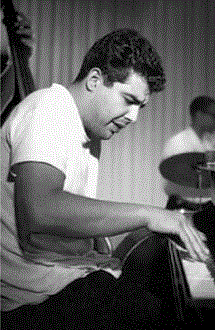
Dick_TwardzikTomorrow evening it will be exactly 60 years since the pianist and composer Dick Twardzik was found dead in his room at the Hôtel de la Madeleine on the Rue de Surène, in Paris’s 8th arrondissement. He was on tour in Europe with the Chet Baker Quartet, and the previous night they had played at the Club Tabu, where they were joined by the great Swedish baritone saxophonist Lars Gullin. After returning to the hotel in the early hours, they were due to reconvene at 4pm for a recording session at the Pathé-Magellan studio. When, after an hour, he hadn’t showed up, a search party went back to the hotel and his body was discovered. A heroin overdose had killed him. He was 24 years old.

Twardzik was a prodigy. Born in Boston, the son of two artists, he had studied with Madame Margaret Chaloff of the New England Conservatory of Music, a renowned teacher who is better known to jazz fans as the mother of Serge Chaloff, one of the great post-war baritone saxophonists. Serge and Dick would play and record together. And share a heroin habit that eventually killed the other man, too.

By the time Twardzik was 21, he was good enough to play with Charlie Parker. You can hear the results on Boston 1952, a Parker album compiled from radio broadcasts recorded at the Hi-Hat Club and released on the Uptown label a few years ago. Symphony Sid Torin, the radio show’s announcer, can’t get the young man’s name right, but listen to the wonderful inventiveness of the piano solo on a relaxed “Don’t Blame Me”, to the way he spins out his double-time lines, shaping them so beautifully, allowing them to float and curl and wind before moving into a passage of contrapuntal and parallel lines, followed by the lightest of block chords. By that time, he had already been using heroin for three years.

After Bud Powell, he might have become Parker’s most stimulating keyboard partner, if they’d both lived and been given time to develop their partnership. Twardzik’s ear and imagination, and his knowledge of modern classical music, would surely have appealed to Bird, and might have inspired an escape from the bebop cul-de-sac into which Parker was heading by the time of his own death in 1955.

But that’s speculation. What we know is that Twardzik made a brilliant set of trio recordings for the Pacific Jazz in October 1954, half a dozen tracks first issued as one side of an LP called Trio which he shared with the group of Russ Freeman, his predecessor as Baker’s pianist, who had brought him to the attention of the label’s boss, Dick Bock. The tracks, with one addition, were later released by themselves as The Last Set. There are three standards — “Round Midnight”, “I’ll Remember April” and “Bess You is My Woman” — along with three of his own compositions, all of them immediately striking, and not just for their titles: “Albuquerque Social Swim”, “Yellow Tango”, “A Crutch for the Crab”. They’re as full of playful character and unexpected twists as those of Herbie Nichols — a comparison that also strikes Alexander Hawkins, the English pianist, who is a student of such matters and a confirmed Twardzik fan. Thinking you might like a break from my views, I asked Alex for a few words. Here’s some of what he sent me:

For me, he fits squarely within that magical clutch of pianists from mid-century who are just so wonderfully sui generis (Monk, Powell, Hope, Nichols, and a few years later, the likes of Hasaan etc). I think it naturally comes out most clearly in his compositions; and to me it’s extraordinary to reflect that we can get such a strong sense of a radical original from so few works. However, it’s also fascinating to listen to him play standards: his arranger’s touch was such that he could make such a ‘standard’ standard as “I’ll Remember April” all his own – in the way he mysteriously stalks the notes of the first eight bars of this over the swinging drums, I hear a weird pre-echo of Misha (Mengelberg) and Han (Bennink).

I love the headlong intensity and clarity of purpose, despite such knotty compositions: in this I hear a real kinship with Bud Powell (“Glass Enclosure”, etc). There’s also clearly an affinity with Bartok, Hindemith, and so on; and I hear elements of Bernstein and Sondheim, too. I can also hear a possible line through to early Cecil Taylor. In the way both composers graft together different melodic/rhythmic strands, I hear some deep similarity with (especially pre-Unit Structures) Cecil: in particular, I’m thinking of the session which produced ‘Pots’, ‘Bulbs’, and ‘Mixed’, and also tunes like ‘Excursion on a Wobbly Rail’. I also hear a kinship with Cecil in the love of contrary motion figures.

The historical context also fascinates me too: just like with Bird, Hasaan, Nichols – where on earth could this music have gone had he lived? It’s so much at the vanguard of what seemed possible at the time that trying to put oneself in contemporary shoes as far as possible and hearing the future directions is completely baffling, and as such, deeply inspiring as a player and composer.

After Twardzik arrived in Le Havre on the liner Île-de-France on September 13 with the rest of Baker’s rhythm section — the bassist Jimmy Bond and the drummer Peter Littman — and met up with the trumpeter, the band began their tour at the Concertgebouw in Amsterdam (supported by the Tony Crombie All Stars!) and continued through Germany, Switzerland, Belgium and France. There were 10 concerts in all, several of which were recorded and are available on various bootlegs. In Paris on October 11 and 14 they also recorded the nine tracks — eight compositions by Bob Zieff, a friend of Twardzik’s from Boston, and one by the pianist himself — that would make up one of the most remarkable small-group records of the 1950s.

Zieff’s cool little pieces have wonderful beatnik titles: “Rondette”, “Mid-Forte”, “Sad Walk”, “Pomp”, “Brash”. Perfectly balanced and slightly formal modernist mechanisms, they’re clean-lined but unpredictable, absolutely devoid of any hint of cliché (jazz or otherwise), stretching the musicians — particularly the trumpeter and pianist — in interesting ways without inducing contortions. It’s no surprise to discover that Gil Evans later became a fan of the composer, and a terrible shame that he was destined to remain in obscurity. And Twardzik’s tune, “The Girl from Greenland”, is typically intriguing and memorable.

Issued on the Barclay label in France soon afterwards, this set is still available and is, I’d say, essential — not just for itself, but also because it represents the last view we would ever get of a great talent taken away, like so many others, by a plague that is still with us, and still taking lives.

* If you want to know more, I warmly recommend Jack Chambers’ excellent biography, Bouncin’ with Bartok: The Incomplete Works of Richard Twardzik, published in Canada by the Mercury Press in 2008, from which the photograph is taken. There’s also an interesting CD of Twardzik’s home rehearsal recordings called 1954 Improvisations, all variations on standards, released by the New Artists label in 1990. Recordings of the Baker Quartet’s concerts in Cologne, Amsterdam and elsewhere are available on various bootlegs.

Matana Roberts in Hackney

Matana Roberts Oslo 2Matana Roberts asked for “comments, questions and critiques” at the end of her remarkable performance at Oslo in Hackney last night (“Well, maybe not the critiques,” she added). That doesn’t happen at every gig. There were many questions from an enthusiastic audience, and she answered them all — whether on David Cameron’s attitude to reparations for slavery or the influence of early ’60s free jazz on her music — with conviction, insight and wit.

A genuinely extraordinary artist of our time, she pursues a vision that places her beyond category. Last night she gave us a version of her latest record, the third chapter of the Coin Coin series, in which she is exploring various aspects of American history. On Oslo’s low stage she sat in front of a screen showing a loop of film she created with the use of family ephemera and other images, and divided her time between cueing and modifying the sound bed created from all sorts of audio sources (the “panoramic sound quilting” of which she speaks) and playing brief alto saxophone passages with her fibrous tone and hymn-like delivery, singing snatches of seemingly half-remembered songs, and reading from an old, scuffed, pocket-sized Bible into which she had pasted the various texts used in Chapter Three: River Run Thee.

She is a natural actor, with a powerful presence even in repose. She can draw us in with the warmest of smiles but suddenly switch and flash her eyes with a Simone-like disdain. Her powerful voice sometimes dissolves into strange mumblings and twitterings.

Some thematic fragments recurred. “Come away with me,” she crooned. “Black lives matter / All lives matter.” “I pledge allegiance to… I pledge allegiance to… I pledge allegiance… to a flag with liberty and justice for some.” And, frequently repeated, “I like to tell stories…” That, most of all, was how it felt. In her voluminous skirt, grey shawl, face paint and wild locks, patiently thumbing through her defaced Bible, fiddling with her laptop and electronics, taking her time as the story unwound, she had brought the meaning and textures of the lives of her ancestors into her own existence — and, quite unforgettably, into ours.

Phil Woods 1931-2015

Phil Woods 2Phil Woods, the great alto saxophonist, died yesterday, aged 83. He was featured on the first jazz LP I ever bought, with money saved from a paper round: East Meets West: The Birdland All Stars on Tour, recorded in 1956, with Kenny Dorham, Conte Candoli, Al Cohn, Hank Jones, John Simmons and Kenny Clarke. It was a second-hand copy, found on a market stall. Not a great album, but not a bad place to start, either. More important, Woods went on to play a wonderful solo on one of my very favourite records: the version of Willie Dixon’s “Spoonful” on the expanded reissue of The Individualism of Gil Evans, recorded in 1964.

I couldn’t begin to count the number of things I love about music that are contained in this 14-minute piece, from the deepest blues to the most sophisticated modern jazz. In strategic terms, it creates, intensifies and sustains an extraordinary mood that is quite unlike anything else I know. The tactical details include Gil’s Zen piano and his at times almost subliminal arrangement (those woodwinds painted across the horizon!), the magical combination of Paul Chambers’ calm bass and Elvin Jones’s brooding drums, Kenny Burrell’s super-cool guitar ruminations, Johnny Coles’ heart-piercing trumpet, the brilliant use of Harry Lookofsky’s tenor violin… and the sense of space, space, space, and time, time, time. Time and space became what Gil made of them, and never more so than here.

In the eighth minute the tension rises as the arrangement prepares the way for a passage of two and a half minutes in which Woods’s improvisation makes the most of the landscape Gil has established, exploiting the freedom offered by the modal framework to drill down from a different angle into the essence of the blues. As elegantly funky phrases coalesce into a double-time flurry, the solo reaches its climax — the climax of the whole 14 minutes, in effect — before meandering carefully back to its starting point, finally decompressing though a series of beautifully syncopated two-note phrases into a light-fingered imitation of the walking bass, deliberately lowering the temperature before an ensemble section leads to the drifting, dissolving finale.

I have no idea whether for Woods this represented more than just another good day’s work in the middle of a long and distinguished career. For me, it’s an example of perfection.

Remembering Paul Desmond

Paul Desmond Down Beat 2Fifty years ago this month, Paul Desmond was on the cover of Down Beat. The other day, when I was buying a new reissue of some of his early recordings, the man behind the counter told me his theory, which in essence was that if it hadn’t have been for Desmond, we’d never have heard of Dave Brubeck.

I had to agree with him, for two reasons. First, the graceful sound of Desmond’s alto saxophone was the first thing you heard when you heard the Brubeck Quartet. It was the identifier. Just as important, Desmond wrote “Take Five”, the group’s biggest hit, the one you heard on Sunday lunchtimes on Two-Way Family Favourites. Probably a lot of people assumed that it had come from Brubeck’s pen, the one that wrote two genuine jazz standards, “The Duke” and “In Your Own Sweet Way”. But its ingenuity was the altoist’s work.

The Fresh Sound album, Desmond: Here I Am, starts with five 1954 tracks with a quintet featuring the bassist Bob Bates and the drummer Joe Dodge from the early Brubeck group, and continues with four from the same year with the Bob Bates Singers, originally issued together as Desmond’s first solo album, on the Fantasy label; then come eight tracks recorded two years later with a quartet for the same label.

Interestingly, there is no piano to be heard on any of the three sessions. One could make a mildly cruel joke about the relief of being temporarily free from Brubeck’s heavy-handed accompaniment, but it would be neither fair nor entirely true. But the pianoless setting certainly suited Desmond: there’s an airiness appropriate to his sound.

Desmond was noted for his dry wit. In the Down Beat interview, talking to Dan Morgenstern, he discussed Brubeck’s most recent attempt to team the quartet with a symphony orchestra, in an extended piece called Elementals. “I kind of hope it stays the last,” he said. “That sort of thing is more gratifying to the composer; to perform it is a kind of struggle. It’s a little frustrating when you’re on stage with 80 symphony musicians and succeed in functioning just about as well as you ordinarily do, and it’s considered a great accomplishment — like tap dancing under water.”

He was a bit of a curmudgeon, in an amusing way. “Between the discotheques and the avant-garde and the folk scene, there isn’t much left,” he observed. But he had kind words for Charles Mingus — “He can be fascinating and very moving to listen to, as well as hitting you with something very difficult” — and his idea of a discotheque would be something that played the music of Muddy Waters, Count Basie and Mose Allison, which sounds pretty good to me.

There was never a sense of struggle or difficulty in Desmond’s music. He was even capable of rising above the kitschy sound of the Bates Singers (although not to the degree that he transcended Bob Prince’s workaday arrangements for strings and woodwind on the RCA album Desmond Blue a few years later). The 1956 quartet tracks, with Don Elliott switching between mellophone and trumpet, require no allowances to be made: these are gloriously lucid, lyrical inventions on standards and originals, the absence of strain and challenge more than offset by the calm, balanced inventiveness of the leader’s improvisations.

By 1965, however, the caravan of jazz was moving on. I remember feeling a surge of righteous anger, after handing over half a crown for this copy of the magazine, when I noticed that the editors had chosen to feature him on the cover rather than the second-billed Ornette Coleman. Desmond died of lung cancer in 1977, aged 52, and time has told the truth about him, which is that he was a player of genuine originality who couldn’t have played a banal phrase if he’d tried.

* Desmond: Here I Am is on the Fresh Sound label. Desmond Blue is available on a six-CD box called The Complete RCA Albums Collection, released by Sony Legacy and including his much admired collaborations with the guitarist Jim Hall.

Loud, louder, loudest…

BerghainThis building, for those who don’t already know it, is Berghain, probably the world’s most famous techno club. It opened in 2004 in a building formerly used by East Berlin’s electricity company, now surrounded by waste ground near the Ostbahnhof station. Its sound system is said to be the best of its kind in the world, and it was put to good use this week at the opening night of a four-day festival called A l’Arme!, which is billed by its curator, Louis Rastig, as an “international jazz and sound-art meeting”.

The first highlight was the opening DJ set by Mieko Suzuki, who spent an hour making a simple drone evolve into something rich and strange, with mesmerising subtlety. Then came a duo performance by the saxophonist Colin Stetson and the bass guitarist Bill Laswell, who exploited that legendary sound system to the full.

In my time I’ve stood next to a nitro-burning Top Fuel dragster as it warmed up for a four-second, 300mph quarter-mile run, underneath a Vulcan bomber as a combined 80,000lb of thrust propelled it in a steep climb from low level, and within spitting distance of the Who’s PA. All of those would be in the range of 120-150 decibels. Stetson and Laswell were louder than any of them.

For the best part of an hour they made great waves of noise in which pulse and pitch were subordinate to the overall intention of filling every cranny of the concrete and steel space. The muscular, athletic Stetson made his bass saxophone howl and groan, using effects to produce many simultaneous sound-layers. The expressionless Laswell prodded at his pedal-board and picked at his strings with a deceptively delicate touch while filling the room with stomach-loosening lines. If you were standing a few feet from one of the speaker stacks, the volume generated a breeze that ruffled your hair and made the fabric of your clothes ripple. Ear plugs were available.

It was brutally exhausting, but somehow magnificent. Goodness knows what Adolphe Sax and Leo Fender, creators of the instruments that Stetson and Laswell were taking to the limits and beyond, would have made of it.

Ornette Coleman 1930-2015

Ornette by Ian DuryIt was 1961 when I first heard the sound of Ornette Coleman. I was 14 years old and I’d somehow scraped together the money to buy This Is Our Music, his latest release. I’d been getting interested in jazz, devouring anything I could find. Every word I read about Ornette, even the scornfully dismissive stuff that was about at the time, made him sound interesting. And, of course, I loved the cover, with its Lee Friedlander photograph of four young men — Don Cherry, Ed Blackwell, Ornette, and Charlie Haden — looking impossibly cool.

So I took it home, put it on the Dansette, switched off the lights, and lay down on the floor. For the next 40 minutes I moved only to get up and turn it over. And then I listened to it again. The effect has never gone away.

To me, Ornette’s music sounded like the most natural thing in the world. Nothing about it — the raw timbre of the horns, the lack of conventional chord sequences — bothered me in the slightest. What it had, apart from undoubted modernity, was the “cry” that went back to the origins of the blues.

(That sound impressed me so much that three or four years later I bought a white plastic Grafton alto saxophone, just like Ornette’s, and invested in some lessons with the lead altoist in a local dance band, who also worked the music shop from which I bought it, and was more of a Paul Desmond man. I didn’t get far. Particularly after the night when, during a club gig with the R&B band in which I played, I got up from behind the drums and attempted to insert a bit of free-form improvising into the middle of a Bo Diddley medley. This was 1965: eat your hearts out, Magic Band, Contortions, Pop Group. And even Prime Time, come to that. But it didn’t go down well, and I couldn’t afford to keep the horn. I think I got £30 for it. They’re rare now, not least because they stopped making them in the ’60s, after which the tools and jigs were destroyed. If you dropped them, they cracked and couldn’t be repaired. The last one I saw for sale in a shop, a couple of years ago, had a price tag of £1,500.)

Later on I was fortunate enough to meet Ornette several times, and to discover his unusual mode of verbal expression. Like Captain Beefheart and Van Dyke Parks, he had a way of answering your questions by taking off in a wholly unexpected direction, making several detours, and finally ending up with a completely logical pay-off. That process could take several minutes, and you had to align yourself to the cadences of his thinking if you wanted to get the most from it.

The most striking encounter was at Abbey Road in 1972, when he was recording The Skies of America, his extended orchestral piece, with the LSO, conducted by David Measham. The work had been written to feature his quartet alongside the orchestra, but union rules made that an impossibility. So it was just Ornette and the straight players, some of whom displayed a ready disdain for his score. To be fair, it did make some unorthodox and occasionally severe demands — usually in terms of the upper range of the wind instruments — on a bunch of players including one or two who liked to fill the gaps between takes by propping a copy of the FT on their music stands and checking the progress of their shares. Some inaccurate copying of the parts didn’t help.

The trumpeters made an informal deal between themselves to alternate the highest notes in order to save their lips from damage. At one point, after the orchestra’s percussionist had observed, quite seriously, that it would help to have three conductors working simultaneously, Ornette took a pair of sticks and showed him exactly what he wanted.

So a degree of pain and struggle was certainly involved in the recording, but it sounded marvellous as the composer took out his alto to play along with them. He was wearing a charcoal mohair suit with a flared flap in the back, a silky cream shirt, and multicoloured patchwork leather boots. Ornette’s self-designed wardrobe was just another facet of his originality.

When the album appeared, it was with a sleeve note in which Ornette wrote: “The skies of America have had more changes to occur under them this century than any other country: assassinations, political wars, gangster wars, racial wars, space races, women’s rights, sex, drugs and the death of god, all for the betterment of the American people.” And somehow he managed to get a sense of all that into his 41 minutes of pure American music.

I heard it performed live a couple of times in New York and London, featuring the quartet with the larger ensemble, as originally intended. As time went by it was gussied up a little to smooth away some of the rough edges and make the orchestra players’ lives a little easier, but I don’t think it ever sounded nearly as good. It needed those tensions to bring out the ideas behind its conception. To me, it still sounds like a masterpiece, the product of a mind in which simplicity and complexity achieved a perfect coexistence.

* The image of Ornette Coleman is from Ian Dury’s design for the first UK edition of Four Lives in the Bebop Business, A.B. Spellman’s classic portrait of Ornette, Herbie Nichols, Jackie McLean and Cecil Taylor, published by MacGibbon and Kee in 1967. You can find a short piece I wrote about Ornette’s significance for the Guardian’s music blog here: http://bit.ly/1FbgxSA