Skip to content

Isaac Hayes in full

Isaac HayesI wish I’d had longer to talk to Isaac Hayes back in January 1971, and that I’d been able to get him to talk in more detail about his childhood and his family background, which involved picking cotton and extreme poverty. That day in Memphis, in his extraordinary office in the Stax corporate HQ, white-hot from the success of Hot Buttered Soul and To Be Continued, sitting in a white egg-shaped chair suspended by a chain from the ceiling, he talked about his plans for the imminent recording of what would become Black Moses, the double album released at the end of that year, with its extraordinary cruciform fold-out cover art.
He talked about making it a big production, mentioning George Harrison’s All Things Must Pass as an inspiration and giving me the impression that it would be based on gospel music and spirituals. “But I’m going do it in a commercial fashion,” he explained. “I hope I haven’t waited too long to do it, because sometimes the trend changes so fast and I feel I can really get right to the roots of it. I know I can from recollecting my own experiences, from being in those small country churches that are no larger than this office, where people didn’t have no piano or anything, just feet on the floor. It’s so beautiful, man, and things like that are what I’m going to try and capture.”

I asked him if he’d heard work songs during his upbringing in Covington, a rural town outside Memphis. “Yeah, I can vaguely remember… I’m sure my grandmother would know them, because her mother was a slave. She tells me about those experiences. I used to sing spirituals in the rural areas of Mississippi and Tennessee and Arkansas. Also I started out playing blues. I used to play with a little blues band — I think it was Valentino and the Swing Cats, or something… I played a little tenor sax, and we’d play on a store porch sometimes. On Friday evenings, man, everybody’s coming in from the fields, they fry the fish here and they’re gambling there and selling corn liquor there and drinking wine right across the tracks. You know, one side of the tracks is white and the other is black. We’d play right out in the porches of the stores, those country blues. I’m going back to those places… I’ve been away from it so long. All this will help in putting this album together, because I’m not only going to include spirituals, I’m going to go the whole bit. It’ll be a picture.”

Well, Black Moses didn’t quite turn out like that. In some ways the strangest thing about Hayes’s career is that, having made his name as one of the great soul-music songwriting partnerships of the 1960s (with David Porter), once he became successful as an artist it was via other people’s songs: his protracted boudoir-friendly versions of pieces from the pens of superior pop song writers, in particular Jimmy Webb’s “By the Time I Get to Phoenix” and Bacharach and David’s “The Look of Love” and “Walk On By”. Such things, not gospel songs or spirituals, would be the basis of the double album he recorded between that March and October.

Hayes was a fascinating musician, and all his facets are displayed in The Spirit of Memphis 1962-76, a thoughtfully compiled and beautifully presented four-CD anthology of his material for the Stax family of labels. There’s a first CD containing 26 examples of his early work as a writer, producer and keyboard player for Stax, including tracks by Carla Thomas, Sam and Dave, Johnnie Taylor and William Bell, the highlights for me being Mable John’s “Your Real Good Thing”, the Soul Children’s “The Sweeter He Is” and, perhaps most of all, Judy Clay’s glorious “You Can’t Run Away From Your Heart”. The second disc has his own hit singles for Volt and Enterprise, including “Phoenix” and the theme from Shaft.

Half of the third disc (which opens with some of his cover versions) is devoted to a mostly unreleased set from an Operation PUSH concert in Chicago in 1972. He exposes his blues, R&B and gospel roots to tremendous effect in a great big-band version of “Stormy Monday”, an epic “If Loving You Is Wrong”, and a heartfelt voice and piano treatment of “His Eye Is on the Sparrow”, the gospel classic which Hayes says he heard his grandfather sing, his spoken introduction reprising some of the things he had said to me almost two years earlier.

The fourth disc throws together several fine and again mostly unreleased funk jams featuring his excellent band, the Movement, with Willie Hall on drums, James Alexander on bass, Sidney Kirk and Lester Snell on keys, and Michael Toles, Harold Beane and Skip Pitts on guitars. The 19-minute “Groove-a-thon” and the 33-minute version of “Do Your Thing”, expanded from the one heard on the Shaft soundtrack, remind us of the place Hayes’s music occupied alongside Norman Whitfield’s psych-soul and Miles Davis’s psych-jazz in an era when stretching out seemed to be the natural mode of musical life.

‘Goal by Garrincha’

Club Inégales

It’s hardly surprising, I suppose, that music in praise of football and footballers tends to concentrate on South Americans — I’m thinking of Jorge Ben’s “Filho Maravilha” and “Ponte de Lança Africano” and Manu Chao’s great song in celebration of Diego Maradona, “La Vida Tombola”. Alexander Hawkins’s “Unequal Baobabs (Goal by Garrincha)” is something different on the same subject.

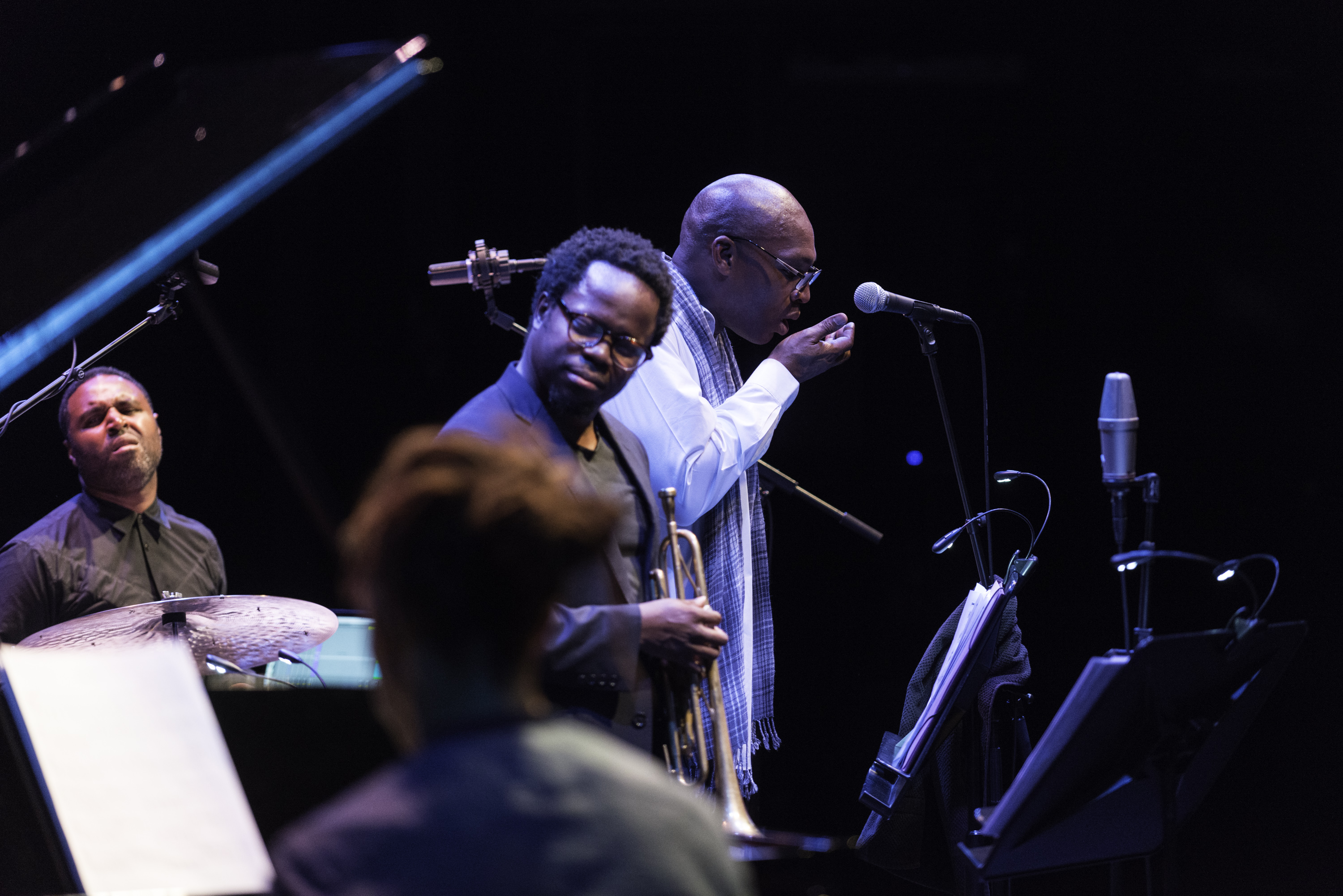
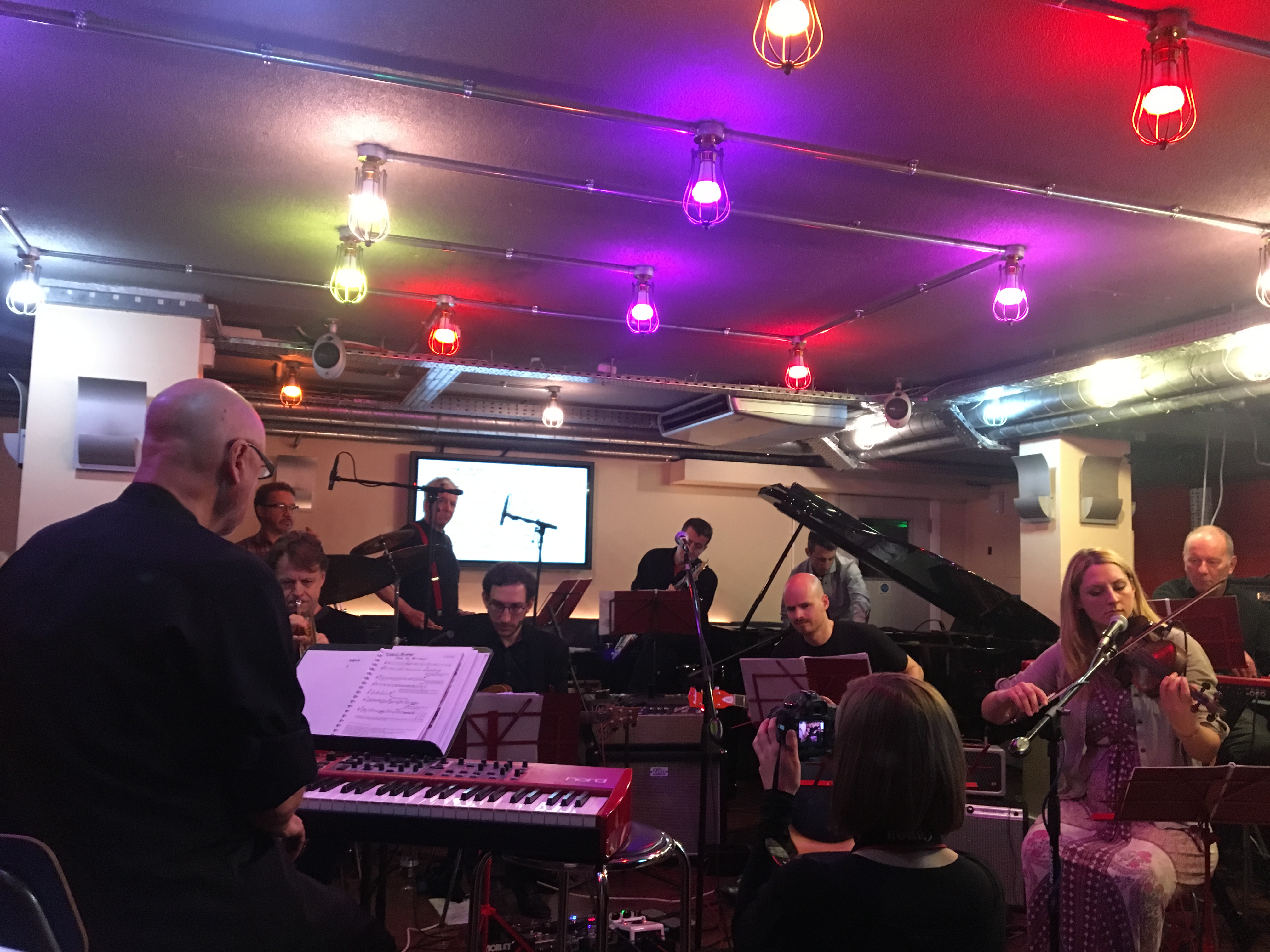
The piece was given its debut in London last night as part of Expect the Unexpected, a two-night affair in which 25 composers were each invited to submit a one-page score to be performed, without rehearsal,  by the band of Club Inégales, led by Peter Wiegold. Part of the EFG London Jazz Festival, the second night in this basement bar off Euston Road featured pieces by Alice Zawadzki, Orphy Robinson, Mark Sanders, Matthew Bourne, Pat Thomas and others, interpreted by a 13-piece ensemble of improvising musicians — an expanded version of Wiegold’s regular band, Notes Inégales.

I had a particular interest in Hawkins’s piece since its existence is the indirect result of a conversation we had a couple of years ago, on the subject of football, during which I recommended a book by the Uruguayan historian Eduardo Galeano called Football in Sun and Shadow, published in an English translation 20 years ago. Galeano’s brief chapters include one called “Goal by Garrincha”, in which he described the effect of a particularly dramatic strike by the great Brazilian winger during a World Cup warm-up match against Fiorentina in 1958.

Hawkins’s score consists of eight “cells” of note sequences, with written instructions such as “Proceed at own rate; no need to synchronise” and “Any cell may be transposed into any octave”. Galeano’s words were read by Zawadzki, who was also playing violin and singing in the group, and by Notes Inégales’ regular percussionist, Simon Limbrick. The piece began with a drone on G and ended after about 20 minutes with all the instruments sustaining their highest possible pitch, at minimal volume. “Hold this final drone for as long as we dare,” Hawkins instructed, “and even then a little longer.”

I meant to ask the composer if he’d also read Ruy Castro’s classic biography of Garrincha, where the author describes the other Brazilian players’ reaction to the goal — in which the player dribbled past the entire Fiorentina side before making a fool of the goalkeeper as he scored. Garrincha’s team mates refused to celebrate with him and were bitterly critical afterwards, complaining that any attempt to repeat such an individualistic feat during the World Cup itself would risk damaging their chances of winning the trophy (which they did, of course).

Football and jazz: both are completely dependent on improvisation, individual and collective, on players with a sense of adventure and possibility but also with a sensitivity to the potential of their colleagues. The two hours of music I was able to hear last night, featuring pieces by Robinson, Sanders, Zawadzki and Helen Pappaioannou as well as Hawkins’s contribution, was full of those qualities. I particularly enjoyed the playing of Hyelim Kim on the taegum (a Korean bamboo flute), Jackie Shave on violin, Ben Markland on bass guitar, Torbjörn Hultmark on trumpet and Chris Starkey, whose interventions on an orange plastic-bodied Airline electric guitar were often startling and always stimulating.

The moods ranged from the refined beauty of Zawadzki’s “In an Old Theatre” through a strange almost-irony in Sanders’ variations on “What a Wonderful World” to the broad humour of Robinson’s piece, whose changes of direction were indicated by the composer via commands displayed on his iPad, the last of which instructed the musicians to blame each other. For once, post-match recriminations were not confined to the dressing room.

‘Real Enemies’ in London

Darcy James Argue KPDarcy James Argue’s Real Enemies is a piece for our time, unfortunately. The Canadian composer’s 90-minute suite for his Secret Society big band is a reflection of the creeping paranoia that began in the post-war years of Joe McCarthy, J. Edgar Hoover and Area 51, and is once again in full spate.

Appropriate voice samples are triggered throughout the piece, but the tone is really set by DJA’s orchestrations for the instrumentation of five trumpets, four trombones, five reeds/woodwinds and four rhythm: the ensemble sonorities are hard, bright, emphatic and precise. Only the fine soloists — I particularly noted David Smith and Jonathan Powell on trumpets, Ryan Keberle on trombone, the altoists Dave Pietro and Rob Wilkerson, and the tenorist Lucas Pino — introduce a note of human vulnerability in the face of the complex workings of the busy machine.

Apart from the two women musicians (trumpeter Naadje Noordhuis and bass trombonist Jennifer Wharton), the members of his New York band wear their own suits and ties. Their expressions throughout the performance are blank, perhaps indicating only a concentration on the demanding score (I caught just one fleeting exchange of grins in the saxophone section). Whether this is an intended effect or not, it certainly enhances the atmosphere: they look like an FBI induction class, circa 1970. The composer’s brisk conducting technique never suggests emotion; the notes do that job.

At the beginning and near the end, the five trumpeters rose from their chairs en masse and stood with their backs to the audience, clustered together around the 9ft Steinway and playing down into its raised lid. Their tightly muted scribbles of sound, and their physical clustering, suggested a discussion of dark secrets: an effect both visually and musically dramatic.

Afterwards you wanted to go home and watch The Parallax View, Executive Action or Three Days of the Condor. DJA would have made a great job of scoring any of those films, which explored the subterfuges of the deep state in the early 1970s. Next, if he’s not sick of conspiracy theories, perhaps he could turn his attention to the Trump/Farage era and the influence of the Koch brothers, Steve Bannon and Breitbart, and Robert Mercer’s Cambridge Analytica.

As John Lewis pointed out in the Guardian the other day, this year’s EFG London Jazz Festival contains an unusual amount of political content, explicit and implicit. Real Enemies is one of the strongest of those statements; its specifics may be date-stamped, but its message is timeless and disturbing.

* The 2016 studio recording of Real Enemies by Darcy James Argue’s Secret Society is available on the New Amsterdam label.

Petula Clark, 85

Petula ClarkPetula Clark turns 85 today. When I saw that information in the Birthdays column of the Guardian this morning, I thought immediately of an album called …in other words, recorded in 1962. That record, not her No 1 hit with “Downtown” two years later, is the reason I think fondly of her.

It’s Petula Clark’s jazz album, recorded over three nights at Olympic Studios in Barnes. She’s accompanied by the Kenny Powell on piano, Brian Brocklehurst  on double bass and Art Morgan on drums, plus Ray Davies on trumpet and Bill Le Sage on vibes. The album was probably intended to have a late-night vibe, although the freshness of Clark’s tone and the vivacity of her delivery remove it from that stereotype.

Her story is an extraordinary one, although probably taken for granted today. She began her performing career in 1942, a month before her tenth birthday, entertaining the overseas troops via BBC radio broadcasts. She sang for King George VI and Winston Churchill, and soon became a juvenile star of wartime films. In peacetime she became a recording artist, under the aegis of Joe “Mr Piano” Henderson, her mentor.

So far, so middle-of-the-road. But then, in late 1962, I heard …in other words; a neighbour’s son, a few years older than me, occasionally let me listen to his jazz albums, and this was a new acquisition, nestling among Dizzy Gillespie’s Greatest Trumpet of Them All, Art Blakey’s Jazz Messengers at the Olympia in Paris (still my favourite live album of all time), and the first volume of Jacques Loussier’s Play Bach series.

Petula Clark was never going to be Billie Holiday or Betty Carter. But when you listen to her sing “Just You, Just Me” or “When Lights Are Low”, you hear someone who swings easily and naturally, who phrases beautifully, who controls her vibrato carefully, and who makes up in directness what she lacks in emotional profundity. I suppose there’s not much more depth here than there was in, say, Julie London, but she delivers ballads like Irving Gordon’s “Be Anything” or “There’s Nothing More to Say” (written by Henderson to mark the end of their relationship) with poise and an affecting simplicity.

Her accompanists are terrific. Powell gets in some cryptic bebop licks fore and aft of “Just You”, Brocklehurst swings hard, Morgan shows his hard-bop chops on Harold Arlen and Ira Gershwin’s “Gotta Have Me With You When You Go”, the great Le Sage excels on “The Night Has a Thousand Eyes”, and Davies — who later became the leader of the Button-Down Brass, and is the father of the producer Rhett Davies — pops up with solos of an excellence that would do credit to a Ruby Braff or a Joe Newman.

There’s humour, too, in perky versions of “On the Atchison, Topeka and the Santa Fe” and “Mademoiselle de Paris”, and most of all in Robert Maxwell’s “George”, a ballad-tempo fragment that might have fallen from the worktable of Dorothy Parker, its entire lyric consisting of these lines: “You and I and George / Were walking through the park one day / And you held my hand / As if to say, ‘I love you.’ / Soon we reached a brook / And George fell in and drowned himself / And floated out to sea / Leaving you alone with me.” It has to be sung straight, without comic inflection, and Clark just about brings it off.

But the track that’s stayed with me most vividly over five and a half decades is Hoagy Carmichael’s “I Can Get Along Without You Very Well”. For this forerunner of 10cc’s “I’m Not in Love”, Bob Dylan’s “Most of the Time” and Donald Fagen’s “I’m Not the Same Without You”, Clark camouflages heartbreak with exactly the right air of Hepburn-like insouciance.

She was 29 when she recorded the 15 tracks that made up …in other words. Now she’s 85, and still singing. Many happy returns, Miss Clark.

It’s wonderful, it’s wonderful

Paolo Conte ticketIf the EFG London Jazz Festival were ever required to stand up in a court of law and produce a convincing justification for its existence, it could point to its habit of bringing Paolo Conte to the South Bank on a regular basis. Last night the 80-year-old former lawyer from Asti was greeted with applause so warm and prolonged that it practically stopped the show on several occasions and was brought to an end only when the singer drew a forefinger across his throat to indicate that there was no more to give.

While this most Italian of performers was doing his stuff, his footballing compatriots were failing to qualify for next summer’s World Cup finals for the first time in 60 years. For two hours, at least, the many Italians in the audience at the Festival Hall were spared that pain, and the lasting glow probably eased the subsequent anguish.

The show wasn’t very different in substance from the one I wrote about on his last visit, four years ago. Most of the favourites were there, including “Max”, “Sotto le Stelle del Jazz”, “Gli Impermeabili”, “Come Di”, a hurtling “Diabolo Rosso” and a wonderfully restrained “Alla Presa di Una Verde Milonga”. And, of course, “Via Con Me”, with which even the monoglot English could sing along — “It’s wonderful, it’s wonderful, it’s wonderful, I dream of you…  Chips! Chips! Chips!” — and which reappeared as a coda to the evening.

The arrangements made full use of the versatility of his 10 musicians, switching constantly between a full range of saxophones (sopranino to baritone), clarinet and bassoon, accordion and bandoneon, violin, piano, marimba, drums, hand percussion, all resting on the base provided by three acoustic guitars and Jini Touche’s double bass. The short improvised solos were beautifully positioned, and the endings invariably cunning. The stage lighting, which cast equal illumination on all those playing at any given moment while leaving the rest in shadow, was brilliant.

Conte gave us his irresistible sandpapered croon, his brief vocal imitation of a trombone (his first instrument in childhood), and a snatch of kazoo. I don’t know anyone else who can do what he does, blending archaic forms and sounds — hints of Ellington’s Cotton Club band, chanson, Palm Court glide, tango, Hot Club of France swing, dolce vita and spaghetti western — into a genuinely modern music with such originality, such grace, such dignity.

The uncommon tenor

Lou GareLou Gare held his tenor saxophone aslant, like Lester Young, whose light-fingered articulation and disdain for the obvious he shared. Gare was born in Rugby but it was in Plymouth in the early 1960s that he first played with the band of the young Mike Westbrook, alongside the even younger John Surman. In London in 1965 he became a founder member, with Eddie Prévost, Cornelius Cardew and Keith Rowe, of AMM, one of the seminal groups of the first generation of British free improvisers. Lou was on their debut album, AMMMusic, recorded at Sound Techniques in Chelsea and released by Elektra Records in 1966. Six years later, with the group reduced to a Gare-Prévost duo, they performed at Harvey Matusow’s International Carnival of Experimental Sound event in London, their set released initially in part on an Incus EP as AMM at the Roundhouse and then in full on a Matchless CD under the same title.

In the 1970s Gare moved to Devon, where he worked as a teacher of Aikido, a modern Japanese martial art. There he played with the pianist Sam Richards in the band Synchronicity; he was also reunited with Westbrook, joining the latter’s locally based Uncommon Orchestra. This piece of film is from their performance at the Barnfield Theatre in Exeter in December 2014. Gare is featured throughout a 12-minute piece called “D.T.T.M.”, adapted from a section of Westbrook’s suite On Duke’s Birthday and dedicated to the trombonist Danilo Terenzi and the drummer Tony Marsh. It’s a quietly phenomenal performance, devoid of rhetoric but bursting with invention, the soloist’s thoughts unfurling at his own pace and expressed with a lovely laconic warmth. I don’t think I’ve heard a more subtly dramatic example of a tenorist working with a big band since Wayne Shorter emerged from the swirling mists of Gil Evans’ “The Barbara Song” in 1964.

Perhaps inspired by the example of Sonny Rollins, Gare was also a wonderful unaccompanied improviser, as he demonstrated on a Matchless album titled No Strings Attached in 2005 and in this clip from 2013. When he died on October 6, aged 78, British jazz lost a voice of quiet but resolute originality.

On a Monday night in Berlin

Andreas Schmidt bwIf you’re ever at a loose end in Berlin on a Monday night, my advice would be to head for A-Trane, the jazz club in Charlottenburg, where Andreas Schmidt, a pianist, composer and teacher at the city’s Jazz Institut, holds a weekly free-admission session featuring a changing cast of friends and students.

Last night he began his set with a quintet featuring two young tenor saxophonists, Nicholas Biello and Marc Doffey, the bassist Oliver Potratz and the drummer Ivars Aratyunun, playing a deceptive simply Schmidt original, “Closing Partners”, on which the instrumental combination and the all-round deftness and intelligence brought to mind Tony Williams’s first two Blue Note albums, Life Time and Spring, which teamed the tenors of Wayne Shorter and Sam Rivers.

Of the two saxophonists at A-Trane, Doffey had the lighter sound while Biello’s tone was darker and his delivery more intense. It was a lovely combination, and it worked equally well on the other number they played together, an abstraction of “All the Things You Are”, quite exquisitely supported by the rhythm section, before leaving the stage to other combinations for the rest of the evening.

Schmidt is a fine pianist, the salient features of his playing located somewhere between the Paul Bley of the mid-’60s and the Chick Corea of Now He Sings, Now He Sobs. You might get an idea of his approach if I say that his first album was made (in 1995) with Lee Konitz, and a later one comprised a duo with Gary Peacock. His music is cerebral, but on the evidence I’ve heard it never lacks wit and humanity.

Just two tunes by this ad hoc quintet, then, and a barely half an hour of music, but this was the sort of serendipitous encounter that, however much you loved jazz before, makes you love it even more.

Remembering Fats Domino

Fats Domino 2

When I was ushered into his room in the Churchill Hotel by the personal valet who had worked for him for more than 20 years, Fats Domino was wearing his off-duty outfit: a brown knitted suit and a hair-net. On stage at the Hammersmith Odeon a couple of nights later, the look was very different: white jacket, shoes and socks, pink tie and trousers, diamonds covering his fingers, his belt buckle, his tie clip, his watch. Here was the man whose record sales in the 1950s were second only to Elvis Presley.

This was April 1973, and he was a couple of weeks away from his 44th birthday. In person, giving an interview to the reporter from the Melody Maker, he was pleasant, if a little guarded. He dutifully ran through his history for me, the stuff that’s been in all the obituaries over the past couple of days, telling me about falling in love with the piano as a child, copying the great boogie-woogie pianists (he mentioned Meade Lux Lewis, Pete Johnson and Albert Ammons), how Lew Chudd had signed him to Imperial, and how when Imperial was bought by Liberty he had left and made deals first with ABC Paramount, then with Mercury and Reprise. When we spoke, he was without a recording contract.

His stage show was magnificent. Here’s what I wrote, comparing his concert performance with those of other rock and roll pioneers in middle age: “Unlike Chuck, he wasn’t cynical or saddled with a poor backing band; unlike Jerry Lee, he didn’t want to sing country ballads; unlike Little Richard, he wasn’t carried away with his own divinity. He was, quite simply, Fats Domino. He sang almost nothing that wasn’t a million-seller, or close to it, and he sang them exactly as he’d laid them down on the original recordings.”

He’d brought a fine band from New Orleans: the ripe-toned saxophone section of Fred Shepherd (alto), Walter Kimball, Maurice Simon and Fred Kemp (tenors) and Roger Lewis (baritone), plus the great Roy Montrell on guitar, David Douglas on bass and Walter Lastie — a member of one of those Crescent City musical dynasties — on drums. The songs they performed included “I’m Walkin'”, “Blue Monday”, “Let the Four Winds Blow”, “I’m in Love Again”, “I’m Gonna Be a Wheel Some Day”, “I Want to Walk You Home”, “Hello Josephine”, “Ain’t It a Shame”, and “So Long”, plus “The Saints”, “Stag-o-lee”, “Shake, Rattle and Roll” and Professor Longhair’s “Goin’ to the Mardi Gras”, all in 45 minutes. Apart from the general impression of good humour and good times, I can recall Lastie’s brisk double-shuffle on “I’m Walkin'” and an excellent gravel-toned baritone solo on “Blue Monday”.

It was only Domino’s third visit to the UK. He’d been here as part of a package tour in 1962, and had returned in 1967 for one of Brian Epstein’s concerts at the Savile Theatre. Given that the Beatles loved and revered his music, it’s a pity they didn’t sign him to Apple and help him make some more good records.

I mentioned to him that Dave Bartholomew, the trumpeter and bandleader who had been the co-writer and musical director on his early hits, had told me a year or so earlier that, when they went into the studio back in the early ’50s, they were attempting to make the first fusion of Dixieland jazz and R&B. Fats didn’t entirely agree. “We was just doing what we wanted,” he said. “That’s all — there weren’t no more to it than that.” Enough, however, to help change the world.

The Weather Station in Islington

The Weather Station in IslingtonA few hours ahead of her gig with her band, the Weather Station, at the Lexington pub in Islington last night, the Canadian singer-songwriter Tamara Lindeman tweeted a photograph she’d taken during a walk along the nearby Regent’s Canal. “Sandy Denny in headphones,” she added. Sandy would have been pleased by the compliment and intrigued by her admirer’s performance, and in particular by the way Lindeman managed to make the 50-year-old concept of folk-rock sound brand new.

The Weather Station’s new self-titled album embraces electric guitars in a characteristically modest and subtle way. Lindeman took the stage at a sold-out Lexington with the lead guitarist (and occasional organist) Will Kidman, the bass guitarist Ben Whiteley, and the drummer Erik Heestermans, and made the relatively new approach sound like the most natural thing in the world.

Perhaps the key was her rhythm guitar playing, the core of the sound, the central strum and the enunciator of chord patterns that move between the comfortingly familiar and the ear-teasingly sophisticated, unpushy but generating real momentum behind melodies that are liable to soar at unexpected moments. The other instruments arranged themselves around her with discreet sensitivity, leaving plenty of space for us to appreciate the care with which she modulates her tone and enunciates her extraordinary lines.

There were lots of songs from her last two albums, among them “Way It Is, Way It Could Be”, “I Mined”, “Floodplain”, “Tapes”, “I Could Only Stand By” and “Impossible” (with organ drone and galloping tom-toms) from Loyalty and “Free”, “Thirty”, “Kept It All to Myself”, “Black Flies” and “You and I (On the Other Side of the World)” from the new one. A short central solo acoustic segment expanded to a duo when she was joined for one song by Will Stratton, the American singer-songwriter who had provided a pleasant support set.

What was interesting about seeing her live was the way her lyrics were given, if anything, even greater value. Some of these songs are like the deepest conversations you ever had with someone you care about — and very often they’re like things that were formulated but somehow never got said. On the faster songs she piles lines on top of each other to create a river of thought and feeling. And none of the nuances are lost when she sings them with a band in front of an audience.

Lindeman doesn’t do stage dramatics or ingratiation. When a song ends (and her endings, whether abrupt or lingering, are always worth attention), she tends to make no acknowledgment of applause but goes straight into adjusting her tuning for the next song. Yet there’s no distance between her and her listeners. Although her spoken comments tend to be restricted to dry asides, she radiates a warm intelligence; her fleeting changes of expression — a grimace at a fluffed entrance, a small and mysterious smile now and then — say most of what she needs to convey. By the end of the evening I don’t suppose there was a man or a woman in the place who wasn’t a bit in love with her.

* The Weather Station play tonight (October 24) in the Eagle Inn, Salford and tomorrow at the Music’s Not Dead record shop in Bexhill on Sea (free, 7pm). They’ll be back for another UK tour in January and February. The new album is on the Paradise of Bachelors label.

‘Astral Weeks’ in Camden Town

Astral WeeksIf your name isn’t Van Morrison, it takes some kind of courage to tackle Astral Weeks, one of the sacred texts of the late ’60s. No one has ever really explained how the singer, his American musicians and Larry Fallon, the arranger and conductor, and his producer, Lewis Merenstein, came up with the unique blend of idioms that make the album so distinctive. Jazz, folk, rock and blues are all in there, but so thoroughly metabolised that the eight songs create, for the length of a long-playing record, an idiom of their own. In his lyrics, too, Morrison plunged head-on into a new world of poetic spirituality.

So when Orphy Robinson and the Third Eye All Stars presented the album at the Jazz Café last night, there was an element of risk. Morrison himself performed it in its entirety on a tour in 2009, but it was his right to do so, and he brought it off quite satisfactorily, although he couldn’t quite summon the magic that had occurred during three rushed days in the late summer of 1968, when he worked with musicians he didn’t know in a line-up that adhered to no known formula. The idea of someone else taking on this precious and delicate creation and trying to invent variations on its wild, hypnotic swirl of emotions seemed foolhardy, to say the least.

As it turned out, there was no need to worry. The 10-piece Third Eye band — Robinson on vibes and percussion, singers Joe Cang and Sahra Gure, flautist Rowland Sutherland, cellist Kate Shortt, Justina Curtis on electric piano, acoustic guitarists Mo Nazam and John Etheridge, bassist Neville Malcolm and drummer Mark Mondesir — chose not to attempt a radical reinterpretation of the material. They played it straight, content to infuse the music with their own freewheeling spirit.

A couple of solos — Sutherland on “Cyprus Avenue” and Robinson on “The Way Young Lovers Do” — brought the house down, while Malcolm and Mondesir did a fine job of following the template established on the original by Richard Davis and Connie Kay, who had no idea who Morrison was when they turned up for the sessions but found themselves devising a new application for their jazz chops in service of the grumpy little Irishman who barely spoke to them.

Neither Cang nor Gure attempted to imitate Morrison. They just sang the songs with a respect that did not prevent them from injecting their own energy into this hallowed material. I had never imagined that I would want to hear anyone singing “Madame George” other than its creator, but Cang — after successfully calling for quiet as the guitars strummed the intro — delivered it in a way that, like the whole evening, did no disservice to a high-wire masterpiece.