Skip to content

1965: Annus mirabilis

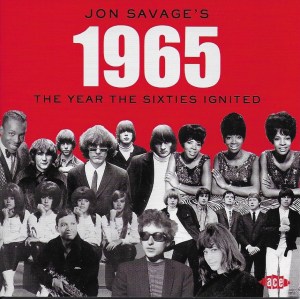
Jon Savage 1965

When Jon Savage compiled his excellent 2-CD sets of hits and curiosities from 1966 and 1967 for Ace Records, he was just clearing his throat. Now, with 1965: The Year the Sixties Ignited, he arrives at the real point of the exercise: a celebration of the best year in the history of popular music. OK, I’m biased: I was 18, which is a pretty important age to be. Jon’s selection of 48 tracks on two discs is characteristically idiosyncratic and stimulating; mine would be very different. I loved 1965 while it was happening, and I’ve felt that way ever since. Twenty years ago I wrote a piece about it for the Independent on Sunday’s Review section, and then expanded it slightly for inclusion in a collection of my music pieces titled Long Distance Call. Here, because you almost certainly won’t have read it in either form, is a truncated version.
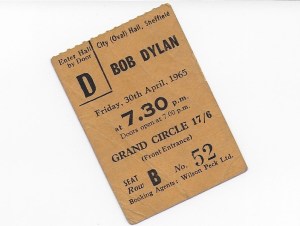
 

Bob Dylan 1965 ticket

IT’S A FRIDAY evening in the spring of 1965. In a house in the Midlands, an 18-year-old boy is waiting to take a 17-year-girl to the opening night of Bob Dylan’s first British concert tour. He has two tickets in his pocket. Sheffield City Hall, grand circle, second row, seven shillings and sixpence each.

The television is on as they prepare to leave her parents’ house. It’s Ready Steady Go!, live from London, the weekly hotline to the heart of whatever’s hip. One of the presenters — either the dollybird Cathy McGowan or the incongruously avuncular Keith Fordyce — announces the appearance of a new group. They’re from America, they’re called the Walker Brothers, and this is their first time on British TV. Their song is called “Love Her”.

On the small black and white screen, the face of a fallen angel appears. The boy and the girl are already cutting things fine for Dylan, but still the girl freezes in the act of putting on her coat and, as if in slow motion, sits down to watch the 21-year-old Scott Engel, clutching the microphone as though it were a crucifix, delivering the straining, heavily orchestrated teen ballad in a dark brown voice borrowed from the romantic hero of a comic strip in Romeo or Valentine.

As the song ends and the image fades, the girl shakes herself lightly, refocuses on her surroundings and pulls on her coat. OK, she says. Ready to go.

A COUPLE OF hours later they would be among the first people in Britain to feel the impact of the new songs that were still a fortnight away from release on Dylan’s fifth album, Bringing It All Back Home. With “It’s Alright Ma”, “Gates of Eden”, “Love Minus Zero”, “Mr Tambourine Man” and “It’s All Over Now, Baby Blue”, a flood of dazzling images and ideas was released. “The lamp post stands with folded arms, its iron claws attached…” “He not busy being born is busy dying…” “To dance beneath the diamond sky / With one hand waving free… ” He was bringing the unformed thoughts of his audience into focus, inventing new emotions and redefining old ones.

Reeling out into the night, speechless with awe, saturated by those visions, they couldn’t know that Dylan was already bored with the way he’d been presenting himself up. The Beatles, Rolling Stones and Animals may have worshipped him, but he wanted what they’d got. Less than two months after opening that tour in Sheffield, he would convene a full-tilt rock and roll band in a New York studio to record “Like a Rolling Stone”, the first six-minute 45. In July he took a band with him on to the stage at the Newport Folk Festival, where he had been a hero in previous years but was now reviled for his supposed act of heresy. Highway 61 Revisited and “Positively 4th Street” followed, in all their ornate mystery.

But although his change of direction was a shock, it was not a surprise. Because in 1965 change was expected: every month, every week, almost every day. Every time you walked into a record shop, opened a book, bought a magazine, turned on the TV. Between picking up your coat and putting it on.

THE YEAR 1965 started with the Righteous Brothers’ “You’ve Lost that Lovin’ Feelin'” (the greatest of all orchestral pop records) and ended with the Beatles’ Rubber Soul (their most satisfying album) and contained so much great music that it would take a year to listen to it, even now. In the sense that pop musicians were still waking up to the reality of their own economic power, and had not yet taken the logical step of attempting to control the means of production, this was also the last year of innocence.

It was filled with perfect examples of what we think of as ’60s moments. David Bailey wore a crewneck sweater to marry Catherine Deneuve. Mods and rockers spent the Easter holiday hurling deckchairs at each other on the Brighton seafront. Marianne Faithfull, much to her own surprise, turned down Bob Dylan’s advances (she was pregnant and about to marry a man who owned a bookshop and art gallery). Julie Christie starred in John Schlesinger’s Darling and Jane Birkin flitted in and out of Richard Lester’s The Knack, giving us two defining images of Swinging London. The Beatles reunited with Lester to make Help!, played Shea Stadium, visited Elvis at home in Beverly Hills, and went to Buckingham Palace to receive their MBEs and smoke dope in the lavatories — not quite all on the same day, but almost. Liverpool, probably not coincidentally, won the FA Cup for the first time. Jean Shrimpton (whose sister was going out with Mick Jagger) lived with Terence Stamp (whose brother was managing the Who) and horrified Australian society by turning up to the Melbourne Cup in a simple shift dress that terminated four inches above her knees.

That’s how easy it was to shock people in those days. When a small rip opened up in the weakened crotch seam of the American singer P. J. Proby’s velvet trousers on stage in Croydon in January, he was banned by the ABC theatre chain and excoriated by the newspapers. When three of the Stones — Jagger, Richards and Wyman — were reported to have urinated against a wall at a petrol station on the way home from a show in Romford, they made the front pages and were fined £5 each. There was a fuss about these incidents but under the outrage, much of it bogus, there was a sense that they were adding to the gaiety of the nation.

In what was left of the real world of Great Britain, the Kray twins were being remanded, the Moors Murderers were charged, Harold Wilson’s government announced an “experimental” 70mph speed limit, legal blood-alcohol limits for drivers were brought in, and incitement to racial hatred was banned. Heath succeeded Home as Tory leader and declared his intention to take Britain into the Common Market — to which, in any case, the government had just applied for a £500 million loan. Internationally, the big issues were the Vietnam war and civil rights, both of which spilled over the frontiers of the United States and commanded the attention and concern of young people throughout the world.

In January, Lyndon Johnson sent the B-52s to bomb North Vietnam. In June, the first American troops went into action on the ground against Vietcong bases near Saigon; by the time they got there, the VC had vanished. The President’s answer: send more troops. the Rev Dr Martin Luther King was arrested during a voter-registration protest in Selma, Alabama; eight weeks later he marched back into town at the head of 25,000 people, protected by 3,000 federal troops and the camera crews of the world’s television networks. Between times, Malcolm X had met an assassin’s bullet in New York. In August, 28 people died and 676 were injured when Watts exploded in three days of rioting.

Everything seemed connected, somehow or other. When Cassius Clay beat Sonny Liston to take the heavyweight championship of the world, even that was part of the bigger deal: the youthquake, black power, the generalised feeling that the Establishment was there for the taking. Liston and Floyd Patterson, against whom Clay subsequently defended his title, were black, too, but other, older kinds of black. Clay was Dylan’s age, Jagger’s age, Lennon’s age. Our age.

And ours was also a visual age. Coming between the studied sloppiness of the Beat generation — sandals and shapeless sweaters — and the romantic self-indulgence of the hippies, it was the time of the mods, whose aesthetic may have ended up with the skinheads of the British Movement but had begun with better intentions in the jazz clubs of Soho, the tailors of Whitechapel and the liberal atmosphere of the London art colleges, among people who knew about Fellini and Jasper Johns.

Much of that came together in the Who, who began the year with the terse, staccato chords of their first single, “I Can’t Explain”. They ended it with the thrillingly anarchic feedback of “My Generation”. In between came “Anyway Anyhow Anywhere”, described by Pete Townshend, its composer, as “anti-middle age, anti-boss class, and anti-young marrieds”. If the Who had packed it all in at Christmas, after those three 45s, they’d have been regarded as the greatest rock group of all time, no contest.

British rock music, high on its own huge success in the US and fuelled by a profound admiration of Bob Dylan’s wilful unpredictability, was moving away from covers of Chess and Motown records and beginning to explore its creative potential. The Beatles started to enter the regions beyond two-dimensional love songs, distilling the darker complexities of “Help!” and “Norwegian Wood”, both indelibly marked by Dylan’s influence on Lennon, while George Martin’s experience enabled Paul McCartney to achieve the imaginative leap that led to “Yesterday”.

The Stones, with Jagger and Richards forced into the role of composers by their manager, Andrew Loog Oldham, who recognised the value of copyrights, used the influence of Howlin’ Wolf and Muddy Waters to create the template for riff-based rock music with “The Last Time” and “(I Can’t Get No) Satisfaction”, benefitting from Keith’s acquisition of something called a fuzz box and from the funkier ambiance of American studios. The Animals built a denser sound, more conscious of dynamics, with “We’ve Gotta Get Out of This Place” and “It’s My Life”. The Yardbirds were experimenting with mood and structure on “For Your Love” and the quasi-liturgical “Still I’m Sad”. Georgie Fame and the Blue Flames emerged from the Flamingo all-nighters with the finger-popping “Yeh Yeh”, the sound of an Ivy League jacket and a French crop. The Kinks progressed from the kinetic power chords of “Tired of Waiting for You” to the prophetic quasi-oriental drone of “See My Friends”, which anticipated raga-rock and a certain strand of psychedelia. The Small Faces (real, rather than art-school, mods) made their debut with the pugnacious “Whatcha Gonna Do About It?”, a healthy plundering of the chord-riff from Solomon Burke’s “Everybody Needs Somebody to Love”. Out of Belfast came the incomparably surly Them with “Baby Please Don’t Go”, a devastatingly supercharged version of a country-blues text, followed by “Here Comes the Night” and the opening chapter of the Van Morrison legend.

“Gloria”, the B-side of “Baby Please Don’t Go”, may have been the first punk-rock record. Or perhaps that was the pounding “I Want Candy” by the Strangeloves, a non-existent group created to counter the British invasion by a bunch of New York studio-hack writer-producers. Or possibly it was the magnificently silly “Wooly Bully” by Sam the Sham and the Pharoahs, or the Sir Douglas Quintet’s “She’s About a Mover”, out of Texas. Or, from New York once more, the McCoys’ “Hang on Sloopy”, a kind of punk-bubblegum hybrid based on the Vibrations’ vastly superior “My Girl Sloopy”. The year was full of one-offs like these as American groups (and the commercial interests behind them) fought back, producing guitar-driven music to counter that coming from the other side of the ocean.

The Byrds — not a one-off — took an electric 12-string guitar to his “Mr Tambourine Man” and invented jangling folk-rock (refined later in the year with “Turn Turn Turn”, their version of Pete Seeger’s take on the Book of Ecclesiastes). Music producer Lou Adler bought his staff songwriter Phil Sloan a corduroy Dylan cap, handed him a copy of Highway 61 Revisited and an acoustic guitar, and locked him in a Hollywood bungalow for a weekend. On the Monday morning Sloan handed Adler the demo tape of “Eve of Destruction”, an instant worldwide No 1 for the hoarse-voiced Barry McGuire.

Harold Battiste, a veteran of the New Orleans R&B scene, helped a couple of Hollywood brats, Salvatore Bono and Cherilyn LaPier, to become Sonny and Cher with “I Got You Babe”, a folk-rock minuet with an oboe where most records would have a guitar or a saxophone. Brian Wilson, fiddling about in his studio while the rest of the Beach Boys toured the world, pushed the enrichment button on surf music so hard that it turned into the sunlit symphonies of “Help Me Rhonda” and “California Girls”. The Everly Brothers, relics of pop’s first golden age, a duo with roots in the music of the Appalachian chain, were reborn with the crunching drive of “Love Is Strange”, as powerful a sound as any in the whole year,

In cities around America, soul music had reached its mature phase. Detroit’s Hitsville USA was in top gear with Marvin Gaye’s “Ain’t That Peculiar”, Martha and the Vandellas’ “Nowhere to Run”, Kim Weston’s “Take Me in Your Arms”, Jr Walker’s “Shotgun”, the Marvelettes’ “I’ll Keep Holding On”, Stevie Wonder’s “Uptight”, the Four Tops’ “I Can’t Help Myself” and “It’s the Same Old Song”, the Supremes’ “Stop! In the Name of Love” and “Back in My Arms Again”, and half a dozen Smokey Robinson masterpieces: three for the Temptations (“My Girl”, “It’s Growing” and “Since I Lost My Baby”) and three for his own group, the Miracles (“Ooo Baby Baby”, “Goin’ to A Go-Go” and the incomparable “Tracks of My Tears”). In Chicago, Curtis Mayfield was using the memory of his grandmother’s Sunday morning church sermons to create “People Get Ready”. In Memphis, the Stax house band was launching Wilson Pickett into “In the Midnight Hour” and Otis Redding into “Respect”. James Brown stopped off while touring to record “Papa’s Got a Brand New Bag” in Charlotte, North Carolina and “I Got You (I Feel Good)” in Miami, Florida.

That’s to say nothing of Barbara Mason’s swooning “Yes I’m Ready”, the Dixie Cups’ “Iko Iko” and Shirley Ellis’s “The Clapping Song” (which both found new uses for children’s playground songs), Lou Christie’s falsetto tour de force on “Lightning Strikes”, Betty Everett’s “Getting Mighty Crowded”, Tom Jones’s “It’s Not Unusual”, the Shangri-Las’ “I Can Never Go Home Any More”, the Ronettes’ “Born to Be Together” (their finest moment), the Drifters’ “At the Club”, Dusty Springfield’s glowing “Some of Your Loving”, Petula Clark’s “Downtown”, and the boiling, gospel-driven “Heartbeat Pts 1 and 2” by Gloria Jones. Or Dionne Warwick’s staggering “(Here I Go Again) Looking With My Eyes (Seeing With My Heart)”, the Searchers’ “What Have They Done to the Rain”, Wayne Fontana’s “Game of Love”, Fontella Bass’s “Rescue Me”, the Lovin’ Spoonful’s “Do You Believe in Magic?”, Dobie Gray’s “The ‘In’ Crowd”, Little Richard’s utterly magnificent “I Don’t Know What You Go But It’s Got Me Pts 1 and 2”, and, to get back to where we started, two further Walker Brothers classics, “Make It Easy on Yourself” and “My Ship Is Coming In”. All of them — and many others — still played and recognised today.

MOST SIGNIFICANTLY, though, and paradoxically in the light of all this frantic activity, 1965 was the year in which pop music started to slow down. First there was the way in which the working process itself became more leisurely, a result of increasing affluence among musicians who had started out two or three years earlier traipsing up and down the M1 crammed into Transit vans, and the freedom it gave those who had previously been the slaves of managers and record companies. And there was the accompanying desire to spend more time creating records in the studio, exploring the potential of both the developing technology and the musicians’ own imaginations.

In 1965 the Beatles, as they had every year since signing with EMI, released two albums, Help! and Rubber Soul. The Stones released No. 2 and Out of Our Heads. The Beach Boys released Today and Summer Days (and Summer Nights!). That was the standard working schedule. But in 1965 the sense of artistic competitiveness was growing fast. The Beatles would hear the new Beach Boys single and know they had to top it. The only way was to spend more time in the laboratory. The following year, there would be only one album from each of these three leading bands: Revolver, Aftermath and Pet Sounds. And that would remain the pattern.

The music also slowed down in a more literal and far-reaching sense, thanks to the combined influence of James Brown and Andy Warhol. Together, the effect of Brown’s one-chord funk in the clubs and the influence of Warhol’s image-repetition in the art colleges began to thin out the music’s layers, simplifying its structure and reducing the density of its content. This was the birth of pop minimalism, and it also led directly to the inversion of what might be called the music’s weight distribution. Where the aural focus had been on the lead voice(s) — an emphasis reflecting the old “Vocal with rhythm accompaniment” tag that used to be printed on the labels of pre-war 78s, under the singer’s name — now the bottom end of the rhythm section began to take greater prominence. This shift of balance arrived hand in hand with technological developments allowing discothèques to install sound systems which played extra emphasis on the elements of the music that made people dance: the bass and drums. In that sense the most important records of 1965 were not “Satisfaction”, “Ticket to Ride” or “My Generation”, but “Papa’s Got a Brand New Bag” and “I Got You (I Feel Good)”, whose long-term effect on the time-frame and event-horizon of popular music is all around us today — in disco and house music, hip-hop, drum ‘n’ bass, trance, and just about everything else.

Buried within 1965, then, were the seeds of 1966, which also included the debut of Jefferson Airplane at the Matrix in San Francisco and of the Grateful Dead at the first Acid Tests. In November, the two bands shared the bill at the opening night of Bill Graham’s Fillmore Auditorium. That same month, on the east coast, Lou Reed and John Cale gave their new band a name under which they played their first gigs in a New Jersey high school auditorium. Around the corner of the new year lay Cream, Pet Sounds, “Paint It Black”, “Eleanor Rigby”, the aloof visions of Blonde on Blonde and the tumultuous tour that prefaced Dylan’s motorcycle crash. And The Velvet Underground and Nico, with which another future would begin.
Bebop and Basquiat

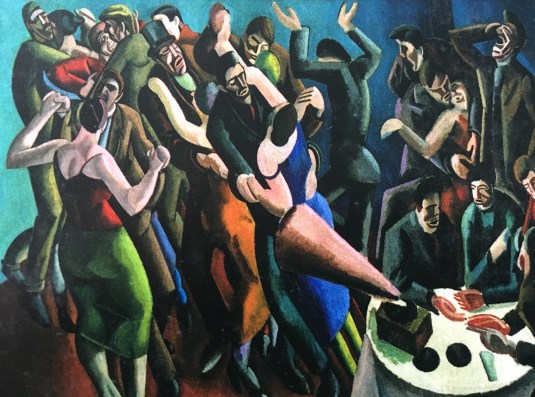
Basquiat Bird 3

There’s only another week in which to see Boom for Real, the big Jean-Michel Basquiat retrospective at the Barbican, before it closes on January 28. I left it until last week to pay my first visit and I’m going to try to go again. There’s a lot to see and I want to spend a bit more time thinking about his relationship with modern jazz in general and Charlie Parker in particular, which is what struck me most of all as I was going around the show.

Basquiat, who came to fame as a teenage graffiti artist on the streets of New York and died in 1988 at the age of 27, must have really loved Parker’s music. It can’t have been a pose. The names and phrases scrawled in many of the paintings show an intimate knowledge of Bird’s work. Crispus Attucks High School was the one Parker attended in Kansas City. Buster Smith was the alto saxophonist he admired in his apprentice years. Doris Sydnor was his third wife. Joe Albany was one of his pianists. Dial and Savoy were two of the labels for which he made his finest recordings. “Half Nelson”, “KoKo”, “Now’s the Time” and “Warming Up a Riff” were some of the tunes he cut. The Stanhope Hotel was where he died.

There’s a real feeling for jazz here. Not just Parker but Louis Armstrong, Duke Ellington, Thelonious Monk and Dizzy Gillespie are referenced in the works included in Boom for Real. Basquiat’s blend of the heroic and the grotesque seems to me a fair representation of an art form that had to fight its way first into existence and then towards acknowledgement. The harshness and challenges of a jazz musician’s life are as present in the paintings as the aesthetic value of what they produce. There’s a title of a Monk tune that sums it up: “Ugly Beauty”.

“Jean-Michel says his paintings are jazz on canvas,” Jennifer Clement writes in Widow Basquiat, a portrait of the painter’s relationship with his girlfriend, Suzanne Mallouk, first published in 2002. There’s a passage in which, having discovered that Billie Holiday’s grave has no headstone, he spends a weekend designing one with the help of his friend, the art curator Diego Cortez, while Suzanne makes trips to get them cocaine.

There are people who don’t appreciate the way Basquiat turned street art into something for which collectors now pay vast sums. To them, the $110.5m paid for one of his canvases last May, setting a record for a painting by any American artist sold at auction, represents an insult to the history of art. But I think he did something important in getting the spirit of the music on to canvas. I wish he could have done it without feeling the need to copy Parker’s heroin habit, but I’ve felt that about a lot of people and there’s really no point. Just go and look.

* Untitled (Charlie Parker) was painted in 1983 and is in the Barbican exhibition, on loan from the Schorr Family Collection.

The Clapton movie

Eric Clapton film

Quite the most striking thing about Eric Clapton: Life in 12 Bars is its chronicling of the evolution of the guitarist’s hairstyle throughout his life, and the way its constant revision so accurately mirrors the changing modes of popular culture: a perfect early mod cut growing out into a bubble perm and then an early-70s stoner straggle and through countless other stages until reaching the present-day elderly rockandroller look, of which there were many versions in the audience at the Richmond Odeon last night.

Whatever you think of Clapton’s music (and I was never a fan of that style of blues-rock guitar playing), he always had great hair — and he knew it. It’s unsurprising that a strikingly emotional moment in Lili Fini Zanuck’s film occurs when, on a visit to his estranged mother and her husband on a Canadian army base in Germany in his mid-teens, he is forced to have it cut short. No man of roughly Clapton’s generation who lived through a similar ordeal in his own adolescence will fail to recognise that excruciating, almost life-threatening humiliation.

The walk to the cinema took me past the site of the old Railway Hotel opposite Richmond station, a key location in the history of the Thames Delta. It was in the back room of those premises that the Yardbirds made their first impression on the public, succeeding the Rolling Stones as the resident band at Giorgio Gomelsky’s Crawdaddy Club and allowing Clapton’s extraordinary magnetism to emerge.

The voice of the Yardbirds’ Chris Dreja is one of many heard in the documentary. Another from that period is the late sculptor Ben Palmer, the pianist in the Roosters, Clapton’s first band, and clearly a powerful influence on the sensibility of a young man who, during his year at Kingston Art College, was reading Baudelaire and Steinbeck while discovering the music of Blind Blake and Big Bill Broonzy. Clapton’s mother, his sister and his grandmother (who brought him up as her son) are also heard.

But it’s the years of superstardom and addiction that are the film’s real priority, and where it becomes repetitive to the point of tedium. We hear from some of the principal figures of Clapton’s life in the ’70s and ’80s — notably Bobby Whitlock, his keyboard player, and Pattie Boyd, his muse — at what seems like inordinate length, accompanied by endlessly repeated home-movie clips and stills. These are deployed with only the most cack-handed grasp of the lessons taught by the innovative documentarist Ken Burns to a generation of directors in the creative use of the combination of a rostrum camera and limited visual material. In terms of Clapton’s musical history and the influences that reshaped it, the complete absence of any mention of Music from Big Pink, J. J. Cale, the Delaney and Bonnie tour of 1969 or the Pete Townshend-directed Rainbow comeback concert of 1973 seems a bit strange.

Nevertheless there are many affecting sequences. They include a brief clip of Clapton crossing a London street and getting into his Mercedes 600 in the company of his then fiancée and fellow junkie, the ill-fated Alice Ormsby-Gore, vividly evoking the darker side of the lives of the jeunesse dorée of the late ’60s, and the reconstruction of the death of his four-year-old son in a fall from the 53rd-floor window of a New York hotel in 1991. His dreadful racist outburst on stage in Birmingham in 1976, after brandy and wine had taken over from heroin, is not glossed over; others may disagree, but to me it seems consistent with what we know about the radically distorting effect of an immense alcohol consumption on his personality at the time (Boyd is eloquent on that subject).

It’s good that Clapton is living through the golden sunset of a settled family life and the fine work done by his Crossroads charity to rescue others from addiction. As far as the film goes, however, I’d have been happier staying at home and listening to the only two records of his that I ever play: the sublimely sentimental “Wonderful Tonight”, a song that absolutely hits its chosen spot, and, more seriously, the Unplugged version of “Old Love”, where in both his voice and his playing you can hear echoes of the sensitive, troubled boy whose instinctive love of the blues earned him a ride on a roller-coaster that he was lucky to survive.

* Eric Clapton: Life in 12 Bars is in cinemas from January 12. The Richmond Odeon screening was supposed to include the live transmission of a Q&A between Jools Holland and Clapton taking place on stage at the South Bank; some technical problem blacked it out, but neither explanation nor refund was offered.

Freedom now… and then

Trevor Watts 1

L to R: Veryan Weston, Alison Blunt, Hannah Marshall and Trevor Watts

No musicians get more of my admiration than those working in the field of jazz-derived free improvisation. An idiom under development for more than 50 years, it has never offered public acclaim or material reward to its practitioners, despite requiring levels of creative imagination and technical ability far beyond the norm in other genres. For the attentive and sympathetic listener, nothing offers quite the same degree of reward as the experience of hearing a group of musicians — or even a solo improviser — imagining the music from scratch, relying on their inner resources from start to finish and (in the case of ensembles) on an extreme sensitivity to the other individuals and to the group dynamic.

It’s a music best heard live, when the listener is able to witness that dynamic at work and watch the musicians exploring the extended instrumental vocabularies developed during the music’s long period of evolution. Given the sounds and skills involved, too, visual evidence sometimes helps in sorting out who is playing what. And so, no less than a Bob Dylan studio album, a recording of free improvisation is a snapshot of a moment.

Sometimes, however, the snapshot can carry a lasting meaning that makes it more than just a souvenir. In the second section of this piece I’ll deal with an album that has carried such significance for half a century. But this part is about a new recording from a group of experienced improvisers who have been playing together for a while, and which seems to me to convey a value beyond the hour it took to play it.

The saxophonist Trevor Watts was one of the originators of British (and European) free music, as a founder member of the Spontaneous Music Ensemble in 1966 with his former RAF colleague John Stevens. Trevor’s passionate alto playing was heard on the SME’s first album, Challenge, recorded soon after their formation, and later in his own groups, including Amalgam and Moiré Music. Now approaching his 79th birthday, Trevor retains the combination of finely tuned energy and emotional generous energy that has always distinguished his work.

His latest venture is a co-operative quartet with the violinist Alison Blunt, the cellist Hannah Marshall and his long-time musical partner, the pianist Veryan Weston. Last year Watts and Weston released a fine duo album called Dialogues for Ornette (a reminder that 50 years earlier Challenge contained a track titled “2B Ornette”)The new quartet’s debut is titled Dialogues with Strings, but it would be a mistake to assume the existence of any kind of hierarchy, or even the feeling of a pair of duos.

This is densely woven music, sometimes hectic, sometimes legato, but motivated, whatever the velocity or trajectory, by a sense of urgency from four musicians playing together as unit for the first time. It isn’t the heavy-metal variety of free jazz; there are passages of wonderful delicacy, but the overall impression throughout the album’s three pieces, recorded last spring at Cafe Oto, is one of a powerful momentum that continues to surge even through the occasional silences. It’s full of the kind of magic that the best free improvisers can conjure when they work together in the right environment.

SME 1Free improvisation is a complex business. Is the idea to create something from nothing that nevertheless sounds as though it was pre-composed? Surely not, although that can be an occasional effect. The reissue of Karyōbin, the SME’s second album, taped in February 1968, shows the music in an embryonic state, when individuals were still mixing and matching their discoveries and feeling their way towards a true group music.

Recorded at the behest of Island Records’ Chris Blackwell for a short-lived label called Hexagram, produced by the engineer Eddie Kramer in a single evening using free after-hours time at Olympic Studios in Barnes, this Watts-less version of the band features — from left in the photo above — Dave Holland (bass), John Stevens (drums), Evan Parker (soprano saxophone), Kenny Wheeler (trumpet and flugelhorn), and Derek Bailey (guitar). The album captures the sound of the musicians as they were heard in many different combinations at the Little Theatre Club in Covent Garden, a crucible of the new jazz.

The individual musicians are at various angles in their relationship to this music, but their personal voices are unmistakeable: Wheeler’s liquid squiggles, Bailey’s surreptitious scrabbling, Parker’s terse flutter and stutter, Stevens (on his skeletal Launcher kit, adopted to bring his playing down to the prevailing volume level of this unamplified music) alternating dry tapping with the pings of cymbals and small gongs. Each of these adventurous approaches would eventually be widely imitated as other musicians joined the cause.

Remastered from the original master tapes, now in Parker’s possession, and cleaned up and rebalanced by Adam Skeaping, this new reissue of the only LP to appear on the Hexagram label is a vastly better proposition than earlier efforts (a Japanese reissue, for instance, was dubbed from a vinyl album), and is matched by packaging which retains the original artwork but adds new essays and a selection of previously unseen black and white photographs taken with Parker’s camera during the session.

It’s a cornerstone of this music and has repaid repeated listening throughout its long life. If you don’t know what happened after Karyōbin, and want to find out, get hold of the 2014 reissue of the SME’s third album, Oliv, recorded in 1969 for Giorgio Gomelsky’s Marmalade label, coupled with an unissued session from the previous year featuring an extended piece called Familie. Both feature Watts back in the fold alongside various other additions, including the bassists Johnny Dyani and Jeff Clyne and the singers Maggie Nichols, Pepi Lemer and Norma Winstone.

It’s all the stuff of history. And, thanks to Watts and others, history is still being made.

* Dialogues with Strings is on the FSR label. The photograph of the quartet is from the album’s jacket, and was taken by Mark French. The reissues of Karyōbin and Oliv & Familie are on Emanem. The photograph of the SME is from the sleeve of the former and was taken by Jak Kilby. Evan Parker and Dave Holland, the only survivors of the Karyōbin quintet, will be playing at the Vortex in Dalston on Friday March 2, in a benefit for the club (www.vortexjazz.co.uk).

Swing Out Sister’s ‘Almost Persuaded’

Swing Out SisterOne of the nicer things that happened to me in 2017 was an encounter with Corinne Drewery and Andy Connell, otherwise known as Swing Out Sister. The circumstances — the funeral in Grimsby of Corinne’s dad, the lead singer and bass guitarist with the R&B band in which I played during the mid-’60s — could have been happier. But it was fun to tell her about the band, about the nights we supported Screamin’ Jay Hawkins and Tom Jones, and about how Rae, her dad, was always on at me — quite correctly — to stick to a simple backbeat rather than trying to lay Elvin Jones licks all over the 12-bar blues of Jimmy Reed and Howlin’ Wolf.

It was some time after Swing Out Sister registered their first big hit, “Breakout”, in 1986 that I realised I had a tenuous connection to the girl with the Louise Brooks bob and the great pop-soul voice, whom I had seen as a very small child more than 20 years earlier. It took another 30 years for us to meet again, and to have a conversation which revealed the depth of the love and knowledge of music that she and Andy share.

When I saw that their 10th studio album, Almost Persuaded, was being self-released via PledgeMusic before Christmas, I signed up. The product of three years of thought and work, the CD arrived a couple of weeks ago and I’ve been playing it almost non-stop ever since, enjoying the way the duo create and sustain an escape into a neo-Bacharachian world of romantic elegance. The settings for their poised melodies and lyrics feature cool grooves, beautiful keyboard textures, deft horn flourishes and the mentholated sounds of vibes and (synthetic) strings. The music makes you feel that you’re sitting in a penthouse lounge, looking down on the lights of the city, with the first drink of the evening in your hand.

There’s no irony in play here, which is one of the reasons I like it so much. It’s a kind of uptown pop music that flourished in the era of Dee Dee Warwick’s “When Love Slips Away”, Lou Johnson’s “The Last One to Be Loved” and the Forum’s “The River Is Wide”, but with updated components and a modern sheen. In other words it’s civilised escapism, pure and simple, designed to carry you into a different world.

The arrangements soar and swirl and sigh, restrained by fine judgement from excesses of lushness or sentimentality. There are hints — and they are only ever hints — of Francis Lai and Michel Legrand, of blaxploitation soundtracks and early Eurodisco. The best song, the gorgeous “All in a Heartbeat”, comes in two versions, and the second of them sounds like a classic to me, switching from restrained verse to ecstatic chorus with a heart-lifting rush that reminds me of Corinne’s deep affection for Northern Soul.

From start to finish, Almost Persuaded is beautifully conceived and artfully crafted, and is warmly recommended to anyone who fancies slipping into a seat in that penthouse bar, high above the city lights.

* The photograph of Corinne Drewery is from the cover of Almost Persuaded and was taken by Gersende Giorgio. The album is available now on CD and download via PledgeMusic: http://www.pledgemusic.com

2017: the best bits

SLIDESHOW 4 -® Camille Blake - Berliner Festspiele-41

L to R: Kendrick Scott, Gerald Clayton, Ambrose Akinmusire, Dean Bowman (pic: Camille Blake)

Ambrose Akinmusire’s MaeMae

About a year ago I invited the trumpeter and composer Ambrose Akinmusire to listen to the four short blues songs sung in 1939 by Mattie Mae Thomas, an inmate of the women’s wing of the Mississippi State Penitentiary at Parchman Farm. She sang them into a recording device set up by Herbert Halpert, a musicologist from the Library of Congress, in the prison’s sewing room, where the female inmates made uniforms and bags for collecting cotton. Unheard by the outside world until 1987, when they were released on a LP by the Rosetta label, these unaccompanied songs are just about as deep and powerful as any blues singing I know. (Here’s one of them: “Workhouse Blues”.) And they are all we know of Mattie Mae Thomas. No details of her life have survived. We don’t know where she came from, how old she was, why she was in prison, or what became of her. All we know is that voice, with its astonishing strength, self-confidence, and nuanced phrasing.

After listening to her, Ambrose accepted a commission to create a piece for the 2017 Berlin jazz festival, my last as artistic director. He told me that Mattie Mae’s voice reminded him of his grandmother, who came from a small Mississippi town called Drew, not far from Parchman Farm, singing in the kitchen when she visited them in Oakland during his childhood. His mother’s middle name, he told me, was also Mae. She had picked cotton as a girl and left Drew to move to California as soon as she could. When he suggested that they make a visit to her old home, she declined. She never wanted to go back there.

In the months between our meeting and his arrival at the festival in the first week of November, I didn’t ask Ambrose any questions about the nature of the piece. All I knew was that he would be bringing a specially assembled sextet including the guitarist Marvin Sewell, the pianist Gerald Clayton, the bassist Joe Sanders, the drummer Kendrick Scott, and the singer Dean Bowman. Once they were in Berlin, I didn’t even go to their rehearsal. I wanted to be surprised.

And I was. The 70-minute song cycle, called MaeMae, contained elements of all the rich sophistication that characterises Ambrose’s music, but dialled right down so that what emerged was a restrained, often sombre, blues-drenched meditation on the music and the culture of the Delta and its echoes in the present day. Samples from Mattie Mae Thomas’s recordings emerged like ghost fragments, lying against the music or integrated into it. Variations on her phrases were sung by Bowman, who sometimes shaped his tone to evoke the texture of voices heard on old shellac 78s and at others ululated to dramatic effect. In one section he explored other hallowed blues motifs (“Another man done gone…”).

The piece took a while to settle — this was a new band, and a new piece — but before long Kendrick Scott was exploring a deep rhythmic pocket, a master drummer of the 21st century channeling the Chicago blues backbeats of Sam Lay and Fred Below.  Marvin Sewell played a magnificently eerie unaccompanied bottleneck solo that paid homage to the masters of the Delta blues. Ambrose, the most eloquent of today’s trumpeters, announced the piece with an unaccompanied liquid fanfare but held back in his solos with a masterful sense of economy.

For me, MaeMae is a composition that involves itself in some of the deepest currents flowing through this period of history, a time in which old battles are suddenly needing to be refought. I hope its life is not confined to a single performance on November 3, 2017 in the Haus der Berliner Festspiele, because it deserves a chance to evolve and deliver its message to the widest possible audience. And to make Mattie Mae Thomas live again.

Now here’s the rest of what I’ve particularly enjoyed this year.

Live performances

1. Vijay Iyer Sextet (Wigmore Hall, October)

2. Darcy James Argue’s Secret Society (Kings Place, November)

3. Paolo Conte (Royal Festival Hall, November)

4. Mary Halvorson Octet (New School, New York, January)

5. Caetano Veloso / Teresa Cristina (Barbican, April)

6. Art Ensemble of Chicago (Cafe Oto, October)

7. The Weather Station (Lexington, October)

8. Samora Pinderhughes’ The Transformation Suite (New School, New York, January)

9. Aarset / Bang / Henriksen: The Height of the Reeds (Humber Bridge, Hull, April)

10. Wanja Slavin’s Lotus Eaters (Tiyatrom, Berlin, January)

11. Catherine Christer Hennix (Silent Green, Berlin, March)

12. Steve Winwood (Hammersmith Apollo, July)

13. Giovanni Guidi Trio (Rosenfeld Porcini Gallery, May)

14. Han Bennink / John Coxon / Ashley Wales (Cafe Oto, August)

15. Vyamanikal + 2 (Kings Place, September)

New albums

1. Hedwig Mollestad, Nels Cline, Bill Frisell, David Torn etc: Sky Music: A Tribute to Terje Rypdal (Rune Grammofon)

2. Mavis Staples: If All I Was Was Black (Anti-)

3. Roscoe Mitchell: Bells for the South Side (ECM)

4. Trio Da Kali / Kronos Quartet: Ladilikan (World Circuit)

5. The Weather Station: The Weather Station (Paradise of Bachelors)

6. Amir ElSaffar / Rivers of Sound: Not Two (New Amsterdam)

7. Kendrick Lamar: DAMN. (Top Dawg)

8. Tyshawn Sorey: Verisimilitude (Pi)

9. Little Steven: Soulfire (UMe)

10. Alexander Hawkins: Unit[e] (AH)

11. Bill Frisell / Thomas Morgan: Small Town (ECM)

12. Matt Wilson: Honey and Salt (Palmetto)

13. Binker and Golding: Journey to the Mountain of Forever (Gearbox)

14. Jaimie Branch: Fly or Die (IARC)

15. Ron Miles: I Am a Man (Yellowbird)

16. Yazz Ahmed: La Saboteuse (Nain)

17. Sharon Jones: Soul of a Woman (Dap-Tone)

18. Jimmy Scott: I Go Back Home (Eden River)

19. Gerald Clayton: Tributary Tales (Motéma)

20. Rhiannon Giddens: Freedom Highway (Nonesuch)

Archive / reissue albums

1. Tony Williams Lifetime: Live in New York 1969 (HiHat)

2. The Transcendental Music of Alice Coltrane Turiyasangitananda (Luaka Bop)

3. Isaac Hayes: The Spirit of Memphis 1962-1976 (Stax)

4. Chris Wood: Evening Blue (Hidden Masters)

5. Bob Marley & the Wailers: Lively Up Yourself (Wewantsounds)

6. Bobby Hutcherson & Harold Land: UCLA 27 September 1981 (Timeless)

7. Jon Hassell: Dream Theory in Malaya (Tak:til)

8. Mike Westbrook Concert Band: Marching Song (Turtle)

9. Gillian Hills: Zou Bisou Bisou (Ace)

10. Harry South: The Songbook (Rhythm and Blues)

Feature films

1. A Quiet Passion (dir. Terence Davies)

2. Moonlight (dir. Barry Jenkins)

3. Certain Women (dir. Kelly Reichardt)

4. Land of Mine (dir. Martin Pieter Zandvliet)

5. Personal Shopper (dir. Olivier Assayas)

Documentary films

1. I Am Not Your Negro (dir. Raoul Peck)

2. Chasing Trane (dir. John Scheinfeld)

Books

1. Svetlana Alexievich: The Unwomanly Face of War (Penguin Classics)

2. Sam Shepard: The One Inside (Knopf)

3. Thomas Dilworth: David Jones: Engraver, Soldier, Painter, Poet (Jonathan Cape)

4. Timothy Snyder: On Tyranny (Bodley Head)

5. Jeremy Whittle: Ventoux (Simon & Schuster)

Music books

1. Peggy Seeger: First Time Ever (Faber & Faber)

2. Todd Mayfield w/ Travis Atria: Travelling Soul: The Life of Curtis Mayfield (Chicago Review Press)

3. Bob Dylan: The Nobel Lecture (Simon & Schuster)

4. David Hepworth: Uncommon People (Bantam)

5. Trevor Barre: Convergences, Divergences & Affinities (Compass)

Exhibitions

1. Cy Twombly (Centre Pompidou, Paris)

2. Soul of the Nation (Tate Modern)

3. States of America (Nottingham Contemporary)

4. Cézanne portraits (National Portrait Gallery)

5. John Singer Sargent watercolours (Dulwich Picture Gallery)

Mavis Staples goes high

030913_mavisstaples_2685As soon as she made her first record with her family’s gospel-singing group in the early 1950s, Mavis Staples made it clear that she occupied a vocal and emotional register of her very own. At the age of 14, already she could invest the lines “Won’t be the water / But the fire next time” with an almighty dread. Today, at 78, she may have lost some of the range and raw power of her youth but she retains every ounce of the visceral impact. And in terms of its relevance to the state of the world, her new album, If All I Was Was Black, takes its place among the year’s most essential recordings.

It’s her third album with Jeff Tweedy, the leader of Wilco. Tweedy wrote all 10 songs, three of them in collaboration with Mavis, and plays in the small band assembled for the project. The songwriting is superbly sensitive and appropriate, using various forms of primal guitar-led R&B as settings for lyrics dealing with the racism that has refused to go away in the 50 years since the Staple Singers recorded “Freedom Highway” and played their part in the civil rights struggle.

“Little Bit”, structured on a wiry riff reminiscent of the early Magic Band, deals with the deaths of boys and young men at the hands of the police. “Who Told You That” is similarly stripped-back, putting Mavis and her backing singers firmly in the spotlight as they reject advice not to “rock the boat” and to “stop acting up”. Mavis is at her most urgent on “No Time For Crying”, which hits a relentless groove like a cross between Tinariwen’s desert blues and Otis Taylor’s one-chord chants. “We Go High” marries a famous phrase from Michelle Obama’s speech in support of Hillary Clinton — “When they go low, we go high” — to a gentle, soulful tune that could have come from Curtis Mayfield. “Try Harder” is another exhortation; fuelled by a couple of fuzz guitars and a crunching riff, it could have come from the Staple Singers’ “I’ll Take You There” era. The album closes with the meditative “All Over Again”, in which the duet between Mavis and Tweedy’s finger-picked acoustic guitar reminds us that her dad, Roebuck “Pops” Staples, grew up on a plantation in the Mississippi Delta, listening to Charley Patton and Son House.

That’s one of the things I love about this deceptively simple-sounding album: in its search for a language with which to express its very immediate concerns, it makes connections with important traditions. Nourished by the deepest roots, it makes a direct and poignant address our own perplexing, disturbing time.

* The photograph of Mavis Staples is by Chris Strong.

Otis Blue

Otis Blue 1Otis Redding died 50 years ago today, on December 10, 1967, when his light plane crashed into a lake near Madison, Wisconsin. Six others — the pilot, Otis’s valet, and four members of his band, the Bar-Kays — also lost their lives. A fifth musician, the trumpeter Ben Cauley, was the only survivor.

Two years earlier, one Saturday in the late autumn of 1965, I’d bought his album Otis Blue. It’s the same copy that you see in the picture above, and it came from Rediffusion Records in Nottingham, where I’d had a Saturday job the previous year. What I remember about that day is taking it out of its bag, throwing the bag away, and walking around town with the record under my arm, so that people could see what I’d bought. I was 18, and that sort of thing mattered. (Distressingly, perhaps it still does.)

You could argue, and I might agree, that his peak came the following year with the studio version of “Try a Little Tenderness”, an epic beyond compare, and that “(Sittin’ on) The Dock of the Bay”, completed only three days before his death and released posthumously, is a wholly original piece suggesting fresh directions his music might have followed had he not been taken at the age of 26.

But Otis Blue is the goods, the work that defines him at his most immaculate. Naturally its 11 tracks contain examples of the transcendental fervour that inspired a thousand imitators, the songs that soaked his sharkskin suits with sweat on stage in clubs and concert halls. That’s what you get in “Respect”, “Shake” and his famously frantic cover of “(I Can’t Get No) Satisfaction”.

But an unusual tone has already been set by the first track, a self-penned blues-ballad called “Ole Man Trouble”. It’s a strange way to start a soul album, although it fools you for a moment when it opens with two hits from Steve Cropper’s Fender Esquire and Al Jackson Jr’s snare drum that sound like the fanfare for a fast song. Instead there’s a half-beat pause before the guitar, Jackson’s bass drum and Duck Dunn’s bass guitar release the tension with the start of the backing to a slow song in which Redding mourns his problems and pleads for a change of luck. The arrival of the B3 organ (Isaac Hayes, I think) and the four-piece horn section emphasise the lifts built into the song as it works to its climax, but they do nothing to get in the way of a mood that is almost austere.

This carefully judged economy of means and approach is maintained in the album’s other outstanding slow songs: a version of “My Girl” that rivals the Temptations’ original; a deep-soul treatment of William Bell’s “You Don’t Miss Your Water”; the classic “I’ve Been Loving You Too Long”; a conversation with Cropper on B.B. King’s “Rock Me Baby” that shows what a bluesman he would have been, had soul music never been invented; and, maybe best of all, a reading of Sam Cooke’s “A Change Is Gonna Come” that gives us a second great version of one of the key songs of the civil rights era.

All the way through, he delivers his lines with a fine control of tone and phrasing as well as the expected commitment. There is no hint here of the stereotyped soul man — a caricature from which “The Dock of the Bay” promised, in vain, to deliver him. He is simply magnificent. And if you had to choose half a dozen great albums from the 1960s, Otis Blue would be one of them.

Bye bye, Johnny

Johnny Hallyday RIPOn this side of the English Channel, we spent decades laughing at Johnny Hallyday. He was the eternal proof that the French couldn’t do rock ‘n’ roll. At all. But if there was one quality that defined Johnny, apart from his obsession with American popular culture, it was persistence. And eventually I saw past the dreadful cover versions of US hits (“Viens danser le Twist”) and found myself starting to enjoy and even admire what he did.

The turning point was a composition by Michel Berger called “Quelque chose de Tennessee”, featured in Johnny’s 1985 album, Rock ‘n’ Roll Attitudes. It’s a beautiful song with really wonderful words, and it enabled Hallyday to find the perfect balance between his oft-thwarted desire to sing with the emotional abandon of an American rocker and his heritage in the more dignified cadences of French chanson. The ambiguity of the title — Berger was writing about Tennessee Williams, but since this is Johnny we’re listening to, there’s also an implicit hint of Memphis — helps to set up a genuinely great performance.

Five years ago, that song gave me an unforgettable moment. It was October 2012, and Johnny was playing the first proper UK concert of his entire career. The Royal Albert Hall was packed to the rafters, and I seemed to be one of only a very small number of English people present (remember that London — for the moment, at least — has a French population of somewhere around 300,000). It was a gig I really didn’t want to miss, for cultural as much as musical reasons.

Johnny did his thing in front of an excellent band, singing with a power and an energy astonishing in a man of his age and with his medical history. And when he delivered “Quelque chose de Tennessee”, the audience rose to join him, singing Berger’s tune and lyric with great feeling. So did I, and if I tell you it was like joining in with Springsteen when he does “Hungry Heart”, you’ll probably know what I mean. Both songs address a yearning for something beyond our ordinary little lives, and Johnny evoked that feeling as effectively as Bruce.

His death was announced today, at the age of 74. His country will be in mourning for a man who had his first hit in the month that Elvis was demobbed and half a year before John, Paul, George and Pete made their first trip to Hamburg. No more Paris-Match cover stories. No more buying the paper on holiday in France to check out the itinerary of his latest annual summer tour, with its sports stadiums and Roman amphitheatres. Adieu, Jean-Philippe Smet. Bye bye, Johnny.

A little afternoon music

Necks matinee 1This is the line of ticket-holders waiting to enter Cafe Oto for the Necks’ sold-out lunchtime concert today. It might have seemed an unusual time of day to experience the intensity of free collective improvisation, but the Australian trio’s music tends to work its unique magic at any time of day or night, in any location.

In between a festival in Madeira and a concert in Helsinki, they were stopping in Dalston for this single show. As usual, they played two sets of approximately 45 minutes each, separated by a short break. And, again as usual, the two sets were contrasting in nature and effect. I wasn’t at all surprised when one confirmed admirer went into raptures about the first set, while another said the second set was the best he’d ever seen them play.

The three musicians themselves don’t talk about individual performances in terms of differing type or quality levels. Chris Abrahams, Lloyd Swanton and Tony Buck were there, doing what they do, exposing the process of creating music from scratch on the basis of three decades of shared experience. To them, in a sense, the existence of the Necks is one unbroken performance, divided for convenience into chunks that happen to be the length of an old-fashioned LP.

Necks matinee 3Abrahams began the first set with tentative piano figures, joined by Buck’s bass drum and, eventually, Swanton’s arco bass. The pianist tended to hold the initiative throughout, creating arpeggiated variations that slowly surged and receded, gradually building, with the aid of Buck’s thump and rattle and the keening of Swanton’s bow, to a roaring climax — including, from unspecified source among the three, a set of overtones that gave the illusion of the presence of a fourth musician — before tapering down to a perfectly poised landing.

After the interval it was Swanton’s turn to open up, his plucked octave leaps offered as an invitation to the others. This time Buck began with a stick on his open hi-hat and a mallet on his floor tom-tom, while Abrahams seemed to devote more time than usual to open single-note lines. At one point, about 10 minutes in, the pianist spent a few seconds picking out what sounded like a Moorish melody, but he declined to pursue its possibilities and after a brief pause moved on to something more like his familiar strumming and roiling techniques. About 20 minutes later, however, he returned to that melody, or something very like it, using it as the material from which to fashion his contribution to another supremely graceful conclusion.

What began in 1987 as a private experiment between three young Sydney-based musicians has evolved into an institution with a large and devoted worldwide audience. Somehow they manage to make it new every night, even when that night happens to be a Sunday lunchtime. They’ll be back at Cafe Oto next March.