Skip to content

Posts from the ‘Uncategorized’ Category

Looking at Monk

SchlippenbachThe phenomenon of piano players committing themselves to a study of Thelonious Monk’s compositions is neither new nor unusual; it probably started with Monk’s friend Bud Powell, who cut a wonderful version of “Off Minor” during his historic trio session for the Roost label in 1947 and recorded an album called A Portrait of Thelonious in Paris in 1961. Perhaps no one, however, has got so deeply under the skin of Monk’s music as the German pianist Alexander von Schlippenbach, who appeared at the Cafe Oto in London last night as part of an all-star free jazz quartet with the saxophonist Evan Parker, the bassist John Edwards and the drummer Eddie Prevost.

Eight years ago Schlippenbach released a three-CD set on the Intakt label called Monk’s Casino, in which he and four other musicians (including the remarkable bass clarinetist Rudi Mahall) performed all 70 of Monk’s known compositions, arranged as a sort of giant medley and recorded in three one-hour sets at the A-Trane club in Berlin, the pianist’s home town. It was, I think, one of the great achievements of modern music, a phenomenally detailed and multi-faceted exploration of a seemingly inexhaustible resource. There don’t seem to be such things as canonical works in jazz any more, but if there were, this would deserve to stand high among them.

I thought of Monk’s Casino towards the end of the first of last night’s two enthralling sets, when Parker, Edwards and Prevost fell silent and the pianist spent several minutes creating what sounded to me, at least, like a miniature distillation of that three-hour epic. All of Monk seemed to be in those few minutes — and all of the player himself, too, because there is nothing imitative about Schlippenbach, who shines the light of a piercingly original intellect upon whatever material he happens to be investigating (a couple of years ago he released two fascinating albums of serial compositions for solo piano: Twelve-Tone Tales Vols 1 and 2, also on Intakt).

Schlippenbach was 75 last month. His recent releases include Blackheath, a performance with Prevost on the drummer’s own Matchless label, recorded at Blackheath Halls in South London in 2008 and consisting of a solo improvisation by each and a 25-minute duo invention called “Skipping With Monk”. His latest solo album is called Schlippenbach Plays Monk, in which his own brief interludes are slipped between new thoughts on eight of Thelonious’s tunes. Once again you can hear his principal characteristic: the warmth beneath an apparently austere surface. I listened to it on the way home, and I know I’ll be playing it often.

It was nice to meet him again during the interval, more than 40 years since I interviewed him for the Melody Maker during the annual Anti-Festival held at Berlin’s Quartier Latin club, an event set up in opposition to the formal Berliner Jazztage at the Philharmonic Hall (he was polite enough to pretend to remember me). In the mid-60s he had founded the Globe Unity Orchestra, the first multi-national ensemble devoted to the new jazz; now, like Parker and Prevost, who are also in or approaching their eighth decade, he is an elder statesman of a movement that, on a night like this, seems capable of infinite self-renewal.

* The photograph of Alexander von Schlippenbach is by Manfred Rinderspacher and is taken from the insert to Schlippenbach Plays Monk (Intakt CD 207). Parker, Edwards and Prevost are at the Cafe Oto again tonight (May 29), with the German trombonist Christof Thewes as their guest.

A meeting of hearts and minds

Hawkins-MoholoIt’s almost half a century since Chris McGregor’s Blue Notes arrived in London: five refugees from apartheid South Africa whose impact on the UK jazz scene was so profound that the sound and spirit of their playing continue to echo in the music of succeeding generations. Four of them — the trumpeter Mongesi Feza, the altoist Dudu Pukwana, the pianist Chris McGregor and the bassist Johnny Dyani — are no longer with us. The sole survivor of the classic Blue Notes line-up is Louis Moholo-Moholo, their firestarting drummer, who is now 73 and living back in a very different Cape Town from the one he and his comrades left in 1964.

Louis returns to Britain every now and then, reminding us that he has lost nothing of the spark that ignited a thousand sessions in those early years. One of his current projects is an occasional duo with the young English pianist Alexander Hawkins, and if you have 70 minutes to spare, and you’re in the mood to concentrate, I advise you to click on this link. You’ll find a set played during the Gateshead Jazz Festival a few weeks ago which is a fine testament to the musical relationship developing between two musicians who are four decades apart in age but soul-mates on the stage.

In October 2011 they recorded an album, Keep Your Heart Straight, which has just been released on the Ogun label. It’s a record on which Hawkins reminds his listeners that the piano, too, is a percussion instrument. He and Moholo attack the music with a brusque desire to get to the heart of the matter, even when they’re playing romantic ballads like “If I Should Lose You” and “Prelude to a Kiss”, which both get a good pummelling. It’s an exceptional document.

The Gateshead set is very different in tone: more relaxed and expansive, the 50-minute opening medley beginning with the stately, hymn-like tune of Pule Pheto’s “Dikeledi Tsa Phelo” (which reappears at the very end of the concert) and containing the same two standards, treated more tenderly this time. The medley is succeeded by a heartfelt treatment of Dudu’s “B My Dear”, a staple of the Blue Notes’ repertoire: originally titled “Marie My Dear”, it appeared under that name on Very Urgent, their wonderful 1968 album, and is one of the loveliest ballads ever written by a jazz musician, blending a dollop of Ellingtonian lyricism with a dash of Monkish astringency.

Moholo is magnificently alert and responsive throughout (and occasionally droll), while Hawkins, who continues to impress in all sorts of contexts, shows his ability to play alongside the great drummer without falling for the obvious temptation to imitate the distinctive South African piano styles of McGregor and Abdullah Ibrahim. He can absorb the sounds and syntax of the past while forging a style that is on its way to becoming distinctly his own.

* The photograph of Louis Moholo-Moholo and Alexander Hawkins is from the inner jacket of Keep Your Heart Right, and was taken by Roberto Cifarelli.

Empress of the supper club

Mabel MercerNow here’s a find, picked up for a tenner out of the vinyl racks at Ray’s Jazz Shop in Soho yesterday. I’m no longer a vinyl hound, but I couldn’t resist this well-preserved original US Atlantic copy of an album by a singer who influenced Billie Holiday and Frank Sinatra, with its elegant typography and an artfully out-of-focus photograph by Jay Maisel, who shot the cover of Miles Davis’s Kind of Blue.

By the time I saw Mabel Mercer, she was in her early seventies and performing from an ornate armchair to audiences at the St Regis Hotel in New York City, in a room that held around 75 people. She was giving two shows a night on Tuesdays, Wednesdays and Thursdays, and  three on Fridays and Saturdays, with Sundays and Mondays off, and she was filling the place. At each show she performed around two dozen songs with her long-time accompanist, Jimmy Lyon, at the grand piano.

She could no longer sing. Instead she more or less talked her way through her repertoire, which was based on the classic American songbook: the theatre songs of Gershwin, Rodgers and Hart, Jerome Kern and so on, sprinkled with more recherche items from the likes of Alec Wilder or Cy Coleman, sometimes written specially for her. But in the way she spoke the lyrics, in the understated dramatic precision of her phrasing, you could easily see why other singers admired her so much.

Strangely enough, the woman who came to epitomise the civilised entertainment to be found in Manhattan’s mid-century supper clubs was born in Burton upon Trent, the daughter of a white English music-hall artist and a black American who is sometimes referred to as a jazz musician — although, since we are talking about the year 1900, that description might have been slightly premature. At any rate, she never knew him, and she was still a child when her mother and stepfather left for the United States, leaving her to board at a Manchester convent, where her colouring and short, dark hair led her fellow pupils to nickname her “Golliwog”.

At 14 she left to join her aunt’s song-and-dance troupe, beginning a career in show business that took her to London in the 20s, to Paris in the 30s, to the Bahamas in the early 40s, and eventually to New York, where she settled. In each of those cities, her audiences included the A-list celebrities of the day: film and theatre people, literary stars, fellow musicians, royalty. But it was in New York that she found her niche and secured a recording contract with Atlantic Records; here’s an example of this remarkable artist in her prime, singing “Les Feuilles Mortes” on one of her earlier albums, produced by the label’s founders, Ahmet Ertegun and Herb Abramson. She usually performed solo but Whitney Balliett, the New Yorker‘s nonpareil jazz critic, saw her share the Philharmonic Hall stage with Stan Getz  during the Newport Jazz Festival in 1973 and remarked that she induced the saxophonist to play “in a hymnlike manner he hasn’t shown in years”. There’s a black and white clip of her, a year later, performing Lerner and Lane’s “Wait ‘Til We’re 65” and Sondheim’s “Send in the Clowns” at a benefit concert. She appeared twice at Carnegie Hall in the mid-70s with the great cabaret singer Bobby Short, a musical soul-mate, and in 1983, the year before her death, she travelled to the White House to receive the Presidential Medal of Freedom from Ronald Reagan.

Alec Wilder, contributing a sleeve note to The Art of Mabel Mercer, released by Atlantic in 1965, described the human variety to be found among those who came to listen to her: “From pompous executives to wild-eyed hepcats; from fragile Victorian spinsters to bumptious banner-bearing avant-gardists; from graphologists to trumpet-players; from Back Bay to Broadway; from conservative to radical — behaving with respectful quiet in the presence of Mabel’s songs.” There’s isn’t much of an audience any more for what she did. A fair proportion of those following the links above will probably find her care for diction alone hopelessly old-fashioned. They should listen to her languid, lustrous version of Cole Porter’s “So in Love”, recorded in 1954: if it was good enough for Lady Day and Ol’ Blue Eyes, it’s good enough for me.

C’est Chic, encore

Norma JeanIt was while watching the series of YouTube mini-interviews with the collaborators on Daft Punk’s new album, Random Access Memories, that I started thinking about Nile Rodgers and found myself catching up with The Hitmaker, Martyn Stevens’s hour-long bio-documentary on the co-founder of Chic, made last year for BBC Wales. One of the people Stevens interviewed was Norma Jean Wright, Chic’s first lead singer when Rodgers and Bernard Edwards put the band together in New York in 1976. Norma Jean sang on “Dance, Dance, Dance”, their first hit, and then became the first singer to have them serve as the writers and producers on her own record, thus becoming the precursor of David Bowie, Madonna and many others.

Her first single with them, “Saturday“, became a club hit and still sounds great. It has all the Chic trademarks, including a characteristic of their earliest records: as well as Rodgers’s rhythm guitar licks, Edwards’s tentacular bass lines and Tony Thompson’s perfect four-on-the-floor drumming, there was often a distinctive keyboard or tuned percussion sound. In the case of Chic’s “I Want Your Love”, for instance, it was a set of tubular bells; with “Saturday” it was a vibraphone, played by the jazz musician Dave Friedman. On the original 12-inch disco mix, you don’t hear much of Friedman for almost four minutes: he restricts himself to sounding the chord changes, the traditional role for the vibes in Motown-and-after soul music. But then, at 3:56, he eases out of the rhythm section with a solo that adds a lovely cool new flavour to the track, a kind of mentholated sophistication. It isn’t jazz, exactly, but there’s no surprise that it comes from a guy who studied at Juilliard and recorded with Chet Baker, George Benson and others. (In the same year that he laid down his part on “Saturday”, he also recorded an album for ECM with Double Image, the band he co-led with his fellow vibist Dave Samuel.)

Nile Rodgers has done many wonderful things, but I still love that early stuff. If you haven’t already seen it, here’s the BBC documentary, in full: http://youtu.be/VVmAXWZu_PQ

A feudal horn

Feudal horns

They were playing Blood on the Tracks in the shop I wandered into yesterday. “Lily, Rosemary and the Jack of Hearts” was halfway through: a song that always lightens my step. The choice of music in shops is an underrated business and although I didn’t really want to buy anything, their sound system was good enough to make me stick around to listen to some more of Bob. Two songs later it was “Shelter from the Storm”, with that quietly impassioned vocal set against the strumming acoustic guitars and the halved-time bass guitar.

An hour later I was in a restaurant, having lunch with a friend who loves Dylan as much as I do, and I mentioned that I was always amused by a line in the seventh verse: “And the one-eyed undertaker, he blows a feudal horn…” No, no, she said. That’s not it. It’s funeral horn. Undertaker. Funeral horn. Get it? Well, I said, I’d always thought it might be flugelhorn, with a slightly mangled pronunciation, but “funeral horn” sounded too literal, particularly for Bob. So she got out her smartphone and went on to bobdylan.com and discovered just here that the official version is “futile horn”.

Not for me it isn’t, and nor will it ever be. Do we really imagine, I said to my friend, that Bob Dylan transcribes his own lyrics? That’s just some devoted functionary getting it wrong. In fact there’s an entire website devoted to mishearings of Dylan lyrics (find it here) and sure enough someone agrees with me on the matter of the one-eyed undertaker’s “feudal horn”. (Someone else also thinks it might be “flugelhorn”; there appears to be no recorded corroboration of my friend’s “funeral horn”. Only Dylan could be the subject of four conflicting versions of a single word.) To settle the matter, take a listen to the driving version on Hard Rain, from the Rolling Thunder tour in 1976: the vocal is very clear, and that’s a “d”, not a “t”. And I know exactly what a feudal horn sounds like, even though I’ve never heard one. So does Bob.

Richie Havens 1941-2013

The death of Richie Havens has just been announced, of a sudden heart attack at his home, aged 72. A lot of people will think fondly of “Freedom”, “High Flying Bird” and his Beatles and Dylan covers. The tracks I’ll remember him by are both from the double album titled Richard P Havens 1983, released on Verve Folkways in 1969:  they are “Parable of Ramon” and “What More Can I Say, John?” — a pair of protest songs all the more effective for their sombre understatement. The former is about a dirt farmer, the latter about Vietnam, and they both deserve to be thought of as classics. They also feature Paul Williams, Havens’s superlative lead guitarist, whose filigree solos and accompaniments provided a perfect foil for the leader’s rough-hewn voice and guitar strumming. I haven’t a clue what happened to him, but whenever I went to see Richie play in those days I looked forward to Williams’s contribution as much as anything.

I interviewed Havens once, for the Melody Maker, and it gave me a good story to tell. It was at a hotel on Park Lane, in 1970 or 71. I went up to his room at the appointed time, knocked on the door, and was shown in. He greeted me with great warmth, and looked me straight in the eye. “Aquarius,” he declared. Er, sorry, I said, but no. Still that piercing look. “Sagittarius!” No, wrong again. “Capricorn!” Look, sorry about this, but… “Taurus!” You can guess the rest: he ran through the whole card before a process of elimination gave him the right answer.  He didn’t appear at all embarrassed, and it certainly amused me. Then we got to talk. He seemed like one of the good guys.

Ancient and modern

Scodanibbio

All the way through the year of 1995, or so it seemed, I was stalked by a song. “Besame Mucho” was already quite familiar to me, particularly from the work of Art Pepper and Barney Wilen, two saxophonists for whom I’ve always had a special admiration, and who both played it frequently. But in 1995 it seemed to be coming at me from all over the place: a cocktail pianist in a Johannesburg hotel, a bandoneon-player busking by the ancient walls of Lucca, and most of all on an album called Marvellous by the French pianist Michel Petrucciani, who performed it in a spellbinding arrangement for the Graffiti String Quartet augmented by the bassist Dave Holland.

It was Petrucciani’s version that made me realise what a truly remarkable song this is. Written by Consuelo Velazquez, the daughter of a Mexican army officer and poet (you can read more about her in an obituary here), it was inspired by the sight of a couple kissing in the street and the first of its countless recordings was made by the singer and actor Emilio Tuero, the Carlos Gardel of Mexico, in 1941 (listen to his version here). Tuero’s example was followed by countless singers, from Frank Sinatra to Diane Krall. As the obituary says, it is the only Mexican song most people know.

I love the contours of its melody. In common with many of my favourite songs from mid-century Broadway shows, such as “Here’s that Rainy Day” and “My One and Only Love”, it has a strongly chromatic tune containing shapes that seem, by themselves, to suggest the flow of powerful emotions. The main melody of “Besame Mucho” ascends in steps that portray an ardour bursting out of its conventional restraints before returning with a yearning elegance to the starting point. The bridge passage brings a decorous contrast, suggesting the dominant emotion recollected in tranquillity. Like many great love songs, it seems to contain an intimation of sadness to come.

And now there’s an outstanding new version, from an unexpected source. It comes from Reinventions, a ECM New Series album devoted to pieces chosen and rearranged by the Italian virtuoso double bassist and composer Stefano Scodanibbio and performed by the Quartetto Prometeo. Scodanibbio (pictured above) died last December of motor neurone disease, aged 55; he was previously known to me for his work with Terry Riley, but his other collaborators included Luigi Nono, Iannis Xenakis, Brian Ferneyhough, Markus Stockhausen and Vinko Globokar.

His work is founded on extended instrumental techniques making powerful use of string harmonics (the higher sounds produced by the bow when the fingers of the left hand touch the string lightly rather than pressing it down on to the fingerboard, if I remember rightly from childhood violin lessons). In the compositions selected for Reinventions, which was recorded two years before his death, three items from Bach’s The Art of Fugue are juxtaposed with sequences of guitar pieces from Spain and songs from Mexico, and in all cases the results are striking. The combination of the harmonics and the sounds produced by “normal” bowing and pizzicato techniques produces marvellous textures, at once ethereal and earthy, ancient and modern.

Inevitably, I suppose, it’s the seven-minute arrangement of “Besame Mucho” that keeps drawing me back to the record. There’s something magical about the way Scodanibbio seems to refract the theme, slowly and gently dismantling and reassembling it in a more complex form, like an image seen in mirrors set at different angles, new shades of emotion overlapping as you feel the the tectonic plates of its harmonies shift beneath you. Each freshly revealed facet is tested for weight, light and meaning. It’s something new, and unforgettable.

Scodanibbio clearly had a strong feeling for Mexico. He chose to die (like Charles Mingus, another great bassist and composer) in Cuernavaca, and he apparently believed “Besame Mucho” to be the most beautiful song ever written. I wouldn’t argue over that. With this recording he and his players took a lovely thing and made it even lovelier.

2013 (A merman I should turn to be…)

HendrixThe last time I saw Jimi Hendrix, he was getting into a helicopter to take him away from the Isle of Wight, still wearing the stage clothes, flowing silks in orange and dark red, in which he’d performed in the early hours of August 31, 1970. It was a chilly, misty morning, not long after dawn. Eighteen days later he was dead, and the speculation began about what, in musical terms, he might have left undone.

None of the posthumous releases have given us much of a clue, and that’s certainly true of People, Hell and Angels, the Hendrix estate’s latest production, in which mostly familiar songs are presented in the guise of alternative takes or versions cleansed of the overdubs undertaken after his death. Hard-core obsessives will find more than enough to satisfy their appetites, but it’s foolish now to hope for revelations.

So what would he have gone on to accomplish? Could he really have moved on beyond the basic template laid down by “Hey Joe” and Are You Experienced soon after his arrival in London in 1966? What happened to truncate the arc of musical progression created when that first album was followed within the next two years by Axis: Bold As Love and Electric Ladyland?

The year 1969 was the one in which he seemed to hint at future directions. Not just the staggering Woodstock version of “Star Spangled Banner” — a Guernica for the Vietnam era — but the jams that took place whenever he was in New York, often involving musicians associated with Miles Davis. In March of that year the guitarist John McLaughlin took a night off from playing with Tony Williams’ Lifetime to jam at the Record Plant with Hendrix, the bassist Dave Holland (then a member of Davis’s quintet) and Buddy Miles. In May there was a much bootlegged session with Hendrix, the organist Larry Young (another member of Lifetime), Billy Cox and Mitch Mitchell. Later that summer a session was booked at the Hit Factory for Hendrix and Miles Davis, at Miles’s behest, but was aborted half an hour before the scheduled start time when the trumpeter demanded $50,000. And there were rumours that Hendrix and Gil Evans, the arranger of Davis’s Sketches of Spain and other classics, were planning to make an album together.

None of this resulted in anything of consequence and Hendrix never found himself with those musicians in a structured environment where serious work might have occurred. For all his sublime talent, would he have been technically capable of taking McLaughlin’s place in Lifetime, the most adventurous jazz-rock group of its time? (“He wasn’t very schooled; he had a limited knowledge as far as harmony is concerned,” McLaughlin later reflected. “But he had such an imagination that he made up for it.”) How would he have sounded with a group of post-Coltrane free improvisers? Could a meeting of Hendrix and Albert Ayler have worked out? But these weren’t the sort of projects in which his managers were interested, and Hendrix’s own way of life probably militated against any more rigorous pursuit of musical adventure.

There’s an interesting quote from Carlos Santana, who was present at the Record Plant during a session in November that year: “This was a real shocker to me. He said, ‘OK, roll it,’ and started recording and it was incredible. But, within 15 or 20 seconds into the song, he just went out. All of a sudden, the music that was coming out of the speakers was way beyond the song, like he was freaking out, having a gigantic battle in the sky with somebody. It just didn’t make sense with the song any more, so the roadies looked at each other, the producer looked at him and they said, ‘Go get him.’ I’m not making this up. They separated him from the amplifier and the guitar and it was like he was having an epileptic attack… When they separated him, his eyes were red. He was gone.”

The following summer, Ian Anderson of Jethro Tull was surprised by what he saw when his band shared the bill with Hendrix at the Randall’s Island festival in New York. He seemed like a different person, Anderson said, from the one he had known a year earlier. “I wanted to go and talk to him, but I couldn’t get anywhere near him because he was surrounded by a phalanx of very sinister people. I saw him briefly as he made his way to the stage and he looked very out of it.”

It all reminds me of Charlie Parker, who had a similar revolutionary effect on the way music is played before meeting a similarly premature demise in 1955 (Hendrix was 27 when he died; Parker was 34). The tinest scraps of Parker’s output are preserved and cherished, and we know that he remained capable of great improvisation all the way to his death. But, like Hendrix, Parker died leaving questions about what would have happened next. Was his work already done, or might he have found a new context to stimulate and nourish further artistic growth? In both cases, the odds seemed to have been stacked against it. But, of course, we’ll never know.

* The photograph of Hendrix is by Gered Mankowitz and is taken from the cover of People, Hell and Angels, just released by Sony Legacy. The quotes are from Eyewitness Hendrix by Johnny Black, published by Carlton (1999).

The Museum of Loneliness

Museum coverThis beautiful painting, by Emma Matthews, forms the cover of Chris Petit’s new vinyl LP, Museum of Loneliness. It reminds me of the days when record companies had art directors who viewed the 12×12 space on the front of an album as an opportunity to do something interesting, creative, and complementary to the content of the package, which is what is happening here.

What is the Museum of Loneliness? In Petit’s words, it exists to “embark on a series of projects of infiltration” including audio projects that might feature “installations from the memory bank; non-radio exercises for radio and i-players. Sound montages for the electronic age, the audio equivalent to channel-hopping, sound quilts, alternative programming. Cubist radio. Post-DJ. Cut-ups. Audio junk. Electromagnetic slums. Music played in another room. Lonely songs for lonely places.”

There are no discernible songs, lonely or otherwise, on this album. On the first side Petit reads extracts from his fiction, including Robinson (1993), his debut novel; on the second he reads what is in effect the Museum’s manifesto. His voice is set into sound-beds compiled from a variety of sources — “last year’s traffic news… tinny surveillance recordings… dead weather reports… calls waiting… dial-up internet connections” — by Jess Chandler and Will Shutes of the Test Centre, the producers of this disc. There’s a short extract from it on this page; you’ll get the idea.

I first met Petit in the mid-1970s at Time Out, where he edited the film section. His career as a director started in 1979 with Radio On, a British road movie which made extensive and highly effective use of contemporaneous music (Berlin-era Bowie, Kraftwerk, Ian Dury, Robert Fripp, Wreckless Eric, etc). It was around that time that I sent him to Germany to write a long piece for the Melody Maker about what was happening in German music; he spoke to Ralf Hutter and Florian Schneider, to Frank Farian (the producer of Boney M), and to the producer/engineer Conny Plank, who gave him a memorable quote: “The future will be a little bit kitsch, but ice-cold.”

Some of that future can be discerned in Museum of Loneliness, which is released in an edition of 600 copies (www.test centre.org.uk). Petit will be appearing at the Whitechapel Gallery in East London on May 2, talking about his project and showing Asylum, one of the four films he has made with his pal Iain Sinclair, who will also be present.

Otis Taylor’s trance blues

Otis TaylorWhen Otis Taylor was 16 years old, back in 1964, he got his picture in the local paper for playing a five-string banjo while riding a unicycle. By coincidence, that was the year in which my fellow bandmates and I, only a year or two older than Taylor, clubbed together to buy a bottle of Johnny Walker Red Label whisky with which to lure John Lee Hooker into talking to us between his sets with Tony McPhee’s Groundhogs at the Elizabethan Rooms in Nottingham, a dance hall above the Co-operative store in the city centre. The coincidence lies in the fact that when I listen to Otis Taylor, I always think of Hooker, a great hero to those of us who were trying with such desperate earnestness, several thousand miles and an entire culture away from the birthplace of the blues, to learn its language.

Taylor, who is now 64, approaches the blues with the same elemental attitude as Hooker. Most of his songs have one chord, sometimes two. Time seems to stop while he plays, as it did with John Lee’s boogies. He comes from a more sophisticated background — his parents, he once told me, listened to John Coltrane and Dave Brubeck, while he spent his early teenage years hanging out at the folklore centre in Denver, Colorado, where the family had moved from Chicago — but his blues, like Hooker’s, stay closer than most to their, and his, African roots.

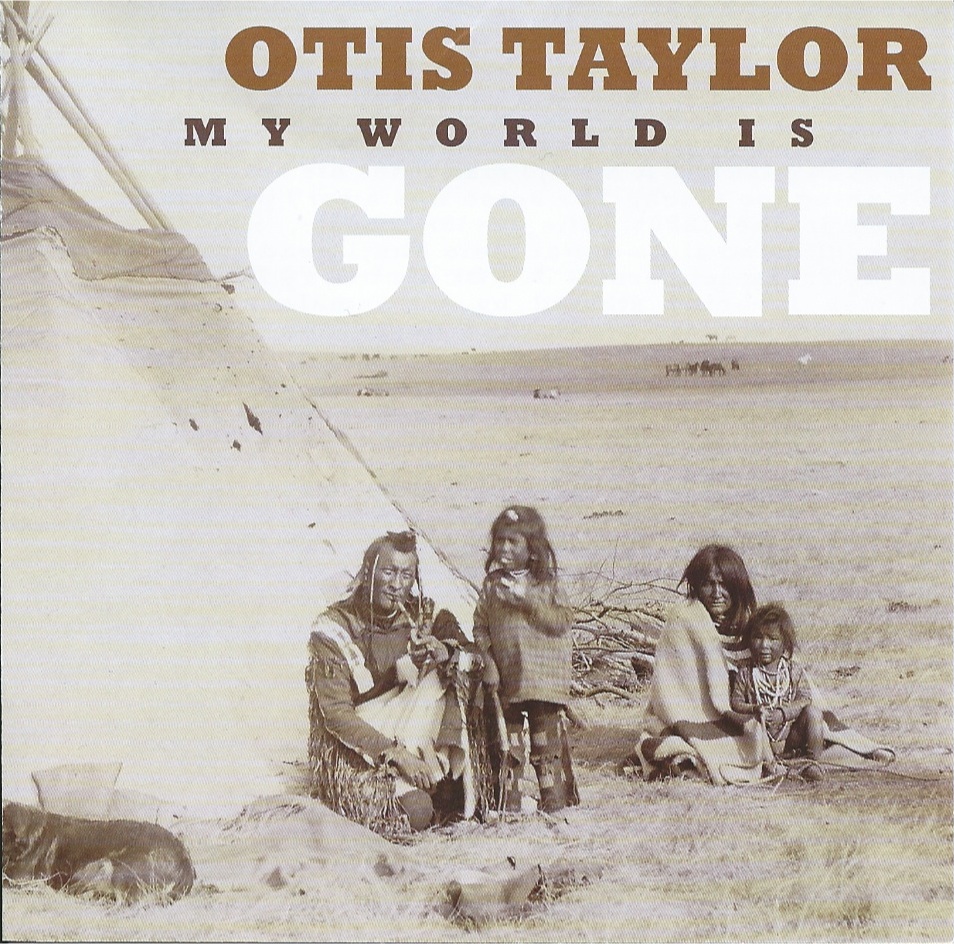
Taylor came to London in the late 1960s as a solo blues singer, guitarist and banjoist. He supported Fairport Convention at the Roundhouse and was scheduled to record for the Blue Horizon label until a disagreement over musical policy put an end to the plan. He went home and spent the next few decades running an antiques business and a bicycle racing team until resuming his career in the mid-1990s with the first of a string of albums of his “trance blues”, of which My World is Gone (Telarc) is the 13th.

This latest sequence of songs concentrates on the world of the American Indian. Like Harry Smith in the notes to the Anthology of American Music, he adds little glosses to the title of each song: “A man stops drinking, hoping that his lover will come back”, “A Navajo man loses his horse from drinking too much”, or “A young man recounts the tale of his mother’s murder, where men came with crosses in the middle of the night.”

“I used to be told that what I did wasn’t cool,” he told me. “They said, ‘You don’t use chord changes and your songs are depressing. People want chord changes and happy songs.’ But that’s the way it is. Appalachian songs can be pretty depressing, too. Even Dolly Parton gets depressing sometimes.”

The arrangements — for various combinations of guitar, banjo, bass, tuba, drums, fiddle, cornet and organ — are simple but often imaginative. On “Huckleberry Blues”, for example, a flickering banjo strum builds an incessant groove over Todd Edmunds’ mobile funk bass in the manner of the guitar on Isaac Hayes’s Shaft theme, while Ron Miles’s cornet adds a spare, lyrical counterpoint to Taylor’s weathered voice. Brian Juan’s Booker T-ish Hammond B3 is a highlight of “Never Been to the Reservation”.

Almost half a century after my pals and I persuaded Hooker to sit down with that bottle of Scotch, the whole round world is fluent in the language of the blues. Not many of today’s people, however, speak it as convincingly as Otis Taylor, whose authenticity comes not just from his background and his musicianship but from his ability to find the common ground between past and present, and thereby to make his music seem as timeless as the human condition it describes.