Skip to content

Posts from the ‘Uncategorized’ Category

Dylan at the Albert Hall

Bob Dylan Albert HallOn the way in to the Albert Hall tonight, I told a friend that, what with the inconsistent quality of his recent tours and the cost of tickets on the grey market, this might be the last time I would be seeing Bob Dylan live. The first half didn’t do a great deal to change my mind. It had its moments, most of them when Dylan was not at the piano, where his erratic contribution seemed to muddy and confuse the ensemble sound. A brusque “Things Have Changed” gave the evening a challenging statement to start with, and “Pay in Blood” and “Love Sick” seethed with a sullen power, but “Duquesne Whistle” was a bit of a mess and a metrically refracted version of “Tangled Up in Blue” wasn’t exactly a treat. After the interval, however, the lights seemed to come on — the lights inside the music, that is, since the highly effective low-level stage illumination seldom varied.

The band found its range straight away on “High Water (For Charley Patton)”, Dylan delivered a rather beautiful “Simple Twist of Fate”, he growled effectively through “Early Roman Kings”, and then came the moment I’ll treasure. Everything came into focus on “Forgetful Heart”, the lovely ballad he wrote with Robert Hunter for Together Through Life: his voice, the band (with the brilliant Donny Herron on violin) at their gentlest and most discreetly responsive, the melody, the lyric, the restrained harmonica-playing. I’ve been going to see him in concert since 1965, and for me this ranked with “It’s Alright, Ma” from that year at Sheffield City Hall, “Like a Rolling Stone” at Earl’s Court in 1978 and “Barbara Allen” at the NEC in 1989.

“Scarlet Town” was almost as good, another example of the marvellously warm and alert support given to him by Charlie Sexton (lead guitar), Stu Kimball (rhythm guitar), Tony Garnier (bass), George Recile (drums) and Herron on pedal steel and rhythm guitars, mandolin and banjo as well as fiddle. At these moments you could hear the sound Dylan is after nowadays: a wonderfully flexible blend of bluegrass, Western swing and Chicago R&B. And it was a treat to watch the musicians catching each others’ eyes as they tried to predict the dynamic shifts and unpredictable endings, mostly with success. And by this time, too, his piano-playing had sorted itself out.

There were seven songs from Tempest included in the set list, and Dylan delivered them with such a persuasive sense of an engagement in his own creative present that if I didn’t have it already, I’d be out buying it this morning. “Roll On, John”, not a song I’d previously cared for much, turned out to make a perfect finale. So probably not the end of the affair, then.

Last tango in Kilburn

ManzaneraA corroncho, Phil Manzanera tells me, is a particularly ugly fish found in Colombia. When fisherman pull one out of the water, they take a look and throw it straight back. It’s what the people of Bogota call the inhabitants of Barranquilla.

The Two Corronchos is the name of a project on which Manzanera is currently working with his friend Lucho Brieva, a Colombian sculptor who occupies part of the mews in north-west London where the former Roxy Music guitarist has his recording studio. Manzanera was born to a Colombian mother, spending much of his early life in Venezuela, Colombia and Cuba, and the album will tell the possibly somewhat picaresque story in music of two men travelling round the Americas, providing social and political commentary while reflecting local sounds and styles.

A profusion of Brieva’s iron gates and railings are a feature of the buildings, which were once a stables and a railway depot. The main line from Euston runs a stone’s throw away, necessitating considerable efforts to sound-proof the rooms when the studio was built. On Manzanera’s walls are the posters and gold records and other bits and pieces of memorabilia that you’d expect, but also lots of South American art and several large paintings by Nick de Ville, the professor of visual art at Goldsmiths College and the art director of the early Roxy Music album covers.

I first met Phil in November 1970, when he and Bill MacCormick, one of his fellow members of a band called Quiet Sun, came to see me at the Melody Maker. They’d sent me a tape, I’d liked the sound of it, and after we talked in the Red Lion, the pub round the back of Fleet Street where artists used to come to be interviewed, I wrote a piece about them. The next time I saw him, several months later, was at an old cinema in Battersea, where he was doing a spot of roadying for the embryonic Roxy Music. They were auditioning for EG Management and he was about to step into the shoes of the departing David O’List.

When I paid him a visit this week, Manzanera was welcoming a string quartet led by Ros Stephen, the violinist and arranger whose work made such an impact on For the Ghosts Within, the album she made three years ago with Robert Wyatt and Gilad Atzmon. Like Wyatt’s previous two albums, it was made at Phil’s studio. This time she and her colleagues were here to add their contribution to a piece from the Corronchos project and to a track from Manzanera’s next album of his own guitar music.

The latter came first, and presented Stephen with the challenge of writing an arrangement for a piece called “Rosemullion Head”, a gentle, lyrical acoustic guitar improvisation (inspired by a coastal path in South Cornwall) to which minimal piano, bass and percussion had been added later. The sobriety of the lines for two violins, viola and cello placed a gently restraining hand on any hint of romantic indulgence, and after a handful of takes — in which adjustments were made to compensate for metrical irregularities in the original improvisation — an interesting phenomenon emerged: what had started out sounding like an accompaniment began to create the illusion of a dialogue. As one playback followed another it seemed as though the guitar, recorded long before, was now responding to the strings.

Next came “El Tango Infinito”, in which the two Corronchos visit Buenos Aires and whip up a fantastic groove, something of which the Gotan Project mob would be proud, with a laconic rap from Brieva and a fine guitar solo. Here, too, Stephen found a way of making the string quartet sound integral. Later in the day her husband, Julian Rowlands, would be arriving to add his bandoneon to the mix. He’s also her partner in their bands Tango Siempre and Orquesta Tangazo; you’ll find an example of their work here.

Outside in the courtyard, the early winter sun was setting on Lucho Brieva’s exotic ironwork. I left with the echoes of two pieces of music that won’t make their public appearance for some time, but which I’m looking forward to hearing again.

One used record store: £300K, no offers

On the BeatA seemingly nondescript little doglegged cut-through just north of Soho, linking Oxford Street and Tottenham Court Road, Hanway Street is the sort of alley that has always given central London its character. It’s a mess of scaffolding and construction at the moment, with a big hole where something’s been torn down and something grander will no doubt be erected.

For me Hanway Street was aways notable for its musical associations. In the early 1970s there was the office of John Abbey’s Blues & Soul magazine, which I read principally for the magnificently obsessive columns published under the name of Dave Godin. The same building was also the headquarters of the magazine’s associated record labels, Contempo and Mojo, whose catalogues included such names as Oscar Toney Jr, Doris Duke and Timmy Thomas. I’m pretty sure I did my first interview with the great Mable John on those premises. More recently there have been JB’s Records, a collectors’ vinyl-only shop which closed a couple of months back and is now a place where you can get your eyebrows plaited or your nether regions waxed, and On the Beat, a shop selling vinyl of all types along with old music magazines and books.

You might have read in the last few days about On the Beat, whose proprietor has put it up for sale on eBay, at a buy-now price of £300,000 with a guaranteed 10-year lease on the premises. I stopped by there today, and he told me that if a buyer isn’t found by the end of January, the shop will close.

For old times’ sake, I dropped a tenner on a copy of Joe Tex’s “A Mother’s Prayer”, a 1973 B-side on the Dial label that US radio disc jockeys preferred to the designated A-side, “I Gotcha”. It’s one of my favourites of Tex’s sermons, and I think I might have heard it for the first time when it was part of the repertoire of Kokomo, the great English pub-soul band. Anyway, the copy I found in On the Beat looks unplayed, which is more than you can say about the UK Mercury version already in my collection (or the rather battered one that some kind soul has uploaded on to YouTube).

It would certainly be welcome if a buyer stepped forward. But these places are disappearing, one by one. Maybe we were just lucky to have them for so long.

Lou Reed 1942-2013 (2)

Lou Reed:MM

You might feel you’ve read enough about Lou Reed in the last couple of days (and here is my Guardian obituary), but here are a few last thoughts.

1.

You’ll have heard a lot about how difficult it was to interview Lou successfully. Without wishing to criticise my colleagues, it always seemed to me that the journalists who had a hard time with him were the ones who felt he owed them answers to questions he had already been asked a million times. I mean, “Were you really on heroin when you wrote ‘Heroin’?” — asked 40 years after the fact — was unlikely to elicit a positive reaction.

Not to say that he was a little ray of sunshine even in the most propitious circumstances. But, like a lot of artists, he preferred contemplating the present and anticipating the future to raking over the past. He was proud of the early stuff, but you can tell just by reading the later interviews that he didn’t want to spend his life discussing it. He usually responded well to people who showed that they had taken the trouble to keep track of what he had been up to in the years since the achievements that brought him his legendary status. If an interviewer wanted to talk about Ornette Coleman (as Bob Elms did on Radio London) or Tibetan philosophy (as Mick Brown did in the Telegraph), he was likely to show genuine enthusiasm and engage in something resembling a real dialogue.

I suppose I was lucky to get to him before the period that began when Transformer and “Walk on the Wild Side” made him a hot act, the point at which large numbers of reporters started to interrogate him. He hadn’t yet met David Bowie — and might not even have heard of him — when I sat down with him at the Inn on the Park in London one day in mid-January, 1972.

He was in London to record his first solo album, accompanied by his producer, Richard Robinson, and Richard’s wife, Lisa, then the New York correspondent of Disc and Music Echo. The Robinsons were friends of mine and they knew I was a Velvet Underground fan of long standing, and soon after their arrival we all had lunch together at the hotel. Lou was quiet and a little preoccupied but perfectly good company.

A few weeks later, after they’d recorded and mixed most of the album with a very heterogeneous bunch of English musicians at Morgan Studios in Willesden (where Rod Stewart had cut Every Picture Tells a Story), I sat down with Lou in his room to listen to some of the near-completed tracks, with the intention of writing a piece for the Melody Maker. It was a very congenial experience. He was so relaxed and willing to talk about his past that when I read the piece now, I feel guilty that I didn’t convey more of his thoughts about the new material. As things turned out, the album — called Lou Reed — created barely a ripple of public interest; soon to be overshadowed by Transformer and his liaison with Bowie, it acquired the dismal aura of a failed project. Give it a proper listen today, however, and you’ll find that “Wild Child”, “Love Makes You Feel” and “Ride into the Sun” are more than worth their place in his canon.

At one point I asked him about the Velvets’ third album, and if he would be willing to support my theory, aired in a review when it came out in 1969, that its 10 songs constituted a single narrative. He seemed delighted. “I’ve never known whether it worked for other people,” he said. “I’ve always written with the idea of putting songs into concepts so that they relate to one another. I always thought of these like chapters in a novel, and that if you played the first three albums all in order, it would really make huge total sense. No one ever seemed to pick up on that, and why should they? I don’t put out that many albums anyway, so by the time Chapter Three arrived, you had to go running back to the archives to find where Chapter Two left off.”

When the song on Lou Reed called “Berlin” mutated, a couple of years later, into the entire album called Berlin, with its cast of characters and single continuous and coherent narrative, he seemed to have achieved his ambition to make a rock and roll album that worked like a novel.

2.

No doubt there will be a great deal of reassessment of Reed’s work in the coming years. Given the way the once-despised Berlin was rehabilitated, don’t bet against something similar happening to Lulu — his recent album with Metallica, even more voceriferously despised by US critics — one day. I’ve been listening to it over the past 24 hours, and it seems to me that anyone who claims to adore the harsher moments of White Light/White Heat yet dismisses this one needs to have a serious rethink.

A more likely beneficiary, however, could be Songs for Drella, the album he made with John Cale for Sire in 1990 as a farewell to Andy Warhol, their former patron. Originally performed at the Brooklyn Academy of Music, it’s a biography in music, beginning with Warhol’s origins as a youthful misfit in Pittsburgh and tracing the story through his early days as an advertising artist and his rise to prominence as a succes de scandale in the New York art world of the 1960s to Valerie Solanas’s attempt to kill him and his eventual death from a heart attack following gallbladder surgery in 1987.

Reed and Cale were close to Warhol, but their view of his world is as clear-sighted and illuminating as it is generous and affectionate. Musically, it gains impact from its sense of intimacy: the instrumentation is restricted to Reed’s guitars and Cale’s various keyboards and viola. They both sing, the simplicity of the surroundings highlighting the restrained emotion in their voices. There’s a lot of contrast, effectively employed, like the jump from the elegance of Cale accompanied by strings on the delicate “Style It Takes” to Reed’s rapid-fire delivery over the chattering keyboard and buzz-saw guitar of “Work”, but the whole song-cycle coheres beautifully, forming a perceptive and touching tribute to a man who played a significant role in their careers. It’s easy to imagine its reputation increasing as the years pass.

3.

If you don’t already know it, try to hear Lou’s version of Doc Pomus and Mort Shuman’s “This Magic Moment”, included in a CD called Till the Night Is Gone: A Tribute to Doc Pomus, issued in 1998 by Forward/Rhino. The album features a stellar cast — Dylan, B.B. King, Brian Wilson, Irma Thomas, Los Lobos, Roseanne Cash, Dr John, Aaron Neville, Dion, Solomon Burke, etc — but his track is a standout. Originally a Top 20 hit for the Drifters in 1960,  it allows him to demonstrate both his deep affection for R&B and his gift for stripped-down rock and roll, his two guitar parts — one skirling, the other snarling  — accompanied by Fernando Saunders on bass and George Recile on drums. And he really was among the most unorthodox and creative of rock guitarists, a fact often overlooked in the desire to acclaim his more headline-friendly characteristics.

Lou Reed 1942-2013 (1)

Lou Reed 2The death of Lou Reed has just been announced. I’m thinking back to the early weeks of 1967, and the release of The Velvet Underground and Nico, which had such a profound impact on all who were prepared to be receptive to such provocative music: “I’m Waiting for the Man”, “All Tomorrow’s Parties”, “I’ll Be Your Mirror”, “Black Angel’s Death Song” and, of course, “Heroin”. And then White Light/White Heat and the third album. Each of them a map leading to a different future. He was a strange, difficult and brilliant man.

Forty five years ago I managed to get an extended review of the first album into the local paper for which I was working as a junior reporter, serving my apprenticeship. It made a change from covering juvenile court and golden weddings. And now I have to sit down and write his obituary for the Guardian. So although I’ll keep any further thoughts for that, I didn’t want his passing to go unmarked on this blog. The pages above are from the copy of Screen Tests (Kulchur Press) I bought in the year that The Velvet Underground and Nico was released. Words: Gerard Malanga. Photograph: Andy Warhol.

Two kinds of modern beauty

Necks1.
It was my friend and erstwhile Guardian colleague John L Walters who made the neat comparison between the experience of listening to the Necks and a stroll through an art gallery, during which the attention might wax and wane as the eye is caught, becomes absorbed, moves on, glances briefly at something else and moves on again. While listening to the Australian trio’s new CD, Open, which consists of a single 68-minute piece, I thought of a different analogy, one that works better for me. It’s like being on a long train journey, perhaps through several countries: the view can change many times in the course of the trip, gradually but inexorably, perhaps from vast wheatfields to industrial landscapes to valleys between snow-capped mountains, and the weather modulates along with the scenery. Occasionally you might dive into a tunnel, requiring the senses to adapt, and the landscape might have changed again when you re-emerge.

“Open”, which is also the name of the piece, starts with the gentle clanging of something that sounds like (but almost certainly isn’t) the strings of an abandoned piano being struck with a rubber mallet. Little cymbals are struck, a double bass enters (with the sort of sparse, sonorous, simple figure that so often provides an underpinning to the Necks’ long-form pieces), and a real piano makes its appearance, sounding a series of vaguely oriental arpeggios with the sustain pedal held down. Tony Buck, Lloyd Swanton and Chris Abrahams are all aboard, and we’re on our way.

The landscape changes pretty slowly on this trip. As it does, there’s always one element — perhaps the bass figure, or the tapping of a closed hi-hat, or the piano holding the key centre — to maintain a sense of continuity. There are quiet periods when nothing much seems to be happening, and passages of great intensity. In the first third there’s some fine drumming from Buck, whose ability to draw a lovely tone from his instruments reminds me of the young Tony Williams; around about the mid-point the oscillations of a single octave-doubled note held on a Hammond organ blend with a baleful industrial noise; there are several passages in which Abrahams moves between the quietly ecstatic approaches of Alice Coltrane and Charlemagne Palestine; and the gentle final stages feature what sounds like a choir of Swanton’s overdubbed basses.

It’s their 17th album, and even at this early stage of listening it sounds like one of their best, up there with Aquatic and Silverwater, in my view. And there are UK gigs — including three nights at Cafe Oto — to look forward to next month.

2.

Arve Henriksen is also visiting the UK in November, to play Andrew Smith’s Requiem (inspired by the Utoya massacre) with a choir and the organist Stale Storlokken at St Luke’s in London and elsewhere. In the meantime there’s his new CD, Places of Worship, a work of very special beauty.

I’ve never heard Henriksen’s trumpet (or his counter-tenor vocals, for that matter) sound as profoundly and consistently expressive, that ability to mutate tone and attack matched by some wonderful phrase-making and a powerful sense of continuity. Nor has he ever benefited from more lustrous electronic backgrounds, the samples and programming mostly manipulated by Jan Bang and Erik Honore, with occasional help from Eivind Aarset’s guitar and Jon Balke’s keyboards. As a tailpiece, there’s a pretty song called “Shelter from the Storm” (not that one), sung by Honore.

In his five-star review in this morning’s Guardian, John Fordham drew a comparison with Sketches of Spain. That had been going through my head, too, particularly when listening to “Le Cimetiere Marin” and “Bayon”, two of the album’s 10 tracks. I was also reminded of Siesta, Miles Davis’s soundtrack to a 1987 film (directed by Mary Lambert) that nobody seemed to like but for which Miles, with the help of Marcus Miller, produced some beautiful moments at a time when conventional ideas of beauty did not seem to be high on his agenda.

Where Open demands a proper degree of commitment, Places of Worship opens its arms to any listener. In their different but equally wonderful ways, these are likely to be the albums by which I’ll remember the year.

* The photograph of the Necks — left to right: Lloyd Swanton, Tony Buck and Chris Abrahams — is by Camille Walsh. Their album is released on the RnR MEGACORP label. Henriksen’s album is on Rune Grammofon.

Volume control

Romain PilonNo one influenced the way jazz has been played on the guitar for the last 40 years more profoundly than Jimi Hendrix, who wasn’t a jazz musician in any way but nevertheless exerted an influence as profound as that of Charlie Parker or John Coltrane on saxophone players.

Hendrix’s example granted guitarists a licence to exploit the variations in tone and attack made possible by their electronic equipment, to break away from the restrained approach of earlier giants, from Charlie Christian to Wes Montgomery, and to spend more time exploring colour and texture in sound. A list of those players whose conception was touched by his influence to a greater or lesser degree might include such figures as Larry Coryell, Sonny Sharrock, John McLaughlin, Terje Rypdal, David Torn, Vernon Reid, Bill Frisell, Pat Metheny and the man we saw in London last week, Marc Ribot.

So it makes a nice change to listen to a young guitarist whose playing, while thoroughly modern, shows no traces whatsoever of a similar inclination. Romain Pilon was born in Grenoble, spent four years studying at Berklee, lived in New York for a year and is now based in Paris. The Whirlwind label released his first album, by a trio, last year, and now comes its successor, called Colorfield. This one features a quartet in which Pilon is joined by three Americans: the tenor saxophonist Walter Smith III, the double bassist Michael Janisch and the drummer Jamire Williams. Recorded in London, the album contains seven of Pilon’s absorbing compositions plus Horace Silver’s lovely ballad “Lonely Woman” (not to be confused with Ornette Coleman’s oft-performed piece of the same title).

Here is an hour of music in which substance triumphs over style. The tunes are attractive and varied but never flamboyant, and they inspire solos which have no ambition beyond a thorough exploration of their themes and structures. Pilon plays with a small, rounded, soft-edged tone reminiscent of the great Jim Hall, and uses absolutely no effects other than his great ear for harmonically acute, melodically elegant, rhythmically fluid improvisation. His colleagues are equally outstanding, particularly Smith, who confirms the impression he made last year on the trumpeter Ambrose Akinmusire’s much praised debut album — he’s another unshowy player, avoiding the customary influences in favour of an approach that might be what you’d get if you blended Warne Marsh with Sam Rivers and added a dash of Joe Henderson.

Janisch and Williams play a full part in these outstanding conversations, in which everyone has something worth saying and no one tries to shout anyone down. If you want a lesson in how to swing very hard indeed without raising the voice above a civilised murmur, listen to the final track, “7th Hour”. All in all, highly recommended.

John Abercrombie is a guitarist of an earlier generation, similarly unflashy and always worth hearing. His 39 Steps caught my eye before it caught my ear. It’s on ECM, whose releases are noted for the quality of the photography adorning their covers. But where there’s usually a moody land- or sea- or cityscape, with this one there’s an aerial picture of part of a football pitch: just the mown grass and the whitewash of the halfway line, the centre circle, the penalty area and the D. No players, however. In this context the image has more to do with geometry than sport; it seems to have no relationship to the music, which is by the American guitarist’s quartet, including  Marc Copeland on piano, Drew Gress on double bass and Joey Baron on drums. Or, indeed, to the album’s title, which is reflected in several tunes named after other films by Alfred Hitchcock.

This is an even quieter album than Pilon’s. With six compositions from Abercrombie and two from Copeland, plus the standard “Melancholy Baby” and one short collective improvisation, it barely disturbs the air in the room. A form of chamber music, certainly, but of a very high order when the four men are exploring the nuances of tunes as elegantly appealing as the guitarist’s “Vertigo” or the pianist’s “Spellbound”. Copeland occasionally inserts a hint of astringency that I suppose you could call noir-ish, but no violence is committed. For those prepared to listen closely, the relatively circumscribed emotional range will be no barrier to enjoyment of another exceptional album.

* The drawing is from the cover of Colorfield. It is uncredited.

Old apple, new garden

The Serpent TailThe only time I visited Wilton’s Music Hall, in the old streets just north of Tower Bridge, was on New Year’s Eve in 1998, to hear the actress Fiona Shaw recite The Waste Land, an experience rendered all the more unforgettable by taking place close to several of the locations mentioned in Eliot’s poem (“The river sweats / Oil and tar / The barges drift / With the turning tide…”).  I wish I were able to return there tomorrow night, to see Kate and Mike Westbrook perform their new song cycle.

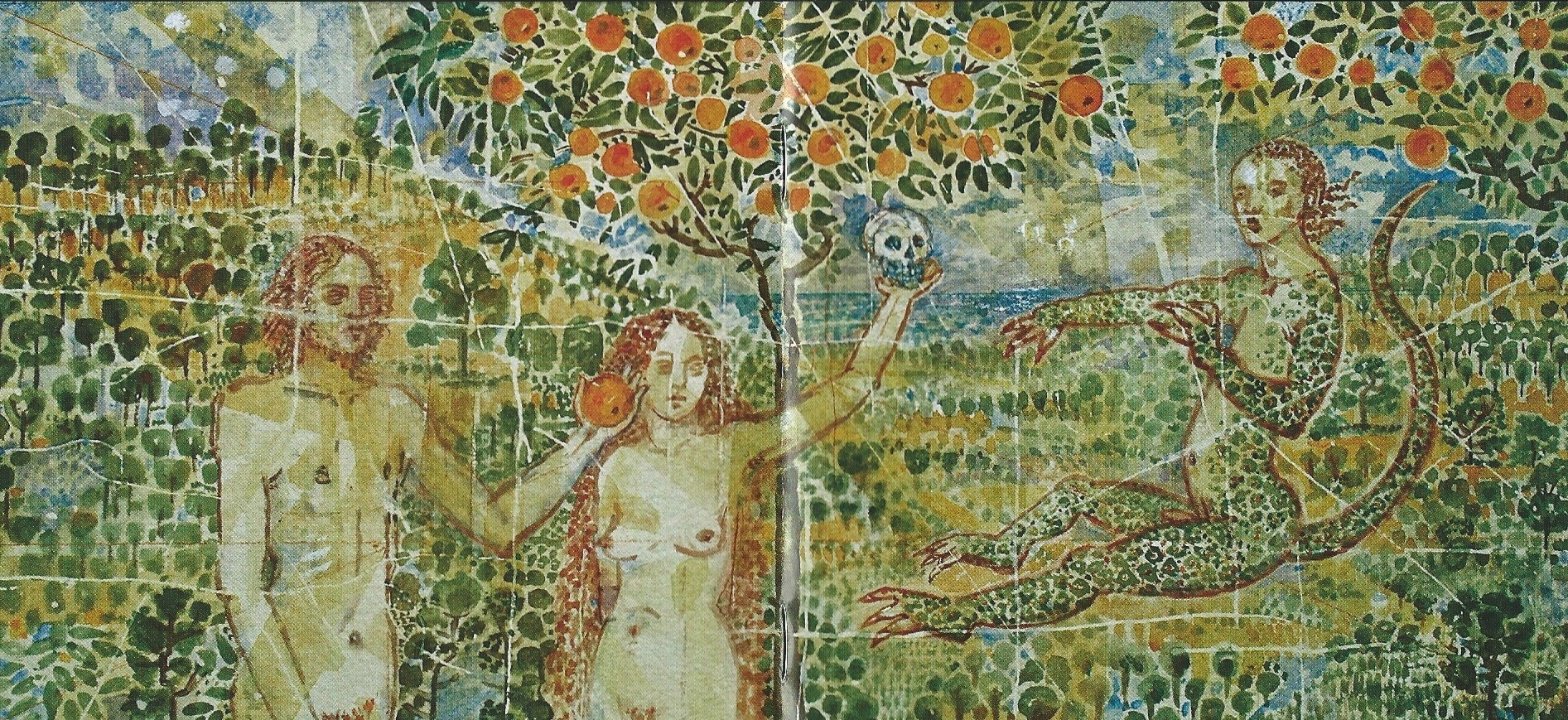
The Serpent Hit is its title, and also that of Kate Westbrook’s painting (above), the illustration on the cover of the CD, just released on the their own label. The piece deals with a big theme: mankind’s continuing fall from a state of grace, through the careless disregard of warning voices.

Five of the six individual pieces making up The Serpent Hit are written for Kate’s voice, a saxophone quartet (Andy Tweed, Chris Biscoe, Karen Street and Chris Caldwell) and a drummer (Simon Pearson); the sixth is an instrumental interlude. The music is Mike’s, and reminds us of his very personal gift for voicing: there are passages that echo his very earliest recordings, Celebration and Release, which were made with his big band in the late ’60s and still sound startlingly fresh. He writes beautifully for the saxophones, and in turn the soloists — notably Biscoe on alto and Caldwell on baritone — rise to the occasion, driven by the tireless Pearson. The effect of the ensemble is somewhere between the Ellington reed section and a Southern European marching band, but dominated by that pungent Westbrook flavour.

No less striking are Kate’s lyrics, spoken and sung in a theatrical style that has its roots in Lotte Lenya’s work with Brecht and Weill. It is an approach built for music of protest, and those three would have appreciated this harsh and bitter tirade against those who would rob the world of its innocence, its fruit and its future.

So, perhaps, would Eliot. And I can imagine Wilton’s — said to be the world’s oldest surviving music hall, with origins as an alehouse going back to the early 18th century — providing the perfect ambiance.

Oh, what a sound (September 1963)

September 1963For me, music changed exactly 50 years ago this month. It was in September 1963 that, as a 16-year-old schooolboy, I first heard all the 45s you can see in the photograph above. They are, clockwise from top left: “You’re No Good” by Betty Everett,”The Monkey Time” by Major Lance, “Heat Wave” by Martha and the Vandellas, “Anyone Who Had a Heart” by Dionne Warwick, “Can I Get a Witness” by Marvin Gaye,”It’s All Right” by the Impressions, “You Lost the Sweetest Boy” by Mary Wells, and “Hello Stranger” by Barbara Lewis.

When you’re 16, everything seems important. But these records really were. All of them were brand new; together they rearranged the possibilities inherent in a fusion of R&B, gospel and pop. Beamed in from Detroit, Chicago and New York, they announced the birth of soul music.

“Heat Wave” was the first, and it remains the closest to my heart. I can remember the feeling of being transfixed as those guitar and piano chords and that driving snare-drum came out of the radio. But each of them was a lesson of its own.

As you can see, I preserved the original copies, each in its proper seven-inch bag. They’re the ones I bought back then — with a single exception. One summer night in 1967, during a party at my parents’ house on the day my sister got married, someone stole my complete run of Martha and the Vandellas’ Stateside 45s, half a dozen of them, from “Heat Wave” to “Wild One”. Nothing else; just those. A thief with impeccable taste, obviously.

Mulatu Astatke’s Sketches of Ethiopia

Mulatu AstatkeThere’s a party scene in Paolo Sorrentino’s The Great Beauty — a film I like a great deal, although if Fellini’s La Dolce Vita, its spiritual and stylistic ancestor, is universally known by its Italian name, then so should be La Grande Bellezza — in which an elegant woman of a certain age says something like: “Everybody knows that Ethiopian jazz is the only kind worth listening to these days.”

She’s trying to be superior, but there’s something to what she says. Lots of kinds of contemporary jazz are worth listening to, of course. But when I first encountered the saxophonist Getatchew Mekurya on one of the volumes of Francis Falceto’s Ethiopiques series, it was like walking into a parallel universe, one in which Albert Ayler had been born and spent his entire life in the Horn of Africa. Like discovering jazz all over again, in a way.

Falceto’s series began its schedule of releases in 1998, became a favourite of hipsters and is now up to Vol 28. The extraordinary Mekurya — The Negus of Ethiopian Sax, to quote the title of Vol 14, which is devoted to his work — was the one who caught my ear, while others were knocked out by Mulatu Astatke, the vibraphone player and bandleader. Now Astatke has a brand-new album on the Jazz Village label, titled Sketches of Ethiopia, mostly recorded in London and featuring a basic band including names that will be familiar to followers of the contemporary British jazz scene — the trumpeter Byron Wallen, the pianist Alexander Hawkins, the bassist John Edwards and the drummer Tom Skinner — alongside others from Africa, France and elsewhere, such as the singers Tesfaye and Fatoumata Diawara, plus a chorus.

The album is very far from being a showcase for Astatke’s vibes-playing: it’s all about interlocking rhythms (he also plays congas) and shifting instrumental combinations. His best moment on his main instrument comes during a piece based on a traditional tune called “Hager Fiker” in which the vibraphone rides a sinuous conga-driven rhythm quite beautifully before giving way to two traditional instruments: first Messale Asmamow’s krarr, a five-string instrument, then Yohanes Afwork’s washint, an end-blown flute. His mallets also provide a sound-bed for  a glorious out-of-tempo introduction to an original titled “Gambella”, the metre gradually seeping in before the piece evolves into one of the irresistible funk grooves in which the album abounds. But the highlight is “Motherland Abay”, written by Astatke: eight and a half minutes of constantly changing textures, in which Wallen’s fine muted solo is shadowed by a wonderfully subtle horn arrangement.

At such a moment, as Kevin Le Gendre notes in his review of the album in the new issue of Jazzwise, what we’re hearing is music that seems to exist “right on the cusp of African and Arab culture” — but, I’d add, with a seemingly limitless horizon. It’s the music, in some respects, that I was always disappointed Weather Report didn’t quite get around to making. A terrific album.

* The photograph of Mulatu Astatke is by Alexis Maryon and is taken from the insert to Sketches of Ethiopia.