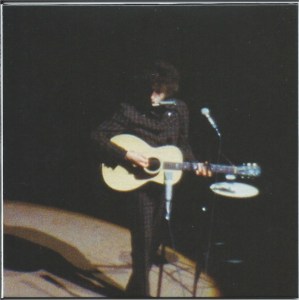
 I suppose I’ve always thought of the man who shouted “Judas!” at Bob Dylan in Manchester in 1966 as a dull-witted denier of truth and progress. To my astonishment, however, after spending the last couple of months listening, on and off, to the 36-disc box of the surviving music from that tour, I’ve come to see things a little differently.
According to researches by Andy Kershaw and C. P. Lee, the Judas man was a Manchester law student named John Cordwell. His interjection was the most prominent and celebrated of the many voiced in disapproval of Dylan’s alliance with Robbie Robertson, Richard Manuel, Garth Hudson, Rick Danko and Mickey Jones during the second half of each show, most of which featured a between-songs commentary of grumbles and shouts and whistles, occasionally luring the singer into responses that ranged from the wry to the exasperated.
Of course, the music they played after the interval was head-spinning, earth-shaking and world-changing, fuelled to a greater and greater extent as the tour went on by anger at the pincer attack from a combative Fleet Street on the one hand and outraged folk purists on the other. But after listening to many of these concerts, it’s hard to avoid the somewhat heretical conclusion that the finest and most enduring music came in the first half.
If he was feeling impatient to get to the second half and the revolutionary music he’d been concocting with his new friends, it never shows. The seven songs making up the basic acoustic set — “She Belongs to Me”, “Fourth Time Around”, “Visions of Johanna”, “It’s All Over Now, Baby Blue”, “Desolation Row”, “Just Like a Woman” and “Mr Tambourine Man” — receive a high degree of care and attention. The approach each night depends on the condition in which Dylan takes the stage, but the performances are never less than nuanced and fascinatingly varied. I could listen to every one of these versions of “Visions of Johanna” end to end without wearying of the experience. And apart from the voice, there’s the harmonica: which, in 1965/66, he was playing with a much underrated inventiveness and a powerful interest in developing the architecture of a solo.
Some of these concerts — like those at the Sheffield Gaumont and Birmingham Odeon, or the first Albert Hall show — find him in pristine form, honouring these songs with great concentration and spellbinding delicacy. Elsewhere his altered consciousness, shall we say, makes itself evident in a looser approach to the songs’ contours and details, producing results sometimes even more compelling than the more faithful treatments. The Olympia music hall in Paris and the second Albert Hall concert are particularly striking examples.
By no coincidence at all, these are the shows on which he spends most time responding to the audience. When he’s whistled for taking forever to tune his guitar before “Desolation Row” in Paris, for instance: “I’m doing this (tuning up) for you. I don’t care. If you want to hear it that way, I’ll play it that way.” And, as the noises of restlessness continue: “You just can’t wait. You have to go to work at 10 o’clock? Oh, it’s a drag for me, too, y’know. But that’s folk music for you. Folk music, it does this all the time.” And then: “Oh, come on now, I wouldn’t behave like this if I came to see you…” (It’s his 25th birthday, and Françoise Hardy is in the audience.)
It seems to me that the record company has made a mistake by issuing the first Albert Hall show as a stand-alone two-CD set. It’s beautiful, of course, and relatively unblemished by the sounds of a disputatious audience. But the second London concert was what the legend of this tour was all about: full-on music, full-on conflict, everything on the brink of falling apart, Dylan stoned to the gills and taking a last chance to harangue the dissenters during the final date of a psychologically gruelling tour, During a four-minute monologue between “Tell Me Momma” and “I Don’t Believe You”, he says this:
I love England, I like it a lot (sniggers), but we did all this in the States from September on, and we’ve all been playing this music since we were 10 years old, and folk music just happens to be a thing which interrupted … which was very useful, you know … but frankly the rock and roll thing in the United States was (sniggers) … forgive me … forgive me … Anything I sing now, don’t hold against me … I realise it’s loud music and all that kind of thing, but if you don’t like it, that’s fine. If you’ve got some improvements you could make on it, that’s great. But the thing is, it is not English music you’re listening to. It’s a shame that we’re here now and it might sound like English music to you, if you haven’t really heard American music before, but the music is-a, is-a, is-a … (laughter) … I would never venture to say what it is.
Quite. But I find myself thinking about people listening to Bob Dylan in, say, 50 years’ time, and wondering what it is they’ll be listening to, which of the many Dylans will have survived the years. The one who sang “Like a Rolling Stone”, no doubt. But maybe the acoustic songs, where his wisdom and subtlety as a writer and performer are most in evidence, are the ones that will turn out to have the real staying power: “Johanna”, “Tambourine Man”, “Baby Blue”, “Don’t Think Twice”, “Desolation Row”, “It’s Alright, Ma”, “It Ain’t Me, Babe” and the rest (among which we’d have to include “Tangled Up in Blue” and “Shelter From the Storm”).
The tumultuous music he made with the Hawks in 1966 enriched the culture and was perfect for its historical moment. But perhaps that shout of “Judas!” was not quite as wrong-headed as it seemed.
* Please don’t mistake this for a review of Bob Dylan: The 1966 Live Recordings. Somebody else can take that on. The photograph is a still from the unreleased film of the tour shot by D. A. Pennebaker.
 It had been an enjoyable enough concert for the first 40 minutes or so, but when Lucinda Williams dismissed her band and introduced “The Ghosts of Highway 20”, the mood of the evening deepened. “I’ve been filled with the need when I’ve sung this song lately to say that not everybody from the South is a bad person,” the woman brought up in Louisiana, Mississippi and Arkansas told the crowd at the Shepherd’s Bush Empire. They knew what she was getting at.
 If you were to draw a straight line connecting Hank B. Marvin to Jimi Hendrix and then extend it a bit further, the next point on the line would be Terje Rypdal, the Norwegian guitarist and composer who celebrated his 70th birthday this weekend with a couple of concerts at Oslo’s Victoria Nasjonal Jazzscene, an old cinema converted into a 300-capacity theatre for improvised music. I went to the first of the concerts, in which Rypdal was joined by the trumpeter Palle Mikkelborg, the keyboardist Ståle Storløkken and the drummer Pål Thowsen. It was an unforgettable evening, and a reminder of his singular importance.
 If you wanted to isolate an individual moment that summed up the curious position of the Beach Boys vis à vis the changing modes of youth culture in 1967, you might come up with the one in “Darlin'”, a single released in that pivotal year, when Carl Wilson sings a phrase written by Mike Love which lands precisely in the space between a letterman’s sweater and a paisley kaftan, between the disappearing culture and the emerging one: “You’re so doggone outtasight…”
 In 1964, while just about everybody else was still learning how to be a musician, Steve Winwood made his first national appearances seemingly fully formed in every way: already, at 16 years old, a great blue-eyed soul singer, a lethal exponent of the Hammond organ and a fluent blues-rock guitarist. That precocity was both his great gift and, in a way, his handicap: he had less ground to cover in his adult years, and perhaps it made him less ambitious.
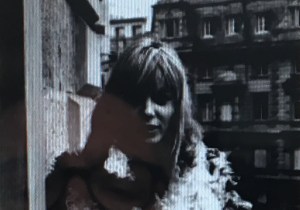 In the Rialto Theatre, Montreux, with only their technicians and a TV crew for company, the Rolling Stones were rehearsing for the Exile on Main St tour. It was May 1972, and the first date in Canada was a fortnight away. The small theatre on the shore of Lac Leman was the kind of setting that always showed them to best advantage, far from the stadiums in which they became a rock and roll circus act. The rhythm section locked in as played “Tumbling Dice”, “Shake Your Hips” and various boogie jams. In those surroundings even a sceptic (which I was) could have listened to them all night.
 I’m looking at some 50-year-old cuttings from a morning newspaper called the Nottingham Guardian Journal. The first of them is dated Saturday, May 13, 1967. It’s from a page called The Younger Set, containing pieces on fashion and music. The reviews include Hendrix’s “The Wind Cries Mary” (“magnificent… the most creative musician in Britain today”) and Percy Sledge’s “Out of Left Field” (“reaffirms my faith in soul music”). A week later we have the Doors’ debut album (“a very cool, tight sound”), Jefferson Airplane’s “Somebody to Love” (“a very mind-blowing cut from from one of the leading new-wave groups”) and, er, Dave Dee, Dozy, Beaky, Mick and Tich (“completely moronic”).
 Harvey’s book moves mostly between San Francisco and Los Angeles on its journey from January to December, with detours to Monterey and London. Some of the oral history — from backroom people like Andrew Loog Oldham, Shel Talmy and Bones Howe as well as stars such as Jerry Garcia, Al Kooper and Carlos Santana — is of rich in opinion and anecdote, despite being mostly divided into bite-sized chunks and arranged around the visual material. There are some real gems, as when the actress Peggy Lipton, one of the great beauties of the time, tells Kubernik about her Monterey Pop Festival experience: “There was a light drizzle and we went to hear Ravi Shankar. I remember I left my body.”
 What’s so funny about peace, love and understanding? The fiftieth anniversary of the Summer of Love might be a good time to reconsider Nick Lowe’s rhetorical demand. In these harshly polarised times, we might look back with wonder on a brief era when a young generation commanded the world’s headlines with a philosophy that was essentially generous, outward-looking and benevolent.