Skip to content

Posts from the ‘Jazz’ Category

Apropos of Barney Wilen

Barney WilenLouis Malle’s Lift to the Scaffold begins a season at the BFI in London this week, providing an opportunity to enjoy the conjunction of the director’s (and his cinematographer, Henri Decae’s) images and Miles Davis’s historically significant soundtrack. A classic of French film noir, made in 1957, it looks and sounds wonderful — particularly when experienced on a big screen in a proper cinema.

Miles recorded the music in a Paris studio, using four musicians with whom he had just embarked on a short tour: Rene Urtreger on piano, Pierre Michelot on bass, Kenny Clarke on drums, and — a surprising choice, and a particularly inspired one — the 20-year-old tenor saxophonist Barney Wilen, a prodigy who would become one of the most significant European jazz musicians of his generation. Together they took the conceptual leap that would lead Davis, within a couple of years, to Kind of Blue.

Wilen’s story is a fascinating one. Born in Nice in 1937 to a French mother and an American father, he left France with his family in 1940 and spent the next six years in America, where an uncle gave him a saxophone. On returning to Nice at the end of the war, he developed his interest in music; at 13 he was already playing with local jazz bands and at 16, having moved to Paris, he was performing at Le Tabou in Saint-Germain-des-Pres with his fellow saxophonist Bobby Jaspar and the pianist Henri Renaud. In 1957, a few weeks before answering Davis’s call, he made his first recordings under his own name, for the Vogue label: reissued on CD a few years ago under the title Tilt, they show a young man clearly fascinated by the compositions of Thelonious Monk and completely at ease with such pieces as “Round Midnight”, “Think of One”, “Hackensack”, “We See”, “Blue Monk”, “Let’s Call This” and “Misterioso”.

His style was never one that cried out for attention, but it evolved into an approach that could hold its own among the hard-bop giants of the day, such as Roy Haynes, Milt Jackson and Donald Byrd, with whom he also recorded during the 1950s. (In 1959 he wrote a film soundtrack of his own, for Edouard Molinaro’s Un Temoin dans la ville, which he recorded with a band including the trumpeter Kenny Dorham.) Although his playing never lacked strength, there was no sense of trying to grab the listener by the lapels. He could swing forcefully while still seeming to take his time, and it’s hard to think of anyone who would have fitted so beautifully into the soundtrack recording with Miles, where subtlety and light-footedness were crucial. He had a lovely tone and a frictionless sense of swing; if there were a missing link between Lucky Thompson and Wayne Shorter, perhaps it would be him. He knew how to be cool without being cold.

He also possessed an inquiring and unorthodox mind, and was keen to venture beyond the confines of an idiom he had so quickly mastered. Seduced by the possibilities of free jazz, and encouraged by the adventurous German record producer Joachim-Ernst Berendt, in 1968 he recorded an album called Auto Jazz: The Tragic Destiny of Lorenzo Bandini, in which he and his quartet improvised against a recording of the commentary from the previous year’s Monaco Grand Prix, during which Bandini had been burnt to death at the wheel of his Ferrari. It was released on the MPS label, and is now hard to find.

“I have a French passport and I live in  Paris,” he once observed. “I consider myself a musician of the world, temporarily French.” In 1969, having grown his hair, adopted a more relaxed wardrobe and befriended such leading lights of the Parisian counter-culture as the film director Philippe Garrel and the actor Pierre Clementi, he and his girlfriend, the English-born model Caroline de Bendern, went to Africa, where they spent several months travelling in a Land Rover through Morocco, Algeria, Niger, Mali, Upper Volta and Senegal, recording with with local musicians as they went. The first results were issued under the title Moshi in 1972, on the Saravah label; about a year ago de Bendern  issued a second instalment of this fascinating Afro-funk trance music — with bits of conversation and street song interpolated and overlapping — under the title Moshi Too, on the Sonorama label.

Then, in effect, he disappeared. The next couple of decades were apparently spent back on the Cote d’Azur, where he played occasionally with a local group, effectively off the scene and out of the mainstream. Until, in 1988, an illustrator named Jacques de Loustal and my old friend Philippe Paringaux, a former editor of Rock & Folk magazine, collaborated on what we would nowadays call a graphic novel titled Barney et la note bleu, a romanticised version of Wilen’s life as an itinerant saxophonist on the jazz scene. Stylish and evocative, it was a huge hit (it’s still in print) and prompted Wilen to record a new album, titled La Note Bleu and using Loustal’s artwork. Accompanied by an excellent rhythm section, he proved that his old skills — particularly as a ballad player, on Gordon Jenkins’ “Good-Bye” and a short unaccompanied version of “Besame Mucho” — had not atrophied. His tone was, if anything, even more perfectly formed.

People suddenly remembered how good he was, and he was invited to make more recordings. I have a lovely quartet recording with the guitarist Jimmy Gourley from 1987 (Double Action, on the Elabeth label) and a fine duo album with the pianist Alain Jean Marie, his longtime associate, from 1992 (Dreamtime, on Nocturne). Both, coincidentally, contain versions of “Good-Bye”; along with “Besame Mucho”, it’s among my very favourite songs, and although his fondness for revisiting both these tunes at every opportunity is not why I’m such a fan of his, it probably helps.

According to Blue Melody, a short biography written by Yves Buin and published in France by Castor in 2011, Wilen already knew that he was suffering from stomach cancer by the time he travelled to the US in 1994. There he recorded an album called New York Romance at Rudy Van Gelder’s studio, with an A-team rhythm section: the pianist Kenny Barron, the bassist Ira Coleman and the drummer Lewis Nash. The following year he made Passione with his own musicians plus the Italian trumpeter Enrico Rava. It would be his last recording; the man who was as great a ballad player as any produced by the European jazz scene died on May 25, 1996, aged 59. Go and see Lift to the Scaffold and marvel not just at an ageless film but at how good Barney Wilen had already become when his 20th birthday was still a recent memory.

And if you want to know more, spend 55 minutes watching The Rest of Your Life, Stephane Sinde’s terrific biographical film, made in 2005:

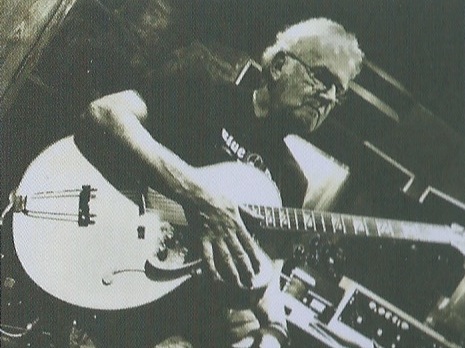
* The photograph of Barney Wilen (and the bassist Beb Guerin) is from the back cover of Auto Jazz: The Tragic Destiny of Lorenzo Bandini and was taken by Jean Maurice Pioton on February 13, 1968 while the musicians improvised the soundtrack as they watched the footage on a screen in the Tonstudio Bauer, Ludwigsburg.

Ibrahim Maalouf’s Illusions

Ibrahim MaaloufWe all have our instinct-based responses, and mine is to recoil from bombast. That’s why I liked the last two albums by the Lebanese trumpeter Ibrahim Maalouf — lovely music filled with subtle touches — and also why I’m surprised that I enjoy his latest one. Its predecessors — Diagnostic (2011) and Wind (2012) — were marked in the first case by a subtle blend of east and west and in the second by a perfect understanding of the sort of melodic, modally based two-horns-and-rhythm jazz perfected by Herbie Hancock with “Maiden Voyage” and heard most recently on Manu Katche’s first two ECM albums.

The new one, titled Illusions, is very different, and its cover seems to set the tone: Maalouf, all blinged up in a white suit, shiny turquoise shirt and gold shoes, surrounded by what appear to be a kind of burlesque version of the musicians from Prince’s band. There’s surely something ironic going on here.

Born in Beirut 33 years ago, he moved with his family to Paris during Lebanon’s civil war. His father, Nassim Maalouf, was a well known trumpeter,  the inventor of the four-valve quarter-tone instrument, and ensured that his son was thoroughly educated in both Arab and western music. Ibrahim was on the road with his dad from the age of nine, long before he began his studies at the conservatory in Paris. His subsequent career has been varied and distinguished.

The trumpeter’s extensive sleeve notes to Illusions — which is released on his own label, Mi’ster Productions — describe his ambition of using the album to portray the lives of men and women in the modern world as he sees it, with all the dissatisfactions, deceits, dilemmas and compromises that stand in their way. So the music makes use of three trumpeters (as well as himself) and keyboards to provide textures that often flare like neon above a hard-driving jazz-funk rhythm section. The playing is outstanding (Frank Woeste, the keyboards player, is a holdover from Wind), even when it goes a little too far over the top for my taste, as on the hard-rock “hidden” track — but perhaps that’s the point. As a composer, Maalouf shows in an intricately arranged piece like “Unfaithful” (listen here) that he is capable of juxtaposing the churn and the lyricism and blending them into something exhilarating.

I don’t love Illusions in the way I loved its predecessors, although I think I see what Maalouf is trying to achieve through this sustained essay in garishness. His own playing, however, is extraordinary. This is a voice that definitely comes from a non-western world, with a silvery tone and liquid phrasing, whether bouncing lines off the answering trumpet choir or producing passages of glowing lyricism. Like Ambrose Akinmusire in the US and Arve Henriksen in Norway, he demonstrates that this ancient instrument, with a history going back several millennia, definitely belongs to the present day.

If you don’t know him, I’d recommend starting with Wind, which consists of music written by Maalouf to accompany a  Rene Clair silent film from 1927, The Prey of the Wind, and was inspired by Miles Davis’s soundtrack for Louis Malle’s Lift to the Scaffold. It’s relatively conventional, but he and Woeste sound completely at home in the company of three top-class American musicians: the always-interesting tenor saxophonist Mark Turner, the bassist Larry Grenadier and the drummer Clarence Penn. Then you’ll probably want to discover what else he’s been up to.

* The photograph of Ibrahim Maalouf is from one of the postcards included with Illusions and was taken by Denis Rouvre.

Blake’s London

Blake 1In a pair of parallel alleyways under the railway line that runs through Lambeth from Waterloo station, parallel with the river, you will find two dozen panels like the one above, created by Southbank Mosaics, a non-profit community enterprise, to commemorate the work of the great English visionary William Blake. A few yards away is the housing estate that occupies the site on which stood the house where Blake and his wife lived between 1790 and 1800, and in which he composed and printed his Songs of Experience. One of those poems is called “London”, and this is how begins: “I wander thro’ each charter’d street / Near where the charter’d Thames does flow / And mark in every face I meet / Marks of weakness, marks of woe…” In the late 18th century, it needs to be said, the term “charter’d” could be taken to mean “in private ownership”. It’s a shattering poem, born of the conditions to which Blake bore witness every day of his life amid the teeming riverine streets, and it doesn’t seem to have lost any of its force or relevance.

Hercules Road, on which Blake’s house stood until it was demolished in 1912, is not a place to attract tourists in search of his traces. The anonymous postwar council estate — which bears the poet’s name and an appropriate plaque — occupies one side; the railway arches line the other. It takes some imagination to link it to the music composed by John Zorn for In Lambeth, an album inspired by the time Blake spent there.

This is Zorn’s second attempt to capture the poet’s spirit. The first, released in 2012 (also on the composer’s Tzadik label), was called Vision in Blakelight and was written for a sextet of keyboards, harp, vibes, bass, drums and percussion; its 10 sprightly, occasionally almost ecstatic pieces featured particularly fine playing by John Medeski on organ and Trevor Dunn on double bass.

In Lambeth, subtitled “Visions from the Walled Garden of William Blake”, filters that mood through a finer mesh. The group here is Zorn’s Gnostic Trio, in which two members of the Blakelight group, the harpist Carol Emanuel and Kenny Wolleson on vibes and bells, are joined by the guitar of Bill Frisell. The music is no less lively and active, often based on arpeggiated figurations reminiscent of the ostinatos of Terry Riley and Steve Reich, but its glistening instrumental timbres and the intimacy of the interplay between these brilliant musicians give it a character of its own. Here’s a track called “The Night of Enitharmon’s Joy”, referring to a female figure used by Blake to signify beauty and poetry (and possibly inspired by his wife, Catherine).

It’s as distinctive, in its own way, as the Jimmy Giuffre Trio of “The Train and the River”, as close as that to jazz — in fact impossible without it — yet breathing quite different air. Beyond category, and highly seductive.

In related Blake-and-jazz news: on Saturday, February 8, at the church of St Giles-in-the-Fields at the end of Denmark Street (once London’s Tin Pan Alley), Mike Westbrook and his musicians, including the Queldryk Choral Ensemble, will perform Glad Day, his celebrated settings of Blake’s poems, to promote the release of the music on a CD recorded live at the Toynbee Hall in London five years ago. This latest concert is dedicated to the memory of the poet Adrian Mitchell, with whom Westbrook worked on Tyger, the Blake-inspired musical performed at the National Theatre in 1971. Not to be missed, I’d say.

Something for Baraka

BarakaAmiri Baraka’s death at the age of 79 was announced today. Almost 50 years ago, when he was still known as LeRoi Jones, his book Blues People and his “Apple Cores” column in Down Beat magazine helped reshape a lot of thoughts, including mine. He wrote about Albert Ayler, Archie Shepp, Sun Ra, Pharoah Sanders, Cecil Taylor, Sunny Murray, John Tchicai. He saw this music — the “new thing” — as an expression of social and political as well as cultural revolution.

I bought his books of poems (Preface to a Twenty Volume Suicide Note, The Dead Lecturer), his essays (Home, Tales), his plays (Dutchman), his novel (The System of Dante’s Hell), which contained paragraphs like this: “Blonde summer in our south. Always it floats down & hooks in the broad leaves of those unnamed sinister southern trees. Blonde. Yellow, a narrow sluggish water full of lives. Desires. The crimson heavy blood of a race, concealed in those absolute black nights. As if, each tiny tragedy had its own universe / or God to strike it down.”

Later in the ’60s he got less lyrical, more angry, and became an activist. A few years ago, at St Mark’s Church on East 10th Street in New York City, I heard him read a poem about Rudy Giuliani that was truly shocking in its directed fury. After 9/11 he’d ruffled a lot of feathers — and lost his post as the poet laureate of Newark, New Jersey, his hometown — with a poem called “Somebody Blew Up America”, which was easily and sometimes wilfully misunderstood: here he is reading it in 2009 at the Sanctuary for Independent Media in Troy, NY, with Rob Brown playing Monk on the alto saxophone.

“One of the most baffling things about America,” he wrote in 1964 in his sleeve note to Coltrane Live at Birdland, “is that despite its essentially vile profile, so much beauty continues to exist here. Perhaps it’s as so many thinkers have said, that it is because of the vileness, or call it adversity, that such beauty does exist. (As balance?)” Vileness and beauty: both present and correct in the work of an irreplaceable figure, a man of his time.

The big bands are back (for a couple of minutes, anyway)

American HustleThe first sound you hear on the soundtrack of David O Russell’s new film American Hustle is that of the Duke Ellington Orchestra playing “Jeep’s Blues” during their historic appearances at the Newport Festival in 1956, and it just about lifted me out of my seat. There’s something about the sound of six brass, five reeds and three rhythm — in this particular case — that no amount of technology can reproduce or match.

I suppose whole generations have grown up without experiencing that sensation. I was lucky enough to see Ellington, Basie and Lionel Hampton leading their full-scale outfits, and a few others besides. The species still exists, if you search for it (I’m no great fan of Jools Holland, but he should certainly be commended for doing his bit in that respect), allowing people to discover what happens when all those instruments start disturbing the air in a room — preferably that of a smallish club.

The Jimmy Heath Big Band is an occasional ensemble led by a tenor saxophonist and composer who would have replaced John Coltrane in the Miles Davis Quintet in 1959 had he not been on parole at the time and not allowed to leave his native Philadelphia, thus preventing him from going on the road with one of the three or four leading small groups of the day. His consolation prize came when Miles recorded his composition “Gingerbread Boy” on the Miles Smiles album a few years later. He is the brother of the late Percy Heath, the bassist with the Modern Jazz Quartet, and the drummer Albert “Tootie” Heath: probably Philadelphia’s greatest musical family.

Heath is now 87; he was a mere 85 when his band recorded their new album, Togetherness, at the Blue Note club in New York City for the JLP label. It features several Heath originals, plus his arrangements of the standard “Lover Man”, Billy Strayhorn’s “A Flower Is a Lovesome Thing”, Dizzy Gillespie’s “Fiesta Mojo” and Charlie Parker’s “Yardbird Suite”, the presence of which reminds us that in his youth, when he was playing alto, Heath was known in Philly as “Little Bird”.

This is music that never attempts to escape the conventions of the type of straightforward modern jazz which emerged from the bebop revolution. Heath arranges as he plays, with a complete understanding and command of that idiom, translating his knowledge to the broader canvas. The sections do exactly what they are supposed to do: they swing, they shout, they purr, and occasionally they whisper. Heath’s “A Sound for Sore Ears” is a terrific opener, and his tender improvisation on “Lover Man” is the highlight of the whole set for me. The other soloists include the trumpeter Roy Hargrove and the altoist Antonio Hart. The double bassist is Peter Washington and the drummer is Lewis Nash, which means that the rhythm section moves on well oiled bearings. This not an album to start a musical revolution, but it’s a reminder of how well the format can still work.

“Jeep’s Blues”, incidentally, is just the first of many pieces of music featured throughout American Hustle — which, as you might already know, is set in the 1970s, that decade beloved of a generation of film directors too young to have experienced it at first hand. Nothing else on the soundtrack — with the possible exception of Steely Dan’s “Dirty Work” — lives up to that great start. But it’s still a very clever and entertaining film.

* The still from American Hustle shows Christian Bale, Amy Adams and Bradley Cooper.

Miles: back to mono

Miles in MonoLike a fool, I gave myself a Christmas present. After all, I could hardly justify asking anyone else to buy Miles Davis: The Original Mono Recordings for me. It’s just too much of a record-company scam. But I’m enough of an idiot to fall for it. Which is exactly what they’re counting on.

The trouble is that Miles Davis isn’t around any more. I spent around 30 years buying his records when he was alive, and more than 20 years later it’s still hard to get out of the habit. So every time they repackage something artfully enough, I open my wallet. It’s the nearest thing to having him back again.

And I can’t say I regret holding in my hand the black and white box containing The Original Mono Recordings, even though the nine albums in the package contain not a single note of music that I don’t already own (and in the case of several of the albums, several times over in marginally different forms). The albums included are Round About Midnight, Miles Ahead, Milestones, Jazz Track (including the Lift to the Scaffold soundtrack), Porgy and Bess, Kind of Blue, Sketches of Spain, Someday My Prince Will Come and Miles and Monk at Newport, recorded between 1957 and 1961, and all presented in card sleeves with miniaturised versions of their original US artwork. At the very least, it’s an excuse to listen again to the products of this phenomenally fertile and career-defining period.

The remastering engineer, Mark Wilder, talks in the accompanying booklet of how he “added a little more bass and mid-range” to Miles Ahead, “as well as a little high-treble equalisation to create air around the instruments,” and used a tube compressor to “tone down the treble a little” on Someday My Prince Will Come. Of course they sounded fine to most of us in their original monaural vinyl incarnations, thanks to the particular properties of Columbia’s 30th Street studio and the sensitive ears of the engineers, such as Fred Plaut and Harold Chapman, who worked there but go uncredited in this repackage.

You can listen to these “restored” versions with enormous pleasure, but direct comparisons reveal evidence not always supporting the implication behind the claim of George Avakian, Miles’s first producer at Columbia, that “mono has always been truer to the studio sound and the original intent”. When I flip back and forth between the mono and stereo versions of “Summertime”, a particular favourite from Porgy and Bess, it’s impossible not to notice how the stereophonic picture clarifies the individual voices in Evans’s horn arrangement behind Miles, while in mono they coalesce into a more recessed and undifferentiated blur of subdued colour. Maybe the latter effect is what the arranger had in mind, but somehow I doubt it. On the other hand, I much prefer the sound of Davis’s flugelhorn in the new mono versions of “Springsville” and “Blues for Pablo” from Miles Ahead: it’s more rounded, not so brightly burnished by the studio EQ, and somehow truer to itself.

These matters are less of a consideration when it comes to the combo albums, where mix and balance are more straightforward, although I’ve never been sure whether I prefer to hear “Milestones” — probably my favourite piece of music ever, when all is said and done — with all the instruments separated and laid out in a panorama, every detail highlighted, or with the tighter aural focus of the version in which I learnt to love it, and which still seems perfectly suited to its sense of forward movement.

Just in terms of the music, the album that interests me most at the moment is Someday My Prince Will Come, always seen as a transitional affair in terms of Davis’s career. Perhaps feeling that his basic 1961 working quintet with Hank Mobley on tenor was not stimulating enough, Miles invited John Coltrane back to play on two of the album’s six pieces, both in 3/4, a metre in which Coltrane was deeply involved with his own quartet: the title track (where he solos after Miles, Mobley and Wynton Kelly, providing the piece with its climax), and the modal, Spanish-tinged “Teo”, on which his long solo is an absolute beauty. Davis’s own playing is luminous and inventive thoroughout, particularly on “Teo” and the ballads: “Old Folks”, “Drad-Dog” and “I Thought About You”.

It’s wonderful to listen closely to this music again. And I certainly don’t want to do Mr Wilder — or the reissue producer, Steve Berkowitz — a disservice. Maybe their diligence has made it a little easier, for instance, to appreciate the genius of Paul Chambers on these marvellous recordings, to which the great bassist, with his lovely tone, impeccable note selection and peerless swing, contributed so much. And if that’s so, perhaps we can say the whole project was worthwhile.

* The photograph of Miles Davis (playing flugelhorn) was taken by Don Hunstein during the Miles Ahead sessions and appears in the booklet accompanying The Original Mono Recordings (Columbia/Legacy).

Three’s company

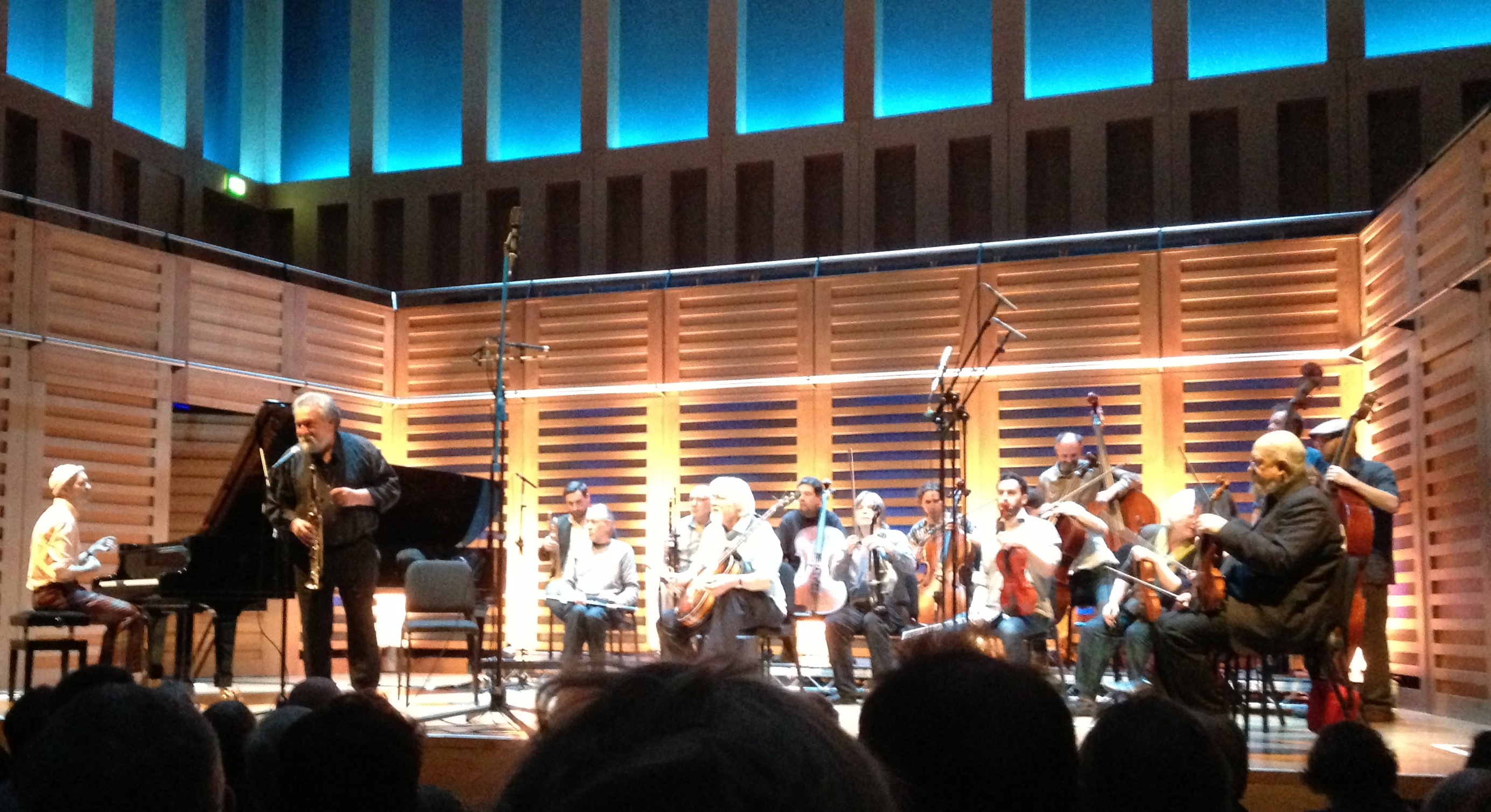
Schlippenbach trioThe Schlippenbach Trio ended their 18-date European tour at the Vortex on Friday night with two sets of free improvisation that drew some of the most enthusiastic and sustained applause I’ve heard this year. Three musicians of immense experience — the pianist Alexander von Schlippenbach, the saxophonist Evan Parker and the drummer Paul Lovens — were operating, after more than 40 years of playing together, at a peak of inventiveness and maturity.

I was enjoying it too greatly to take much in the way even of mental notes, but the evening left a residue of powerful memories: Schlippenbach spending a great deal of time working in the octave below middle C, his playing austere but never forbidding; Parker producing wonderfully mellow improvisations, constantly searching for and finding the most perfect entry and exit points; Lovens leaning forward, staying close to the surfaces of his drums and cymbals, making time and no-time slip in and out of each other with a marvellous control of energy-flow.

Remembering Nino Rota

Amarcord Nino RotaWhen it appeared in 1981, Hal Willner’s Amacord Nino Rota kick-started the phenomenon of tribute albums. The New York producer gathered a bunch of musicians — among them Carla Bley, Jaki Byard, Bill Frisell, Chris Stein and Debbie Harry, Steve Lacy, and the then-unknown Wynton Marsalis — to take a variety of approaches, in various combinations, to Rota’s music for the films of Federico Fellini.

Last night, as part of the EFG London Jazz Festival, Willner presented a greatly expanded version of the project, featuring only two of the original participants — Bley and her partner, the bass guitarist Steve Swallow — but adding a bunch of new pieces arranged by and featuring the likes of Mike Gibbs, John Etheridge, Kate St John, Steve Beresford, Rita Marcotulli, Nitin Sawhney, Giancarlo Vulcano, Karen Mantler and Steven Bernstein. Now opened up to include Rota’s music from non-Fellini films, the evening contained almost too many wonderful moments to remember.

Those I carried away with me included Beresford’s use of B.J. Cole’s outrageously eloquent steel guitar on music from Il Bidone; the expansion of Bley’s brilliant arrangement of themes from 8 1/2; Mantler’s deployment of her own chromatic harmonica during her marvellous settings of the various themes from The Godfather; the emotions that surged to the surface during Gibbs’s arrangement of music from The Glass Mountain (a 1949 film directed by Henry Cass and Edoardo Anton, and starring Michael Denison and Dulcie Gray); and the very moving conclusion, which found Sawhney at the piano, meditating on melodies from La Strada, accompanied by string quartet and bass flute.

I felt a little less warm towards the brief appearances of Marc Almond and Richard Strange, delivering songs from Fellini’s Casanova films. But the arrangers were fortunate to be able to call on the services of a terrific orchestra, whose soloists included the wonderful brazen trombonist Barnaby Dickinson, the feather-tongued tenor saxophonist Julian Siegel, the deft guitarist John Etheridge, Bernstein on slide trumpet (surely the most Felliniesque of instruments), and Marcotulli, who contributed a fine piano improvisation to The Glass Mountain. Topped and tailed — with typically Willnerian hipster ingenuity — by recordings of Ken Nordine reading Shel Silverstein’s poem “Where the Sidewalk Ends”, the result was a two-and-a-half-hour triumph.

Ten Freedom Summers / 2

Leo Smith 1His Ten Freedom Summers may have been shortlisted for this year’s Pulitzer Prize, but that doesn’t mean Wadada Leo Smith has stopped work on the epic composition which he began writing more than three decades ago (and about which I wrote here back in August). During last night’s performance at Cafe Oto in London, the first of three across which he will deliver the entire sequence, he inserted an entirely new movement, and it turned out to be the most memorable of the lot.

Smith arrived in East London with a slightly reduced version of the double ensemble that appeared on the 4CD version released by Cuneiform Records last year. Alongside his trumpet, the piano of Anthony Davis, the bass of John Lindberg and the drums of Anthony Brown were the Ligeti Quartet — Mandhira de Saram (first violin), Patrick Dawkins (second violin), Richard Jones (viola) and Ben Davis (cello) — with the video artist Jesse Gilbert operating from a desk next to the sound mixer.

A clue to the inspiration behind the new movement, called “That Sunday Morning”, arrived when an image of a church appeared on the screens behind the players, followed by the faces of four young African American girls. They were Addie Mae Collins, Cynthia Wesley, Carole Robertson and Denise McNair, the four members of the congergation who died on September 15, 1963 when a group of Ku Klux Klan members set a bomb under the steps of the 16th Street Baptist Church in Birmingham, Alabama. It was one of the most terrible incidents of the long struggle commemorated by Smith through the titles of the other movements, which mention Dred Scott, Medgar Evers, Emmett Till, Rosa Parks, Martin Luther King, the Freedom Riders, and others.

As you might have expected, the new piece adopted the mood of a threnody, a quiet and reflective lament that contained moments of striking beauty, particularly in Smith’s brief outbursts and in the rolling gospel phrases that Anthony Davis used sparingly but to very powerful effect. It was heartbreaking and spellbinding, and I hope the composer finds a way to record it in this form one day soon.

Two hours of music, with hardly a break, passed quickly, as I imagine they will tonight and tomorrow. I found myself thinking that the rearrangement of the pieces for the string quartet, rather than the nine-piece ensemble used on the album, worked extremely well, and perhaps even better, thanks not least to the talent and commitment of the young British quartet, rising to the challenge of a masterpiece.

Paolo Conte in London

Paolo Conte 1When I get home from a concert by Paolo Conte, the first thing I do is put on some of his records. Great as so many of them are, however, they’re not the same as watching this wonderful figure — half professor, half boulevardier, like someone you might spot in the corner of a cafe in Trieste, quietly writing in a small notebook — deliver his delicious songs while manipulating his excellent musicians through an evening that never seems long enough.

Conte is 76 now, and having given his audience a single encore at the end of an hour and a half of music at the Royal Festival Hall last night, he smiled and drew his finger across his throat, to indicate that there would be no more. But what he had given was more than enough to ensure that he would be bathed in waves of affection, respect and gratitude.

He had brought 10 of the 11 musicians who accompanied him on his last studio album, Nelson, released in 2010, and they were so outstanding, individually as well as collectively, that I’m going to name them all, in the knowledge that the list will give you some idea of the versatility at Conte’s command, and the range of textures available: Claudio Chiara (tenor saxophone, flute, accordion), Luca Velotti (alto saxophone, clarinet), Massimo Pizianti (piano, keyboards, accordion, bandoneon, soprano and baritone saxophones, clarinet), Lucio Caliendo (keyboard, oboe, bassoon, percussion), Piergiorgio Rosso (violin), Nunzio Barbieri, Daniele Dall’Omo and Luca Enipeo (guitars), Jino Touche (double bass, bass guitar), and Daniele Di Gregorio (drums, percussion, marimba).

Conte’s performance was part of the opening weekend of the EFG London Jazz Festival, and although what he does is basically a form of pop music, jazz provides its underpinning and its guiding spirit. For him, sounds that were once at the cutting edge — the horns of Ellington’s Cotton Club band, for instance, or the guitars of the Quintet of the Hot Club of France — have lost none of their modernity. His particular gift is to write songs with chord structures so beguiling that you don’t miss the apparent absence of a melody (if there is one, his mode of laconic recitation barely hints at it).

He has so many songs that it doesn’t really matter which ones he chooses on any given night. He might not sing your favourite, but those he does perform — including the ones you don’t recognise — will be more than sufficient. Last night he included a swooning “Gli impermeabili”, the spaghetti western swing of “Diavolo rosso”, a yearning “Max”, a driving “La Negra” (one of a number of up-tempo songs in which the advantage of having three acoustic rhythm guitars strumming away became apparent) and, best of all for me, a long, slow sweep through the elegantly descending cadences of “Alle prese con una verde milogna”, the sultriest tango you could ever hope to hear, supported by Touche’s swaying bass and drenched in grown-up romance.

There were all sorts of sounds to be heard: Di Gregorio leaving the drums to play a racing marimba improvisation behind the leader’s vocal on “Dancing”, for instance, or an unorthodox horn section of alto, tenor and baritone saxes plus bassoon, or the combination of accordion and bandoneon, or a magnificently flamboyant violin solo from Rosso, or Conte’s occasional insistence on singing through a kazoo, each element within the complex overall design perfectly calibrated while retaining a precious air of informality and spontaneity. There really is nothing like it.