Skip to content

Posts from the ‘Jazz’ Category

Finding Bob Campbell, photographer

Robert Campbell Son House John HammondIt’s 14 years since Jessica Ferber, who had just graduated in sociology and photography from the University of Vermont, was handed a few boxes of photographic prints and negatives and other bits and pieces left by a recently deceased resident of a homeless shelter. She was asked if she wanted to do something with them. They would occupy much of her time for the next decade as she sorted through the material, began the painstaking process of restoration, and then raised funds via Kickstarter to complete the work and to secure publication in book form.

The battered prints, negs, postcards, receipts, letters, cassette tapes and a journal were all that remained of the life of Robert James Campbell, who had died at the age of 65 of accumulated symptoms, including heart and kidney disease, more than 30 years after his career as a photographer had petered out. But what Ferber saw convinced her that here was something worth preserving.

Bob Campbell was born in New York into a wealthy family, and grew up in homes in Portsmouth, New Hampshire and Burlington, Vermont. He was interested in cameras from an early age, and he also played the double bass. He dropped out of college after a year and his first photographs of jazz musicians seem to have been taken when he served in the US Army in the 1950s. When he moved to New York on his 25th birthday in 1961, taking a studio in the West Village, he gravitated towards clubs like the Village Vanguard.

Rebirth of the Cool is the product of Ferber’s 10-year obsession, a handsome large-format book that chronicles not just Campbell’s work but his life, mainly through family photographs from his childhood. It includes impressive black and white studies of many important musicians, among them Bud Powell (at the recording session for The Return of Bud Powell in 1964), Elvin Jones, Miles Davis and John Coltrane, Wayne Shorter, Lee Morgan, the MJQ (shot during a trip to Germany in 1958), Tommy Turrentine, Philly Joe Jones, the Adderley brothers, Dave Brubeck, Gerry Mulligan, and Warne Marsh with Lee Konitz.

Campbell was also taken with Bob Dylan; although there are no shots to document that specific interest, his involvement in the burgeoning Greenwich Village folk and blues scene is reflected in photographs of Son House with the great A&R man John Hammond (see above), Mississippi John Hurt, Miriam Makeba (with Sivuca, the Brazilian accordionist), Richie Havens, Bill Monroe, the Staple Singers and the duo Jim & Jean — Jim Glover and Jean Ray (below), the models for the characters played by Carey Mulligan and Justin Timberlake in Inside Llewyn Davis.

Robert Campbell Jim and Jean

The influence of Henri Cartier-Bresson is pretty clear in these photographs, particularly when Campbell moves outside to shoot scenes in Washington Square and the streets of the Village. He didn’t make stylised images of smoke-wreathed musicians, as Herman Leonard had done. He was after the informality of an emerging counterculture, more in the manner of Carole Reiff or Ed van der Elsken. One shot from a party in a Village apartment is so cool that it makes me wish it were 1964 all over again. He seems to have tried fashion work, but he needed to take other jobs, such as building sets for theatre companies, to keep going.

I’d come across him once before, in the pages of Blue Melody, the excellent memoir of Tim Buckley by Lee Underwood, Buckley’s friend and guitarist. Campbell met Buckley and Underwood at the Tin Angel, a Village club, and moved with them to California in 1967 before drifting out of sight. “Bob was in his early thirties, bearded, very bright, well-read, a musically literate fellow who did not graduate from college,” Underwood writes. “When I asked him why, he said, ‘I like books and I read a lot, but I don’t study. When reading becomes work, a task, then that’s it. My seventh- and eighth-grade guidance counsellor accused me of learning by osmosis. My mother got burned up at my motto in the yearbook: I’m not lazy, I’m just tired.'”

Underwood records Campbell as having turned up at Buckley’s funeral in Santa Monica in 1975. “One true and trusted friend,” he calls him. By that time the photography was over and the set-building was how he earned his money. Ferber reconstructs the story of his last years from minimal evidence, telling us that in the early 1980s he returned to Portsmouth, New Hampshire, where he inherited the family home on his mother’s death in 1987. But it all disappeared, and so did he until 1995, when he was taken in by a homeless charity in Burlington until his death seven years later.

He wasn’t a genius, but the photographs show that there was certainly a measure of poetry in his soul, and Ferber’s devotion to the surviving fragments of his life adds an extra layer of it to this fine book.

* Rebirth of the Cool by Jessica Ferber, with a foreword by Marc Myers, is published by powerHouse Books of Brooklyn, NY. Blue Melody by Lee Underwood was published by Backbeat Books of San Francisco in 2002.

Jazz in the Round

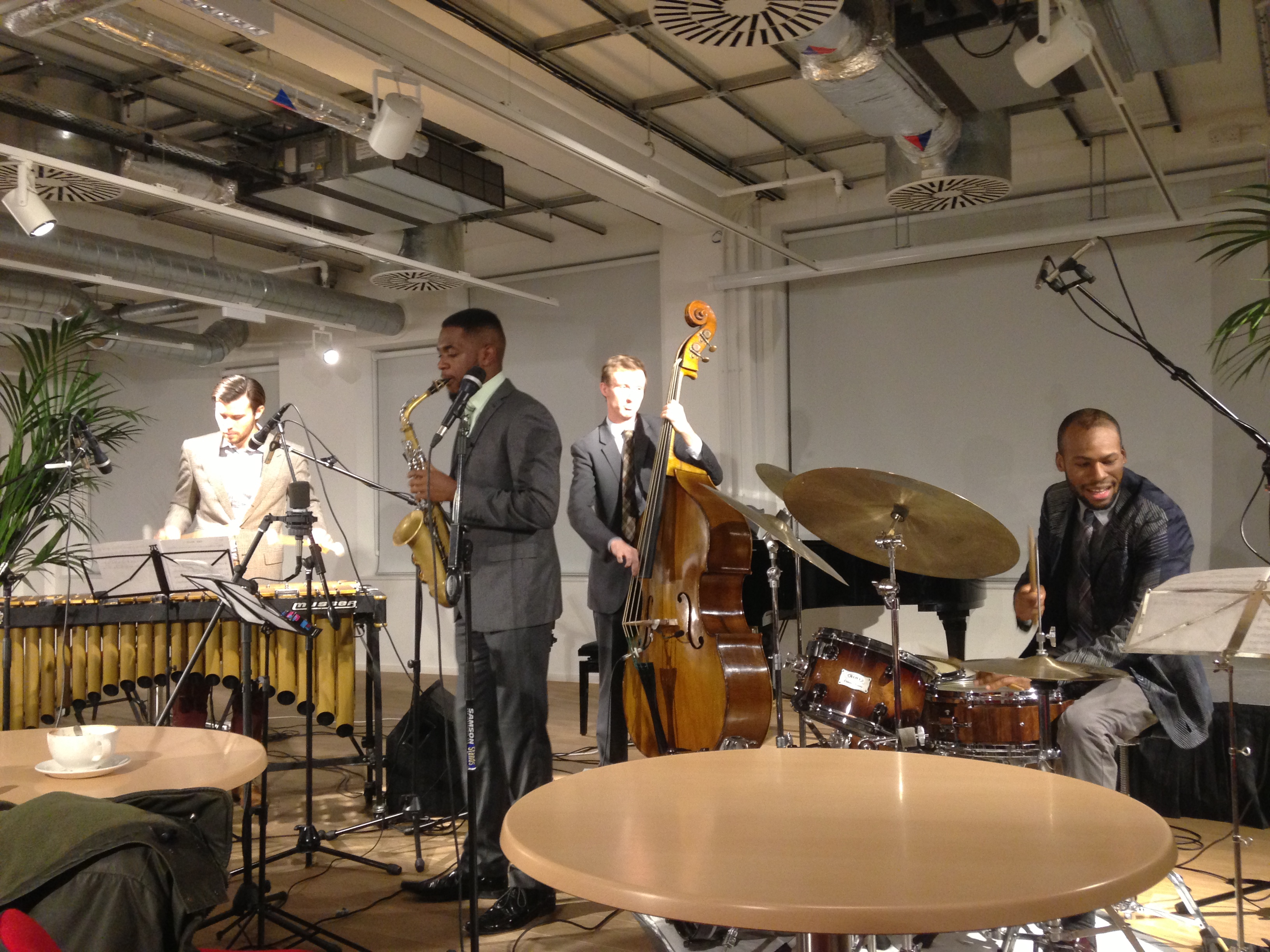
Jazz in the Round 1Jez Nelson’s monthly Jazz in the Round nights at the Cockpit Theatre in Marylebone are as good a way to hear improvised music in London as anyone has yet devised. A couple of hundred listeners settle themselves down in mini-bleachers on all four sides of the floor, where the musicians set up to face each other, creating an unusual degree of intimacy radiating through 360 degrees. As a member of Empirical — I think it was Nathaniel Facey, the alto saxophonist — told last night’s audience, it makes you play differently. In a good way.

Facey and his colleagues kicked off what turned out to be a special night even by the standards of this excellent series. The evening was being recorded for transmission (on March 28) as the last-ever Jazz on 3, which Nelson presents, and after 18 years he was understandably emotional as he introduced a bill handpicked to represent the programme’s philosophy over the years. After Empirical came Django Bates, who gave the solo performance that traditionally separates the evening’s two bands, followed by a set of free improvisation from a multi-generational quartet assembled specially for this event: Laura Jurd (trumpet), Alexander Hawkins (piano), Orphy Robinson (marimba) and Evan Parker (tenor saxophone).

Empirical were coming off a week of thrice-daily gigs in a pop-up revue at Old Street tube station: a wheeze that apparently worked as well as it deserved to, attracting crowds of passers-by intrigued by what they heard. They’re an exceptional band and they played a fine set of striking new compositions by each of the four members, ending with “Lethe”, a quietly beautiful slow tune by the vibraphonist Lewis Wright. I’ve heard them play it before, and it stuck in my head. I was delighted to hear it again, and to discover that it’s on their new album, Connection.

Bates had just arrived from Switzerland, where he is a professor of jazz at Bern’s University of the Arts. He began by singing, to his own deft kalimba accompaniment, a little song about the anxiety of a man introducing himself to a piano (which turns out to be female). Then he sat down at the keyboard to play a piece in which he doubled his improvised single-note lines in the treble register with whistling of virtuoso standard. A tenor horn solo preceded a final stint at the keyboard, which included some gorgeous gospel figurations and a song about a London pub transformed by a developer into empty luxury apartments. “Empty luxury,” he repeated, sotto voce but with emphasis.

The members of the final improvising group were chosen to show how Jazz on 3 has always reflected the way this music spans the generations, with the accent on new developments. They had never played together as a unit, but the shared qualities of musicianship and sensitivity ensured that they created a genuine conversation that not only gripped their listeners but enfolded them in the act of creation. It was, as Nelson pointed out, the best possible way to demonstrate that, in the hands of such people, the music’s future is safe.

* The photograph of Empirical at the Cockpit Theatre was taken by Steven Cropper, and is used by kind permission. His blog, with more of his fine images, is at http://www.transientlife.uk. Jazz on 3 will be replaced on BBC Radio 3 by Jazz Now, presented by Soweto Kinch. Jez Nelson’s Somethin’ Else will be on Jazz FM on Saturday nights from April 2. Jazz in the Round takes place on the last Monday of each month: http://www.thecockpit.org.uk/show/jazz_in_the_round_0.

Feat. Bill Frisell

Bill Frisell at home 2There was a time, seven or eight years ago, when I came to the conclusion that Bill Frisell was simply making too many records. I fell out of the habit of automatically buying his new releases because he seemed to be spreading himself too thin. Good Dog Happy Man (1999) and Blues Dream (2001) are still two of my all-time favourite albums, but I tend to prefer him nowadays as a contributor to other people’s records — something to which his particular expertise is well suited. Used sparingly, the characteristics of his playing add texture and flavour, just like King Curtis or Steve Cropper once did.

The job of being an accompanist is much underrated these days, so it’s good to welcome the arrival of two outstanding new albums on which Frisell fulfils that role: first with the saxophonist and flautist Charles Lloyd on I Long to See You and second with singer-songwriter Lucinda Williams on The Ghosts of Highway 20. They’re very different, of course, but they benefit equally from the guitarist’s modest, graceful touch.

When I interviewed him for the Guardian in 2002, Frisell explained a personal evolution that had begun with his first 45, the Beach Boys’s “Little Deuce Coupe”. Then came the Beatles and Manfred Mann — “that’s where I heard the blues for the first time” –followed by the Rolling Stones, John Mayall and the Paul Butterfield band. “I was coming to the blues backwards,” he said, “by figuring out where the English bands were getting a lot of their stuff from.” He may be in his sixties now, but he’s kept a sense of discovery in his music, whatever company he happens to be keeping.

I Long to See You finds Lloyd and Frisell tackling some familiar material, such as the saxophonist’s “Of Course Of Course” and “Sombrero Sam”, and a version of “Shenandoah” that doesn’t quite match the sublime reading Frisell and Ry Cooder contrived on Good Dog Happy Man. The biggest surprise is a resolute instrumental version of Dylan’s “Masters of War”, while the soulful Spanish traditional song “La Llorona”– previously recorded by Lloyd — invites Frisell to display his innate lyricism. Guest appearances by Willie Nelson on “Last Night I Had the Strangest Dream” and Norah Jones on “You Are So Beautiful” are pleasant but not exactly essential.

The track that justifies the album’s existence, however, is its closer, the 16-minute “Barche Lamsel”. Named after a Buddhist prayer, it allows Lloyd (its composer), Frisell and their three bandmates — the steel guitarist Greg Leisz, the bass guitarist Reuben Rogers and the drummer Eric Harland — to improvise a dreamy five-minute intro on a single chord before drifting into a pulse defined by the drums  for a delicately funky jam that would once have been described as “spaced out”.

The concerns of The Ghosts of Highway 20 are more earthly in tone but no less spiritual in nature, if much less comforting. Lucinda Williams’ ravaged voice and bar-room country-blues songs do not trade in reassurance. Her America is a place of wayfaring strangers fleeing the past and seeking refuge from the future. As the poet of this world of lost highways and dangerous glances, Williams is rivalled only by James McMurtry.

Like its predecessor, 2014’s Down Where the Spirit Meets the Bone (which also featured Leisz and Frisell), this one is a two-disc set. The extra length offered by the format would exhaust the capacity of most singer-songwriters, but it seems ideally suited Williams’ temperament. Although her songs are often skeletal, they need to stretch out and breathe inside arrangements that create their own sense of time. On “Louisiana Story” the two guitarists sit either side of the parched voice, carefully picking out a double commentary against a tempo that flows like a thin stream of black treacle.

* The photograph of Bill Frisell is by Monica Frisell.

Grooving at Falcon Lair

Falcon Lair

Few jazz musicians get to enjoy living quarters like Falcon Lair, a house in the Spanish colonial revival style built in 1924 by Rudolph Valentino high up in Benedict Canyon, in Beverly Hills. The architect was Wallace Neff, a favourite of the movie stars of silent era; four years earlier he had built Pickfair for Mary Pickford and Douglas Fairbanks Jr, turning an old hunting lodge into Hollywood’s most celebrated mock-Tudor mansion.

Doris Duke, the 40-year-old heiress to a vast tobacco fortune, bought Falcon Lair in 1953 and moved in with her new boyfriend, the pianist Joe Castro. They had met a year earlier in Hawaii, where Castro was performing with a jazz-tinged cabaret group called 3 Bees and a Queen. Duke, who liked jazz, asked him to give her piano lessons, and the relationship began.

Having become, on the death of her father when she was 12 years old, “the richest girl in the world”, she was a generous woman. She had previously been married to the Dominican playboy Porfirio Rubirosa; after their wedding in 1947 (her second, his third) she gave him a B-25 bomber to be refitted for his personal use, a string of polo ponies, and a Ferrari for him to drive at Le Mans; later, as part of their divorce settlement, he received a 200-year-old house in Paris. After she hooked up with Castro, they were soon making plans for a new home to share. Falcon Lair was their choice, and a studio was soon installed over the garage, with a Steinway D for Castro and recording equipment to enable him to tape the jam sessions that took place there over the next few years.

Castro, born in Arizona in 1927, was an accomplished bebop pianist who had a good feeling for the blues and a powerful sense of swing, and liked to mix chordal work with conventional single-note right-hand lines. And he soon showed himself to be at ease in fast company, with the great tenor saxophonist Teddy Edwards among his most regular musical companions. When Edwards recorded a pair of quartet albums, Sunset Eyes and Teddy’s Ready!, for the Pacific Jazz and Contemporary labels in 1959 and 1960, Castro was his preferred pianist in a line-up completed by the bassist Leroy Vinnegar and the drummer Billy Higgins. At around the same time, the group recorded an album called (rather misleadingly) Groove Funk Soul for Atlantic under Castro’s name.

Joe Castro 2.jpg

The relationship between Duke and Castro lasted, with the occasional hiatus, until early 1966. During that time they hosted innumerable jam sessions, not just at Falcon Lair but at at her New Jersey estate, Duke Farms, and her Honolulu property. They also booked sessions at various Hollywood studios for groups including Castro’s big band and Edwards’ 10-piece group, and in 1964 they set up a label, Clover Records, to issue the material. Only one album, a Castro quartet session, appears to have seen the light of day before the break-up put an end to the project.

Now comes an extremely handsome six-CD box titled Lush Life: A Musical Journey, devoted to all that lost work. There’s a whole disc devoted to Castro’s very respectable Basie-style big band, which includes such first-call LA session men as the trumpeters Al Porcino, Stu Williamson and Conte Candoli, the trombonist Frank Rosolino, the saxophonists Tony Ortega and Bob Cooper, the guitarist Howard Roberts and the drummer Larry Bunker. Another disc rounds up the work of Edwards’s tentet, with Freddie Hill on trumpet and Lou Blackburn on trombone. A third features an hour of the Castro-Edwards-Vinnegar-Higgins quartet at its best. The other three contain extracts from the informal jam sessions, and include the tenor saxophonists Lucky Thompson, Stan Getz and Zoot Sims (also featured — on alto, strangely — with Castro on a quartet album called Live at Falcon Lair, released by Pablo in 2o04). Among others present are the drummers Chico Hamilton and Ron Jefferson, the bassist Oscar Pettiford and the pianist Teddy Wilson, who takes Castro’s place to join Sims and Getz on tracks recorded at Duke Farms.

The box is released on the Sunnyside label and the compilation, annotation and packaging of the set — in which Castro’s son James played a leading role — are first-class. If none of the musical content is exactly revelatory, it’s all good stuff and highly representative of its period, and the jam session material benefits from the combination of an informal atmosphere and (except for the earliest disc) much better sound quality than was usually the case when such occasions were committed to tape in the post-war years.

Those who don’t know Castro’s work but have a strong feeling for mid-’50s jazz will enjoy making the acquaintance of a really engaging player who went on to work with the singers Anita O’Day and June Christy. He married another singer, Loretta Haddad, in October 1966, before they settled a few years later in Las Vegas, where they brought up their two sons and he became music director at the Tropicana Hotel. His jazz years seem to have ended when he moved his belongings out of the house at 1436 Bella Drive.

Duke died at Falcon Lair in 1993, aged 80. Platoons of lawyers took many years to settle the arguments between those who believed they had a claim to her very substantial remaining fortune, much of which she bequeathed to her charitable foundations. Her estate sold the property in 1998. A restoration project having failed, the house was demolished in 2006.

Her ex-boyfriend died in Las Vegas in 2009. Castro’s entire and rather fascinating story is well told in great depth here. And here, from the 1959 Atlantic album, with Edwards, Vinnegar and Higgins, is a good way to remember him, with a fine example of his ballad and mid-tempo playing, on a lovely version of “Yesterdays”.

Mike Westbrook’s Bigger Show

The Uncommon Orchestra image 1The great English jazz composer and bandleader Mike Westbrook turns 80 next month — on March 21, to be exact. His long career is studded with extended works of great ambition and achievement: Marching Song, Metropolis, Citadel/Room 315, The Westbrook BlakeThe Cortège (his masterpiece, for my money), On Duke’s Birthday, London Bridge Is Broken Down, Mama Chicago, and others. What began in the late 1960s as a distinctively Westbrookian conception of jazz — with undertones of the approach Ellington and Mingus took to blending composition and improvisation — was broadened by an engagement with street theatre and brass bands, and by a collaboration with his wife, the singer and librettist Kate Westbrook, on pieces that reflected the influence of Berlin theatre song and British music hall.

And now there’s another magnum opus to celebrate. A Bigger Show is a piece in eight sections, lasting almost two hours, performed by Westbrook’s latest large ensemble, the Uncommon Orchestra, a 21-piece unit based around his home in Devon. Due to its size, it doesn’t often show its face. But last summer a recording of the piece was made at Exeter’s Barnfield Theatre, and the results — produced by Jon Hiseman — are out now on a 2CD set.

The suite was inspired by the old St Bartholomew’s Day fair, which took place in Smithfield, in the City of London, continuously between the 12th and 19th centuries until it was closed down in 1855 on the grounds of excessive rowdiness and debauchery. Back in 1975 Westbrook’s Brass Band took part in a production of Ben Jonson’s play Bartholomew Fair, and the idea grew into its present incarnation.

Once again the Westbrooks’ vision of modern life finds powerful expression in a work featuring rousing and often turbulent ensemble work with instrumental solos of real substance from such familiar figures as Alan Wakeman on soprano and tenor saxophones and Dave Holdsworth on pocket trumpet and Sousaphone, and newer names like the altoist Roz Harding, the trumpeter Sam Massey and the tenorist Gary Bayley. As has been the case with Mike Westbrook since the beginning of his career, the improvisations emerge from the arrangements in an organic and dramatically satisfying way — the work of composer who has paid close (but never imitative) attention to the lessons handed out by Ellington, Mingus and Gil Evans.

The tone is variously raucous and tender, celebratory and scathing. Kate Westbrook’s lyrics, sung by herself, Martine Waltier and Billy Bottle, are etched in acid (particularly in a song satirising the social media). Human nature and human behaviour, they suggest, are little altered since the days of Blake and Hogarth: in an era when the gap between affluence and poverty is widening rapidly, only the superficial symptoms of excess and deprivation differ.

All this is achieved with a courage, a vigour and a generosity of spirit always characteristic of Mike Westbrook’s work. A Bigger Show is ambitious, thought-provoking, and exhilarating; when it ends, you feel as though you’ve been on a journey. Perhaps one day his extended pieces will be acclaimed as belonging among the most acutely relevant cultural artefacts of our time. Until then, here’s a new one to treasure.

* A Bigger Show is released on ASC Records. Westbrook and the Uncommon Orchestra will perform the piece at the Brewhouse Theatre in Taunton on April 1, Kings Place in London on May 20, and the Plough Arts Centre in Torrington on June 10.

Larry Young rediscovered

Larry Young 4When a friend asked me this week to name the most memorable gig I’ve ever attended, I could answer him in a heartbeat: the Tony Williams Lifetime at the Marquee on October 6, 1970. Nothing has ever felt more like the future exploding in the audience’s ears.

The organist Larry Young was a part of that band, along with John McLaughlin on guitar, Jack Bruce on bass guitar and Williams on drums. Earlier in the year I’d heard them at Ungano’s, a New York club, without Bruce but with Miles Davis leaning against the bar in a tan suede patchwork suit, listening intently, his silver Lamborghini Miura parked at the kerb outside on West 70th Street.

In such places, i.e. clubs with a capacity of around 200, Lifetime were mercilessly volcanic. And Young, the least-known member of the band, was a vital component of a sound that surged and howled and crashed off the walls.

This was no real surprise to those who’d heard his run of Blue Note albums, which started in 1965 with the release of Into Somethin’, on which he was joined by Sam Rivers (tenor), Grant Green (guitar) and Elvin Jones (drums). It’s one of those great recordings, like Jackie McLean’s One Step Beyond, Grachan Moncur III’s Some Other Stuff, Andrew Hill’s Point of Departure and Sam Rivers’ Fuchsia Swing Song, with which the label made a bridge between hard bop and the avant-garde, creating an inside-outside music that satisfied all kinds of demands.

Young came up in R&B bands, and it might have been expected that he would simply follow the example of Jimmy Smith, Jack McDuff, Jimmy McGriff, John Patton, Freddie Roach, Baby Face Willette and all the other Hammond exponents whose playing was strongly influenced by the organ’s traditional role in gospel music. Young’s playing was soulful, certainly, but he steered absolutely clear of cliché. His chosen tone was rounder and softer than that preferred by most of his peers, although it lacked nothing in attack; his nimbleness around the B3 keyboard was unexampled, enabling him to absorb the influence of the new music, and he could more than hold his own alongside McLaughlin and Williams at their most ferocious (listen to “Spectrum” from the first Lifetime album, Emergency!, which is much better than its reputation might suggest, and where, before Bruce’s arrival, he is still using his pedals to supply the bass line).

Miles Davis had included him in the Bitches Brew sessions in 1969, and he had jammed with Hendrix the same year (a track released on Nine to the Universe) shortly before joining Williams’s project. I last saw him in a revamped version of Lifetime at the Berlin Jazz Festival in 1971, with Ted Dunbar on guitar and Juni Booth on bass: a much less overwhelming proposition.

By that time he had renamed himself Khalid Yasin. He died in 1978, in slightly mysterious circumstances. Complaining of stomach pains, he checked himself into a hospital, but died there, apparently of untreated pneumonia. He was 37 years old and had just signed a contract with Warner Brothers.

Any new evidence of his talent, then, is to be welcomed, and the 2-CD set titled Larry Young in Paris is a real gift. Recorded in sessions for the ORTF radio network in 1965, the majority of the tracks at the station’s studios but others at the Locomotive night club, it presents him in generally favourable circumstances, with sidemen including the trumpeter Woody Shaw, the tenorist Nathan Davis and the drummers Billy Brooks and Franco Manzecchi.

The music is hard-swinging post-bop spiced with a strong Coltrane influence, signalled by the titles of two compositions: Davis’s “Trane of Thought” and Young’s “Talkin’ About J.C.” (which he had recorded the previous year on Grant Green’s Talkin’ About). More conventional than anything Lifetime attempted, these 105 minutes of music nevertheless offer an extended view of his brilliant melodic imagination and the great sense of swing evident in his comping for the other soloists. Wayne Shorter’s “Black Nile” and Shaw’s “Zoltan” (which also appeared in a studio version on Young’s Unity) are among the tracks that inspire burning solos from Shaw and Davis. You can hear the music’s gathering sense of adventure starting to strain the seams of the players’ Italian suits.

Issued by Resonance Records with a well edited booklet featuring a great deal of valuable material from the sons of Young and Shaw, plus interviews with Dr Lonnie Smith and Bill Laswell, some background on the Paris scene, and photography by Francis Wolff and Jean-Pierre Leloir, this is a really wonderful discovery.

* The photograph of Larry Young was taken outside the ORTF studios by Francis Wolff.

Matana Roberts in Alphabet City

The StoneMatana Roberts was reminiscing about the first time she played with the great bassist Henry Grimes. It was during the New York blackout of 2004, when she was scheduled to appear at the Jazz Gallery with a group including Grimes and the pianist Vijay Iyer. She had been travelling on the L train from her home in Queens, and it had  just emerged from the tunnel under the East River when all power vanished across the length and breadth of the city.

The passengers were allowed to get out and clamber up to the surface, and she set off to cross Manhattan to the club, which in those days had its home on the west side. She got there to discover that she and Grimes were the only members of the band who had made it to Hudson Street. In response to the situation, they played duets for stranded workers. Afterwards she walked all the way back to Queens. “I would never wear heels again,” she said. “You never know when you might have to walk home.”

She told the story on Sunday, the last night of the season she was curating at the Stone, John Zorn’s bare-bones performance space in Alphabet City, on the corner of Avenue C and 2nd Street (seen in the photograph above). Twice nightly for six days, with a different line-up for each show, she invited groups varying in size from three to six members to improvise together for an hour or so. I made it to four of the shows, and some of the musicians I missed included the pianists Myra Melford and Jason Moran, the flautist Nicole Mitchell, the cellist Tomeka Reid, the trumpeter Peter Evans and the guitarist Liberty Ellman.

The first show I caught featured Roberts with Iyer and the koto player Miya Masaoka, creating three-part inventions of great delicacy and intricacy, the set culminating in a short piece in which they discovered a swelling, hymn-like lyricism. The following night I was impressed by the contributions of the trumpeters Nate Wooley, in the first set, and Forbes Graham, in the second.

Roberts was at pains to explain how important this season, first proposed two years ago, was to her. I suspect that the penultimate set, the one that featured a quartet including Grimes, the guitarist Kyp Malone and the drummer Mike Pride, offered particular satisfaction. Malone, she said, was one of the first people she played with after she arrived in New York. Pride had pointed her towards the paid work that kept her going. “And Mr Grimes,” she added, “has been an inspiration for ever.”

With Pride using bells and gongs as well as his regular kit and Malone flicking out fast-moving note clusters while Roberts deployed her throaty tone in a series of powerful incantations, the blend of textures and the rapt mood of the opening passages reminded me that Grimes had been a participant on Pharaoh Sanders’ Tauhid, a favourite (and nowadays somewhat under appreciated) album from 1966. But then the players stepped up their intensity, Roberts responding with passionate cries recalling Albert Ayler. It was a wonderful performance, full of wisdom and empathy, with Grimes — who turned 80 in November — a marvel throughout.

Regular readers of this blog will know that I think very highly of Matana Roberts (I wrote about her last year here and here). At the Stone she led off every performance that I saw with great energy, and listened to her colleagues with the same intensity with which she played. She could be proud of the whole mini-season, but of that hour on Sunday in particular.

Mette Henriette

Mette Henriette 5The fact that Mette Henriette, a young Norwegian saxophonist and composer, has made her recording debut with a double CD might seem to align her with the current phenomenon of “muchness” recently identified by the New York Times‘s Ben Ratliff in his review of 2015, in reference to the popular appetite for such recent large-scale works as the saxophonist Kamasi Washington’s self-explanatory The Epic and the novelist Elena Ferrante’s Naples tetralogy (I’d add the 12-hour reading of Robert Fagles’ Iliad at the Almeida Theatre and the British Museum in August). But the hour and a half of music on Mette Henriette’s two discs consists mostly of a sequence of miniatures, some lasting less than a minute.

The scale of the music isn’t really important. What matters is that it makes an immediate impact, albeit a subtle and sometimes oblique one. Mette Henriette Martedatter Rølvåg — to use her full name — manipulates space and texture like a watercolourist, allowing tones to blend and separate with a sure touch, hinting at melody, harmony and rhythm without getting too explicit about anything.

The first disc is performed by a trio in which she is joined by the pianist Johan Lindvall and the cellist Katrine Schiott. Limpid, restrained and conversational, this is a kind of jazz-inflected chamber music that has distant and almost certainly unconscious roots in the music of the Chico Hamilton Quintet in the 1950s and the Jimmy Giuffre Trio of the early ’60s (the one with Paul Bley and Steve Swallow), although it doesn’t sound remotely like either of them.

So far, so good. But the impact is greatly intensified on the second disc, where Mette Henriette assembles a 13-piece ensemble in which the members of the trio are augmented by trumpet, trombone, three violins, viola, a second cellist, bandoneon and drums (the only names familiar to me being those of the trumpeter Eivind Løning, the drummer Per Oddvar Johansen and the members of the Cikada Quartet). The music they make is quietly ravishing, again often devoid of familiar components but finding a compelling beauty in the juxtaposition of abraded or squeezed sounds. Occasionally space opens for the leader’s saxophone solos, bred amid the culture of free improvisation encouraged by the open-minded conservatory at which she studied in Trondheim. On the eight-minute “I”, the longest track, she demonstrates a wonderful poise as her improvisation unfurls, changing trajectory with a sense of contained drama.

In terms of her arrangements, you never find yourself thinking, “Oh, there’s a string quartet” or “There’s a piece of writing for the horns.” What you’re hearing is an answer to the question she asked herself during her days as a student: “How could I sculpt something that would move the free improvisation in a different direction?” The result is a music that sometimes glows, sometimes rustles, sometimes shimmers, sometimes looms, sometimes evaporates.

“I” and the other long track, the six-minute tone poem “Wind on Rocks”, show that not everything has to be miniaturised and that she can handle a sonnet as well as a haiku. Throughout the album, however, concision and compression are brilliantly exploited. There’s as much music in the one minute and 53 seconds of the track called “Off the Beat” as in some people’s entire albums.

All in all, it’s one of the best things I’ve heard this year — and, as you might have surmised, it’s difficult to describe. So let’s simplify the task with a clumsy but not inaccurate analogy. If Wayne Shorter had been born a woman in Norway around 25 years ago, this is the music he (or rather she) might be making today.

* Mette Henriette: Trio/Ensemble is out now on ECM. The photograph is by Anton Corbijn.

Georgie Fame’s Swan Songs

Georgie Fame Swan SongCan it really be true that, as Georgie Fame intimates, we should take the title of his new album seriously? Swan Songs is credited to “Georgie Fame and the Last Blue Flames”. It is, he says, his final recording. “In the twilight of a long career / When dementia’s all I have to fear / If I ever get to lose these blues / I’ve learned to put my life to better use,” he sings, and the compositions with which he fills the album seem designed to provide both a summary and a valediction.

He sounds like he’s saying goodbye, at the age of 72, with a reasonably light heart. “I did my time with Van the Man / ‘Cos that’s the kind of fool I am,” he tells us in the same song, “The Diary Blues”. The album opens with a fragment of brass band music, which is how he started in his Lancashire youth, and a Caribbean-styled song reminds us of the days of “Humpty Dumpty” and “Dr Kitch”. He pays tribute to the late arranger and composer Steve Gray, a friend with whom he wrote a musical called Singer, in a song called “Gray’s March”, and to his mentor, Mose Allison, in the witty “Mose Knows”.

There’s a lesson in hip phrasing in the way Fame delivers these lines at a rapid tempo, every stressed, stretched and syncopated syllable adding to or adjusting the momentum on the fly: “He’s a country boy / Made his home in the city / At once bold and coy / Sometimes sombre, always witty / And his canny observations put to melody / Were meant to be heard by folks like you and me / A man so wise, indeed a sage / Who never fails to surprise when he walks on stage / You can raise the roof, you can tear it down / Don’t be square, just be there when Mose Allison’s in town…”

The 12 tracks — 10 of them written by Fame — canter through most of the familiar modes, from shuffle to swing, with space for a lovely ballad called “Lost in a Lover’s Dream”. The “Last Blue Flames” — Guy Barker (trumpet), Alan Skidmore (tenor), Anthony Kerr (vibes), Tristan Powell (guitar), Alec Dankworth (bass), James Powell (drums and Ralph Salmins (percussion) — acquit themselves with the customary excellence, particularly on a finger-snapping instrumental piece called “Spin Recovery” which sounds like something Lee Morgan and Lonnie Smith might have cooked up circa 1967.

Many of us will be hoping that this isn’t the end. But if it is, there’s further consolation to be found in the release of The Whole World’s Shaking, a five-CD box containing all Fame’s recordings for the Columbia label between 1963 and 1966, including the albums Rhythm and Blues at the Flamingo, Fame at Last, Sound Venture and Sweet Things, plus many singles, EPs, out-takes and BBC broadcasts — 106 tracks in all, very nicely packaged, including a handsome book with an extensive sleeve essay from Chris Welch. I’ve always thought of Fame at Last, with its exquisite version of “Moody’s Mood for Love”, as a perfect album, so it’s good to have it available in this form, with so much else besides, like the moment Colin Green cuts into “Last Night” with the guitar riff from “Nowhere to Run”, or Bill Eyden’s triplet figures on “Green Onions”, or Jimmy Deuchar’s muted trumpet obligato on the gorgeous “Lil’ Darlin'”. Oh, I could go on. I just hope he does.

* Swan Songs is released on Fame’s own Three Line Whip label. The Whole World’s Shaking is on Universal/Polydor. The photograph is taken from the sleeve of the new album.

The Bridge

Sonny Rollins 1I heard Sonny Rollins play his sax on the Williamsburg Bridge once and only once live one afternoon so many years ago I can’t recall the walkway’s colour back then. Definitely not the pale red of my tongue when I wag it at myself each morning in the mirror, the walkway’s colour today at the intersection of Delancey and Clinton Streets where I enter it by passing through monumental stone portals, then under a framework of steel girders that span the 118-foot width of the bridge and display steel letters announcing its name. Iron fences painted cotton-candy pink guard the walkway’s flanks, and just beyond their shoulder-high rails much taller barriers of heavier-gauge steel chicken wire bolted to sturdy steel posts guard the fences. Steel crossbeams, spaced four yards or so apart, form a kind of serial roof over the walkway, too high by about a foot for me to jump up and touch, even on my best days playing hoop…

That’s an early passage from one of the best things I’ve read in a magazine this year, a short story called “Williamsburg Bridge” by John Edgar Wideman. I don’t always buy Harper’s magazine, but I seldom regret it when I do and the November issue was worth all of the €12.50 it cost at an airport news stand last week just for that piece alone, an extended monologue delivered by a man perched high on the bridge, with his back to the water, having removed all his clothes except his undershorts, preparing to jump off while allowing his mind to run through the thoughts that prefaced that decision.

Wideman, aged 74, is a novelist whose past honours include the PEN/Faulkner award and a MacArthur fellowship, the so-called “genius grant”. The several mentions of Sonny Rollins by the protagonist of “Williamsburg Bridge” take me back to the time I first got interested in jazz, around 1960, when Rollins was on his self-imposed sabbatical, reassessing his own work in the light of innovations of John Coltrane and working it all out en plein air on the iron structure over New York’s East River, where he could sometimes be glimpsed (and heard). It was part of an attempt to change his life, a regime that included giving up smoking, practising yoga and studying Eastern religions.

He re-emerged in 1961. The New Yorker‘s Whitney Balliett went to hear him and famously proclaimed: “Sonny Rollins isn’t merely back; he’s looming.” The following year Rollins marked his comeback with a very fine album called The Bridge, which — despite the obvious reference to his unconventional sabbatical — surprised critics by its conservative approach. He was accompanied by the guitarist Jim Hall, the bassist Bob Cranshaw and the drummer Ben Riley on a programme of standards and originals. At a time when Coltrane, Cecil Taylor and Ornette Coleman had thrown jazz into a ferment, there was no sign here that Rollins had returned to action with a plan to play them at their own game. (That would come a few months later, when he recruited Don Cherry and Billy Higgins into a quartet that adopted some of Coleman’s freedoms.)

The point of this, however, is to recommend Wideman’s story. The reader is never quite sure whether the protagonist — a writer, we learn — is really up there on the bridge, preparing to jump, or perhaps lying safely in his bed visualising the possibility, or even just writing a story about someone readying himself for the act. But, like one of those stream-of-consciousness improvisations in which Rollins used to specialise, scrolling through his thoughts with absolute confidence and unshakeable internal logic, it takes a grip and doesn’t let go.

* You can read the story here: http://harpers.org/archive/2015/11/williamsburg-bridge/  The photograph of Sonny Rollins is adapted from the cover image of The Bridge, taken by Chuck Stewart.