The Waters of March
 Since Rio de Janeiro is the focus of a lot of the world’s attention at the moment, and since I’ve just watched The Girl from Ipanema: Brazil, Bossa Nova and the Beach, the cumbersomely titled but otherwise mostly pleasant BBC4 programme presented by Katie Derham, it feels like a good time to alert you to the version of Tom Jobim’s “Águas de Março” performed by João Gilberto on Getz/Gilberto ’76, a newly discovered set of 40-year-old live recordings from San Francisco’s Keystone Korner released a month or two ago on the Resonance label.
It wouldn’t take much to persuade me to argue the case for “Águas de Março” — in English, “The Waters of March” — being not just the greatest song of the bossa nova era, or even the greatest Brazilian song ever written, but one of the greatest songs of the 20th century. The way Gilberto sings it on this album makes that seem even less of an outrageous claim.
Jobim’s song is a list of things: just things. It starts with things you might find flushed out by Brazil’s autumn rains. Naturally, it sounds better in the frictionless Portuguese spoken and sung by Brazilians: “É o pau, é a pedra, é o fim do camino / É um resto de toco, é um pouch sozinho / É um caco de vidro, é a vida, é o sol / É a noite, é a morte, é um laço, é o anozl / É peroba no campo, é o nó da madeira / Caingá candeia, é o matita-pereira…” But here’s the composer’s own English translation: “A stick, a stone, it’s the end of the road / It’s the rest of a stump, it’s a little alone / It’s a sliver of glass, it is life, it’s the sun / It is night, it is death, it’s a trap, it’s a gun / The oak when it blooms, a fox in the brush / A knot in the wood, the song of a thrush…” And it opens out to encompass what sounds like the entire human condition. “It’s the wind blowing free, it’s the end of slope / It’s a beam, it’s a void, it’s a hunch, it’s a hope…” The images and thoughts skip by on a snatch of melody, repetition building a hypnotic momentum, the harmonies descending beneath it like a stream running between rocks.
Here’s a famous and lovely version of the song, done as a duet by the composer and the great Elis Regina. But it’s completely shaded by João Gilberto, for whose six-minute version — accompanied by his own acoustic guitar and Stan Getz’s rhythm team, the bassist Clint Houston and the drummer Billy Hart — I can’t provide a link. Gilberto’s phrasing is a marvel of conversational subtlety, full of understated but astonishing little details: sudden pauses, skips, rhythmic elisions, and seemingly infinite ways of attacking an initial consonant or shaping a vowel. You’ll just have to get the album. And you should.
* The photograph of João Gilberto (with Stan Getz in the background) was taken by Tom Copi and is included, with many others, in the booklet accompanying Getz/Gilberto ’76.
 Bud Powell never made being a genius look easy. Fifty years ago tomorrow — on July 31, 1966 — his death at the age of 41 put an end to an existence that seems to have been defined by two factors: first, his extraordinary talent; second, an incident that took place when he was not even 21, and which began the process of stifling his brilliance.
 Croydon’s Fairfield Halls art complex closed this week for a complete renovation that is expected to take two years. The news reminded me of the night back in January 1970 when I got so badly lost in my Fiat 500 in the one-way system around the town’s high-rise office blocks that I missed most of the first half of an important Soft Machine concert.
 The most interesting rock music is often made when people from different backgrounds or disciplines are thrown together, united in a desire to create something previously unheard. That was what made the Beatles, the Who, the Velvet Underground and Roxy Music so special, and it lay behind the brilliance of Suicide, too.
 Catherine Christer Hennix studied with La Monte Young and Pandit Pran Nath, which explains her interest in drones. Her music rejects the 12-step octave in favour of what we westerners would call microtonality. Her new album, Live at ISSUE Project Room, released under the name of the ensemble she calls Chora(s)san Time-Court Mirage, is the most emotionally exhilarating and cathartic long-form piece of music I’ve heard in ages.
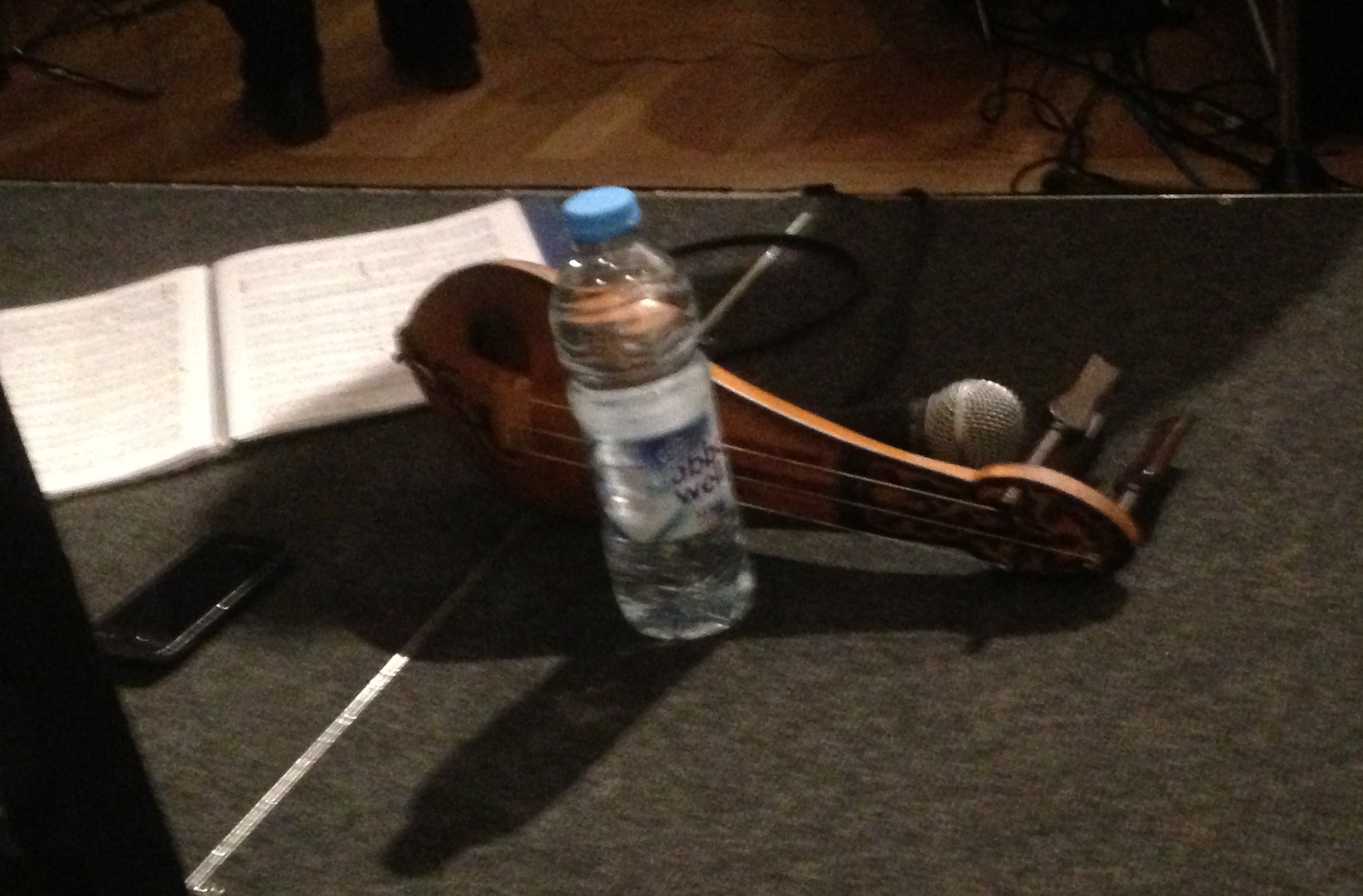 Generally speaking, the chances of one of the gigs of the year taking place as part of an academic seminar titled “Sounds of the Hellenic World, Ancient & Modern” would probably be pretty slim. But that’s what happened yesterday evening at King’s College London, when the Greek lyra virtuoso Sokratis Sinopoulos brought his quartet — completed by Yann Keerim (piano), Dimitris Tsekouras (double bass) and Dimitris Emanouil (drums) — to make their UK debut in the Great Hall in front of an audience whose members had spent the day discussing Homer, Xenakis, Keats and Satie’s Socrate.
 Harry Beckett was ordering a drink at the bar of the Beachcomber Club in Nottingham one night in 1965, relaxing between sets with Herbie Goins and the Nightimers, when I plucked up the courage to address him. The Nightimers were an excellent jazz-inflected soul band — their personnel also included former Blue Flames Mick Eve on tenor saxophone and Bill Eyden on drums, with Mike Carr on Hammond organ — and I wanted to tell their trumpeter how much I’d enjoyed his solo on their set-opening version of Lee Morgan’s “The Sidewinder”. Showing the good humour and courtesy which would become familiar over the years, Harry was happy to chat to a new fan.

