Bruce Springsteen at Wembley
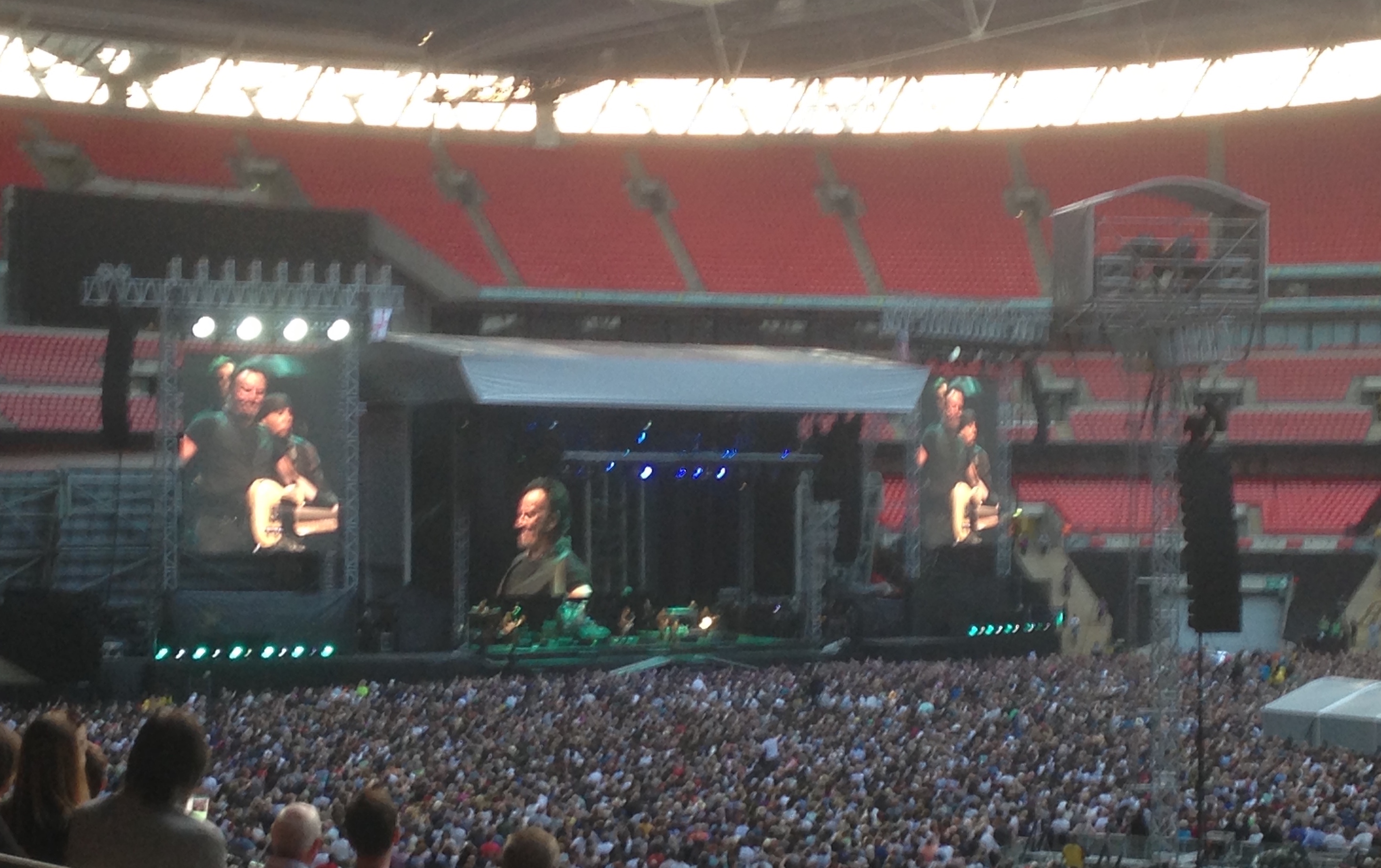
Is it a fan’s wishful imagination, or does Bruce Springsteen reserve something special for the start of his London shows? I think back, in particular, to the spellbound harmonica and piano introduction to “Thunder Road” in a pin spot at Hammersmith Odeon in 1975 and the cathartic, eyes-closed rush through “Born to Run” at Wembley Arena six years later. Last night at Wembley Stadium it was a wholly unexpected solo-at-the-piano version of “Does This Bus Stop at 82nd Street” from Greetings from Asbury Park, N.J., slowed down, like he did with “For You” in ’75, but still a little trip back to the unshadowed wordspinning joy of youth: “Mary Lou, she found out how to cope / She rides to heaven on a gyroscope / The Daily News asks her for the dope / She says, ‘Man, the dope’s that there’s still hope.'”
If that was one for the fans, so was the next: “Seeds”, which I don’t believe he plays all that often. First the harsh voice against the stripped rockabilly guitar, and then an eruption of full-tilt rock and roll thunder — a thousand guitars, a hundred horns, the shout of a Hammond organ, the implacable backbeat, the measured walk of the bass, all churning on and on and on towards some invisible horizon — that reminds you of exactly what this music can do, in the right hands. And the realism of the lyrics: a man drags his family across the country, searching for work, seeing the homeless men by the railroad track, listening to the children’s “graveyard cough”. And watching the world of other men go by: “Big limousine, shiny and black / You don’t look forward, you don’t look back.”
“Sorry, son, it’s gone, gone, gone,” the job-seeker is told. What hasn’t gone is Springsteen’s magical ability to make an audience both dance and think, sometimes in the same song. Over the next three and a half hours of a wonderfully warm evening there were many more moments of contrast between exhilaration and reflection, from the dedication of “Tougher Than the Rest” (a gorgeous duet with Patti Scialfa) to Muhammad Ali to the fury of “Death to My Hometown”, from “Sherry Darling” to “Candy’s Room”, from “You Can Look (But You Better Not Touch)” to “American Skin (41 Shots)”. That last one resonates even more powerfully than it did when he wrote it in 1999, prompted by the shooting of the unarmed Amadou Diallo, a 23-year-old street peddler from Guinea, by four plain-clothes officers of the New York Police Department who were later acquitted of second-degree murder. Last night he gave it full justice in a sombre, intense reading that was, for me, the centrepiece of the concert.
Billed as a tour revisiting The River, it has become something much less specific and more inclusive, although half a dozen songs from that great 1980 double album studded the set (I was sorry he didn’t include “Wreck on the Highway”, but you can’t have everything). This being an arena, the sound was never going to be more than an approximation, albeit a powerful one, of how he and the E Street Band can sound. The salient bits — the lead vocals, Nils Lofgren’s howling guitar solo on “Because the Night”, Jake Clemons’ invocation of his late uncle on “Jungleland”, Charles Giordano’s keyboard salute to Danny Federici on “Hungry Heart” — were fully audible, of course, but you’d wish that everyone hearing them on this tour could also know their impact in halls of more modest size and human scale — like Hammersmith Odeon, to which he returned with the Seeger Sessions show a few years ago — where giant screens are not required and the musical nuances of which they’re capable might be fully explored.
Still, one thing a Springsteen show never lacks is a sense of intimacy. And as it had begun, so it ended: Bruce alone with the audience, strapping on an acoustic guitar to summon our collective history with “Thunder Road”, just as he did on his last visit three years ago but somehow different and still the perfect closure to yet another night invested with so much emotion that every song had the weight of an encore.
 Alexander Hawkins and Evan Parker were two of the winners at the recent Parliamentary jazz awards: the former for being the instrumentalist of the year, the latter for, well, being Evan Parker. Last week they appeared together at the Vortex. Alex is 35; Evan is 72. What they gave us was a demonstration of the special ability of jazz-based free improvisation to span the generations without forcing the younger man to play the older man’s music, or vice versa. Musica franca = lingua franca, you might say.
 Wilko Johnson’s new autobiography, Don’t You Leave Me Here, received an eloquent recommendation from Mark Ellen in the Sunday Times at the weekend. To coincide with its publication, Universal’s Spectrum imprint is issuing a 40-track double CD set compiled by the former Dr Feelgood guitarist called The First Time I Met the Blues: Essential Chess Masters. Its appearance prompted me to dig out the records you see above: three 45s from my all-time Top 100 box, plus two magnificent albums, all licensed for release in the UK on the Pye International label in the early ’60s.
 When the Great Director pulls back to frame the ultimate long shot of Bob Dylan’s career from start to finish, it will be interesting to see what the perspective tells us about his two albums of standards associated with Frank Sinatra. My suspicion is that last year’s Shadows in the Night and the new Fallen Angels will be seen as parallel works to the pair of albums, Good As I Been To You and World Gone Wrong, with which, in the early 1990s, he revisited the blues.
 For an hour or so at Ronnie Scott’s last night, I had the illusion of being in a different place and time: the Middle Earth club in Covent Garden, perhaps, or Implosion at the Roundhouse, or the Temple (formerly the Flamingo), back at the end of the 1960s or the very dawn of the ’70s. Once or twice I had the feeling that if I looked around, John Peel would sitting nearby. The creators of this sensation were a Norwegian trio called Elephant9, who find their inspiration in that era’s jazz-influenced progressive rock, as exemplified at its best by the three-piece version of Soft Machine or Tony Williams’s Lifetime.
 During a public conversation at the ICA a couple of weeks ago, Brian Eno mentioned his interest in churches as potential performance spaces. After all, he pointed out, they were built with the idea of providing an environment for reflection. The truth of his words was evident in London last night, when the Norwegian trumpeter Arve Henriksen presented the music from his 2014 album Places of Worship in the Jerwood Hall at LSO St Luke’s, the deconsecrated and repurposed Anglican church built in Clerkenwell by Nicholas Hawksmoor and John James in 1733.
 Karsten Vogel made his London debut at the Wigmore Hall in 1968, alongside John Tchicai in Cadentia Nova Danica, one of the outstanding European bands of the ’60s jazz avant-garde. A little over a year later he was back as a member of Burnin Red Ivanhoe, the Danish jazz-rock band who played the Lyceum, the Speakeasy, the Marquee and other joints, and recorded their second album for John Peel’s Dandelion label. (Last year I wrote
  XJAZZ is the name of an annual festival held in Kreuzberg, a district of Berlin that is home to a large immigrant population. The four-day event is dispersed between a dozen or so venues, all within walking distance of each other. Most of them are rock or dance clubs, but there are also the very striking 19th century Emmaus Church, reconstructed after 1945, and the Lido, built in the 1950s as a cinema.
 Little Richard is said by his attorney to be “annoyed” at the rumours of his death which spread this week. He survived a heart attack in 2013 and underwent a hip replacement operation more recently, but apparently he’s otherwise fine at 83. Let’s hope so.