Skip to content

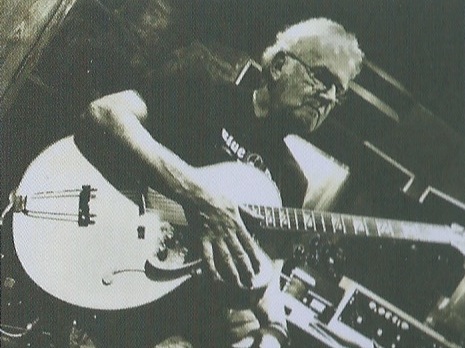
Jesse Winchester 1944-2014

Jesse WinchesterJesse Winchester died today, April 11, five weeks short of his 70th birthday, at his home in Charlottesville, Virginia. He had been suffering from oesophageal cancer. The most soulful of singer-songwriters, he was held in high esteem by his peers. When some of them tried to lighten the burden of his long illness by making an album of his songs, the cast included Lucinda Williams, Lyle Lovett, Allen Toussaint, Rosanne Cash, Vince Gill, Jimmy Buffett, Elvis Costello, James Taylor and Rodney Crowell.

His first solo album, Jesse Winchester, was a very hip one to own back in 1970. Produced by Robbie Robertson for Albert Grossman’s Bearsville label and released on the poorly distributed Ampex imprint, it contained beautifully unadorned versions of such fine songs as “Payday”, “The Brand New Tennessee Waltz”, “Quiet About It” and “Rosy Shy”, and a gatefold cover featuring the same stark sepia portrait repeated on each of the four surfaces. It was followed by Third Down, 110 to Go, then Learn to Love It, and Let the Rough Side Drag, each of which brought more great songs, like “Isn’t That So?”, “All of Your Stories”, “Mississippi, You’re on My Mind”, “Defying Gravity”, and “It Takes More Than a Hammer and Nails to Make a House a Home”. Amos Garrett’s guitar was heavily featured, notably on the wonderful cover of Russell Smith’s classic “Third-Rate Romance”.

Born in Lousiana and brought up in Memphis, Tennessee, Winchester fled the draft in 1967, fetching up in Montreal, where his career began. Not until Jimmy Carter declared an amnesty 10 years later was he able to perform in the US. Here’s how he sounded then, singing “Yankee Lady” at the Bijou Cafe in Philadelphia that year. And here are some words of his, written at the start of his exile, that seem specially appropriate: “Have all of your passionate violins / Play a tune for a Tennessee kid / Who’s feeling like leaving another town / With no place to go if he did / But they’ll catch you wherever you’re hid…”

* The photograph of Jesse Winchester is from the cover of Third Down, 110 to Go and was taken by Henri Dupond.

Georgie Fame: back home in Soho

Georgie Fame 1“I never thought I’d get to sing a Bob Dylan song in Ronnie Scott’s jazz club,” George Fame said tonight, and proceeded to dedicate “Everything Is Broken” to David Cameron’s cabinet. He and his Blue Flames made it sound like a Mose Allison song set to a Horace Silver boogaloo rhythm, an arrangement that worked quite beautifully.

This was the first night of a week’s sold-out residency on Frith Street, and Fame’s serious illness last year meant that it was the first time he and the modern Blue Flames — Guy Barker (trumpet), Alan Skidmore (tenor), Anthony Kerr (vibes), Tristan Powell (guitar), Alec Dankworth (double bass) and James Powell (drums) — had played together in many months. The good news is that the leader was in great form, and that the reunion seemed to have infused the band, which includes his two sons, with a terrific freshness.

Between 1964 and 1966 there was no band I looked forward to seeing visit the Dungeon or the Beachcomber in Nottingham more than this one: the Blue Flames were the coolest of the cool. Put me near a Hammond organ — in my view, an invention to rank with moveable type and penicillin in the history of western civilisation — and I’m not going to stop smiling all night. Back then, the addition of musicians like Eddie Thornton, Mick Eve, Peter Coe, Glenn Hughes, Colin Green, Cliff Barton, Bill Eyden, Mitch Mitchell and Speedy Acquaye guaranteed a blissful experience.

Their successors live up to the legend, and so does Georgie, sprinkling his songs and introductions with anecdotes and references that illustrate his unflagging love of jazz and R&B. There were mentions of Count Suckle’s club on Carnaby Street and of Strickland’s, the jazz record shop on the corner of Old Compton and Dean Streets. Introducing “Preach and Teach” (the B-side of “Yeh Yeh”, the song with which he knocked the Beatles off the top of the charts in 1965), he mentioned its composer, the pianist Johnny Burch, whose wonderful octet — including Jack Bruce and Ginger Baker — happened to be the other featured attraction on the night Fame made his BBC radio debut on Jazz Club. When Dankworth took a lengthy and impassioned solo on the tune, his leader encouraged him with the famous utterances of Charles Mingus on “Oh Lord, Don’t Let Them Drop That Atomic Bomb on Me”: “Don’t let them drop it… stop it… bebop it!”

“Moondance”, in an arrangement borrowed from Van Morrison’s great 1993 live album A Night in San Francisco (on which Fame was the organist), cleverly adapted a chorus of “Blue Moon” to the song’s contours, while Barker’s solo made references to Johnny Coles and to Gil Evans’s arrangement of “It Ain’t Necessarily So” for Miles Davis, and Kerr showed how important he is to the band’s overall sound. Bobby Timmons’ “Moanin'”, the battle hymn of the soul-jazz era, was given a first outing, with Georgie putting lyrics to Lee Morgan’s trumpet solo from the Jazz Messengers’ version and Barker responding with a dramatic solo of his own, and the singer also quoting from Nat Adderley’s “Work Song”. Introducing Willie Nelson’s “Funny (How Time Slips Away)”, a perennial Fame favourite and the last song of the night, he spoke fondly of the late Denny Cordell, who had produced the version on the 1966 album Sweet Things, the last real Georgie Fame and the Blue Flames album; the current arrangement gives it a mid-tempo Chicago soul feel, allowing the singer to namecheck Curtis Mayfield, Major Lance, Billy Stewart, Phil Upchurch and other Windy City greats.

This was a great night on Frith Street, in the old style: a lesson in the kind of authentic hipster cool for which Soho was invented. If somebody were to record the show this week, in the spirit of Fame’s 1963 debut, Rhythm and Blues at the Flamingo, they might find themselves with a candidate for the list of all-time great live albums.

* Quite properly, Ronnie Scott’s doesn’t allow photography while the musicians are performing, but they won’t mind this shot of the stage and Fame’s Hammond organ waiting for the band’s arrival.

Evan Parker w/strings

Evan Parker + 17In Munich for a football match a few years ago, I had a couple of hours to spare in the afternoon and paid a visit to Ludwig Beck, a department store on Marienplatz, the city’s central square. To me it’s a shop remarkable for its vast jazz department, where on the day in question I was able to count no fewer than 72 CDs by the improvising saxophonist Evan Parker: an indication of the esteem in which he is held in some parts of the world.

Tonight at Kings Place in London there was a concert in celebration of Parker’s 70th birthday. (Ten years ago, I interviewed him for the Guardian on the occasion of his 60th: here it is.) Talking to Sebastian Scotney in the current Kings Place magazine, he said this: “I like to have a space with an inspiring and supportive acoustic, a church or a church-like space. What I do in that context is more about intuition than analysis. There are things you try to control, with new combinations of reed behaviour and embouchure and cross-fingering. But that’s the starting point. The complexity of the partials and the overtones and the resonance will always be unique in the moment, and in the particular acoustic of the performance space. The saxophone is such a rich and flexible acoustic source, I will certainly run out of time before I discover all its possibilities.”

The concert featured 18 musicians: Phil Wachsmann, Alison Blunt, Sylvia Hallett and Dylan Bates (violins), Benedict Taylor and Aleksander Kolkowski (violas), Hannah Marshall, Alice Eldridge and Marcio Mattos (cellos), John Edwards, Adam Linson and David Leahy (basses), Django Bates (piano and peck horn), John Russell (guitar), Percy Purseglove (trumpet), John Rangecroft (clarinet), Neil Metcalfe (flute) and Parker himself. The first half consisted of collective improvisations by three quartets and two trios, the most effective of them consisting of Parker on tenor with Edwards and Russell, although Purseglove’s playing with the final quartet (rounded out by Bates, Hallett and Eldridge) sounded like the outstanding individual contribution. But nothing really caught fire: each group featured bowed strings in some form, and there was too little textural variety.

For the second half all 18 musicians were assembled, and it became obvious that what the earlier music had lacked was a bit of mass and density. Parker led off on soprano, chewing up staccato phrases as the rest joined in. There was clearly some form of organisation, although evidently nothing in the way of themes or other notation, and the music gradually assumed tonal and dynamic shapes, sometimes creating an unstated but felt pulse (* see note below).

Again the strings dominated the sound, but the increased heft of the ensemble worked wonders. Occasionally the half-hour piece sounded like a concerto for soprano saxophone and chamber orchestra, but other instruments — notably Metcalfe’s pretty flute, Russell’s scrabbling guitar, Bates’s busy piano and Kolkowski’s weird skeletal viola, with its horn from a wire-recording device attached — periodically worked their way to the fore against the swirls, squalls and slow drift.

Parker dedicated the concert to the memory of John Stevens, the great drummer whom he met in 1966 and with whom he played in the Spontaneous Music Ensemble. As he said in his dedication, Stevens was largely responsible for establishing and nurturing London’s free improvisation scene, which remains a vital field of musical research. The evening ended with a short unaccompanied soprano solo, demonstrating the new instrumental language Parker has been developing since those early days at the Little Theatre Club, one that continues to grow in complexity and richness of meaning.

* Alison Blunt read this and got in touch immediately to say that there had been no form of premeditated organisation.

Basing Street Blues

Basing StreetWhile driving through Notting Hill yesterday I spotted construction fences erected around a familiar landmark. This deconsecrated church is the site of what was once Island’s first recording studios, and it’s where I lived very happily for several months in 1975, in the apartment behind those three deep windows, created during the conversion of the building a few years earlier.

A great deal of history was made during the 1970s in the two studios that occupied the ground floor and the basement, with their 16-track Helios desks. The Wailers’ early Island albums were sweetened and mixed there (and much of Exodus was actually recorded on the premises, after Bob Marley had fled Jamaica following an assassination attempt). The Stones (bits of Goats Head Soup, I think), Traffic (parts of John Barleycorn Must Die and all of The Low Spark of High Heeled Boys), the Eagles (Desperado), Led Zeppelin (the basic track of “Stairway to Heaven”), Brian Eno (Taking Tiger Mountain and Another Green World), Jess Roden, Sparks (Kimono My House, produced by Muff Winwood, the studio’s manager), John Martyn (Solid Air), Roxy Music (parts of Manifesto and Flesh + Blood) and countless others worked there during that era. Somewhere I’ve got a rough-mix cassette of a terrific song that Stevie Wonder recorded with his touring band in one late-night session during a British visit and never released.

Old churches used to make good studios, although Island’s architect chose not to retain the high ceiling that gave Columbia Records’ 30th Street Studio in New York City, a converted Presbysterian church and the location of Kind of Blue, such exceptional reverberance. But both Basing Street studios, especially the basement, had a wonderfully funky atmosphere, very different from the ambiance of the big-label operations like EMI at Abbey Road, Pye in Cumberland Place, Decca in West Hampstead and Philips in Stanhope Place. Olympic in Barnes was its only real rival for dirty-ass rock ‘n’ roll, although a lot of Island’s folkier artists also liked Sound Techniques, off the King’s Road, where John Wood held sway.

My favourite memory of Basing Street, apart from sitting in the window watching Carnival go by in the days when the event was still of modest size and relatively lightly policed, is of the night Chris Blackwell cleared the big studio and held a party for Jorge Ben and his band, who had just finished a week at the Olympia music hall in Paris. They played their full set — “Filho Maravilha”, “Taj Mahal”, “Pais Tropical” and so on — and they were dynamite.

Towards the end of the decade it was bought by Jill Sinclair and Trevor Horn, and became Sarm West. Their ZTT label had its HQ there, it became the site of the Band Aid recording, and other layers of history were added. Now there are new plans. There will still be studios in the basement at Basing Street, but the above-ground building is being reconfigured to include “high-quality duplex apartments behind the retained and restored Romanesque facades”, according to the developers’ signs attached to the fencing. Given the way property prices have gone in Notting Hill over the last 20 years, I suppose the only surprise is that it didn’t happen sooner.

Paul Bley: alone, again

Paul Bley

As a solo pianist, Paul Bley is a bit of a specialised taste. He doesn’t hypnotise like Keith Jarrett at his best or set the nerves jangling like Cecil Taylor, but his performances create a very distinctive universe in which substance triumphs over obvious displays of emotion or virtuosity. Astringent in tone and devoid of mannerisms, they make you listen closer and better. And here comes another one.

It was the appearance of a couple of records by the Canadian in the initial batches of releases from the ECM label at the beginning of the 1970s that persuaded me the new Munich-based independent label would be worth watching. Those albums, Paul Bley with Gary Peacock and Ballads, were trio sessions recorded by Bley himself in New York a few years earlier and entrusted to Manfred Eicher, ECM’s founder. The first Bley album actually recorded under Eicher’s supervision, with Jan Erik Kongshaug at the controls in Oslo’s Arne Bendicksen studio, came out in 1973. Titled Open, To Love, it was an intriguing solo recital of tunes by Bley and two of his former wives, Carla Bley and Annette Peacock.

Bley has since made many albums for other labels, such as SteepleChase, Soul Note and his own IAI imprint, but ECM’s standards of recording and presentation fit him perfectly. In fact I’ve always felt that his personal aesthetic — refined and somewhat austere but not lacking in passion or swing — helped define that of Eicher’s project. His new album, Play Blue, finds him returning to Oslo, but this time to the Kulturkirken Jakob, a 19th century church turned into an arts centre, where this live recording was made in 2008.

He is 81 now and was 76 when the concert took place, but his playing retains all the fine judgement of line and time and the tensile strength that distinguished the work of his earlier years, along with an exquisite and wholly characteristic ability to skirt the fringes of dissonance. If you were to play this and Open, To Love to someone who had never heard him before, I would defy them to say which was by a man in his fourth decade, and which by one in his eighth.

The record consists of four of Bley’s own compositions and an encore of Sonny Rollins’s “Pent-up House”. “Far North” and “Way Down South Suite”, 17 and 16 minutes long respectively, merge into each other without a break and are intense, discursive pieces full of movement and surprise, kaleidoscopic in their effect on the listener. But I love the more concise “Flame” and “Longer”, which display his unsentimental way with the material of a ballad. I can’t think of another pianist so effective at creating drama by alternating legato and staccato phrases — sometimes within the same arc — while sustaining a strong underlying lyricism, and his wonderfully precise touch is beautifully captured by the recording (four decades after his first ECM session, Kongshaug is once again the engineer).

Bley neither ingratiates himself nor sets out to shock. He just plays, with a sinewy restlessness and an apparently inexhaustible fund of ideas, and he has spent his long career proving that a natural reserve and an innate warmth are not mutually exclusive. I’m pretty sure this will be one of my albums of the year.

* The photograph of Paul Bley is from the sleeve of Play Blue and was taken by Carol Goss.

Memphis in the meantime

stax-records-10The purple melamine egg chair, suspended on a chain from the ceiling, swung slowly around above the white shag-pile carpet, disclosing a first sight of its occupant. This was the shaven-headed Isaac Hayes, the recipient that very day in February 1971 of an award for the sales of Hot Buttered Soul, an album released two years earlier and something of a game-changer. Its success had announced a new era, one that promised undiminished creativity and infinite success.

Outside the building on East McLemore Avenue in Memphis, the sign that said SOULSVILLE U.S.A. was still to be seen above the entrance to the old cinema. The special magic, however, had left by the back door. Stax-Volt Records still made hits, and would make many more in the next three or four years, but no longer in the organic, all-for-one-and-one-for-all manner that had characterised the label’s true golden era in the 1960s.

Otis Redding was dead, along with four of the Bar-Kays. Sam & Dave had gone, whisked back to Atlantic Records by Jerry Wexler along with the entire Stax back catalogue upon the expiry of a distribution deal that ended in severe acrimony and tore the heart out of the company started by Jim Stewart and his sister Estelle Axton in 1959. Booker T. Jones and Steve Cropper, no longer wanted on the payroll, had decamped, in Booker’s case to Los Angeles and in Cropper’s to his own Memphis studio. Hayes and his erstwhile partner David Porter had ceased writing together.

True, as I drove around Memphis that week on assignment for the Melody Maker I was listening to Johnnie Taylor’s “Jody’s Got Your Girl and Gone” on WDIA, the great R&B station that had once numbered B.B.King and Rufus Thomas among its DJs. Here was a newly minted Stax classic in heavy rotation alongside Gladys Knight’s “If I Were Your Woman”, the Chairmen of the Board’s “Pay to the Piper”, Candi Staton’s “He Called Me Baby” and Diana Ross’s “Remember Me”. And back in the Stax offices all was brightness and optimism as I interviewed Hayes, Porter (then attempting to launch his own solo career) and others, watched the reconstituted Bar-Kays prepare a recording session in the studio, and met various members of the hierarchy, including Stewart, Al Bell and Deanie Parker.

But, as Robert Gordon describes in Respect Yourself, his new history of the label, just published in the US and the UK by Bloomsbury, bad things lay just around the corner. Bell, an energetic, charismatic, visionary wheeler-dealer brought in by Stewart to lengthen the company’s reach, had big plans for expansion, decentralisation and community involvement, which would eventually lead to the filming of the Wattstax movie in Los Angeles. But the Atlantic debacle — caused by Wexler’s lawyers inserting a clause that Stewart failed to read before signing — turned out to be the first of many reverses that led to the company’s closure in January 1976, under siege from a variety of creditors.

In the beginning Stax was a modest operation run by a core of perhaps a dozen enthusiastic and talented people to whom skin colour was never a consideration and who were surprised and delighted by their success. Then, having been screwed by the business, it decided it had to play by the business’s rules, which meant learning about payola and hiring men with guns. And there, with growth, was where it started to go wrong. “Employees wandered the halls not knowing each other’s names, even what their jobs were,” Gordon writes, and quotes Stewart: “I couldn’t go to the studio and solve people’s problems like had had before. Six people, eight people — you can do that.”

Gordon sets the story in the context of the civil rights struggle, including school busing, union activity, riots and the murder of the Rev Dr Martin Luther King in 1968 on the balcony of the Lorraine Motel, where Stax’s artists, writers and producers often hung out. It was at the Lorraine, two years earlier, that Hayes and Porter had got together with Mable John, who had just been signed to the label after an unsuccessful spell with Motown.

“Isaac and David said, ‘Did you bring anything with you to record?'” she told me a few years ago in an interview for the Guardian. “I said no. I didn’t take anything to Motown to record. Motown told you what they wanted you to do and how they wanted you to do it. That’s how Motown was created. So Isaac and David said, ‘We’ll get something together for you.’ Since I was only going to be there for four days, they would come over to the Lorraine Motel, where I was staying, and we would use it as a place to write.

“They had a piano brought up to my room, but by the end of the second day they still didn’t have anything for me. So I said to them, ‘There’s a story that I need to tell. It’s about a bad marriage.’ Isaac began to play. David had a pad and pencil and he was standing beside me, with the pad on top of the piano. As I talked, he’d say, ‘You could sing that. If you take the last thing you just said and we put that at the beginning of the verse, we could do it just like that.’ And Isaac carried on playing. I had no idea how the music or the melody should go. I just knew it was a story that was inside of me. It was a pain and it need to get out. And when we got finished that night, we had it.”

The next day, over at the converted cinema on East McLemore, in company with the A-team, they recorded it. And of all the great records Stax made, “Your Good Thing (Is About to End)” remains my favourite.

I had a great time in Memphis that week in 1971. There was an evening at a club called TJs, a musicians’ hangout where the blind singer-pianist Ronnie Milsap, some years before his move to Nashville and swift transformation into a country superstar, played a couple of sets of dynamite blue-eyed soul, including a version of the Temptations’ “Ball of Confusion” that I can still hear today. Another night some college kids who were working at a hamburger joint took me to an after-hours bar in West Memphis, on the other side of the Mississippi, where the four-piece house band was good enough to have been the understudies to the MGs or the Hi rhythm section.

But at Stax, for all the cheerful sales patter, there was a sense of unease. It all seemed a little too bright, a little too brittle. Were Margie Joseph and Billy Eckstine, their latest signings, really the heirs to Carla Thomas and William Bell? I went to interview Cropper, who was at his new studio, TMI (Trans Maximus Inc), cutting tracks with his old friend Eddie Floyd. They were good to talk to — Cropper later wrote me the only thank-you note I’ve ever received from an interviewee — and the music sounded great, but you could tell nothing was quite the same as it had been only four or five years earlier.

Some people were willing to admit, although not on the record, that things had never been the same between black and white after Dr King’s murder. In Gordon’s view, race was certainly a significant factor in the tragedy that overwhelmed Stax: once Al Bell took effective control, there were plenty of powerful people in Memphis and elsewhere who did not want to see a black man running an operation that was making it possible for black artists to get rich and ride around in limousines.

Gordon relates how in 1981, after lying derelict for several years, the Stax building was sold to a church for $10 (that’s right: ten dollars). They demolished it in 1989. A decade later, realising what had been done, the city rebuilt it to the original specification as the Stax Museum of American Soul Music, under the guidance of Deanie Parker. Respect Yourself is a terrific book, and a reminder of some wonderful, timeless music, but it’s a sad, sad story.

Julian Arguelles

Julian ArguellesAmid the general euphoria and high-octane wackiness with which the performances of Loose Tubes lit up the London jazz scene in the second half of the 1980s, Julian Arguelles’s saxophone solos were always a highlight: calm, beautifully shaped, emotionally resonant. He was still in his teens, diminutive and boyish-looking, when he first appeared with that extraordinary collective, but his playing already possessed a maturity that suggested a long and rewarding career to come.

After Loose Tubes disbanded in 1990 (they’re reforming in May for dates at the Cheltenham Jazz Festival and Ronnie Scott’s) he formed an octet which made two albums that stand among the most stimulating documents of their time: Skull View (Babel, 1997) and Escapade (Provocateur, 1999) are full of memorable composing, resourceful arranging and fine improvising from the likes of Mike Walker (guitar), Mario Laginha (piano) and Django Bates (tenor horn). Arguelles managed to make the ensemble reflect his own qualities. This is music that manages to be supremely lyrical while staying cliche-free, and in which exquisite textures are coaxed from a seemingly limited palette. If you can find the discs, they’ll repay the investment.

Now he has a new album out: Circularity, on the Rome-based CamJazz label, in which he is joined by the pianist John Taylor, the bassist Dave Holland and the drummer Martin France. Back in 1990 Taylor and France featured on Arguelles’s recording debut as a leader, a quartet album on the Ah Um label called Phaedrus (on which Mick Hutton was the bassist), and the drummer was also present on the octet albums.

Arguelles is 48 now, no longer a precociously gifted youngster but a musician of poise and substance, equally eloquent on his soprano and tenor instruments, fully at home in this A-team company, capable of providing a set of compositions that play to his own strengths while providing a challenge for his companions, each of whom performs to the height of his known abilities. I don’t suppose Taylor has ever played an ungraceful note in his life, while Holland — a US resident since answering Miles Davis’s siren call in 1968 — gives every sign of enjoying the chance to play with compatriots. France keeps the whole thing cooking with a wonderfully light touch and an unflagging rhythmic imagination.

And if, like me, you have a weakness for jazz inflected by what Jelly Roll Morton famously called “the Spanish tinge”, meaning such things as John Coltrane’s “Ole”, Gil Evans’s “Las Vegas Tango”, Albert Mangelsdorff’s “Never Let It End” and Charlie Haden’s “Song for Che”, you’ll enjoy the Arguelles quartet’s “Unopened Letter”, which starts in the time-honoured manner with double-stopped bass strums and soprano trills and works its way through an exemplary seven minutes of intense but never forbidding collective invention.

* The photograph above is from the sleeve of Circularity, and was taken by the recording engineer, Curtis Schwartz. Left to right: John Taylor, Dave Holland, Julian Arguelles and Martin France. 

Hakon Stene

Hakon Stene 2Normally I wouldn’t be telling you now about an album that’s several weeks away from its release date, but in the case of Hakon Stene’s Lush Laments for Lazy Mammal I can’t wait that long. Since I first put an advance copy on the CD player, it’s been a struggle to listen to anything else. No space — workroom, car, outdoors — seems complete at the moment without its shimmering textures.

Stene is a Norwegian percussionist of considerable experience in all kinds of music.  He was a founder of a group called asimisimasa, performing the work of modern classical composers such as Brian Ferneyhough and Alvin Lucier, and he’s currently a research fellow at the Norwegian Academy of Music in Oslo, developing new repertoire for multi-percussion. I went to see him at the Queen Elizabeth Hall last week, performing the Danish composer Simon Steen-Andersen’s Black Box Music with the London Sinfonietta, and I’m sorry to say I didn’t enjoy it at all. But the experience didn’t change my feelings about his album.

Lush Laments for Lazy Mammal — to be released next month on the Oslo-based Hubro label, also the home of Huntsville, one of my favourite bands, and the interesting experimental guitarist Stein Urheim — consists of six compositions by the British composer Laurence Crane and one apiece by Gavin Bryars, Christian Wallumrod and Stene himself. They’re played by Stene on regular and quarter-tone vibraphones, bowed marimba, electric guitar, acoustic guitar with e-bow, electric keyboards and piano, with appearances by Tanja Orning (cello), Hans Christian Kjos Sorensen (cembalom) and Heloisa Amaral and Wallumrod (pianos).

I suppose you’d call this minimalist music, in the sense that there isn’t much going on here in terms of incident and gesture. What the pieces have in common, apart from the overall texture imposed by the keyboards and tuned percussion instruments, is a desire to isolate and exalt the process of modulation. This is a strongly tonal music from which virtually everything has been removed except the simple and repetitive chord changes, which are allowed to occur regularly but free from an explicit pulse, exposing the harmonic shift as the principal trigger mechanism for the emotions, as it is in so many kinds of music.

Here is Stene talking about his decision to play instruments other than the percussion for which he is known: “I am definitely not to be regarded as a guitarist any more (and absolutely not as a pianist!), but all my experience as a contemporary percussionist, where one must constantly adjust oneself to new playing situations and instruments, somehow makes it feasible. I don’t approach these instruments, for example the piano, as an altar, but as a tool for playing these relatively simple pieces. This is the kind of attitude that percussionists often have: instruments are tools one uses in order to produce a particular sound.”

It’s hard to find a language in which to write about this music. In its meditative tone and the beauty of his textures, it reminds me strongly of my favourite pieces by Morton Feldman, “Rothko Chapel” and “For Samuel Beckett”. It’s also reminiscent of some of the Necks’ work. And some of it (like Crane’s “Blue Blue Blue” — here’s a snatch of it) reminds me of what happens when the Beach Boys’ more experimental records are stripped right down to the basic rhythm track. So it might be best just to leave you with a couple more examples. Here’s Crane’s “Prelude for HS”, the first track from the album, with Stene on vibraphone, Orning on cello and Wallumrod on piano. And here’s Stene’s gorgeously ecstatic version of Crane’s “Riis”, on which he plays everything. You’ll get the idea pretty quickly. To me, this is a wonderfully pure distillation of what music can do.

* The photograph of Stene is from his website: http://www.hakonstene.net.

(Just Like) Romeo and Juliet

I remember John Lennon remarking on his affection for songs with brackets in the title. It’s a pure-pop thing, and it was a regular feature of the charts from the late ’50s to the mid-’60s. I like them, too: “Remember (Walking in the Sand)”, “Nothin’ Shakin’ (But the Leaves on the Trees)”, “(‘Til) I Kissed You”, “(Marie’s the Name) His Latest Flame”, “Goodbye Baby (Baby Goodbye)”, “Kentucky Bluebird (Message to Martha)”, “I Got You (I Feel Good)”, “I Never Loved a Man (The Way I Love You)”, “(Love is Like a) Heat Wave”, “(Sittin’ on) The Dock of the Bay”, “This Old Heart of Mine (Is Weak For You)”, “(The Man Who Shot) Liberty Valance” and so on.

My favourite brackets belong to a song released 50 years ago this month: “(Just Like) Romeo and Juliet” by the Reflections, which reached No 6 in the Billboard Hot 100 and, amazingly, No 3 in the Cashbox R&B chart. Amazing, that is, because the Reflections were a white vocal quintet — Tony Micale (lead), Phil Castrodale (first tenor), Dan Bennie (second tenor), Ray Steinberg (baritone) and John Dean (bass) — whose doowop-based style was closely modelled on that of the Four Seasons.

It’s a fabulous record, quite the equal of any of the Seasons’ hits. Written by Bob Hamilton and Freddie Gorman and produced by Rob Reeco for the Detroit-based Golden World label, it has a lyric as great as its title (“I’m gonna buy her pretty presents / Just like the ones in the catalogue” — but only, he reveals in the last verse, if he can find a job), a strong pop melody, great lead and backing vocals, and a driving rhythm track: just listen to the way the handclaps carry the beat while the drummer provides a brilliantly syncopated running commentary on his snare. Here’s a sound-only link of much better quality, recorded from an original Golden World 45 (and sounding a little sharper than my UK copy, released on the Stateside label), in which all the elements are clearly audible.

The baritone sax solo gives a clue to where and when it was made. It’s surely the work of Mike Terry, moonlighting from the Motown studios, where he had already provided a similar service on Martha and the Vandellas’ “Heat Wave” and Mary Wells’ “You Lost the Sweetest Boy”. Which means that the bassist and drummer are very probably James Jamerson and Benny Benjamin, also on surreptitious leave from Berry Gordy’s empire. That would explain a great deal about the quality of the track.

Golden World, founded in 1963 by Ed Wingate and Joanne Bratton, failed to match the achievements of its local rival, although some great records were made in its studio. Gordy bought up the company, including the sister label, Ric Tic Records (J.J.Barnes, Edwin Starr etc), in 1966. By that time the Reflections had failed to find a successful follow-up to their great hit, despite trying to recreate the musical formula with “Like Columbus Did” and “Comin’ At You”. But 50 years later they’re still performing, with Micale and Dean now joined by three singers formerly with other Detroit groups, and “(Just Like) Romeo and Juliet” still lives up to its title.

And it you want to know how to dance to it (and how to dress for the occasion), watch this delightful clip from Dick Clark’s American Bandstand, dated May 30, 1964, when the Reflections were high in the charts:

The N.E.W. thing

N.E.W. liveI could only stay for a single set of the trio called N.E.W. — Steve Noble (drums), John Edwards (double bass) and Alex Ward (guitar) — at Cafe Oto tonight, but it was enough to get excited about. This is an improvising group of ferocious intensity: for my taste, maybe the most effective high-volume band I’ve heard since Tony Williams’s Lifetime set the standard for such adventures more than 40 years ago.

The first piece lasted half an hour, in which everybody played without a break. They work with patterns rather than tempos, usually set by Noble’s relentlessly attacking sticks, mallets or brushes (he also has a way with cymbals that makes me think he’s the post-industrial Billy Higgins). Edwards, surely the most remarkable bassist ever produced by Britain, works off and around the drums, tugging and hammering the strings to produce huge surges of sound and in one passage bowing them above his left hand on the fingerboard while the drummer momentarily toyed  with a light Latin vamp. As for Ward, he is a constant astonishment: Bo Diddley’s “Road Runner”, Jimi Hendrix’s “Star-Spangled Banner”, Sonny Sharrock’s work with Herbie Mann and Last Exit, Robert Fripp’s solo on King Crimson’s “A Sailor’s Tale” and Derek Bailey’s amplified solo pieces — he doesn’t sound like any of them, but they might be some of the sources of inspiration behind the barrage of howling, squealing, chattering and whining but always coherent and compelling noise that he sets up.

They’ve been playing together in this configuration for half a dozen years, and the degree of empathy is phenomenal. You can hear it on their new album, Motion, a vinyl-only release on the Dancing Wayang label, limited to 300 copies (www.dancingwayang.com). The product of a studio session, it can’t possibly convey the impact of hearing them playing to an audience in a small room, but it has other, equally worthwhile qualities.

Try to imagine how a combination of Hendrix, Charles Mingus and Keith Moon might sound, stripped of ego, transported to Dalston in 2014, with modern amplification turned all the way up. If that might be your idea of a good time, don’t miss ’em.