Skip to content

Blown away in Dalston

Louis Moholo 1Listen to them play their hymn-like ballads, township dances, venerable standards, riff tunes, pop songs. Hear them move from one to the other in seamless but brilliantly negotiated transition, sometimes splintering the elements of one before introducing and blending in pre-echoes of the next. Experience the sensation of being blown away by the waves of emotion, whether overwhelmingly ecstatic or exquisitely refined. And most of all, perhaps, listen to the Louis Moholo Moholo Quartet to understand how, in this music, the individual and the collective can simultaneously attain equal importance: a most elevated state of being.

They returned to Café Oto in Dalston this week and once again there were long stretches of time during the evening when I found myself wondering why I would ever bother to listen to anything else. That’s not a response that withstands interrogation, but you probably know what I mean: on a really great live music occasion, that’s how it gets you. In this case it was justified by the sheer inclusiveness of the music made by Louis and his colleagues: Jason Yarde (saxophones), John Edwards (double bass) and Alexander Hawkins (piano). It seemed to contain just about everything you could ever want to hear. Again, a sort of illusion; but what a noble and magnificent one.

This is a band that forces you to drop whatever guard you had up when you arrived, and almost everything they played in their course of two long sets was a highlight. The bits I particularly remember included a surging version of Pule Pheto’s “Dikeledi Tsa Phelo”; a wonderful deconstruction of “If I Should Lose You”, composed by Ralph Rainger for the 1936 remake of Cecil B. DeMille’s Rose of the Rancho; a gorgeous irony-free version of “What a Wonderful World”; and one of the greatest of all modern jazz ballads, Dudu Pukwana’s “B My Dear”. The audience’s response was as wholehearted as the music.

All four musicians seemed to be operating at a level where personal freedom and group interdependence achieve a perfect unity. The way they negotiated the transitions made it very hard indeed to believe that they have played only a handful of gigs as a unit, with Moholo and Hawkins keeping a particularly sharp eye on each other as visual and verbal cues were exchanged. Yarde, who started both sets on a black-lacquered baritone saxophone before moving up the registers to alto and soprano, was consistently impressive, channelling the spirits of Bird and Dudu through his broad-grained sound. And what a treat it was to hear the mighty Edwards slip into passages of driving, huge-toned 4/4, walking his lines like Paul Chambers or Leroy Vinnegar.

You need big chops and big ears to play like this, and an even bigger heart.

The soul of the disco machine

Eveelyn %22Champagne%22 KingA certain machine-like quality was one of the things that people liked about some of the best records of the disco era. Exemplified by Giorgio Moroder’s Munich-manufactured four-on-the-floor, it gave you a beat that was never going to quit. But the release of Action: The Evelyn “Champagne” King Anthology 1977-1986 provides me with an excuse to listen to the record I treasure most from that period, one most notable for its human qualities.

“Shame”, King’s first big hit, was a great dance record to which you could — and can — sit down and listen for hours. It’s one of those records whose inner construction is endlessly fascinating. There’s the subtle contrast between touches of acoustic and Rhodes piano, the way the mobile bass line pushes against the almost laconic feeling of the drums (with a “wet” tom-tom backbeat on the bridge, à la Willie Mitchell), the extra urgency provided by the congas, the keening, raw-toned alto saxophone — and most of all the two rhythm guitars, their insistent background flickering and chattering behind Ms King’s assured vocal.

She was 14 years old when the producer Theodore “T.” Life heard her singing while she was helping her mother clean the restrooms at the Philadelphia International studios. Two years later, signed to RCA, she had her hit. The song was written by John Fitch and Reuben Cross, and it tapped into a combination of sadness and defiance in the teenager’s voice.

I’ve been listening to it regularly for the best part of 40 years without knowing the identity of the musicians responsible for that wonderful rhythm track. Reading the anthology’s excellent sleeve notes, I started to do a bit of research. The producer Theodore “T.” Life used the New Jersey band Instant Funk, who had been discovered by Bunny Sigler and would have their own hit a couple of years later with “I Got My Mind Made Up (You Can Get It Girl)”. As far as I can work it out, at the time they recorded “Shame” they were Dennis Richardson (keyboards), Kim Miller and possibly George Bell (guitars), Raymond Earl (bass guitar), Scotty Miller (drums) and Charles Williams (congas), with Johnny Onderlinde on alto saxophone. Let’s give them some.

King had a few more hits during her decade with RCA, but there would never be anything else quite like “Shame”. The anthology contains the 6:33 12-inch mix, which is how this classic is best appreciated. Here it is. Clear the floor and clear your mind.

* The uncredited photograph of Evelyn “Champagne” King is from the booklet accompanying Action, which is released on Big Break Records.

Joe Wilder 1922-2014

Joe Wilder

Joe Wilder, who died today at the age of 92, possessed one of the loveliest trumpet tones in the whole of jazz. His name cropped up quite frequently as a member of the trumpet section on other people’s albums in the 1950s and ’60s, but the handful of records he made under his own name displayed a talent that deserved far greater renown.

The son of a Philadelphia bandleader, he studied music at college but decided that classical music offered no future to an African American musician and turned to jazz and popular music instead. At 19 he joined the band of Les Hite; subsequent employers included Jimmie Lunceford, Lucky Millinder, Dizzy Gillespie and Count Basie. Later on in his career his flawless technique would make him an in-demand session, TV studio and Broadway pit band man.

I remember Whitney Balliett writing a long profile of Wilder in the New Yorker 20 years or so ago, a typical Balliett choice, given that Wilder was an intelligent, thoughtful man who played intelligent, thoughtful music that paid attention to quality above fashion. He had a good story to tell, and Balliett helped him tell it very memorably.

I’m particularly fond of his 1959 quartet album, recorded for Columbia, of Henry Mancini’s music for the TV cop series Peter Gunn, which Shelly Manne also explored to good effect at around the same time. But it was the recent release of Such a Beautiful Sound, a compilation of two albums released by the invaluable Spanish label Fresh Sound a few months ago, that made me think it was time to write something about him.

The first of the albums in question is Wilder ‘n’ Wilder, a 1956 quartet session with the dream rhythm section of Hank Jones (piano), who also appears on the Peter Gunn album; Wendell Marshall (bass); and Kenny Clarke (drums), recorded by Rudy Van Gelder for Savoy. The second is Peter the Great, by the sextet of the altoist Pete Brown, with Wilder, Wally Richardson (guitar), Wade Legge (piano), Gene Ramey (bass) and Rudy Collins (drums), recorded two years earlier and originally released as a 10-inch album on Bethlehem. Two extra tracks from Savoy’s vaults, “How High the Moon” and “I Think of You With Every Breath I Take”, both recorded in 1955 with the Jones-Marshall-Clarke unit, previously saw the light of day only on a Jones album titled Bluebird and a various-artists disc called Night People respectively.

Wilder’s gloriously burnished tone, easy swing, impeccable poise and flawless discretion are evident throughout, particularly in the intimate, almost candle-lit environment of the quartet dates, where ballads dominate. But even when things get livelier on the session led by Brown, a now-forgotten jump-blues player of considerable distinction, he more than holds his own. Joe Wilder was part of a jazz trumpet tradition that goes all the way up to today’s Ambrose Akinmusire: he knew how to be hot and cool at the same time.

* The uncredited photograph of Joe Wilder is from the insert accompany the Fresh Sound CD.

Before and after Loose Tubes

Graham CollierJazz continues to evolve, as it always has, through a process of emulation and transformation, whether gradual or radical. Take Loose Tubes, the British big band whose youthful spirit and eclectic wit caused a stir almost 30 years ago, and whose successful reunion at the Cheltenham Jazz Festival and Ronnie Scott’s in the last few days has been widely celebrated (here’s John Fordham’s review of the festival gig). Their origins go back to a rehearsal band formed in the early ’80s by the composer Graham Collier, whose generosity in allowing his protégés to bring in their own compositions eventually led to the decision to strike out as a co-operative venture. Since then the members of the band have become mentors and exemplars in their own right. Django Bates, to name the most obvious, has spent much of the last decade teaching at a conservatory in Copenhagen.

Collier died in 2011, aged 74, having played a key role in the phase of British jazz that followed the bebop era. He and Mike Westbrook were the two young composer-leaders who, in the 1960s, nurtured a generation of fine improvisers, including Harry Beckett and John Surman. Now his memory is well served by a 2CD set of two extended pieces that he left behind, now recorded by a fine 15-piece band and issued as Luminosity: The Last Suites on the Jazz Continuum label.

The first piece, The Blue Suite, is explicitly inspired by Miles Davis’s Kind of Blue: the titles of the individual movements include “Kind of So What”, “Kind of Freddie”, “Kind of Sketchy”… you get the idea. But these are impressions, not borrowings. The writing is spare, reflective, full of life and light, free of bombast, offering extensive opportunities to a group of fine soloists, including the tenorist Art Themen, the guitarist Ed Speight and the trumpeter Steve Waterman, urged on by the bassist Roy Babbington and the drummer John Marshall, both once regular Collier sidemen. If I don’t find the second work, Luminosity, quite so invigorating, then that’s because its companion piece sets such a high standard. But the set as a whole makes a good bookend to a Collier collection that starts with his recording debut, the classic Deep Dark Blue Centre album from 1967.

Django Bates’s students in Copenhagen have included Marius Neset, the brilliant young saxophonist whose new album with the Trondheim Jazz Orchestra, Lion (ACT), shows us another aspect of his musical character. These medium-length pieces are written for a 12-piece ensemble, including accordion and tuba, and demonstrate a wide range of resource and an avoidance of anything resembling big-band clichés. Even when the writing is at its most detailed and demanding, there’s never a sense of showing-off. Individually, the inventiveness of Neset’s own playing is matched by that of his colleagues, particularly the bassist Peter Eldh and whichever of the two trumpeters, Eivind Lonning and Erik Eilertsen, takes the solos (unfortunately they aren’t identified). This is music whose innate discipline never conflicts with its powerful sense of exhilaration.

I’m sure Collier would have been thrilled to see the progress made by the members of his old workshop band. And I’ll bet he’d have been equally proud of his role, albeit at one step removed, in Neset’s burgeoning career. In jazz, that’s how it’s supposed to happen. And it still does.

* The photograph of Graham Collier is from the Luminosity package and was taken by Karlijne Pietersma.

Humph and Coe

Humph : John DeakinThis picture of Humphrey Lyttelton rehearsing with his band some time in the 1960s is currently to be seen in a show of the work of John Deakin on the northern fringe of Soho, amid the portraits of Francis Bacon, Lucian Freud, the Bernard brothers and other notable figures of post-war London’s bohemian society. Next to the trumpeter, unidentified, is a young alto saxophonist: none other than the phenomenally gifted Tony Coe, on his way to becoming one of the distinguished musicians ever produced by the British jazz world, although no one seems to talk about him much now.

Three other musicians are visible, and I would guess — although someone will probably put me straight — that they’re the trombonist John Picard, the drummer Eddie Taylor and the bassist Pete Blannin. Humph began his musical life as a New Orleans revivalist, but his approach broadened to encompass mainstream jazz and he employed many excellent musicians who were sympathetic to more modern styles. I’d love to have been present to hear how this line-up sounded the day Deakin, a former Vogue photographer who lived the Soho life to the full, took his camera to record them.

* Under the Influence: John Deakin and the Lure of Soho is at the Photographers’ Gallery, 16-18 Ramillies Street, London W1F 7LW, until July 11.

French cool (encore)

Don WilkersonUnusually, I can remember the exact date I bought this record, and the precise location: July 14, 1963, at the Drug Store on the Champs-Elysées. My friend Dave and I had hitched to Paris during the school holidays, with the intention of heading for the Côte d’Azur and an imagined heaven on earth perfumed with Gauloises and Ambre Solaire and populated exclusively by Françoise Hardy lookalikes.

Our lift dropped us off at the Arc de Triomphe on a warm summer evening. The place seemed lively. Very lively, in fact. Cars were driving up and down sounding their horns non-stop. Wow, we thought. So this is Paris.

We went into the smart new Drug Store, where the record department turned out to have cool stuff you couldn’t get at home, much of it on the sacred Blue Note label. Dave, who was better funded, bought an album: Donald Byrd’s A New Perspective, featuring the wonderful “Cristo Redentor”, with the trumpeter leaning on an E-type Jag in Reid Miles’s classic cover design. I contented myself with an EP: two tracks from Don Wilkerson’s Preach, Brother!, pressed as a seven-inch 45 and repackaged in a nice sleeve to promote the use of one of them, “Camp Meetin'”, as the signature tune for an excellent nightly radio show called Pour ceux qui aiment le jazz, presented by Frank Ténot and Daniel Filipacchi on Europe 1.

Wilkerson, born in Louisiana in 1932 but raised in Texas, joined the band Ray Charles put together in Houston in 1954. He preceded David “Fathead” Newman as the band’s featured tenor saxophonist, and those are his solos you can hear on “I Got a Woman” and “Hallelujah, I Love Her So”. He recorded one album of his own, The Texas Twister, for Riverside in 1960, and three for Blue Note between 1962 and ’63, of which Preach, Brother! (with Grant Green on guitar, Sonny Clark on piano, Butch Warren on bass and Billy Higgins on drums) is the pick. In 1961 he was back with a bigger Ray Charles orchestra on a hugely successful European tour, sharing tenor battles with Newman, and he played the majestic solo on a shattering version — arranged by Quincy Jones — of “Come Rain or Come Shine”, captured in Paris, at the Palais des Sports, just two years before our arrival (and here’s a terrific blog post on that tour).

In his autobiography, Brother Ray, published in 1978, Charles called Wilkerson “one of the best saxophonists of the century. I loved to watch Donald attack Fathead on the stand… it brought out the best in both cats.” He employed him again, albeit briefly on each occasion, in 1962, 1964 and 1978. Michael Lydon’s excellent 1997 biography, Ray Charles: Man and Music, records the fact that disputes over drugs led to Wilkerson’s several departures from the band. After his last release on Blue Note he went back to Houston, where he died in 1986. I love his soulful sound.

And so, on that evening in 1963, we wandered on down the Champs-Elysées. Our only plan was to find a bridge to sleep under, because it seemed like the proper thing to do. But as the hooting and tooting and general gaiety increased, it was starting to dawn on us that something was going on. By the time we reached the Place de la Concorde, where an open-air concert was taking place, the penny had dropped. It was Bastille Day.

French cool

Salut les Copains

This is a magazine I bought a couple of weeks ago from one of those second-hand book and magazine stalls on the left bank of the Seine, opposite the Louvre. Salut les copains was a magazine I read quite regularly in the early to middle ’60s, and I recognised the cover of this issue, which is from September 1965.

The magazine was the invention of Daniel Filipacchi, as was the hugely popular early-evening radio programme of the same name, which went out on Europe 1 and featured good American records as well as a mixed bag of French pop. I was a fan of that, too — the signal was quite audible in the middle of England — and three or four years ago I was delighted to find two nicely packaged four-CD boxes containing music featured on the show between 1959 and 1969, with station ads and idents thrown in: lots of Johnny Hallyday, Françoise Hardy, Richard Anthony (whose EP containing “J’entends siffler le train” was a fixture next to the Dansettes of most of the nice girls I knew), Claude François, France Gall, Eddy Mitchell, Les Surfs, Jacques Dutronc and so on.

You can usually find something interesting in an old magazine, and in September 1965 the editors of Salut les copains had a mixed bag of preoccupations, including the aspirations of a bunch of new French artists: now you think, whatever happened to Muriel Bianchi (debut disc: “Les Jaloux”), Thierry Vincent (“artistes préferés: Johnny Hallyday, les Coasters, Nina Simone”), Michele Sarna (inspired by “le folklore canadien”), Jacky Gordon (“un fan de jazz et son style s’apparente donc fortement au rhythm and blues”), Willy Lewis (“many think of him as one of the best drummers in France”),  Mick Shannon (“the young singer who, in 1962, took the place of Dick Rivers with les Chats Sauvages”), Bernadette Grimm (“son idole: Edith Piaf”) and Laura Ulmer, a fresh-faced 17-year-old spotted by the impresario Eddie Barclay when her photograph appeared on the front page of Nice-Matin?

Out of two dozen candidates, the only name I recognise almost 50 years later is that of Pierre Barouh, already 31 years old and a fan of Georges Brassens and Billie Holiday; a couple of years later he would be playing Anouk Aimée’s husband — an ill-fated film stunt man who strums a guitar and sings Brazilian songs — in Claude Lelouch’s hugely successful Un homme et une femme (A Man and a Woman). Later, in real life, Barouh and Aimée were briefly married; he used his earnings from the film to buy an old mill in the Vendée, where he founded the Saravah label, which released recordings by French and Brazilian artists.

Salut les copains and its short-lived stablemate, Mademoiselle age tendre, provide a great deal of the material contained in a very entertaining new book called Yé-yé Girls of ’60s French Pop, compiled by Jean-Emmanuel Deluxe. It’s published in the US by Feral House, and there are copies in London shops (I got mine at Foyle’s). It’s mostly visual: page after page of Françoise H, Sylvie Vartan, Sheila, France Gall, Jane Birkin and Chantal Goya. There’s also an informative commentary, and good stuff on more obscure girls. It’s a weakness of mine to like this sort of thing, I know, but there you go.

Thumbin’ a riff

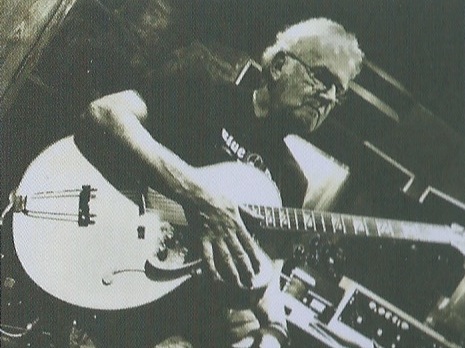
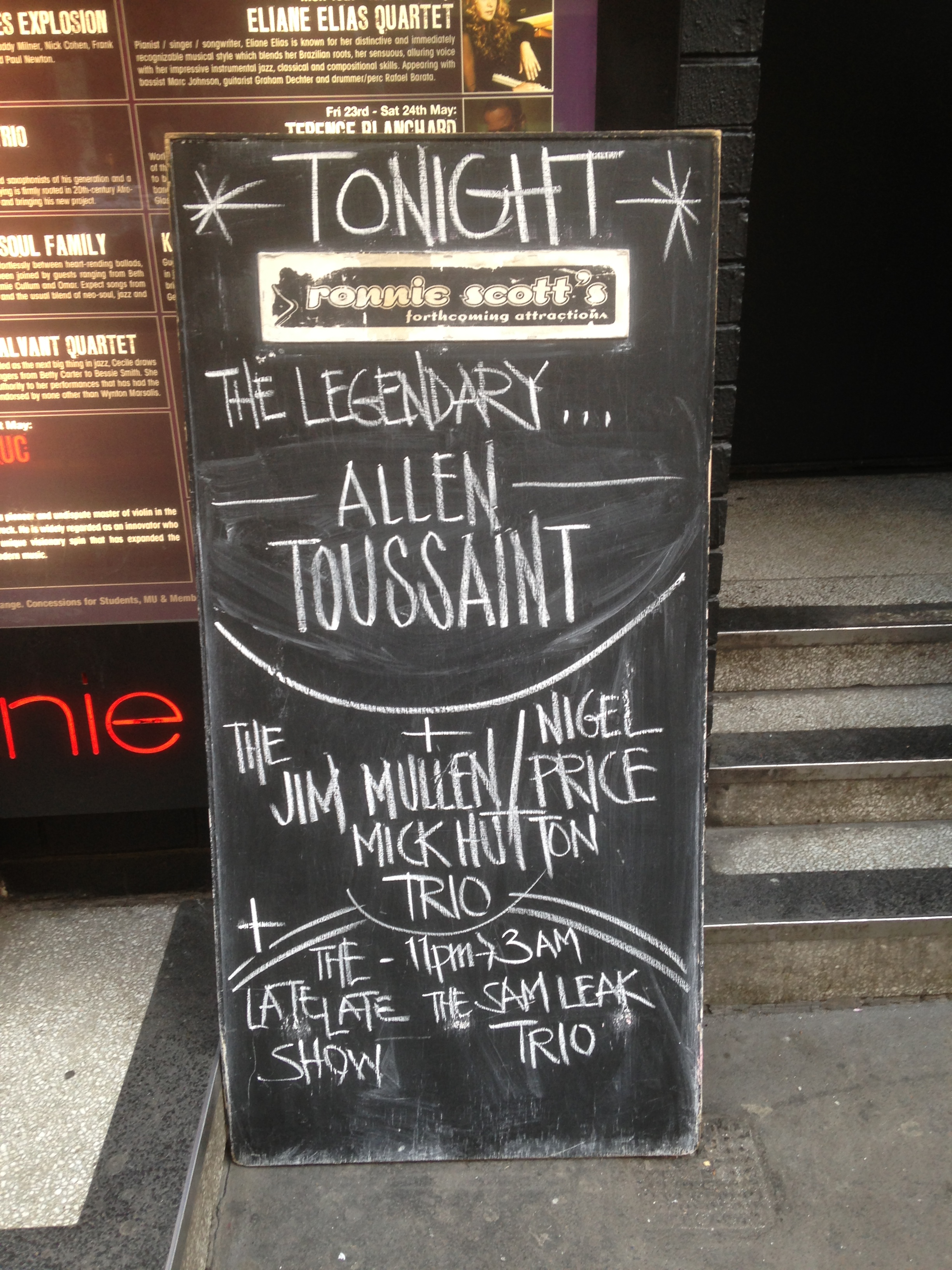
Jim MullenI could have kicked myself, on arrival at Ronnie Scott’s to see Allen Toussaint a few nights ago,  for misreading the bill and not realising that the evening included an early set featuring a trio led by Jim Mullen, the great Scottish guitarist who was part of the soul band Kokomo and then co-led a fusion band for many years with the late saxophonist Dick Morrissey. The group at Ronnie’s was completed by another guitarist, Nigel Price, and the bassist Mick Hutton. I got there in time to hear only the last couple of choruses of a ballad and a complete “Yardbird Suite”, which closed the set, but that was enough time to appreciate the quality of their interplay, and in particular the appealing contrast between the approaches of Mullen, who has always played with his thumb, and Price, who uses a pick. It was, I suppose, the closest you can get in the 21st century to hearing Wes Montgomery (thumb) jamming with Grant Green (pick).

I was even more annoyed with myself because just a couple of days earlier I’d invested in the new album by the Jim Mullen Organ Trio. It’s called Catch My Drift, it’s released on the Diving Duck label, and it features Mike Gorman on Hammond B3 and Matt Skelton on drums. They play standards (“Deep in a Dream”, “Lonely Town”), the Ellington/Strayhorn “Day Dream”, a couple of Tom Jobim tunes (“Samba de Aviao” and “Esquecendo Voce”), Toots Thielemans’ “For My Lady”, Donald Fagen’s “Maxine”, Chick Corea’s “High Wire”, Georgie Fame’s “Declaration of Love”, and Earth, Wind and Fire’s “You Can’t Hide Love”. Again there’s a Wes Montgomery comparison: the format and the mood are strong reminiscent of the excellent trio with which Montgomery recorded for Riverside in 1959, with the organist Melvin Rhyne and the drummer Paul Parker.

Catch My Drift is not a record that’s going to redraw the boundaries of jazz, but in every other way it’s a beauty. Mullen’s own playing is wonderfully mellow, its air of relaxation almost obscuring its more profound qualities of melodic inventiveness and absolute rhythmic security, while Gorman locates an interesting space between the discreet, economical approach of the aforementioned Rhyne and the more adventurous style of Larry Young. Skelton provides unfailing swing and thoughtful shading; the solo with which he ends “Maxine”, improvising against the organ’s comping, is extremely stimulating, as is his light-fingered workout with the brushes on “Day Dream”.

Mullen, who is now 68, really deserves a lot more credit and attention than he has been given since the end of the Morrissey-Mullen band 25 years ago. The next time I get a chance to hear him in person, I’ll be sure to arrive on time.

(The other good news is that Mullen will be taking part in this year’s Kokomo reunion, along with his fellow guitarist Neil Hubbard, singers Dyan Birch, Paddy McHugh and Frank Collins, Tony O’Malley on keyboards and vocals, Mel Collins on tenor saxophone and Jody Linscott on congas, plus Jennifer Maidman on bass guitar and Ash Soan on drums. They’re playing half a dozen dates in August, including the 100 Club, the Half Moon in Putney and the Richmond Athletic Club.)

* The photograph of Jim Mullen is from the cover of Catch My Drift, and is uncredited.

Allen Toussaint takes requests

Allen ToussaintSomething magical happened at the very end of Allen Toussaint’s solo show at Ronnie Scott’s last night. A very enthusiastic fan in the front row, who had been permitted to sing most of the lead vocal on “Brickyard Blues” earlier in the set, invited Toussaint to play “On Your Way Down” — a song that appeared on his album Life Love & Faith in 1972 and was unforgettably covered by Little Feat on Dixie Chicken a year later — as his encore. The great man complied, and immediately led us into territory we had not visited in the preceding hour and a half.

Much of his performance — including a medley of the hits he wrote for Ernie K-Doe, Benny Spellman and Lee Dorsey in the early ’60s, and other classics such as “Shoorah, Shoorah”, “Sneakin’ Sally Through the Alley”, “Yes We Can”, “Southern Nights” and “What Do You Want the Girl to Do” — had been genial, expansive, discursive, showcasing his wonderfully witty and flexible New Orleans-bred piano playing. There was also a sweetly elegiac rendering of Jesse Winchester’s heartbreaking “I Wave Bye Bye”, which Toussaint recorded for the tribute album to the singer-songwriter last year, and a gorgeously plain “St James Infirmary”, as heard on his most recent album, The Bright Mississippi (2009).

But the encore was something different. For a couple of minutes we were transfixed by a 76-year-old master’s journey to the essence of the music with which he has lived his life: to the heart of the blues, of which “On Your Way Down”, with the sober elegance of its contours and its wry reflection on the human condition, is one of the very greatest examples.

Looking into Jackson Browne

Jackson BrowneIt’s not really worth a special trip, but anyone visiting London’s South Bank arts complex between now and June 14 will find an exhibition of photographs by Henry Diltz and Chuck Pulin, titled Both Sides Now: Moments in American Music, in the foyer of the National Theatre, organised by the Corbis picture agency. Diltz, a former member of the Modern Folk Quartet, took mellow colour photos of Laurel Canyon aristocracy in the late ’60s and early ’70s. Pulin took raw black and white snaps of the new-wavers and no-wavers of downtown New York City in the late ’70s. The contrast speaks for itself.

Among Diltz’s contributions are a couple of pictures of Jackson Browne, one of which you can see above. The first time I saw Browne on stage was at the South Bank’s Royal Festival Hall in February 1971, when he and his guitar supported Laura Nyro and her piano. He was aged 22 and his first album was awaited, containing songs of astonishing maturity that he’d written when in his mid-teens; he performed them impressively. Now there’s a new 2CD set called Looking into You: A Tribute to Jackson Browne, on the Music Road label, which features a couple of dozen people interpreting his songs, and I enjoyed it enough to set aside the wariness with which one has grown used to approaching such projects.

It starts with Don Henley treating “These Days” very well and continues with Bonnie Raitt and David Lindley doing “Everywhere I Go” beautifully before moving on to some names less familiar to me, including Bob Schneider (“Running on Empty”), Paul Thorn (“Doctor My Eyes”), Griffin House (“Barricades of Heaven”) and Venice (“For a Dancer”). Jimmy LaFave’s version of “For Everyman” is good enough to have made me order his latest album (Depending on the Distance) straight away.

You also get Lucinda Williams (a wild-eyed “The Pretender”), Lyle Lovett (“Our Lady of the Well” and “Rosie”), Ben Harper (“Jamaica Say You Will”), Bruce Hornsby (“I’m Alive”), Keb’ Mo’ with “Rock Me on the Water”, the wonderful Karla Bonoff with “Something Fine”, the unlikely pairing of the underrated Marc Cohn and Joan as Police Woman with “Too Many Angels”, another Joan — Osborne — with “Late for the Sky”, J.D. Souther with “My Opening Farewell”, Shawn Colvin with “Call It a Loan”, Bruce Springsteen and Patti Scialfa with a sensual “Linda Paloma”, and the Indigo Girls’ lovely version  of “Fountain of Sorrow”, which contains some of my favourite Browne lines, about coming across a photograph of an old lover: You were turning ’round to see who was behind you / And I took your childish laughter by surprise / And at the moment that my camera happened to find you / There was just a trace of sorrow in your eyes.

Many excellent musicians make their appearance in the various backing bands — the guitarist Marc Ribot with Springsteen and Scialfa, the bassist Victor Krauss with Souther, the Parks/Sklar/Kunkel rhythm section with Lovett, the pianist Chuck Leavell with the Indigo Girls — and I can’t imagine anyone who likes Browne not enjoying this. I was left wondering that no one chose “The Naked Ride Home”, “In the Shape of a Heart” or “Sky Blue and Black”, which only goes to show how many fine songs he’s written.

Eliza Gilkyson sings another of his best, and I like what she has to say about it: “I don’t think anyone has ever told the story of our generation — our ideals, illusions and spectacular fall from grace — better than Jackson does in ‘Before the Deluge’. It is forgiving and tender, sad and hopeful, and ultimately prophetic as we now face the very future he predicted when he wrote it in 1974. I wish he had gotten it wrong.”