Tales of Woodstock
 It’s 30 years today since Richard Manuel took his own life in his room at the Quality Inn motel, Winter Park, Florida, a few hours after a gig. Born 42 years earlier in Stratford, Ontario, Manuel was both the owner of one of the most emotionally direct and affecting voices in the history of rock and roll and a member of what had been, by common agreement of most of the people I know, its finest band.
Last night a crowd of people gathered at Rough Trade East in Brick Lane to celebrate the publication of Small Town Talk, Barney Hoskyns’ new book about Woodstock’s musical history. Graham Parker, long a resident of upstate New York, and Sid Griffin talked and played. The atmosphere was warm and the anecdotes amusing, but there was no disguising the fact that the lives of a lot of the people we were hearing about had ended prematurely.
In one of his earlier books, Across the Great Divide, Barney told the story of the incarnation of five men — Manuel, Levon Helm, Rick Danko, Garth Hudson and Robbie Robertson — first as the Hawks and then as the Band; it remains, in my opinion, the finest single account of what compelled young white boys in the 1950s and ’60s to adopt the musical language of black people as their own, with world-altering consequences. It is also the story of a slow-motion tragedy.
There was a lot about Manuel in that first book, of course, and the new one — which is fascinating, and ranges far and wide — contains plenty of reminders of how brightly the fire burned before it began to consume him. His last gig was with Danko, Helm and Hudson in the reformed version of the Band at Winter Park’s Cheek-to-Cheek Lounge, quite a fall from places such as the Royal Albert Hall and the Academy of Music, where the full five of them had played to such unforgettable effect in their heyday.
Back in 1967/68 Richard co-wrote “Tears of Rage” and “I Shall be Released” with Bob Dylan and sang them on Music from Big Pink. He also wrote that album’s “In a Station”, “We Can Talk” and “Lonesome Suzie”. On its successor, The Band, he co-wrote “When You Awake”, “Whispering Pines” and “Jawbone” with Robertson. There were two co-writes on Stage Fright (“Sleeping” and “Just Another Whistle Stop”), and no compositional contribution at all to Cahoots, the fourth album. And that, in miniature, is the story of the Band: the slow disintegration of a sense of communal purpose, eroded by distractions and asymmetrical ambitions.
Eric Clapton once wrote this about Richard: “I wanted so much to be like him, to be able to express with such power and frailty.” Beneath the party-animal exterior, Clapton had spotted “an incredible vulnerability”.
I’m listening to an album called Whispering Pines: Live at the Getaway, Saugerties, NY, recorded on October 12, 1985, five months before Richard’s death. By that time he had ended an unhappy stay in Malibu and relocated to the more familiar and congenial surroundings of Woodstock. “I love it here,” he said in this interview conducted by Ruth Albert Spencer in March 1985. “I love the season changes. I love to see all that. California is just like one season with the weather changing.”
It’s an informal club session and he sings Band songs and a handful of standards: “Grow Too Old”, “You Don’t Know Me”, “Georgia on My Mind” (which the Band had recorded and released as a single to support Jimmy Carter’s presidential campaign) and “Miss Otis Regrets”, plus J.J. Cale’s “Crazy Mama” and Ray Charles’s “Hard Times”. The album was not released until 2002, three years after the passing of Danko, who joins his old friend on four of the 17 songs. Those two voices, seriously ravaged now by comparison with their youth (and “struggling”, as Hoskyns puts it, with heroin habits), nevertheless combine on “Tears of Rage” to summon an echo of that old heart-piercing impact, the sound of two gifted, wayward boys who never quite grew up.
Finally, here’s a sweet, sad thing you might not know: a modest and tender version of “Country Boy” that Richard also recorded in October 1985 and which turned up, elaborately arranged in post-production, on the Band’s 1993 album, Jericho. His final time in a studio, I’d guess.
* The illustration of Richard Manuel is by Jack Dutieux and is taken from the cover of Whispering Pines, as is the quote from Eric Clapton’s sleeve note. Small Town Talk is published by Faber & Faber.
 Jez Nelson’s monthly Jazz in the Round nights at the Cockpit Theatre in Marylebone are as good a way to hear improvised music in London as anyone has yet devised. A couple of hundred listeners settle themselves down in mini-bleachers on all four sides of the floor, where the musicians set up to face each other, creating an unusual degree of intimacy radiating through 360 degrees. As a member of Empirical — I think it was Nathaniel Facey, the alto saxophonist — told last night’s audience, it makes you play differently. In a good way.
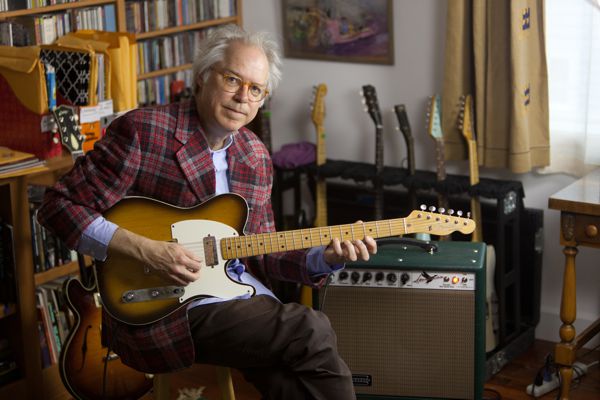 There was a time, seven or eight years ago, when I came to the conclusion that Bill Frisell was simply making too many records. I fell out of the habit of automatically buying his new releases because he seemed to be spreading himself too thin. Good Dog Happy Man (1999) and Blues Dream (2001) are still two of my all-time favourite albums, but I tend to prefer him nowadays as a contributor to other people’s records — something to which his particular expertise is well suited. Used sparingly, the characteristics of his playing add texture and flavour, just like King Curtis or Steve Cropper once did.
 Applewood Road, a trio of female singer-songwriters, recorded their first album around a single microphone. Last night they went one better, clustering around an upright piano at the side of the stage in the Exmouth Market Centre to perform their encore with no amplification whatever.
 The great English jazz composer and bandleader Mike Westbrook turns 80 next month — on March 21, to be exact. His long career is studded with extended works of great ambition and achievement: Marching Song, Metropolis, Citadel/Room 315, The Westbrook Blake, The Cortège (his masterpiece, for my money), On Duke’s Birthday, London Bridge Is Broken Down, Mama Chicago, and others. What began in the late 1960s as a distinctively Westbrookian conception of jazz — with undertones of the approach Ellington and Mingus took to blending composition and improvisation — was broadened by an engagement with street theatre and brass bands, and by a collaboration with his wife, the singer and librettist Kate Westbrook, on pieces that reflected the influence of Berlin theatre song and British music hall.
 When Maurice White told me that he’d deputised for the absent Elvin Jones with the John Coltrane Quartet at a Chicago jazz club called McKie’s in the early 1960s, I was as impressed as I’d been by anything Earth, Wind & Fire had played at the OMNI arena in Atlanta the previous night.
 Through his contribution to the first two Velvet Underground albums, John Cale was one of the people who shifted the tectonic plates of popular music in the 20th century. Maybe it was unreasonable to expect more. But I always believed, based on his work with La Monte Young’s Dream Syndicate, the three albums of archive material from 1965-69 released by Table of the Elements a few years ago, his arrangements on Nico’s The Marble Index, his collaboration with Terry Riley on The Church of Anthrax, his instrumental music for the Warhol films Eat and Kiss, and various other pieces of evidence, that he had the potential to go a long way beyond the rock and roll template into which he settled with Vintage Violence, Paris 1919 and their various successors, whatever his occasional flirtations with punkish sedition (such as the line “We could all feel safe/Like Sharon Tate” which so upset the Island Records hierarchy in 1976).
 When a friend asked me this week to name the most memorable gig I’ve ever attended, I could answer him in a heartbeat: the Tony Williams Lifetime at the Marquee on October 6, 1970. Nothing has ever felt more like the future exploding in the audience’s ears.
 Had he lived, the most influential of all bass guitarists would have been 80 years old this week: on January 29, to be precise. Many of us will never stop marvelling at the creativity shown by the one and only James Jamerson during an era when session musicians who played his instrument were expected to do little more than mark the song’s chord changes and keep in step with the drummer.
 thebluemoment.com