Skip to content

Karsten Vogel in London

Karsten Vogel Soho 1Karsten Vogel made his London debut at the Wigmore Hall in 1968, alongside John Tchicai in Cadentia Nova Danica, one of the outstanding European bands of the ’60s jazz avant-garde. A little over a year later he was back as a member of Burnin Red Ivanhoe, the Danish jazz-rock band who played the Lyceum, the Speakeasy, the Marquee and other joints, and recorded their second album for John Peel’s Dandelion label. (Last year I wrote here about their reunion album.)

He was back in London this week on a rather unusual assignment, invited to play solo alto saxophone at the private view organised by a Danish gallery in a pop-up space on Greek Street in Soho. In a funky room — bare brick walls and open fireplaces, open ceiling beams, artfully minimalist lighting — and surrounded by the work of eight artists, he performed for 10 minutes or so, using a backing tape of almost subliminal sparseness.

There aren’t many alto saxophonists to whom I’d rather be listening. Kirsten has always tempered the raw passion of the music of his youth with a delicate lyricism that occasionally — and certainly in his short set on Wednesday evening — turns into a very touching fragility. He has a lovely tone — slender, fibrous and very human — and a shallow vibrato: a highly distinctive combination. If you listen to one of his improvisations and just concentrate on the shaping of his phrases, it can be a good reminder of how inventive and unpredictable a great jazz musician can be.

An audience of art lovers gathered for the show, which was mounted by Gold-Smidt Assembly and called Sølv. They seemed to find it very enjoyable — in turn, I liked the wall-hung ceramic honeycombs of Stine Jespersen and a 6ft block of South Wales coal carved into an enigmatically plain rectangular shape by Tom Price — but it would, of course, be great to hear Karsten playing at a music venue in London again.

Meanwhile he has a new album, Cry!,  on the Storyville label: a collaboration with the pianist Per Aage Brandt, his friend and compatriot, a poet and linguist who has lived for many years in France. In 1962 Brandt made a radio broadcast in Copenhagen with Albert Ayler, and the following year he became a member of Karsten’s quartet, which lasted until 1966, when the saxophonist joined Cadentia Nova Danica and Brandt went off to the Sorbonne to study semiotics.

Last October they reunited in a studio in Villeneuve-sur-Yonne, where Brandt has made his home. Each of them brought one other musician: the bassist Flavio Perrella was summoned by the pianist, while the drummer Klaus Menzer came with Vogel. For five days they did nothing but play, the pianist and the saxophonist providing a set of challenging  but very appealing compositions and the four musicians coalescing into a a quartet that sounds like a genuine group.

The music is fresh and constantly surprising, with driving bop-influenced tunes and some gorgeous ballad-playing, and a slightly old-fashioned recording quality that suits it perfectly (what I mean is, you get a sense of room they’re in and the space between the musicians). To put it crudely, if Cecil Taylor had kept making progress on a straighter trajectory after his first handful of recordings, this is where his band might have ended up half a century later — which is no bad place to be.

Karsten switches to tenor saxophone for the final track, a duo version of “My Funny Valentine” chosen by Brandt as a homage to Ayler, with whom he used to play Richard Rodgers’ standard. The saxophone playing reminds the listener of Ayler’s idiosyncratic way with a ballad but also manages to be pure Vogel: a perfect way to close a deeply satisfying album which deserves wider international exposure than it will probably get.

Gold-Smidt Assembly’s Sølv is open to the public this weekend (May 13-15) at 49 Greek Street, W1 — but without music, alas.

Piano trios at XJAZZ

Vijay Iyer TrioXJAZZ is the name of an annual festival held in Kreuzberg, a district of Berlin that is home to a large immigrant population. The four-day event is dispersed between a dozen or so venues, all within walking distance of each other. Most of them are rock or dance clubs, but there are also the very striking 19th century Emmaus Church, reconstructed after 1945, and the Lido, built in the 1950s as a cinema.

Of the events I attended this year, the two most striking were both by piano trios. Vijay Iyer’s group (pictured above), completed by the bassist Stephan Crump and the drummer Marcus Gilmore, arrived at a packed Lido on Friday night intending to play the usual hour or so after being presented with the German jazz critics’ association album of the year award for their latest ECM album, Break Stuff. Such was the crowd’s enthusiasm that they ended up playing only a minute or three short of two hours.

They began by playing without pause for more than half an hour, and the applause that greeted the closing notes might have gone almost as long had a rather bemused Iyer not manage to bring it to a halt. The response was the same throughout the set as the trio explored complex but irresistible grooves that created and released tension with an exhilarating effect. They played many original compositions, several of which — such as “Hood” — showed off a love of playing rhythmic games, as well as Thelonious Monk’s “Work” and Henry Threadgill’s “Little Pocket Size Demons”.

Sooner or later the deluge of creative piano-trio music will dry up, but perhaps not for a while yet. The following evening another interesting group took the stage at Watergate, a house and techno club whose bar looks out on to the River Spree. As the light faded on the water through the windows behind them, the Bosnian-born drummer Dejan Terzic, the Danish bassist Jonas Westergaard and the German pianist Florian Weber created three-way conversations characterised by an astringent lyricism and a wonderful ability to play with full commitment while giving each other plenty of room.

These two trios operate at a dauntingly high level of intellectual activity, but the spontaneous enthusiasm of both sets of listeners demonstrated the music’s ability to warm the spirit as well as stimulate the mind.

Cheering for Little Richard

Little RichardLittle Richard is said by his attorney to be “annoyed” at the rumours of his death which spread this week. He survived a heart attack in 2013 and underwent a hip replacement operation more recently, but apparently he’s otherwise fine at 83. Let’s hope so.
Let’s also take the chance to remind ourselves of one of his finest recordings: “I Don’t Know What You’ve Got But It’s Got Me, Parts 1 & 2”, a deep-soul ballad written by Don Covay and cut for Vee-Jay in the blessed year of 1965, apparently during a touring stopover in Los Angeles. Richard’s gospel roots have never been more apparent than here, accompanied by a version of the Upsetters featuring Jimi Hendrix (who had played on Covay’s “Mercy Mercy” the previous year) on guitar and Billy Preston on organ, both clearly audible. It was produced by Calvin Carter, whose sister Vivian was the “V” in Vee-Jay; he probably didn’t have to do much more on this session than give the engineer the signal to roll the tape.

A girlfriend introduced me to this one soon after its UK release, and the US copy pictured above has a permanent place in the box that holds my all-time Top Hundred 45s. If you don’t know it, you should.

Connecting with Empirical

Empirical 1

How many great modern jazz ballads are there? I’m not thinking of the kind of American Songbook standards, such as “Body and Soul” or “Lush Life”, that have offered their melodies and chord sequences to jazz improvisers over the decades. I’m thinking of strictly instrumental pieces written by jazz musicians: things like Monk’s “Round Midnight”, Benny Golson’s “I Remember Clifford”, Bill Evans’s “Blue in Green”, Elmo Hope’s “Mirror-Mind Rose”, Stan Tracey’s “Starless and Bible-Black”, or Dudu Pukwana’s “B My Dear”.

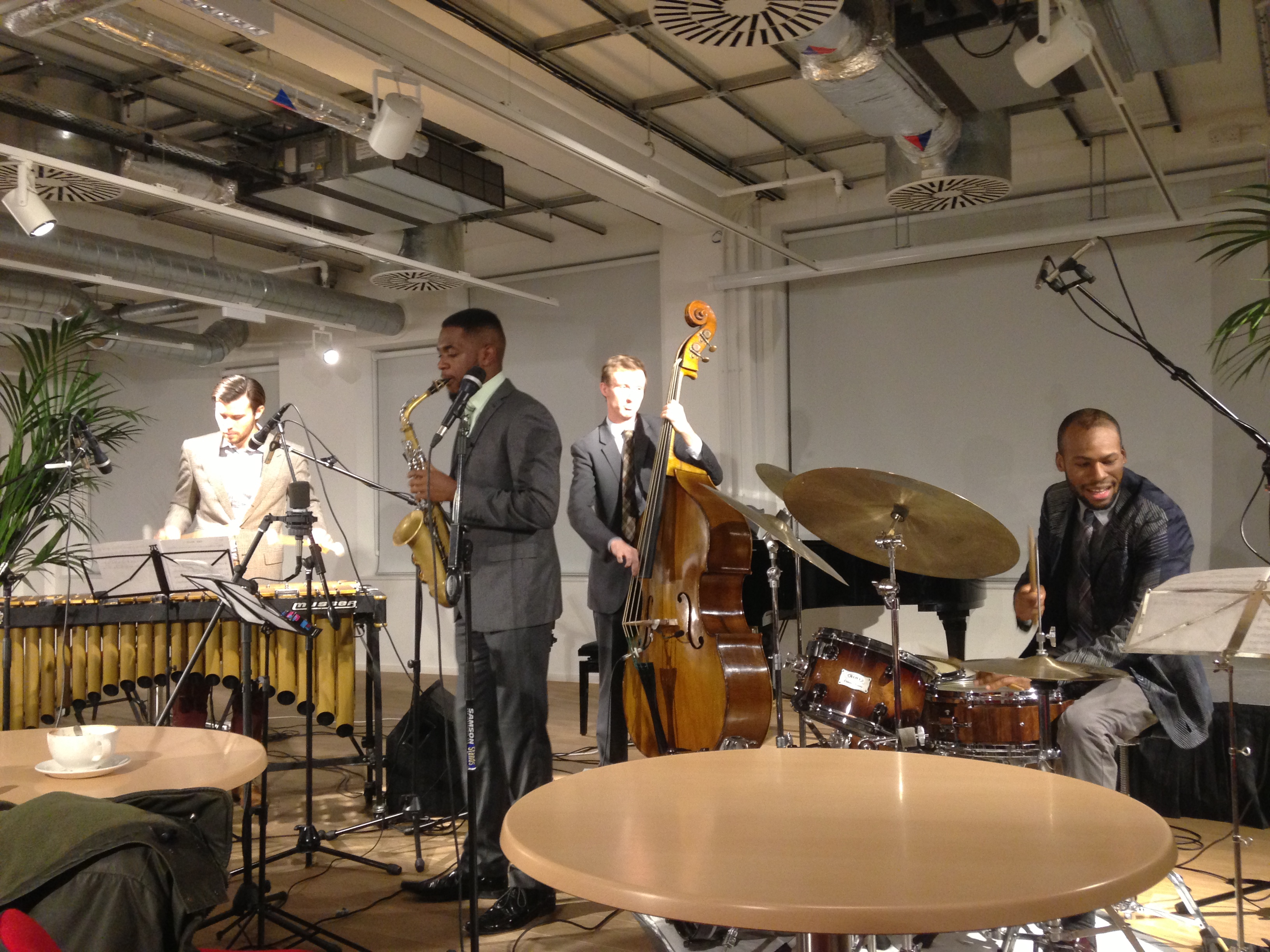
There’s one on Empirical’s new album. It’s called “Lethe”, written by the band’s vibraphone-player, Lewis Wright. It starts with soft chimes and Tom Farmer’s double bass in a rising four-note pattern, Shaney Forbes’s pattering mallets on his tom-toms introducing an exposed theme for Nathaniel Facey’s plaintive alto saxophone. Facey’s subsequent improvisation slips easily in and out of double and triple time, encouraging the others to get busier and thicken the textures, but the band never loses the enraptured mood of the theme, which turns the whole seven-minute piece into a complete and very elegant construction, rather than something that just happened.

I’ve heard them play it two or three times in various settings over the past year, along with some of the other new material, and one of the things that strikes me about the album, which is titled Connection, is the way they’ve not only captured the spirit of their live performances in the studio but even taken the process a step further.

The band’s fifth release continues their 10-year exploration of the kind of jazz first measured out in those Blue Note albums of the mid-’60s — by Andrew Hill, Eric Dolphy, Bobby Hutcherson and others — that took bebop in a late-modernist direction, very harmonically and rhythmically demanding, avoiding the easier options offered by post-Kind of Blue modal jazz. The music is challenging, often superficially austere and angular, but never academic or unfriendly. The 10 compositions by Facey, Wright and Farmer come at the idiom from a variety of angles, offering plenty of light and shade and exploiting the basic tonal palette and their internal relationships to the full.

They can do many things extremely well, and one of them is swing. Forbes’s drumming on two of Farmer’s tunes, “Driving Force” and “Card Clash”, creates classic triplet-based propulsion of the highest quality, establishing a really inspiring platform for the soloists. By contrast, Farmer’s “The Maze” explores a favourite trick of Miles Davis’s second great quartet by having the lead voices — Facey and Wright — stick to a measured written theme while the rhythm instruments are allowed complete freedom to invent. Wright’s closing “It’s Out of Our Hands” brings their innate lyricism back to the surface, with passages utilising a great asymmetrical Latin groove.

Exceptionally well recorded by Richard Woodcraft at RAK Studios in London, and mixed by Alex Bonney, this is a staggeringly good album that stands comparison with the very best of jazz in the 21st century. And from the way “Lethe” has lodged itself in my head over the past 12 months, I’d say that one deserves to become a classic.

* The photograph of Empirical was taken at Foyle’s in London last year.

Not just another chanteuse

KANDACE SPRINGS

You wouldn’t ask your worst enemy to perform at an awards ceremony, particularly a standing-only affair where the audience is milling around, enjoying free champagne and noisy gossip. So it took some guts for the American singer Kandace Springs to perform Mal Waldron’s ballad “Soul Eyes” when she was given a slot at just such a function this week.

As she began by testing out the rather indifferent piano with a few bluesily decorated arpeggios, a friend and I looked at each other with raised eyebrows. It’s like the first sentence of a novel: sometimes you just know that this is going to be all right. And despite a hubbub that barely diminished in volume, Kandace Springs was able to use her allotted handful of minutes to demonstrate a talent that demanded further attention.

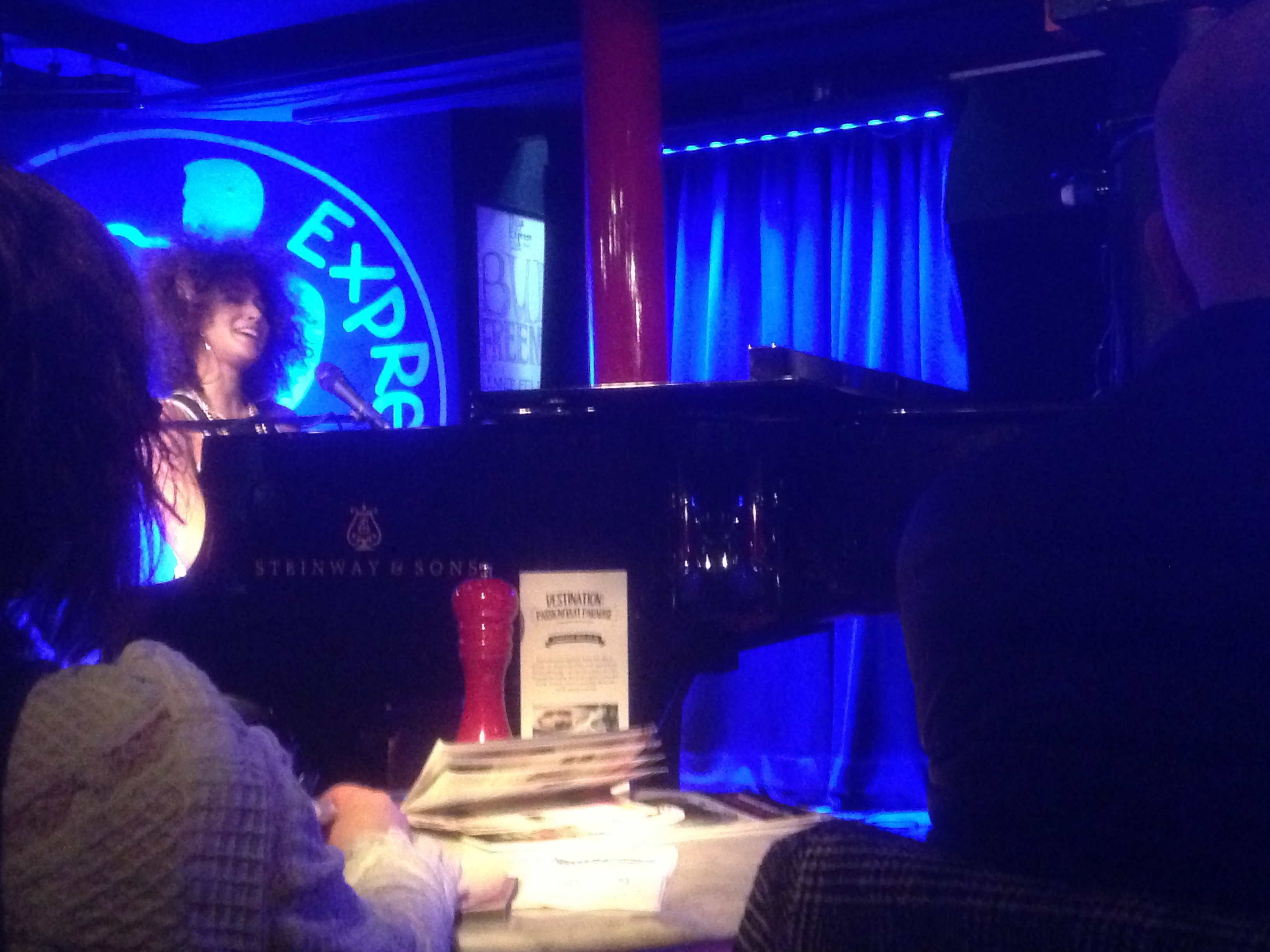
A couple of days later she was at the Pizza Express on Dean Street for a lunchtime showcase gig in front of a more attentive invited audience of industry and media types. One of the half-dozen songs she performed was “The Nearness of You”, written in 1937 by Hoagy Carmichael and Ned Washington. It was Norah Jones’s version of the song, she told us, that had inspired her to embark on a career in music. Tackling the song alone, with only her piano in support, she succeeded in making it her own property, without recourse to distortion or exaggeration, thus deepening the favourable impression.

Ms Springs’s coolness factor is high. Prince called her up after hearing her cover of Sam Smith’s “Stay With Me”. She has an album out on Blue Note in July. She has been opening for Gregory Porter on his European dates, and she is at the Cheltenham Jazz Festival this coming Monday. The world is awash with female “jazz singers” who try to combine the American Songbook repertoire with contemporary sounds, some in the hope of ending up on X Factor. It’s a genre for which I have a pretty limited tolerance. But she seems to have something different and more substantial.

She is 27 years old, she comes from Nashville, and she has a likeable self-possession that gets the audience on her side. Musicians, too. On her British dates she has been expertly and discreetly accompanied by the double bass of Sam Vicary and the drums of Luke Flowers, both from the Cinematic Orchestra, and at the Pizza Express they seemed to be enjoying themselves.

“The Nearness of You” isn’t on the album, which is titled Soul Eyes and was produced — rather conservatively for my taste, but never mind — by Larry Klein. I like the way she feels confident enough to do something other than plug the album to death, and she finished off at the Pizza Express with something else that isn’t on it: a beautifully poised and understated version of Ewan McColl’s “First Time Ever I Saw Your Face” which reminded that if you live long enough, everything comes around again.

Back in 1972 I went to another showcase, at Ronnie Scott’s, to see Roberta Flack, whose fame was secured when Clint Eastwood used her version of the McColl song on the soundtrack to Play Misty For Me. Flack brought an ace band with her, including Richard Tee on keyboards and Chuck Rainey on bass, and she was quietly sensational.  And I have to say that the woman who performed 100 yards away this week was every bit as good. As long as she wards off the dreaded melisma virus and keeps her sights high when selecting her repertoire, she’ll be an adornment to the scene.

Anyway, whenever I try to type the name Kandace Springs, the spellcheck device insists on changing it to “Candace”. I suspect it won’t be long before that particular algorithm wises up.

Brian Eno: The Ship

Brian Eno The ShipSomewhere in West London, there is said to be a dealer in second-hand hi-fi equipment whose face lights up every time Brian Eno walks in. Eno’s interest in speakers of all types and sizes was on show this morning in his Notting Hill studio, where a small audience gathered to listen to a 15-channel 3D mix of his new album, The Ship. After the playback, I took the photograph above in order to give a partial sense of the configuration.

Originally commissioned by a gallery in Stockholm, The Ship has also been seen in Barcelona and Geneva in a larger audio-visual form which enables Eno to describe the installation as “songs you can walk around in”. When plans to install it at Somerset House fell apart, Eno decided to present this stripped-down version privately on his own premises, but there are still hopes of a full public treatment in London in the near future. I hope that happens, because to sit in the middle of it — with the sounds coming from all angles and heights, distributed by Eno and his collaborator, Peter Chilvers, according to the individual speakers’ inherent characteristics — was a very worthwhile experience.

This, Eno says, is his First World War album, treating the sinking of the Titanic in 1912 as a prelude to the slaughter that began on the Western Front two years later. To paraphrase him, its subjects are the relationship between hubris and paranoia, and the way the oceans and the land persist while “we pass in a cloud of chatter”. I had no idea of the theme before I sat down to listen, but I couldn’t miss the sense of a threnody running through the two pieces making up the album: “The Ship” itself, 21 minutes long, and a 26-minute suite in three parts called “Fickle Sun”, in which voices and lyrics are allowed to drift in a sea of sounds largely familiar from Eno’s adventures in ambient music.

At first, listening to the slow electronic washes and bleeps and the dislocated recitative of “The Ship”, and noting a tolling bell, I wondered if this was his elegant way of saying goodbye to his friend David Bowie. Wrong there, apparently. But a lovely piece nonetheless, its overlapping layers of synthetic sounds and occasional choirs of distant shadow-voices gradually building a mood of subdued disquiet.

“Fickle Sun” begins with tintinnabulation and flutter, soon thickened by a muffled bass-drum and a wandering rubberised bass line. Eno’s sombre, careful delivery of his stately melody reminds me of Nico singing “Frozen Warnings” or “The End” — at least until organ and staccato synth-brass chords intrude with a faint echo of Holst’s “Mars”, raising the tension before the textures thin out again to support a conversation between the double-tracked natural voice and its synthesised sibling. The short second movement features the actor Peter Serafinowicz reading Eno’s poem “The Hour is Thin” against simple acoustic piano figures: “The hour is thin / Trafalgar Square is calm / Birds and cold black dark / The final famine of a wicked sun…” The suite concludes with a gently paced cover of Lou Reed’s “I’m Set Free”, that famous declaration from the Velvets’ third album, with Eno’s lead vocal, sometimes double-tracked or harmonised, floating on the bell-like keyboards of Jon Hopkins, the guitar of Leo Abrahams and the violin and viola of Neil Catchpole.

Placed at the end of the album instead of being located in the middle of side two, as it was in its original incarnation on The Velvet Underground, this deceptively reassuring song seems even more unsettling. Which, at the end of a cycle of pieces dedicated to investigating the eternal interplay of hubris and paranoia, was presumably the intention.

* The Ship is released on April 29 on the Opal label in various CD and vinyl formats. The full audio-visual installation is travelling to Belgrade, Istanbul, Copenhagen, Mantua and Lodz.

Trondheim Voices in Bremen

Trondheim VoicesThey were only invited at the last minute after their compatriot Mette Henriette had been forced to withdraw from the Jazzahead! festival in Bremen, but the women of Trondheim Voices provided me with what is likely to be the most lasting musical memory from this year’s event. Based in a city famous for the open-minded young musicians produced by the jazz courses taught at its adventurous and well resourced music conservatory, they have been going, with various changes in size and personnel, since 2001. Over the past year they’ve begun to explore the possibilities of individual sound-tailoring devices created by the mixing engineer and sound designer Asle Karstad: the singers wear discreet wireless boxes on their belts, with controls enabling them to modify their own output in real time.

Currently the group consists of nine members, five of whom were in Bremen. Tone Åse, Torunn Sævik, Heidi Skjerve, Anita Kaasbøll and Siri Gjære (their current artistic director) undertook a 30-minute performance collectively improvised from start to finish, using the possibilities provided by Karstad’s Maccatrol system to create a panoply of sounds, from multiple clucking effects to gorgeous echo-laden chorales. While they did so, an element of restrained theatricality was introduced as they moved around the auditorium, making use of a widened central aisle and the steps up to the stage.

All sorts of music were briefly referenced, from the highly melodic Laurel Canyon singer-songwriter mode through to the sort of fragmented expressionism that might be associated with Diamanda Galas and Yoko Ono, but nothing seemed tricksy or contrived. Their long experience of working together was evident in the way the whole thing was spontaneously shaped into a striking dramatic unity.

A deeply affecting finale featured shimmering layers of voices. After its echoes had died away, Siri Gjære told me that normally they like to give site-specific performances requiring a degree of immersion in their surroundings (in June they’ll be spending several days at Munich’s Whitebox art space). On Saturday the wonderful blend of sound and movement made it hard to believe they’d been given only a few days’ notice and a brief sound-check in a relatively bland environment. I can’t wait for further encounters.

* The photograph shows members of Trondheim Voices after their performance in one of the Jazzahead! halls on Saturday. Their Facebook page — https://www.facebook.com/trondheimvoices/ — contains some examples of their work, including a clip of them using the Maccatrol system.

Masabumi Kikuchi’s ‘Black Orpheus’

Masabumi KikuchiThe pianist Masabumi Kikuchi died last year at the age of 75, mourned by those whose love of jazz is based, at least in part, on the way it offers a home to wandering spirits. It’s clear from the testimony of those who worked with Kikuchi that he wasn’t an easy person, either on himself or on others; his music was the product of an endless pilgrimage towards some sort of essence, some sort of truth, that could not be found in pretty surfaces or routine politeness.

A new solo piano album called Black Orpheus (ECM) is the product of a recital three years ago in Tokyo, his birthplace. Like his last trio album, Sunrise (2012), it reveals the ultimate success of his search: here is a musician who refused to rest until he had discovered his own true voice, his genuine originality.

The first time I saw Kikuchi was the early ’70s, in Gil Evans’s apartment in Westbeth, an artists’ housing co-op in the West Village. He was in the process of making what turned out to be a permanent move from Tokyo to New York, and Gil was acting as a kind of patron. The first time I heard him was when he turned up in London as one of the three keyboard players in the 13-piece band Evans brought to the Royal Festival Hall for his UK debut in 1978, an event that still looms large in the memory of those fortunate enough to have been present. Then I heard the trio records he made with Gary Peacock in Japan in the 1970s, where his personality started to become clear, and a couple of decades later came his memorable trio with Peacock and Paul Motian, which operated under the name Tethered Moon.

His playing grew more distilled as the years went by. All excesses were gradually pared away. In a short essay accompanying the new album, his fellow pianist Ethan Iverson recalls a note Kikuchi left for himself on a piano. “Play slower,” it said. “I sound better when I play slower.” You can hear the effect of that self-imposed ordinance throughout the new album, in the nine wholly improvised pieces and the original composition called “Little Abi”, but most of all in the piece that gives the album its title.

Black Orpheus, the film made by Marcel Camus in Brazil in 1959, won the Palme d’Or at the Cannes festival, and the Oscar, the Golden Globe and the BAFTA award for the best foreign or foreign-language film at the Oscar. It also introduced audiences to Brazilian culture. “Manhã de Carnaval”, the haunting and much-covered Luis Bonfa tune, is its theme.

In almost any hands, the song conveys that special blend of sunny optimism and underlying melancholy that made the first wave of bossa nova songs so appealing. Kikuchi does something different with it. He slows it down to the pace of his thoughts, dismantles its components and slowly reassembles them in new shapes, testing their outline and weight by shifting the voicing of the underlying harmonies and adjusting the trajectory of the familiar melodic fragments. There are many pauses, in which the reverberations of the preceding notes are allowed to hang and decay in their own time.

The result is an eight-minute piece of great poise, beauty and profundity. To know how hard he worked to achieve it, you need only listen to a version he recorded in 1994 and released on a Verve album titled After Hours: Solo Piano, on which the theme is not so closely interrogated and a relatively straightforward two-chord modal structure (with an Evansesque voicing) supports an improvisation which builds towards conventional climaxes. The later version soars to a different level altogether and I can pay no higher compliment than to say it recalls Cecil Taylor’s epic recasting of Richard Rodgers’ “This Nearly Was Mine” (from the 1960 album The World of Cecil Taylor), in which a sentimental little show tune was transformed into a modernist aria, setting the pattern for a certain deviant strand of jazz pianism.

I guess the biggest difference between the two pianists is that Taylor found his voice early on. It took Kikuchi decades of patient burrowing and tunnelling to reach the pitch of perfection he achieved in his final years, of which Black Orpheus — every piece of it, not just “Manhã de Carnaval” — surely represents a pinnacle.

* The photograph of Masabumi Kikuchi is taken from Black Orpheus and was taken by Abby Kikuchi.

The Necks at the Union Chapel

Necks at Union Chapel 1The beautiful Union Chapel in Islington proved to be the perfect final stop for the Necks’ short UK round of pipe organ concerts last night. They were sharing the series, titled The Secret Life of Organs, with James McVinnie, who opened the evening with two pieces by Philip Glass and two short suites by Tom Jenkinson (better known to electronica fans as Squarepusher).

By comparison with the Necks’ appearance at the Kaiser Wilhelm Memorial Church in Berlin last November, this hour-long set more closely resembled what one often hears in their performances using the conventional piano-trio format: an initial gathering of resources leading to surging and slowly mutating waves of sound.

In Berlin most of the audience, facing the altar, could not see the musicians, who were perched in the organ loft/choir balcony above the main door. In London the listeners were facing a stage on which Lloyd Swanton (bass) and Tony Buck (drums) did their stuff. Chris Abrahams was hidden away at the organ console behind the huge central pulpit, but his hands — and the pipes and bellows of the organ — could be seen on a large screen.

Not surprisingly, the sound balance favoured the organ, which was built in 1877 and features 2,000 pipes. Buck’s chattering and rattling percussive commentary could be heard clearly enough, but you had to watch Swanton closely if you wanted to make out his individual contribution. The bass player’s job in this environment, with Abrahams having the organ’s foot pedals at his disposal, is the hardest of three.

It’s fascinating to hear these musicians adapting to the circumstances, and in particularly to the way the various organs “speak”. I hope they release an album of one of these performances. Meanwhile, Abrahams has a new solo CD, Fluid to the Influence, which contains a great deal of absorbing music assembled on a variety of acoustic and electronic keyboard instruments and one marvellous track, “Trumpets of Bindweed”, on which he plays the pipe organ at the Melbourne Town Hall, where the Necks gave their first organ concert in 2005.

Last night they brought the set back to silence with one of those conclusions whose combination of spontaneous mutual decision-making and intuitive aesthetic logic simply take your breath away. Only improvisers can do this.

* The Secret Life of Organs was part of the Barbican’s contemporary music series, co-presented with No-Nation. Future concerts feature the Kronos Quartet, the Bang on a Can All Stars, and Colin Stetson + Sarah Neufeld.

Two soundtracks/2: ‘Ran’

Ran 1Until its re-release this week, I hadn’t seen Ran, Akira Kurosawa’s masterpiece set amid the turmoil of 16th century Japan, since its first appearance in 1985. I had, however, listened to its soundtrack, by Toru Takemitsu, many times. In terms of orchestral accompaniment to films of great quality, it ranks for me alongside the scores provided by Ennio Morricone for Sergio Leone’s Once Upon a Time in America and Alberto Iglesias for Pedro Almodóvar’s All About My Mother.

Takemitsu (1930-96) was to classical composition as Kurosawa was to film: a master with a love of formal experimentation, whose reputation became global. Both of them helped introduce Western audiences to the history and the culture of Japan. Takemitsu composed many pieces for all kinds of ensembles; they included the celebrated Requiem for String Orchestra in 1957 and, 10 years later, the beautiful November Steps for biwa, shakuhachi and orchestra. He also wrote the music for more than 100 films, but never one like Ran.

To accompany Kurosawa’s adaptation of King Lear, in which an old ruler’s bungling of his legacy leads to intra-family warfare, madness and disaster, he juxtaposes Japanese and Western instruments: a solo flute (possibly a hochiku rather than a shakuhachi), woodblocks and other dry percussion sounds, and a full symphony orchestra. Kurosawa’s genius is to use this wonderful music sparingly, bringing it to the forefront during the central battle scene.

Ran is the Japanese word for chaos. Amid astonishing scenes of death and destruction, colour-coded armies hurtle silently back and forth on a wasteland of volcanic dust while flights of arrows pass across the screen like flickers of static and blood-soaked bodies lie in piles; the only sound is that of the orchestra. The slow sweep of strings and the mourning incantations of bassoons and English horns form a stately, richly textured lamentation for human folly.

* The restored version of Ran is showing at the BFI Southbank in London and at arthouse cinemas around the country. Sadly, the soundtrack album is out of print.