Skip to content

Moses Boyd at Frieze

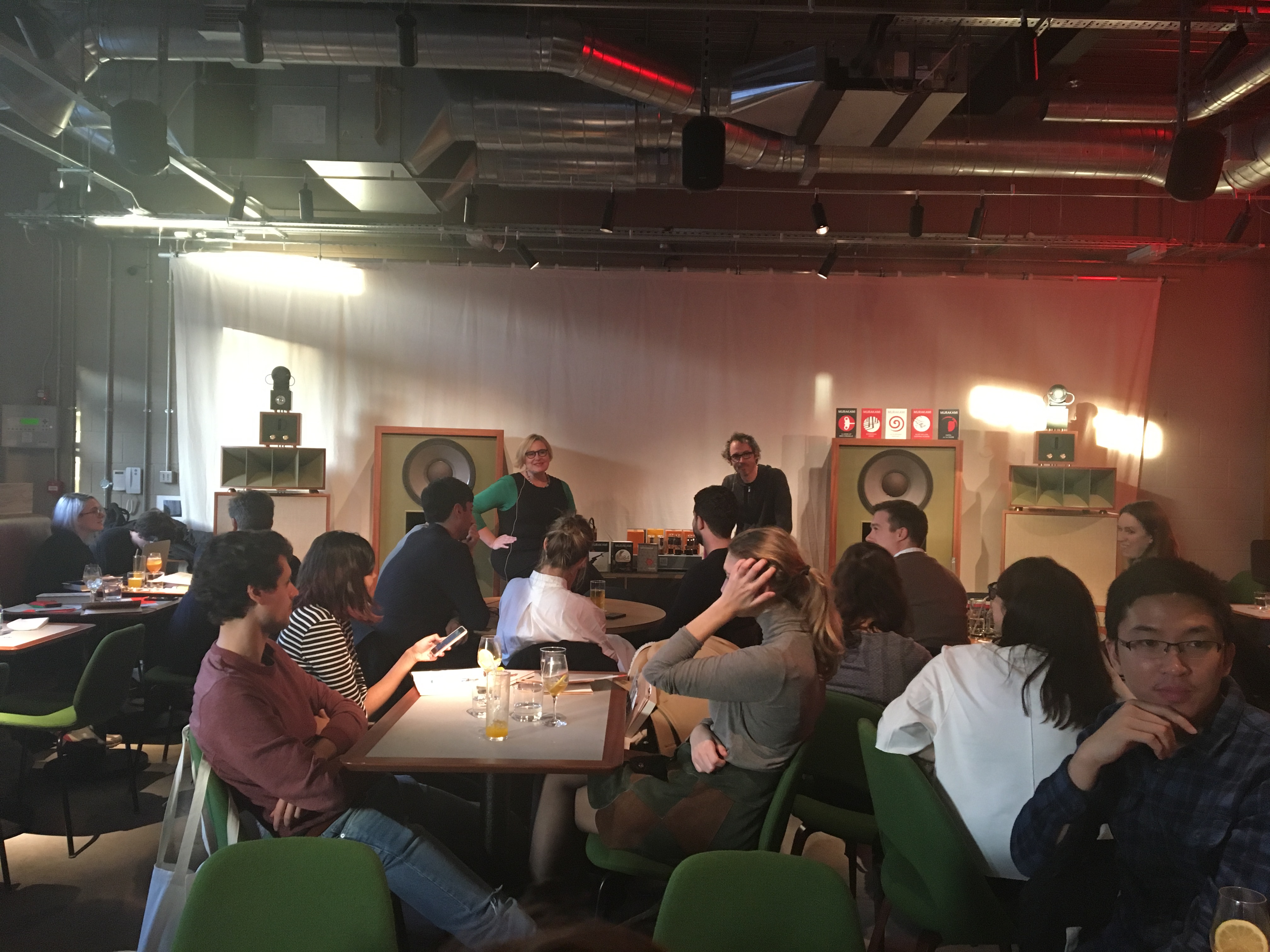
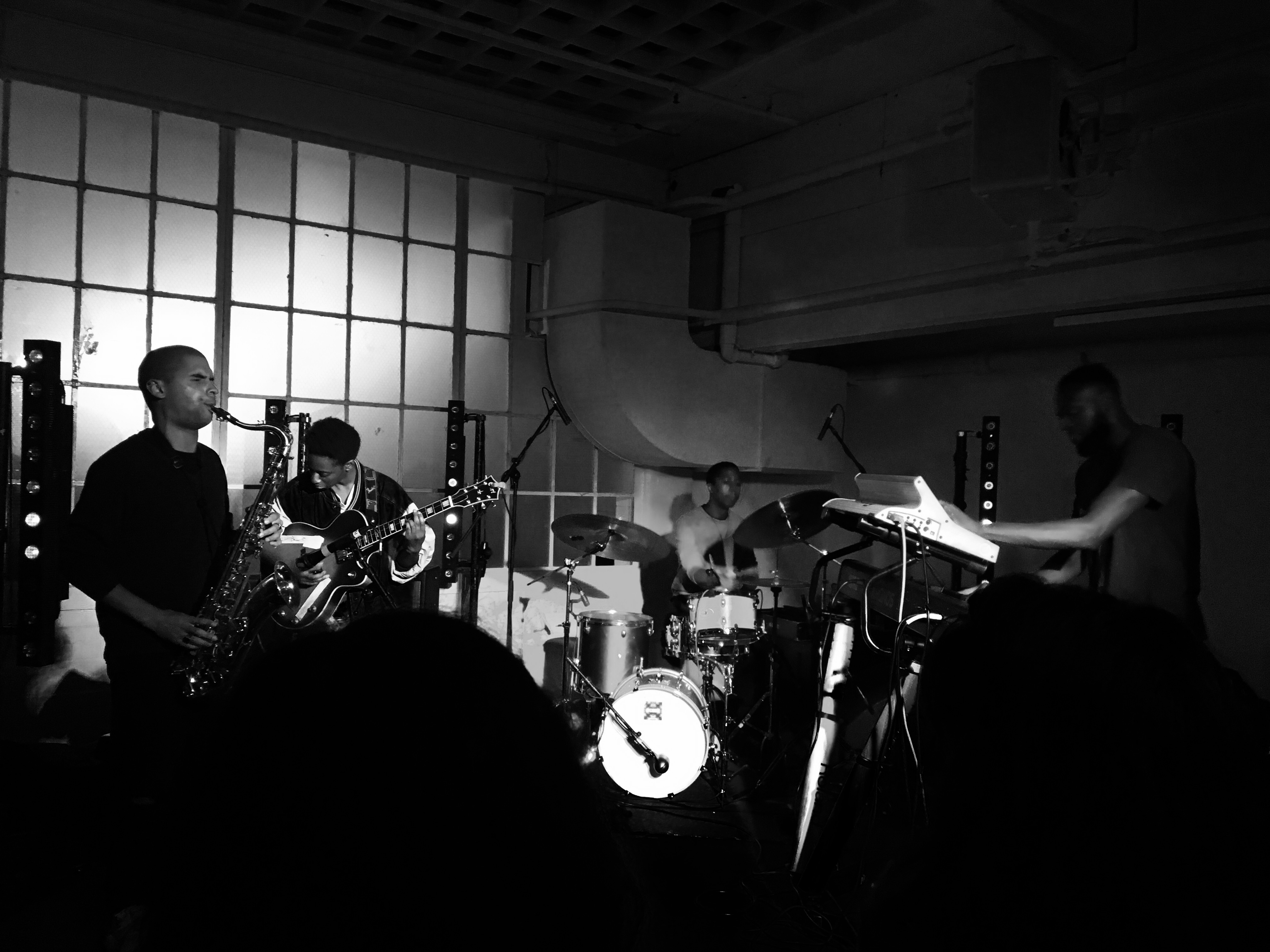
moses-boyd-at-tt-bwIt’s Frieze week in London, meaning that the streets of the more fashionable quarters of the city are thronged with art people. Last night some of them made their way to a party thrown by the Timothy Taylor Gallery in a Soho basement beneath the Phonica vinyl record shop on Poland Street, where the music was provided by a quartet under the leadership of the drummer Moses Boyd.

I’ve written about Boyd’s much-praised duo with the tenor saxophonist Binker Golding and, more recently, about his contribution to Orphy Robinson’s salute to Bobby Hutcherson, but this was something very different. Completing the quartet were Golding, the guitarist Shirley Tetteh and the keyboardist Niji Adeleye, and they started as they meant to go on: with Moses setting a groove that got the room moving, and the others joining in at full throttle. That’s where they stayed for the best part of an hour of unbroken music, with the groove shifting gears a couple of times but the volume and the intensity staying high.

If you can imagine a cross between the wildly distorted noise of the early Lifetime and the sophisto-funk of those Grant Green albums recorded live in 1970-71 at down-home joints like the Cliché Lounge in Newark, New Jersey and the Club Mozambique in Detroit, you’ll be part of the way to imagining what they sounded like. There were rough edges all over the place, but in a good way. Shirley Tetteh’s playing sound like it might be heading towards an interesting blend of Green’s plain-spoken bluesiness, the fluid rhythmic stutter of Hux Brown from Coxsone Dodd’s Studio One rhythm section, and the floaty lyricism of King Sunny Adé’s guitars. It’ll be interesting to see where she takes it.

Anyway, they blew apart any notion of what a conventional Frieze week social occasion organised by a high-end Mayfair gallery might be. “Party” is what it said on the invitation, and a party is what they made it. If the four of them can get the sense of unstoppable energy on to a record, you’ll be able to have that party in your very own home.

‘Eight Days a Week’

beatles-eight-daysTowards the end of Eight Days a Week, Ron Howard’s Beatles new documentary, all reason and proportion briefly fled and I was overpowered by a sense of rage. Those bloody Americans: it was all their fault. With their idiotic 50,000-seater stadiums and their imbecilic urge to misconstrue a perfectly innocent remark about Christianity in a John Lennon interview, they ruined the whole thing.

Not entirely true, of course. The dream was always going to end sometime. But you can see very clearly, in a film that purports to concentrate on the group’s touring years, how the pressure exerted by their immoderate success in the US in particular drove them to fall out of love with what life on the road had come to represent, once the novelty faded. After 1963 they were never able to perform live in an environment that allowed them to show how good they were. All four of them felt that frustration. The Plastic Ono Band, Wings and George’s stint with Delaney and Bonnie were among the consequences.

It’s interesting to speculate what might have happened had America not taken to them. Beatlemania in the UK and Europe would have died down a little, perhaps enough to allow them to continue touring together in more helpful conditions. Would they have been able to spend so much time in the studio, concocting Sgt Pepper and the White Album? Probably so; that’s the way they were heading anyway.

There are many cherishable moments in the film, not least a version of “I Saw Her Standing There” that shows what a blazing little band they were. The picture above, which I’ve grabbed from the trailer, is from that sequence; it captures the feeling. And the final sequence of “Don’t Let Me Down” and “I Got a Feeling” from the concert on the roof of No 3, Savile Row on January 30, 1969 — the first time they’d played live together in public not wearing a band uniform since Brian Epstein became their manager, as well as being the last time they played live together in public at all — is, as ever, deeply sad for the same reason. Imagine if they’d had the sort of rock-concert facilities they lay just around the corner.

As for the film itself, it’s a shame Ron Howard hasn’t learnt the lesson of the great documentary director Asif Kapadia’s work on Senna and Amy: at all costs, avoid showing talking heads on the screen. They slow it down and clutter it up. Elvis Costello and Whoopi Goldberg (particularly) are among those who have genuine insights to impart, but we don’t need to see them when there’s such a richness of archive footage available. But, of course, Eight Days a Week is not to be missed.

Remembering Bobby Hutcherson

orphy-robinsonOrphy Robinson must have known he’d had a great idea when he put together an octet to celebrate the music of the late Bobby Hutcherson at the church of St James the Great in Hackney on Thursday night. But I don’t think he can have expected the large crowd who turned up to respond in quite the way they did.

Fans of contemporary jazz generally listen to their music with a silent attentiveness, occasionally applauding a solo but mostly reserving their signs of approval until the end of a piece. That wasn’t the case on Thursday. The unusual fervour of the music was matched by the response of the listeners, who shouted approval and encouragement during solos in a manner associated with the tenor battles of the 1940s.

Somehow, on this occasion, the musicians had accessed a different spirit. To me, it was the spirit of gospel music: the wave of emotion that can lift you to another level of feeling, in which inhibitions are broken down. Doubly appropriate, given the venue and the fact that the organisers were the promoters of a series known as Church of Sound.

Putting together the evening’s repertoire, Orphy mixed Hutcherson’s own compositions with those from other writers that the great vibraphonist recorded during his long career. I was only able to stay for the first of the two sets, so I missed the versions of Eric Dolphy’s “Gazzelloni” and “Hat and Beard” from the classic Out to Lunch. But I loved the arrangements devised for Eddie Marshall’s boppish “Knucklebean”, James Leary’s “So Far, So Good” and Hutcherson’s oft-recorded “Little B’s Poem” and the rousing “8/4 Beat”.

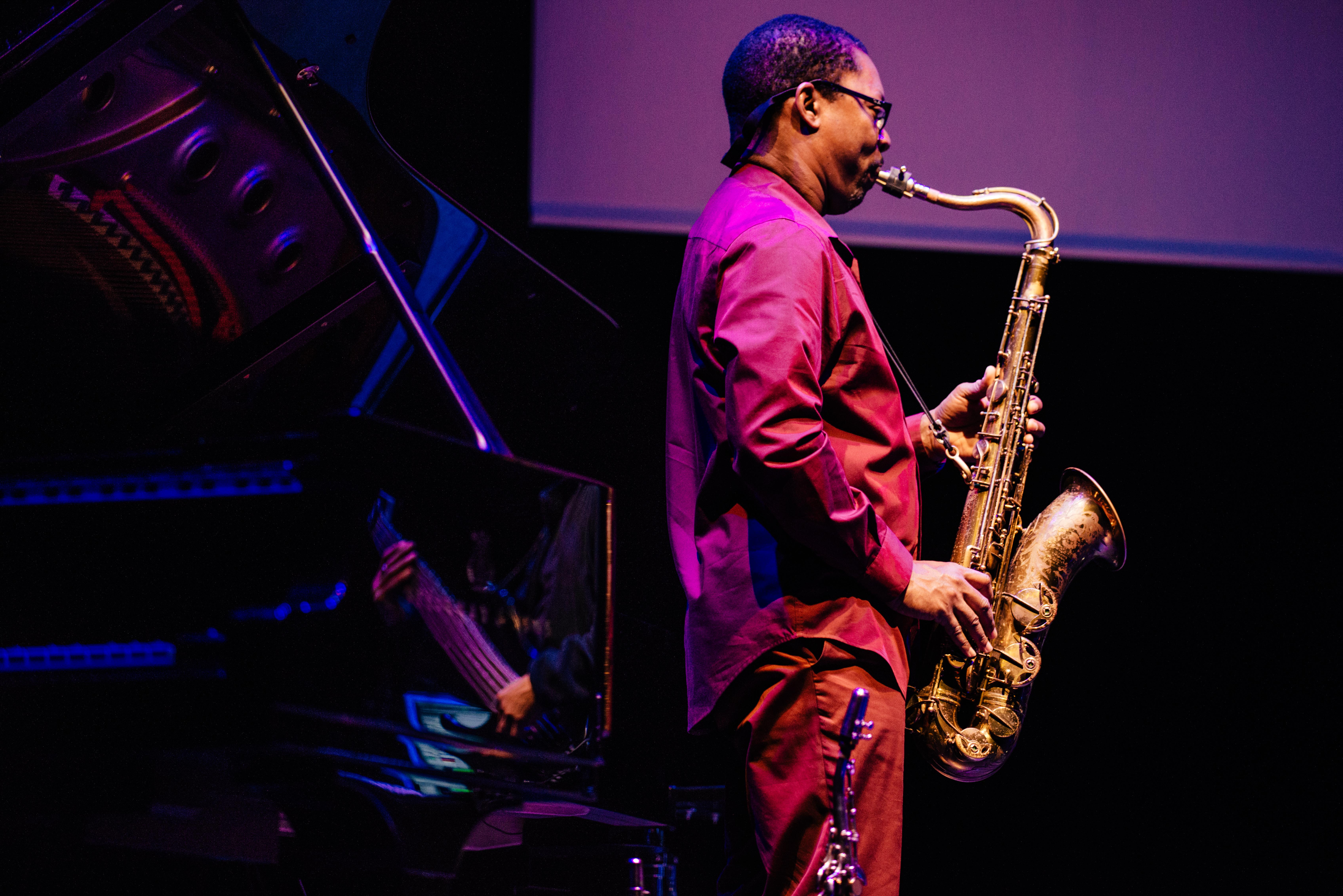
The line-up was a dream. Byron Wallen (trumpet), Roland Sutherland (flute), Tony Kofi (alto), Nubya Garcia (tenor), the leader on marimba and electric vibraphone, Robert Mitchell (piano), Dudley Philips (double bass) and Moses Boyd (drums) set up in the middle of the church, facing each other, surrounded by their listeners. As with the monthly Jazz in the Round series at the Cockpit Theatre, it made this seem the best possible physical format for jazz.

Kofi came close to blowing the doors off the place every time he took a solo. Orphy unleashed dazzling cross-hatched patterns of melody that skittered around the vaulted ceiling. Mitchell played one lengthy solo — on “8/4 Beat”, I think — of such ferocious emotional intensity that it threatened to melt his small electronic keyboard. And in an immaculate rhythm section, it was a special treat to hear Boyd playing straight time with such a lovely feel for swing, blending the alert crispness of Tony Williams with the beatific serenity of Billy Higgins.

The sound wasn’t perfect, but it didn’t matter a bit. Sometimes, for whatever reason, music goes beyond all the things that make it up and finds its way into a fourth dimension. This was one of those times.

‘In C’ at the Barbican

terry-riley-at-80One of the great qualities of Terry Riley’s In C, a foundational work of modern music, is that it can be played by any number of people using any kind of instruments for as long as they choose to make its sequence of 53 motifs last. Since the appearance of the original album in 1968 it has been recorded by a wide variety of ensembles, including the Shanghai Film Orchestra, Acid Mothers Temple, the Salt Lake Electric Ensemble, Adrian Utley’s Guitar Orchestra, and Africa Express with Damon Albarn and Brian Eno. The original album version lasted 42 minutes, but it can be made to go on much longer. (I haven’t heard of an attempt to compress it into the length of a 45rpm single, but I’ll bet someone’s had a go.)

The fact of its remarkable flexibility, however, does not mean that every performance is guaranteed to be successful. Last night the composer himself, looking wonderfully spry for his 81 years, took his place at a prepared piano amid the London Contemporary Orchestra on stage in the Barbican Hall. Just over 70 minutes later the final chord was greeted with an ovation from a full house. I left feeling flat and disappointed.

In its best performances, In C seems to float not just on its famous eighth-note ostinato (suggested to Riley by Steve Reich, and originally the top two Cs of the piano keyboard) but on the moiré patterns created by the combination of instruments, which could be the  brass, reeds and tuned percussion of the original ensemble or the kora, balafon, melodica and calabash of Africa Express. It’s a magical thing — but not an inevitable product of the score.

Last night’s ensemble of 20 musicians, under the direction of Robert Ames, featured bassoon, clarinet, alto saxophone, flute, two guitars (one of them played by Riley’s son, Gyan), flute, violin, viola, cello, viola da gamba, double bass, chamber organ, celeste, and three singers, with a drummer and two percussionists who reproduced the ostinato in a variety of ways, using various implements. This was not far off the 1968 line-up, in which a group of 11 musicians augmented themselves via overdubbing: 10 instruments at the first pass, seven at the second, giving a maximum aggregate of three trumpets, three saxophones, three trombones, three flutes, three oboes, three violas, three vibraphones, two marimbas, two bassoons, two clarinets and piano, a total of 28.

Sheer weight of numbers, then, could not have been the reason I found the Barbican performance so earthbound. For all the panoply of resources, the only element of variety in use seemed to be that of volume. There were soft passages and louder passages, but the rest of it sounded curiously like a big band riffing rather than an ensemble layering and juxtaposing the short motifs provided by the composer. It was all rather prosaic and — despite the composer’s active, if discreet, presence and the ensemble’s evident enthusiasm — hardly true to the spirit of the piece. There was also a rather imprecise attempt at a bravura ending, signalled by the director, which seemed completely inappropriate.

The first half of the evening had consisted of duets by the Rileys, father and son, mostly for piano and electric guitar, although Terry also sang in a deceptively artless voice and played a plaintive-sounding melodica while the nimble-fingered, quick-witted Gyan switched briefly from his Telecaster to an acoustic instrument. Beginning with a loose-limbed piece based on a raga, the set included a song with a strange fantastical lyric which ended with a line about rolling a joint, and which the elder Riley described, to appreciative laughter, as “the national anthem of California”. Cutting through the hippieish mood from time to time were lightning-fast unisons and slashing chordal passages.

At the time Riley conceived In C, in 1964, he was working as a ragtime pianist in the Gold Street Saloon, a waterfront bar in San Francisco, and in his solo passages last night there were frequent echoes and occasional direct hints of blues, stride, boogie-woogie and other vernacular forms. One piece swayed to an elegant habanera rhythm, and contained some lovely filigreed piano/guitar interplay that exposed the substance beneath the charming surface.

The album titled Live that they released a few years ago on Riley’s own Sri Moonshine Music label, featuring duets recorded between 2004 and 2010 in Drogheda, Nantes, Berkeley and Petaluma, is highly recommended. Those interested in looking further into Riley’s vocal music are directed to Atlantis Nath (2002), another self-distributed album, full of fascinating chants and songs with accompaniments including electronics and a string quartet.

* Photo credit: Jean-Pierre Duplan / Light Motiv

Nico: the last journey

nico-2Nico died in Ibiza, a place she had loved for many years, one hot July day in 1988. Leaving the rented farmhouse where she was staying with her son, Ari, she headed into town, apparently intending to buy some hashish. At some point in the journey she fell from her bicycle and suffered a head injury. It was not until the following day that Ari called the police, gave them a description, and received the news that she had died in hospital.

Stephan Crasneanscki of Soundwalk Collective is not the only one to have found himself trying to visualise that last journey. With a new album called Killer Road, he and his partners in the band, Simone Merli and Kamran Sadegh, together with the composer Jesse Paris Smith, present a cycle of pieces based on Nico’s songs and poetry in which they attempt to evoke the thoughts and sounds that might have been going through her mind as she pedalled through the heat and the noise of crickets. The words are read by Jesse’s mother, Patti Smith.

There is a historical connection. Patti once rescued Nico’s harmonium from a pawn shop and gave it back to her. She is, however, not an idolator. “It influenced us all, to have such a bold delivery of bold songs by a female singer in that period, the early ’60s,” she writes in the sleeve notes, but explains that she doesn’t “identify” with Nico beyond the admiration of someone who worked to find a way of delivering her poetry through the medium of music. Nevertheless her commitment to the project leads her to deliver the words in a way that reflects Nico’s own manner: “half-singing — like a child singing to themselves,” as she puts it. Her mission, she says, was “to just, somehow, represent a small part of her, even though we have different voice tones and no obvious similarities.”

In the event, it would be hard to imagine a more effective interpreter for this project. Smith’s performing experience allows her to imbue the lyrics of “Evening of Light”, “Secret Side”, “My Only Child” and others with quiet drama, using a mostly whispered delivery (exception: “Fearfully in Danger”, which she sings in a raw New Jersey voice). The approach works perfectly against the brooding, shifting electronic soundscapes created by her collaborators, which often summon (without trying to replicate) the effect of the harmonium, Nico’s signature instrumental sound. The original melodies are entirely eliminated. When Smith recites the lyric to “Saeta” against the tinkling of distant prayer-bells and hovering synthesiser sounds, the tune is nowhere to be heard; yet for those who know the song, Nico’s loveliest, it is inescapably present.

This is a album of ghost music: an attempt to pay tribute by creating something as strange, original, atmospheric and appropriate to the material as the arrangements through which John Cale moulded the great trilogy of The Marble Index, Desertshore and The End into something without precedent. The result is subtle, respectful, and wholly successful.

* Killer Road is released on the Bella Union label. The photograph of Nico is from the cover of the 1981 album Drama of Exile and was taken by Antoine Giacomoni.

Roland Kirk in Swinging London

roland-kirkHere’s a surprise: in the middle of an assembly of frames snipped from contact prints included in a Photographers’ Gallery show of the work of the late Terence Donovan, there’s a picture of Roland Kirk. It was taken in 1963, during the American multi-instrumentalist’s first visit to London, when he played a season at Ronnie Scott’s Club — the original one on Gerrard Street in Chinatown — and a few concert dates around the country.

Donovan was primarily a fashion photographer — one of the trio of working-class London boys, along with David Bailey and Brian Duffy, who revolutionised the profession in the early ’60s — and his image of Kirk is surrounded by shots of Jean Shrimpton (to be seen directly above Kirk), Celia Hammond, Paulene Stone and other celebrated models of the era.

I saw Kirk for the first time during that short tour in 1963, in Nottingham, where he was accompanied by a British rhythm section. He had yet to add the “Rahsaan” to his name, and he was still wearing a dark business suit on stage. He was startlingly good, whether playing three reed instruments at once — the skill that had brought him to public attention — or just one. And to preface his tune “We Free Kings” he spent a good five minutes telling a very funny and very hip version of the story about the Three Wise Men on their way to Bethlehem, holding his audience spellbound.

The music-related element of the Photographers’ Gallery show also includes Donovan’s nice colour portrait of Jimi Hendrix, swathed in silks, from 1967, his famous videos for Malcolm McLaren’s “Madame Butterfly” and Robert Palmer’s “Addicted to Love”, and his series of portraits of British pop stars — including Elvis Costello, Jarvis Cocker, Supergrass and Bryan Ferry — for an issue of GQ magazine in the 1990s.

But it was the reminder of Kirk that I took away. There’s a new documentary about him, Adam Kahan’s The Case of the Three-Sided Dream, which is just out on DVD. It includes a marvellous sequence from a 1971 edition of the Ed Sullivan Show on which Rahsaan leads a band including Charles Mingus, Archie Shepp and Roy Haynes. After Sullivan has announced that they’ll be playing “My Cherie Amour”, they cut loose instead on a wild version of Mingus’s “Haitian Fight Song”. Sullivan takes it in his stride; following the appearances of Elvis Presley in 1956 and the Beatles in 1964, it was his third great moment of musical history — and maybe the one that finished him off, since his show ended its 23-year run a few weeks later.

Philip Clemo at Kings Place

philip-clemoPhilip Clemo did well to attract Arve Henriksen not only to play on his sixth album but to participate as a member of the octet that launched Dream Maps in Kings Cross last night. The Scottish-born guitarist and composer’s work was greatly enhanced by the contribution of the Norwegian trumpeter and singer, who proved himself an excellent team player as Clemo’s soundscapes unfolded beneath a screen on which film of tundras, mountains and oceans gave an indication of the music’s subtexts.

The cellist Emily Burridge, Sarah Homer on clarinets and soprano saxophone, Steven Hill on guitar, Martyn Barker on drums, Simon Edwards on  bass guitar and the singer Evi Vine were the other members of the octet, which concentrated mostly on pieces from the new album. Gently insistent grooves, to which the combined texture of cello and bass clarinet added an interesting flavour, alternated with jangly folk-like structures in which the guitars came to the fore. Henriksen’s improvisations on regular and pocket trumpet were the highlights, but he also joined Vine and Clemo in vocal passages which made use of distortion, both natural and electronic.

Artfully mixed together with recordings of heartbeats and water by the sound engineer Phill Brown, the music washed gently but insistently over the clearly beguiled near-capacity crowd in Kings Place’s Hall 2. A term like “ambient trance” might have been evoked, but there was substance, too. The occasional rough edge betrayed the fact that this was Clemo’s first live gig in 10 years; its success should encourage him. And Dream Maps — on which Henry Lowther, B. J. Cole, John Edwards and others also make appearances — is well worth investigating by anyone who enjoys the territory explored by the likes of Jon Hassell (with and without Brian Eno), Jakob Bro and Henriksen in his various other guises.

Harmolodics: the truth at last

ornette-harmolodicsSo I’m wandering into Mayfair on Monday, on my way to the launch party for this year’s EFG London Jazz Festival, and I have 10 minutes to spare. On Dover Street there’s an antiquarian book shop called Peter Harrington. I’ve never been in there before but there’s some nice stuff in the window so I open the door.

Within a couple of minutes I’ve forgotten all about the stuff in the window. There are clues to what’s about to happen in a shelf of jazz-related publications, including Johnny Otis’s Listen to the Lambs, a signed copy of Dizzy Gillespie’s To Be or Not to Bop. and a complete set of Les Cahiers du Jazz, 1959-64. But then I see a display case. Inside it — alongside a signed photograph of Sonny Rollins mowing a lawn in Sweden, taken by the famous jazz critic Randi Hultin, rather incongruously juxtaposed with an autographed and dedicated copy of Marc Bolan’s volume of poetry, The Warlock of Love — is a sheet of manuscript paper. The word scrawled at the top is “Harmolodics”. The signature at the bottom is that of Ornette Coleman.

Harmolodics was Ornette’s system of musical organisation — one apparently based on a highly personal disregard of regular methods of transposition for wind instruments. You knew it when you heard it: it was what made his music sound the way it did. But whenever interviewers asked him to explain it — and I was among their number myself — the answer was so gnomic and cryptic as to be beyond normal comprehension. Which was certainly not to say that there was anything wrong with it.

Anyway, this piece of manuscript paper headed “Harmolodics” contains eight staves of musical annotation and looked as if it might explain something. Seeking enlightenment, I sent my snapshot of it to the pianist Alexander Hawkins, who shot back a reply within an hour. It turned out that, by coincidence, he had just been transcribing some chords from Prime Design/Time Design, Ornette’s piece for string quartet and drums, dedicated to Buckminster Fuller and recorded in 1985 at the Caravan of Dreams festival in Fort Worth. Interestingly, he was immediately struck by certain similarities. Here’s an extract from his reply:

On the third line up from the bottom on the Ornette manuscript, that Eb-Gb minor 10th/compound minor third interval… is embedded in the string quartet harmony. Ornette’s chromatic scale (4th stave down) yields this harmony when it is read with different clefs. So that first pitch (the flattened note on the bottom line of the staff) of course reads as the Eb in the treble clef, and as a Gb in the bass clef. If you then invert that interval of the minor third, you get a major sixth; and sure enough, a major sixth is the voicing between the ‘cello and viola in the quartet… This system of ‘equivalences’ you can also see in Ornette’s bottom two staves. The arpeggio which he spells out – bottom line, first four notes – reads Eb – G – Bb – D in the bass clef, or Cb (=B) – E – Gb – B in the treble clef. Hence, perhaps, the next four notes on that bottom line, which in the bass clef read of course B – Eb – Gb – Bb. (Although I can’t at present explain with this isn’t B – E natural – Gb – B natural: it seems unlikely that Ornette would slip up on two accidentals)…

I was told by the bookseller that the manuscript was the property of the dedicatee, a man who had helped Ornette with archiving his papers and had been given it as a present. It may have been lying around on Ornette’s floor; there’s what seems to be the faint trace of a footprint, possibly from a trainer, on the right-hand side.

In case you’re thinking that it might be a nice thing to have hanging on the wall, here’s the sticker price:

£10,000.

A glimpse of Anne Briggs

Folk singers

It was my good fortune to see and hear the great folk singer Anne Briggs in her youthful prime, before she turned away from public performance, leaving only a handful of recordings and an indelible influence on the likes of Sandy Denny, June Tabor and Kate Rusby. A fine half-hour programme about her on BBC Radio 4 last week, titled The Voices of Annie Briggs, written and presented by Alan Hall, brought that precious memory springing back to life.

She would have been not yet 20 when I saw her at the Nottingham Folk Workshop, close to the old Lace Market (at a time when it still contained a few surviving lace manufacturers). That was where she had encountered Ewan McColl and Peggy Seeger, who heard her sing one night in 1961 and took her off to join Centre 42, their travelling folk-arts festival. She was 17 then, so I must have heard her a year or two later on a return visit to her native city; by then she would have learnt “Blackwaterside” from A.L. Lloyd and hooked up with Bert Jansch, who became first her boyfriend and then her lifelong pal.

I don’t remember exactly what she sang that night in 1962 or ’63 — although I’m pretty sure her short set included “She Moved Through the Fair”  — but I do remember, very vividly, the impression she made: she looked like the girl you wanted to run away with, and she had a voice that you’d have followed anywhere.

But she resisted any attempt to turn her into a commodity, and her nature seems to have resisted stability on someone else’s terms. As she tells Hall in the radio programme: “You must remember that in the late ’50s, early ’60s, I think it was hoped that I might become a nurse, for instance, or a hairdresser, and that I’d marry and have children and become quietly domesticated. I’m a bit feral, perhaps.”

Hall interviewed her at her home in the west of Scotland, where she lives alongside nature and beside running water, which seem to provide all the music she needs. The last time she sang was when she put her infant grandson in a sling and took him for a walk by the river. “It seemed to soothe him,” she says.

* The photograph of Anne Briggs was taken by Brian Shuel in Hampstead, North London, in 1962.

Prince Buster 1938-2016

When I read today of the death of Prince Buster at the age of 78, I thought immediately of my favourite piece of music writing. It’s an essay titled “Johnny Cool and the Isle of Sirens”, written by Johnny Copasetic, a nom de plume disguising the identity of Mark Steedman, a computational linguist who is now the professor of cognitive science at Edinburgh University’s School of Informatics. The piece first appeared in 1972 in the first volume of Rock File, a paperback edited by my friend Charlie Gillett and including a selection of commissioned pieces alongside a pioneering list of every record to enter the British Top 20 between 1955 and 1969.

The essay’s author meditates at length on certain evolutionary strands of black popular music, concentrating on Prince Buster and Curtis Mayfield, and in particular on Buster’s 1967 hit “Johnny Cool” and the Impressions’ “Isle of Sirens”, a relatively obscure track (first released on the 1967 LP The Fabulous Impressions) that is nevertheless up there with Mayfield’s finest work.

He also talks about “Ghost Dance”, which is my favourite Buster track because of its sheer strangeness. “The theme,” he writes, “is that it is an open letter to his friends back in Jamaica, written/sung from abroad… it shows the use he makes of everyday phrases, the effect of the phrase with no context, the effect of sequence without a story.” Indeed, “Ghost Dance” is a kind of epistolary poetry:

“Dear Keith, my friend, good day — hoping you’re keeping the best of health / How is the music down there in Bone Yard? / I hear that Busby have a sound system / And that Nyah Keith is the disc jockey / But them can’t get no Red Stripe beer to sell in the dance at night / Tell Zackie, the high priest, who used to lead the toughest / Give him my regards / Tell him Prince Buster said, ‘Hello.’ / And Keith, if you should see Rashie / You know, Rashie from Back o’ Wall? / Give him my regards / And if you should see the two brothers, Stinky Pommels and Herman / We grew together / Tell them Prince Buster says, ‘So long, / Sorry we had to go, so soon.’ / Since music be the food of love / I’ll forever sing on / And Forresters Hall will soon get back my shape.”

Real people and places are being described here. Busby was indeed a sound system. Nyah Keith, born Albert Brown and murdered by a gunman in West Kingston in 1966, became the subject of a song by Burning Spear included on the 1978 album Marcus’ Children. Zackie was apparently a heavy for Edward Seaga’s Jamaican Labour Party, shot dead in 1966. Back o’ Wall was a Rasta community in West Kingston, demolished in the early ’60s and redeveloped as Tivoli Gardens. Forresters Hall was a popular dance hall on North Street in, I think, Campbell Town. On Rashie, Stinky Pommels and Herman, history is silent.

Thanks largely to Mark Steedman, the characters and scenes evoked by Prince Buster in his “Ghost Dance” have been running through my head for more than 40 years, along with that touching little valediction: “So long. Sorry we had to go, so soon…”