Skip to content

Trygve Seim’s ‘Rumi Songs’
 

OLYMPUS DIGITAL CAMERA

With the arrival of the long-playing record almost 70 years ago, the art of shaping an improvised solo took a serious hit. All those perfectly proportioned solos of eight or 12 bars turned into 10-minute soliloquies, for good and ill. It’s not a lost art — enough of today’s players have listened to Wayne Shorter to understand the powerful effect of concision — but one of the reasons I’m so fond of the playing of the Norwegian saxophonist and composer Trygve Seim is that he seems to have an inbuilt self-editing mechanism which makes his improvisations all the more powerful and memorable.

Born in Oslo 45 years ago, Seim released an album called Different Rivers in 2000, featuring a variety of line-ups, from two to nine musicians, including the trumpeter Arve Henriksen and the drummer Per Oddvar Johansen. This was patient, luminous, ego-free music, finding a perfect balance between composition and improvisation; it sounded to me then like a modern classic, and it still does.

Since then I’ve looked out for his name on records (usually, like Different Rivers, on ECM) and have seldom been disappointed. I’ve seen him live twice, with Manu Katché’s quintet in Paris a few years ago and with the Oslo Festival Jazz Orchestra (also a quintet!) at Ronnie Scott’s last year, and his playing had even more presence in person than on record. Now there seems to be a flood of Seim: he’s on four new albums from ECM, three of them — Sinikka Langeland’s The Magical Forest, Mats Eilertsen’s Rubicon and Iro Haarla’s Ante Lucem — as a sideman.

Ante Lucem is a majestic piece of writing for symphony orchestra and jazz quintet, a fully realised piece in the spirit of the old Third Stream: not so much a blend of jazz and classical practices as a juxtaposition, but a successful one. In my view it also achieves Haarla’s aim of spiritual transcendence. Rubicon is a sequence of well organised pieces for septet, with Olavi Louhivuori from the excellent Finnish band Oddarrang on drums and Eirik Hegdal playing saxophones and clarinets alongside Seim in a two-man front line. The Magical Forest features delicate and often beguiling settings of Langeland’s songs, in some of which she is joined by the three female singers of Trio Mediaeval.

The fourth and last album is Seim’s own Rumi Songs, in which he arranges nine poems by the 13th century Sufi poet for the pure voice of Tora Augestad, the accordion of Frode Haltli and the cello of Svante Henryson. His use of the modern translations by the American poet Coleman Barks will please those who love Barks’s The Essential Rumi, a hugely successful anthology, although I prefer the more traditional renderings of R.A. Nicholson and the more recent and less decorative ones of Nader Khalili.

This is a chamber recital, in which jazz makes its guiding spirit apparent only in the sonorities of Seim’s soprano and tenor saxophones and in the flexibility of the interplay. A tenth track, “Whirling Rhythms”, is an instrumental piece that captures, in less than three minutes, the non-verbal essence of  the project, as well as demonstrating the rewards of Seim’s trips to Egypt and the poet’s birthplace in Anatolia.

It would be a mistake to assume that Rumi’s verses are not suited to the Nordic atmosphere in which these fine musicians operate. If you’re in the right mood, the track called “There Is Some Kiss We Want”, with which the album closes (and which is featured in a little promo clip), might be one of the loveliest things you’ll hear this year.

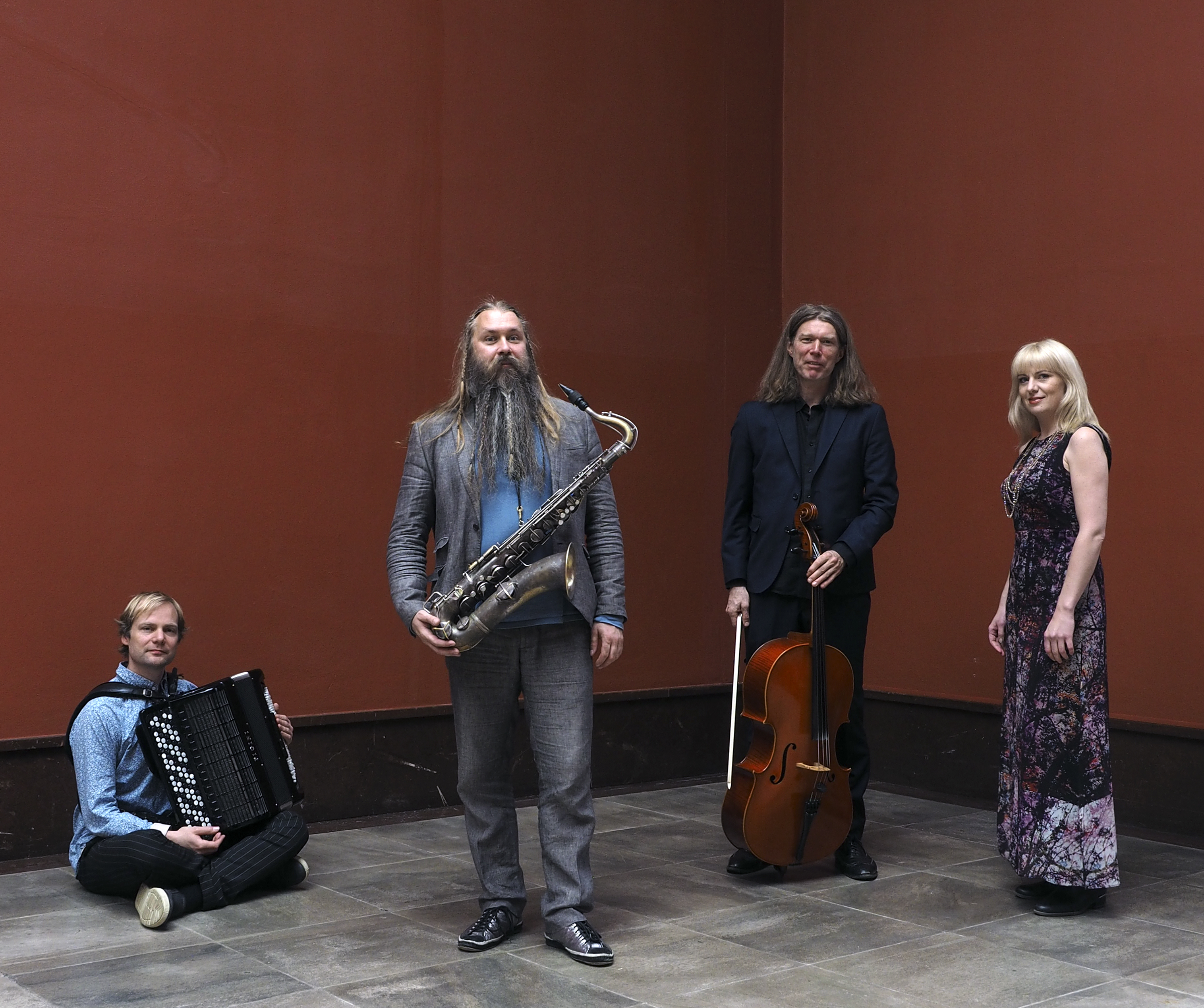
* The photograph above, by Knut Bry, shows the Rumi Songs band: (from left) Frode Haltli, Trygve Seim, Svante Henryson and Tora Augestad.

Chet Baker at the Canteen

Chet Baker at the CanteenThe Canteen was a jazz club at 4 Great Queen Street, on the eastern fringe of Covent Garden: a narrow single-fronted space on the ground floor, backing on to Parker Street. It functioned for probably not much more than a year in the early 1980s, after which it became Blitz, the headquarters of the New Romantics, then Browns, a sort of celebrity discothèque. Now it’s a “gentlemen’s club” called the Red Rooms. Among the musicians I saw there during its jazz incarnation were Ahmad Jamal, Slim Gaillard, Lee Konitz, Howard McGhee, Bill Perkins and Esther Phillips, who was backed by a tidy little band including Tim Hinkley on keyboards and Mel Collins on tenor saxophone. The club’s energetic publicist was a man called K.C. Sulkin, whose father had been a society bandleader in Boston between the wars.
Chet Baker’s week at the club in March 1983 was among the highlights of its short life. If you needed proof that he was always more than just a Great White Hope, here it was. “The former golden boy of the cool school has come through the fire,” I wrote in a review for The Times, “but you would not know it from his playing at the Canteen.” Accompanied by an excellent local rhythm section — John Horler (piano), Jim Richardson (bass) and Tony Mann (drums) — and sitting sidelong to the audience, his improvising was serious and creative and full of substance.

Luckily, and with Baker’s permission, Richardson recorded the engagement on a Sony cassette machine. Now, more than three decades later, the tapes have been disinterred, professionally restored and released as a two-CD set. The sound is excellent and the quality of the playing compares favourably, I would say, with the recordings from Paris, Tokyo and Hannover (1981, 1987 and 1988 respectively) on which I wrote in a post about Chet a while ago.

The trumpeter’s tone on tunes like Sam Rivers’ “Beatrice”, Hal Galper’s “Margarine”, Richie Beirach’s “Leaving” and the standards — including “I’ll Remember April”, “Have You Met Miss Jones?” and “With a Song in My Heart” — is firm and confident, the lines long, the phrasing fluent. By this point in his life, 30 years after first recording it with the Gerry Mulligan Quartet, he had played “My Funny Valentine” so many times that you would have expected his interpretation to be threadbare; here, in the course of a long solo, he investigates its familiar contours as if exploring them for the first time, shaping his double- and triple-time runs with such elegance that it’s easy to forgive him for running out of steam in the closing bars, before handing over to Horler.

The rhythm section is alert and resilient throughout the recording, exemplary in its collective command of the appropriate post-bop approach. So it was a treat to see the trio reassembled for the first time in 33 years at Ronnie Scott’s last week to celebrate the album’s imminent release, and playing just as well. They were joined by the trumpeter Quentin Collins, the tenorist Leo Richardson and the singer Norma Winstone to pay tribute to Baker by reprising the repertoire from the Canteen sessions. Wisely, Collins did not attempt an imitation, evoking the spirit rather than the manner (his personal stylistic compass points him closer to Lee Morgan territory). On “Beatrice”, Richardson’s middleweight sound and mobility reminded me a little of Hank Mobley, which can’t be bad. Winstone delivered “The Touch of Your Lips” and “My Ideal” with characteristic grace.

A few days earlier I’d been to see Ethan Hawke portraying Baker in Robert Budreau’s film Born to Be Blue. Like Don Cheadle impersonating Miles Davis in the recent Miles Ahead, Hawke gives an honest and sincere performance, at times genuinely touching. There are several good scenes, but the apparent need to modify the narrative to fit a Hollywood feature-film template diminishes rather than enhances the story. Your money would be better spent on Chet Baker Live in London, a valuable souvenir of an interesting week.

* Chet Baker Live in London will be released on the Ubuntu label on October 28.

David Enthoven: the last goodbye

EG King's RoadOn my way to David Enthoven’s funeral this morning, I walked from Sloane Square down the King’s Road and paused at No 63A, where it all began. The weather was glorious: in the perfect sunshine, it was easy to drift back to the Chelsea of an imagined and sometimes real ’60s.

David died in London last week, aged 72, five days after being diagnosed with kidney cancer. Behind that door and up a flight of stairs, he and Johnny Gaydon, his schoolfriend and first business partner, set up EG Management in 1969, with King Crimson as their first clients. Marc Bolan, ELP and Roxy Music soon joined the roster. They were great days. (And here’s the obituary I wrote for the Guardian.)

When I got to St Luke’s, a large 19th century Anglican church just off the King’s Road, it was already close to packed with people wanting to say farewell to an extraordinary man. As they lingered in the sunlit churchyard after the ceremony, the event had something of the qualities of an English garden party, which was just as it should have been.

Tim Clark, his friend and partner in IE:Music, his second management company, gave an address which stressed the life-enhancing qualities that made David special to every single member of the congregation. Robbie Williams, whose life and career David and Tim had salvaged and remade, sang “Moon River” — a lovely choice — accompanied by the acoustic guitar of Guy Chambers. Lucy Pullin and a choir sang “Angels”, which Williams and Chambers wrote after David and Tim had brought them together. Lamar led the singing of “Jerusalem”.

The congregation included Robert Fripp, the founder of King Crimson, and all five surviving members of Roxy Music from the sessions for the band’s debut album in the summer of 1972: Brian Eno, Bryan Ferry, Andy Mackay, Phil Manzanera and Paul Thompson, who came down for the funeral from Newcastle, where he now plays the drums with Lindisfarne.

One of the morning’s pleasures, over which the man in whose memory we were gathered would certainly have shared a chuckle, was the sight of Fripp, Eno and Ferry (so much history there, from Ferry’s failed audition for King Crimson to Fripp and Eno’s collaboration on No Pussyfooting and beyond) joining the singing of “All Things Bright and Beautiful”. You don’t get that every day.

On the Beat route

On the Road

In the beginning, probably around the start of World War Two, there were hep-cats. They were hip. Then they weren’t, because hip became hip and hep-cats gave way to hipsters. There were hippies, too, except they were decidedly unhip. Until they became hip, of course, in the Summer of Love. Some decades later hipsters returned, albeit in a modified form, with matching (rather than weird) beards and craft beers. How soon before the hep-cats make a comeback?

So the queue for entry to the Centre Pompidou the other day was just too long, and I decided that I’d probably get another opportunity to see the “Beat Generation” exhibition before it closes on October 3. (I saw a really good show on the same theme — “Beat Culture and the New America 1950-1965” — at the Whitney Museum in New York 20 years ago, its centrepiece the unbroken roll of paper on which Jack Kerouac typed the original unparagraphed On the Road.) I consoled myself for the disappointment in Paris by crossing the Seine to the excellent Gibert Joseph store on the Boulevard Saint-Michel and buying Beat Generation: Hep Cats, Hipsters and Beatniks 1936-1962, a three-CD anthology assembled to tie in with the exhibition and just released by Frémaux et Associés, the label responsible for many fine historical compilations.

It’s a real box of goodies, a useful reminder that the soundtrack to the beat life wasn’t just composed of the super-cool stylings of Miles Davis’s “Boplicity”, Gerry Mulligan’s “Soft Shoe” and Bobby Troup’s “Route 66” (all of which are included among the 72 tracks). It was also the sheer stomping mayhem of Roy Eldridge’s “Heckler’s Hop” and Cootie Williams’s “Gator Tail Pt 2”, which features a bar-walking tenor saxophone solo by Willis “Gator Tail” Jackson so extreme that, having scaled the heights of rampantly priapic  wailing, it ends in a series of exhausted squeaks. Something like this:

“The tenor man jumped down from the platform and just stood in the crowd blowing around; his hat was over his eyes; somebody pushed it back for him. He just hauled back and stamped his foot and blew down a hoarse, laughing blast, and drew breath, and raised the horn and blew high wide and screaming in the air. Neal was directly in front of him with his face lowered to the bell of the horn, clapping his hands, pouring sweat on the man’s keys, and the man noticed and laughed in his horn a long quivering crazy laugh and everybody else laughed and they rocked and rocked; and finally the tenorman decided to blow his top and crouched down and held a note in high C for a long time as everything else crashed along and the cries increased and I thought the cops would come swarming from the nearest precinct.” 

That’s how Kerouac recalled a Saturday night in a San Francisco jazz dive as he tapped out the original manuscript of On the Road, which also contains descriptions of performances by George Shearing, Slim Gaillard, Lester Young and Charlie Parker. With the exception of Shearing, all of those are represented in the anthology. There’s a lot of Kerouac, too, reciting his “American haikus” with Al Cohn’s tenor saxophone, reading from On the Road and Visions of Cody, and giving his lecture asking “Is There a Beat Generation?” to the students of Hunter College in 1958. There’s Allen Ginsberg reciting the complete “Howl” and “Kaddish”, and Lennie Bruce’s “Psychopathia Sexualis”, and authentic hipsters like Babs Gonzales and Oscar Brown Jr and hilariously bogus ones like Edd Byrnes (“Kookie’s Mad Pad”). And satire like Bob McFadden and Rod McKuen’s “The Beat Generation” (the inspiration for Richard Hell’s “The Blank Generation”), and fine music from Charlie Christian and Dizzy Gillespie and Chet Baker and Stan Getz and Les Double Six and Eddie Jefferson, with a wonderful vocal recasting of “So What”. A hint of hipsters/hippies to come appears in Dave Van Ronk’s “Winin’ Boy Blues” and Bob Dylan’s “Talkin’ New York”, and there’s a curious coda with a reading of e.e. cummings’s anti-war poem “i sing of Olaf glad and big” in 1962 at the Avant Garde coffee house in Milwaukee by Roger Steffens, then a 21-year-old actor and today the owner of the world’s largest Bob Marley archive.

And, of course, the set would not be complete without the immortal Lord Buckley, giving his hipster interpretation of the New Testament’s Lazarus story in “The Nazz”:

“So the Nazz and his buddies was goofin’ off down the boulevard one day and they run into a little cat with a bent frame. So the Nazz look at this little cat with the bent frame and he say, ‘What’s a matter wit’choo, baby?’ And the little cat with the bent frame he say, ‘Well, my frame is bent, Nazz, it’s been bent from in front.’ So the Nazz look at the little cat with the bent frame and he put the golden eyes of love on this here little kitty and he looked right down into the windows of his soul and he said to the little cat, he said: ‘Straighten!’ The cat got up straighter’n an arrow and everybody jumpin’ up and down  and say, ‘Look what the Nazz put on that boy!’ You dug him before, dig him now!”

I read in this month’s Uncut that a film about Buckley’s life is coming out this autumn. It’s called Too Hip for the Room. Now that’s hip.

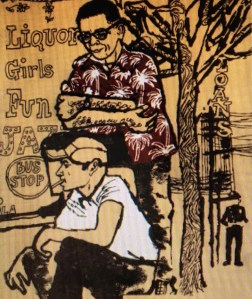
* The illustration above is a detail from Len Deighton’s jacket design for the first UK edition of On the Road, published by André Deutsch in 1958.

The Waters of March

Joao GilbertoSince Rio de Janeiro is the focus of a lot of the world’s attention at the moment, and since I’ve just watched The Girl from Ipanema: Brazil, Bossa Nova and the Beach, the cumbersomely titled but otherwise mostly pleasant BBC4 programme presented by Katie Derham, it feels like a good time to alert you to the version of Tom Jobim’s “Águas de Março” performed by João Gilberto on Getz/Gilberto ’76, a newly discovered set of 40-year-old live recordings from San Francisco’s Keystone Korner released a month or two ago on the Resonance label.
It wouldn’t take much to persuade me to argue the case for “Águas de Março” — in English, “The Waters of March” — being not just the greatest song of the bossa nova era, or even the greatest Brazilian song ever written, but one of the greatest songs of the 20th century. The way Gilberto sings it on this album makes that seem even less of an outrageous claim.

Jobim’s song is a list of things: just things. It starts with things you might find flushed out by Brazil’s autumn rains. Naturally, it sounds better in the frictionless Portuguese spoken and sung by Brazilians: “É o pau, é a pedra, é o fim do camino / É um resto de toco, é um pouch sozinho / É um caco de vidro, é a vida, é o sol / É a noite, é a morte, é um laço, é o anozl / É peroba no campo, é o nó da madeira / Caingá candeia, é o matita-pereira…” But here’s the composer’s own English translation: “A stick, a stone, it’s the end of the road / It’s the rest of a stump, it’s a little alone / It’s a sliver of glass, it is life, it’s the sun / It is night, it is death, it’s a trap, it’s a gun / The oak when it blooms, a fox in the brush / A knot in the wood, the song of a thrush…” And it opens out to encompass what sounds like the entire human condition. “It’s the wind blowing free, it’s the end of slope / It’s a beam, it’s a void, it’s a hunch, it’s a hope…” The images and thoughts skip by on a snatch of melody, repetition building a hypnotic momentum, the harmonies descending beneath it like a stream running between rocks.

Here’s a famous and lovely version of the song, done as a duet by the composer and the great Elis Regina. But it’s completely shaded by João Gilberto, for whose six-minute version — accompanied by his own acoustic guitar and Stan Getz’s rhythm team, the bassist Clint Houston and the drummer Billy Hart — I can’t provide a link. Gilberto’s phrasing is a marvel of conversational subtlety, full of understated but astonishing little details: sudden pauses, skips, rhythmic elisions, and seemingly infinite ways of attacking an initial consonant or shaping a vowel. You’ll just have to get the album. And you should.

* The photograph of João Gilberto (with Stan Getz in the background) was taken by Tom Copi and is included, with many others, in the booklet accompanying Getz/Gilberto ’76.

The sound of ’66

The portrait painted in 1966: 50 Years Ago Today, the BBC4 Arena documentary directed by Paul Tickell and based on Jon Savage’s recent book, was full of interesting things (notably a reminder of Jonathan Miller’s sensational quasi-psychedelic TV version of Alice in Wonderland). The mood Tickell strove to evoke, concentrating on a dour, monochrome paranoia, wasn’t the way I remember 1966 — a year only half a notch below its immediate predecessor in terms of cultural stimuli and general euphoria — but at least his programme had a point of view. And it also had, towards the end, a snatch of one of the greatest of all cover versions of a Lennon & McCartney song.

J.J. Barnes would eventually become a Northern Soul hero through tracks such as “Real Humdinger”, “Please Let Me In” and “Our Love (Is in the Pocket)”. His version of “Day Tripper” precedes and surpasses them, in my view. It was arranged and co-produced for Detroit’s Ric-Tic label by Andrew “Mike” Terry, a Motown studio regular whose fruity baritone saxophone solos could be heard on “Heat Wave”, “Where Did Our Love Go”, “This Old Heart of Mine” and many others. I love the way Terry takes on the riff from the Beatles’ original and, while keeping the driving 4/4 rhythm and the fuzz guitar, hardens up the groove, those trumpet stabs and flourishes adding an extra dimension behind Barnes’s Wilson Pickettish vocal. And presumably that’s James Jamerson, Paul McCartney’s bass-guitar hero, moonlighting from Hitsville USA to dig into the riff.

What gives the record its special immediacy is the grainy low-fi sound that would never have made it past Berry Gordy Jr’s quality control department. It was there on the original UK Polydor version I bought the week it came out in 1966, and it’s still there today, proudly resistant to any kind of digital clean-up technology.

Since we’re on the subject, there’s another favourite I’d like to mention. It’s Roy Redmond’s soulful version of “Good Day Sunshine”, arranged and produced by Jerry Ragovoy for the Loma label, Warner Bros’ soul subsidiary, in 1967. It has the lot: great laconic guitar intro, heat-drugged slow-drag beat, greasy southern horns, gospel-style female back-up choir, and an excellent lead vocal from another obscure soul-music hero. I believe McCartney himself had nice things to say about it, and no wonder.

* Ace Records have just announced the September release of Let It Be, the second volume in their Black America Sings Lennon & McCartney series. Vol 1 (titled Come Together) included Roy Redmond’s “Good Day Sunshine” among a quantity of other good stuff. J.J. Barnes’s “Day Tripper” isn’t on either volume, sadly. For that reason alone, there is bound to be a Vol 3.

Bud Powell | 31 July 1966

BudPowellBud Powell never made being a genius look easy. Fifty years ago tomorrow — on July 31, 1966 — his death at the age of 41 put an end to an existence that seems to have been defined by two factors: first, his extraordinary talent; second, an incident that took place when he was not even 21, and which began the process of stifling his brilliance.

It happened in 1945, after a gig in Philadelphia with the band of the trumpeter Cootie Williams. Powell had already been marked out for greatness. While still in his teens, and thus technically underage, he had become a regular at Monroe’s Uptown House and Minton’s Playhouse, the crucibles of bebop, and had been befriended by Thelonious Monk. But that night in Philadelphia it seems that he was beaten by police while wandering the streets in an intoxicated condition after the gig, and was thrown into the cells. After his release, persistent headaches — seemingly induced by the beating — led him to treatment first in Bellevue hospital and then in a psychiatric institution.

Alcohol was a companion to him, but not a friend. His behaviour could be erratic and aggressive and in 1947, after a fight in a club, he was sent back to Bellevue and thence to Creedmore State Hospital in Queens, where he was kept for 11 months. From late 1951 to early 1953 he was in a mental hospital again, this time committed after being found in possession of marijuana. At some time or other he is believed to have been subjected to electroconvulsive therapy, which had come into use in 1938, and whose dangerous side-effects were little understood.

Some of those who heard him in his youth claimed that he was never the same player after 1945, which makes us shake our heads in disbelief when we listen to the trio recordings he made (with Curley Russell on bass and Max Roach on drums) for the Roost label in 1947, two years after that first incarceration. Through the terrible sound quality, the dazzling quality of his inventiveness on a track like “Indiana” still shines through.

Despite his misfortunes, there would be further great recordings, both live and in the studio: with Charlie Parker and Fats Navarro at Birdland in 1950, with Parker, Dizzy Gillespie, Roach and Charles Mingus at Massey Hall in Toronto in 1953, and his own recordings for Alfred Lion and Norman Granz in the early 1950s, most notably the piece “Glass Enclosure”, whose title and disturbing melodic angles reflect his experiences in hospital and other institutions. He was, in fact, a brilliant composer — check out the profound lyricism of the 1958 piece “Time Waits” — as well as the only improviser of the post-war generation who could match Parker’s standards of inexhaustible creativity.

In 1959 he relocated to Paris, where he found supportive friends such as Nicole Barclay, the wife of the record label boss Eddie Barclay, and Francis Paudras, a young jazz-loving commercial artist who later wrote a touching memoir of their association, its title — Dance of the Infidels — borrowed from one of the pianist’s best known compositions. Powell became a regular at Left Bank clubs such as the Cafe Saint-Germain and the Blue Note, where he played with kindred spirits like the drummer Kenny Clarke, a fellow émigré, and the gifted French tenorist Barney Wilen, as well as with old friends visiting from New York. In France, his colleagues, acquaintances and fans knew that to offer him a drink would not be doing him a favour. Here’s a version of Duke Ellington’s “Satin Doll” from 1963 which I love for the subtle way he infiltrates ambiguous voicing into such a well known tune.

One of my favourite pieces of Powelliana is a film of his guest appearance with Mingus’s quintet at the Antibes jazz festival in 1960. He played only one tune with them, but this long version of “I’ll Remember April” (which he had also recorded on that 1947 Roost trio session) contains six choruses of piano that repay close attention. The diamond-cutter articulation and lightning speed are gone, and there are occasional minor missteps, but the constant stream of lovely ideas and the relaxed intensity of the performance make it something to be treasured, even before the horns — Ted Curson (trumpet), Eric Dolphy (alto) and Booker Ervin (tenor) — have their say. And note the notably respectful way Mingus, an old sparring partner, and Dannie Richmond concentrate on providing solid support while staying out of his way.

In 1964, with his health precarious, Powell returned to New York, accompanied by Paudras, for a comeback engagement at Birdland. Although he was welcomed, his playing had lost its edge and its lustre. Paudras returned to Paris but Powell decided to stay on, dying two years later in a Brooklyn hospital of a combination of tuberculosis (contracted during his final year in Paris), alcoholism and malnutrition. A vast crowd filled the streets outside his funeral in Harlem, where he had been born and where he had first been acclaimed as a prodigy.

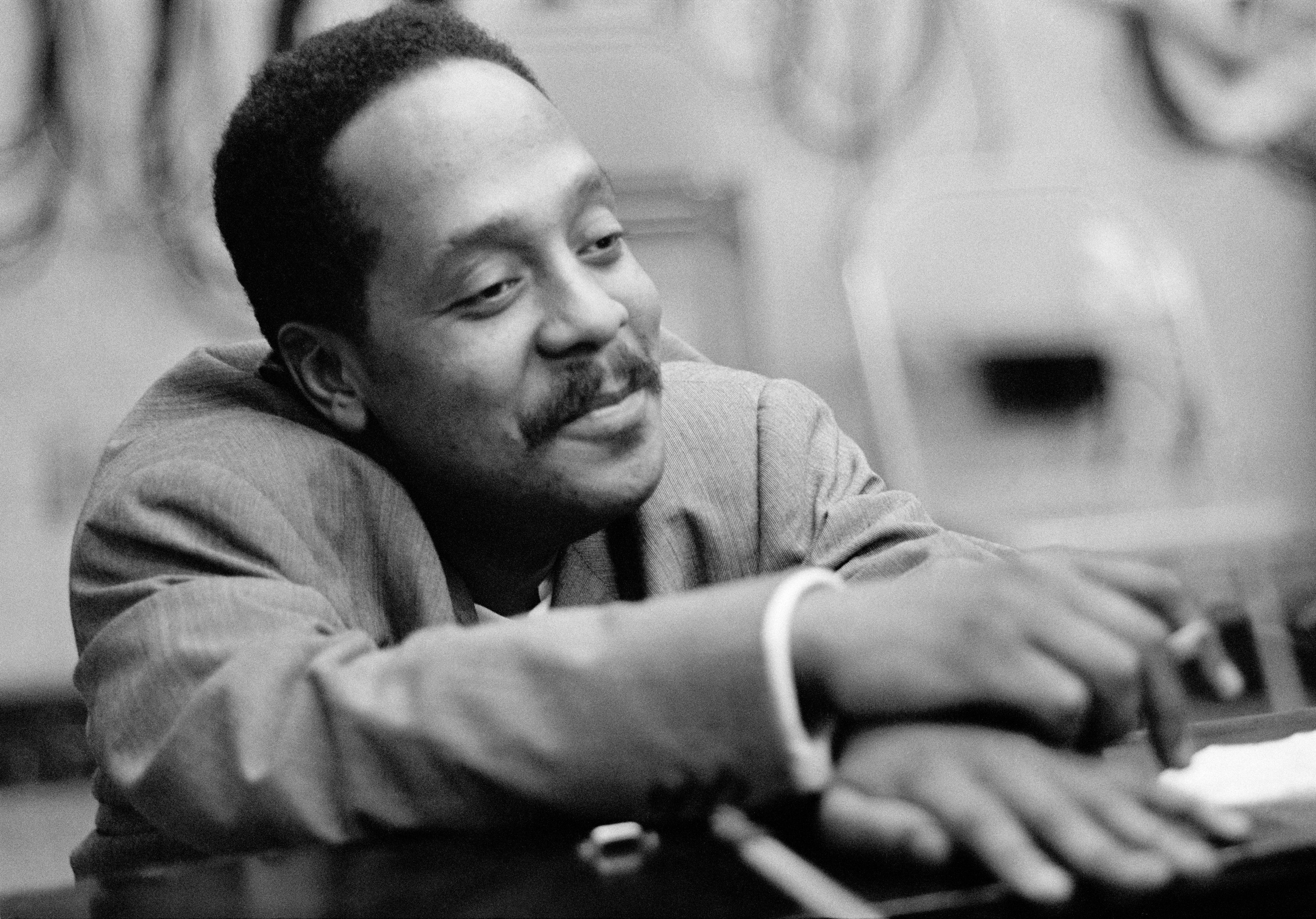
* The photograph of Bud Powell was taken in New York in 1964 by Robert James Campbell and is taken from Rebirth of the Cool, a book of Campbell’s work edited by Jessica Ferber and published by powerHouse Books.

Soft Machine in Croydon, 1970

Softs in CroydonCroydon’s Fairfield Halls art complex closed this week for a complete renovation that is expected to take two years. The news reminded me of the night back in January 1970 when I got so badly lost in my Fiat 500 in the one-way system around the town’s high-rise office blocks that I missed most of the first half of an important Soft Machine concert.

It’s always interesting when a gig you attended turns up on a CD decades later, even though part of one track, “Facelift”, was taken and used, after editing and overdubbing, on the Soft’s first album for CBS, the classic Third, later that year. Some years ago the Cuneiform label released the complete 75-minute show under the title Noisette; it’s still available, and well worth investigating.

Back in 1970, this is how I started the review in the following week’s Melody Maker: “It seems to me that this might just be Soft Machine’s year. Having done things the unconventional way by finding first fame on the Continent, the group should find the musical climate of Britain coming round to embrace them in the near future.”

The hall was “all but sold out”, the audience “young and attentive”. I got there in time to hear “Hibou, Anemone and Bear”, the final number of the first half. Thanks to the Cuneiform disc, I now know that Robert Wyatt — for whom, having been brought up in Dulwich, this was practically a home fixture — introduced the concert with these words: “The programme for this evening is that we do a bit and then we stop for a bit and then we do a bit more.”

It turns out that I missed 25 minutes of excellent music. Had I heard it live, I might not – after praising the playing of Wyatt, Mike Ratledge, Hugh Hopper and Elton Dean — have written the following about the fifth member, the saxophonist and flautist Lyn Dobson: “I have grave reservations about Dobson, who seemed to be trying to do too much. Only on tenor did he say the piece of which he is capable”.

Dobson had joined the Softs the previous year, as part of a four-strong horn section. The other three members — Dean, Marc Charig and Nick Evans — had been nicked from the Keith Tippett band. Charig and Evans had left at the end of 1969, after a French tour. (Here and here are rare glimpses of that shortlived seven-piece line-up on a French TV show, L’invité du dimanche, with the added attraction of the great Delphine Seyrig.) The five-piece didn’t last long, either. Here they are in Paris that spring, shortly before Dobson left, thereby missing the band’s historic appearance at the Albert Hall in August, when they became the first ensemble from the field of popular music to appear at the BBC Proms.

At the time of his stint with the Softs, Lyn was a well-known face on the London scene. He had played the flute solo on Manfred Mann’s “Pretty Flamingo” and recorded with the Small Faces. He was a member, along with John McLaughlin, of Georgie Fame’s first post-Blue Flames bands in 1967, and could be heard with the People Band, which also included Terry Day and Mike Figgis. He played with the Keef Hartley Band, he would appear on the title track of Nick Drake’s Bryter Layter and on John and Beverley Martyn’s The Road to Ruin, and in the 1990s he made a couple of albums with the Third Ear Band before going to live, I believe, on Crete.

Anyway, I can now admit that in the section of the evening I missed was one of the concert’s highlights: Lyn’s flute solo on Ratledge’s ballad, “Backwards”. Introduced by the composer’s wah-wah’d electric piano, he produces a beautifully constructed improvisation that achieves an excellent blend of Eric Dolphy’s pure-toned inventiveness and Roland Kirk’s funky distortion, the latter feature coming to the fore as the piece goes into a wild Mingus-like 9/8 vamp. (Mingus, along with the Coltrane quartet of “My Favourite Things” and Uncle Meat-era Zappa, seemed to be the Softs’ most powerful influences at the time.) His tenor solos, like the one on Hopper’s “12/8 Theme”, manage to retain their clarity and logic in the heat of a furnace stoked by the non-stop focused clatter of Wyatt’s impassioned drumming.

As it happens, Wyatt was already beginning to become detached from the band. “Hugh, myself and Elton were pursuing a vaguely jazz-related direction,” Ratledge told Rob Chapman in a Mojo interview in 1997. “Robert was violently opposed to this, which is strange looking back on it because he was passionate about jazz. But he had defined ideas of what pop music was and what jazz was.” Wyatt’s verdict, quoted by his biographer Marcus O’Dair in Different Every Time: “To me, fusion jazz was the worst of both worlds. It was rock rhythms, played in a rather effete way, with noodling, very complicated solos on top.”

Robert may have been right in general terms, but that’s not true of the music preserved from the Croydon gig, which has power and inventiveness and its own kind of authenticity. To me, the five-piece was the last great Soft Machine line-up, before the noodling began to take over.

By the time Dobson joined the Softs, he had already developed a serious interest in eastern music and mysticism. Not long after he departure he generously lent me Hazrat Inayat Khan’s book about Sufism and music. It stayed with me through many house moves but eventually went missing. Maybe, like the recording of the enthralling Croydon concert, it will one day magically reappear, ready to provide a reminder of a time of open-minded, open-hearted creativity.

* The photograph of Lyn Dobson, Hugh Hopper and Elton Dean was taken by Mark Ellidge, and is from the booklet accompanying Noisette.

Alan Vega 1938-2016

SuicideThe most interesting rock music is often made when people from different backgrounds or disciplines are thrown together, united in a desire to create something previously unheard. That was what made the Beatles, the Who, the Velvet Underground and Roxy Music so special, and it lay behind the brilliance of Suicide, too.
The singer Alan Vega, who died on Saturday at the age of 78, and the keyboardist Martin Rev formed their duo in New York in the mid-1970s: they were part of the downtown scene that revolved around the Mercer Arts Centre and CBGB. Suicide’s eponymous 1977 debut album, released on the Red Star label, belongs with the Ramones’ first album, Television’s Marquee Moon, Talking Heads’ 77 and — from outside the New York scene — Père Ubu’s The Modern Dance and Devo’s Q: Are We Not Men? A: We Are Devo.

Vega was a visual artist who listened to La Monte Young and the Stooges. Rev had studied with the pianist Lennie Tristano (a unique figure who had a whole school of jazz named after him in the late 1940s) and admired Cecil Taylor. If they had a jukebox, it was probably packed with ? and the Mysterians and obscure early rockabilly 45s. Together they made outsider art that, although too scary for most tastes, influenced a generation of adventurous young musicians.

In January 1977 I reviewed their debut album for the Melody Maker; it seems to have been the first piece written about them in the British press. I loved their stripped-down aesthetic and Rev’s camouflaged musicianship. Naturally I focused on “Frankie Teardrop”, the album’s longest (at 10 minutes) and most extreme track: the story of a 20-year-old factory worker who, in a state of existential despair, kills himself and his young family. Against Rev’s minimalist backing of industrial electronic noise and racing-heartbeat drum machine, Vega’s breathless recitative is punctuated by screams, howls and whimpers.

A few months later they supported the Clash on a UK tour. Shortly afterwards I saw them at the Marquee, where they added an entire dimension to their recorded work, largely thanks to Vega’s compelling presence. My friend Howard Thompson, who had alerted me to their existence, got the album released in the UK in his capacity as head of A&R at Bronze Records.

That first album was recorded at Brooks Arthur’s 914 Studios in Blauvelt, Rockland County, where Bruce Springsteen’s Greetings From Asbury Park, NJ had been created four years earlier. Its influence is all over Springsteen’s Nebraska, recorded in 1982, and in 2005 Bruce used Vega and Rev’s lovely “Dream Baby Dream” as a concert-closing anthem during his Devils & Dust tour. (In this interview with the Guardian‘s Martin Longley, Vega described Springsteen’s version as “America’s national anthem”.)

Every track on Suicide had something interesting to offer, whether it was a hymn to a revolutionary icon (“Che”), a hymn to a girl (“Cheree”), or hymns to a lost future (“Rocket USA”) and a lost American innocence (“Ghost Rider”). What Kraftwerk were to Europe in the mid-’70s, Suicide were to the US: a snapshot of the Zeitgeist, an artful simplicity and some great grooves concealing profound and often troubling complexities.

* The photograph of Alan Vega (left) and Martin Rev is by Michael Robinson. It is taken from the back jacket of Suicide’s first album.

Drones for peace

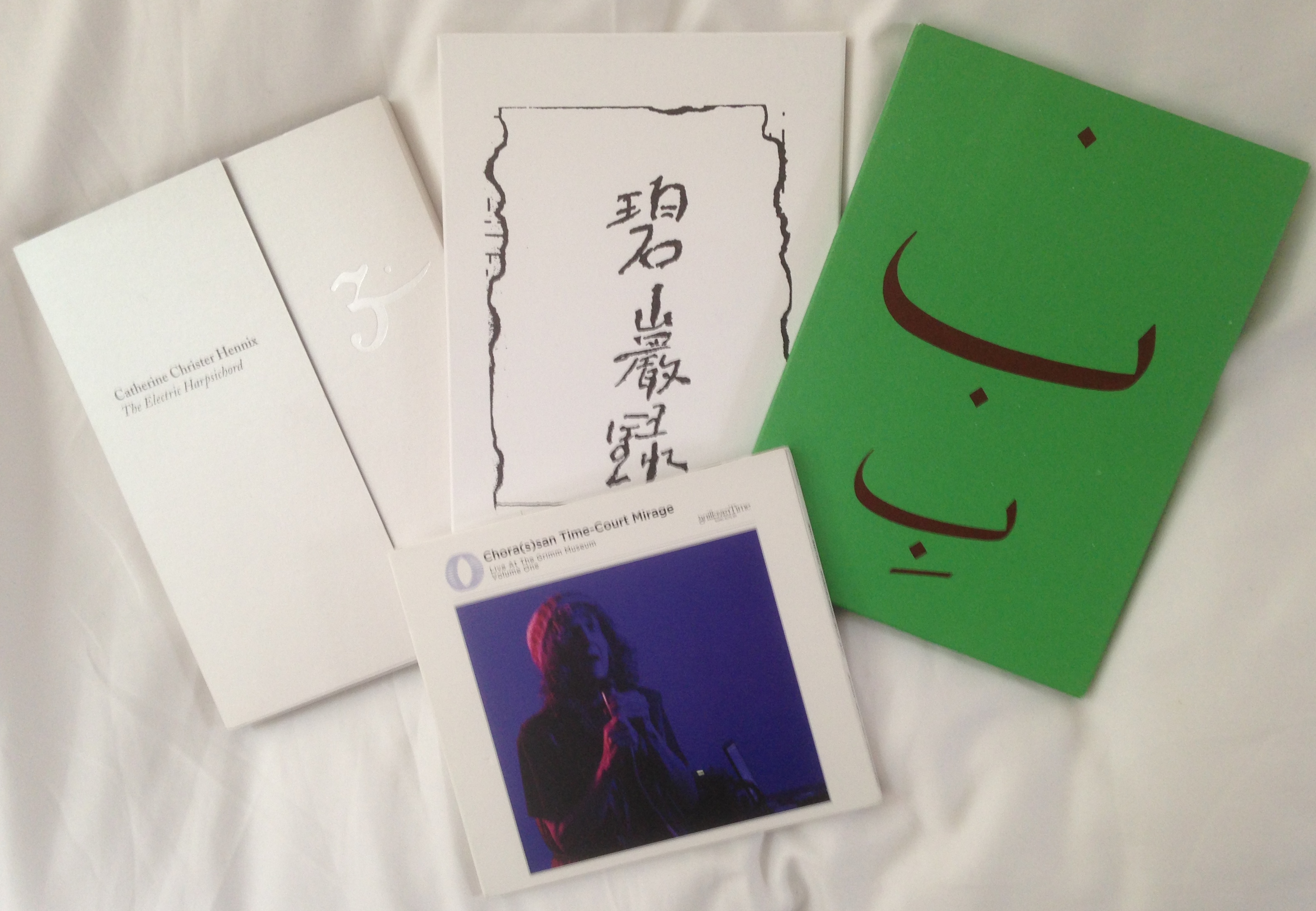
Catherine Christer Hennix 2Catherine Christer Hennix studied with La Monte Young and Pandit Pran Nath, which explains her interest in drones. Her music rejects the 12-step octave in favour of what we westerners would call microtonality. Her new album, Live at ISSUE Project Room, released under the name of the ensemble she calls Chora(s)san Time-Court Mirage, is the most emotionally exhilarating and cathartic long-form piece of music I’ve heard in ages.

Born in Stockholm in 1948 of Swedish and American parents, CCH studied contemporary western classical before meeting Young and Pandit Pran Nath in 1970 at the Foundation Maeght gallery in St Paul-de-Vence, during the famous music festival in which Albert Ayler also took part. That encounter changed her approach, which was also affected by studies of the medieval music of Japan (gagaku) and Europe.

Her most famous work is probably The Electric Harpsichord, a 25-minute piece recorded at a festival of modern music in Stockholm in 1976, on which she is the only performer, playing a keyboard and a sine wave generator. Static but enveloping, it sounds like Nico’s harmonium processed through a machine introducing the sonorities of bells, gongs and finger cymbals, with a gentle undertow of cello-like sounds. It was reissued by Die Schachtel in 2010, in a special edition including several haiku-like poems by Young and an essay by CCH’s friend Henry Flynt (the dedicatee, back in the mid-’60s, of Young’s composition X for Henry Flynt, which John Cale seized upon during his time at Goldsmiths College).

The other albums of which I’m aware are Central Palace Music From 100 Subjects for H, in which Hennix meets Peter Hennix (renaissance oboe) and Hans Isgren (sheng), and Chora(s)san Time Court Mirage’s Live at the Grimm Museum Vol 1, recorded by a five-piece ensemble in Berlin in 2011. Both are released on the Important label, the latter in collaboration with the Dutch festival Sonic Acts.

Live at ISSUE Project Room, also on Important, is a different kettle of fish altogether, a much more extensive exploration of resources. The musicians involved at this Brooklyn concert in 2014 were Hennix, Imam Ahmet Musin Tüzer and Amirtha Kidambi (voices), Amir Elsaffar and Paul Schwingenschlögl (trumpets), Hilary Jeffrey (trombone), Elene Kakaliagou (French horn), Robin Hayward (microtonal tuba) and Stefan Tiedje and Marcus Pal (computers and live electronics).

The single 80-minute piece, which is titled “Blues Alif Lam Mim in the Mode of Rag Infinity / Rag Cosmosis”, begins conventionally enough with tambura-like drones (presumably produced by electronic means) setting the scene for the introduction of elegant vocal ululations. Thereafter the music evolves in long, slow waves, its textures gradually thickening and then being pared away, the brass chorale and electronics coming and going beneath the voices: sometimes delicate and reticent, sometimes reaching a mindquaking intensity. This is a different kind of wall of sound, one on which an ever-changing variety of colours and images can be projected.

The listener might be occasionally made aware of the use of an unfamiliar tonality, but it is never remotely disconcerting. I have no idea of the belief system from which this music originates, but I do know that it stirs and nourishes something in my spirit. In its richness, in its patience, in its emotional generosity, a piece which seems to come from another world ends up feeling like the most natural sound imaginable.