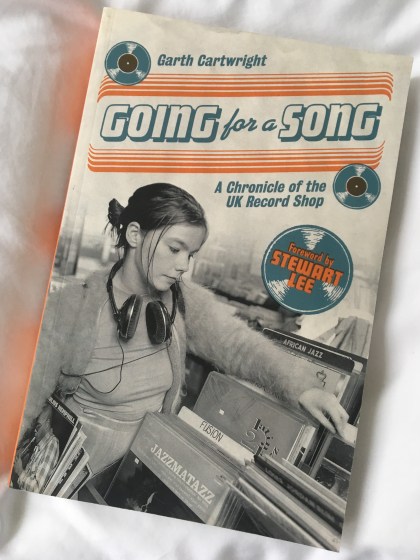
The history of the British music scene from the 1950s onwards can be told through the story of the nation’s record shops, which is exactly what Garth Cartwright does in Going for a Song, his newly published survey of the retail outlets that drew fans and musicians to their specialist stock and thereby shaped the evolution of the music in all its forms.
Whether it was John Mayall buying blues 78s at a shop in Manchester’s Marsden Square, David Bowie buying Bob Dylan’s first album in the folk department of Dobell’s on Charing Cross Road, Mick Taylor buying B. B. King’s Live at the Regal at Transat Imports in a basement on Lisle Street, or Joe Strummer hearing Vince Taylor’s “Brand New Cadillac” at Ted Carroll’s original Rock On stall in the Golborne Road market, these were the places where enthusiasms were incubated and encouraged.
For a few months in 1964-65 I had a Saturday job in the basement record department of a TV rental shop in central Nottingham, using the shop’s main deck to listen to imported Blue Note albums which I’d been allowed to order but no one wanted to buy (that Christmas, Jim Reeves was outselling Eric Dolphy by about 1,000 to one). But the places I haunted as a customer were a second-hand stall in the covered market, where I bought my first jazz LPs from a rather doleful man who travelled in each day from Grantham, and a West Indian record shop near the bus station, where the sleeve of Jimmy McGriff’s I Got a Woman hung in the window and they stocked Prince Buster 45s on the Blue Beat label.
Those are the things that stay with you. On trips to London I bought an imported Mar-Keys 45 on Stax at Transat, My Name Is Albert Ayler at Dobell’s and an album by Shinichi Yuize, the koto master, at the achingly cool One Stop on South Molton Street. After I’d moved to London I spent more hours at Collet’s on New Oxford Street (run by Ray Smith and Gill Cook) than anywhere else, with occasional trips to Golborne Road and to Peckings’ tiny Studio 1 ska shop in Askew Road, Shepherds Bush. Nowadays it’s mostly the excellent Ray’s Jazz Shop in Foyle’s, sometimes Sister Ray in Berwick Street and Sounds of the Universe on Broadwick Street, and occasionally — not often enough — Honest Jon’s on Portobello Road.
I miss the little independent soul and oldies shops clustered in Hanway Street, a doglegged alley off Oxford Street, and, at the other end of the scale, Tower Records on Piccadilly Circus, with its amazing stock: the primary haunt of what David Hepworth named “the 50 quid man”, the sort of consumer who — growing into middle age with a bit of disposable income — would drop in for a new CD and pick up a couple more that filled gaps in his collection. I miss Dobell’s and James Asman’s on New Row for their sometimes cranky character. In New York I miss Village Oldies, later Bleecker Bob’s; the fabulous Colony Records on the corner of Broadway and West 52nd Street, which closed in 2012 after 64 years; and a more recent casualty, the adventurous Other Music on East 4th Street.
A great record shop sometimes requires a form of negotiation that doesn’t apply widely in the world of retail: the need for customers to prove themselves worthy of making a purchase. The first time I encountered that phenomenon was in Dobell’s, when I bought the Ayler album and was brusquely informed by a tall man with a beard that “the guy can’t play”. That was 50-odd years ago. The most recent time was last year, in House of Oldies on Carmine Street in Greenwich Village, where I kept my head down while the owner frightened off a customer who had bothered him with requests that revealed what he clearly saw as an unacceptable ignorance of doo-wop music.
One of the most memorable record-store visits, back in 1970, was to the great R&B producer Bobby Robinson’s shop at its original location on 125th Street and 8th Avenue in Harlem, opposite the Apollo Theatre. Charlie Gillett and I spotted the dust-covered boxes of 78s on high shelves, undisturbed for more than a decade. Another was to buy Northern Soul singles at Selectadisc on Arkwright Street in Nottingham — a street of vibrant working-class character since completed obliterated by urban development — and being transfixed by the beauty of the proprietor’s wife while handing over the cash for bootlegged copies of the Fuller Brothers’ “Time’s A Wasting” and Moses Smith’s “The Girl Across the Street” at the urging of my pal Dave Milton, who ran his own shop in Derby.
I could go on. Couldn’t we all, when it comes to record shops? More to the point, Garth Cartwright’s book is a wonderful guide to many of the places I’ve mentioned, and to the the people who brought them to life, from such well known figures as Doug Dobell, Ted Carroll and Geoff Travis to the more obscure characters like the Levy family of Whitechapel, Lee Gopthal of Musicland, Rita and Benny Isen of R&B Records in Stamford Hill, Laurie Krieger of Harlequin, Barry Class of the Disci chain and the mysterious Brian Abrams, whom I first encountered at his original Record & Tape Exchange in the Goldhawk Road in 1970, when he was on his way to creating a little empire based on eccentric employment policies and journalists’ review copies.
Cartwright goes right back to 1894 and the opening in Cardiff of Spillers, which survives today as the world’s oldest record shop, and tells the stories of projects that had a significant lifespan, like HMV and Virgin, and those that didn’t, like the Vogue label’s record shop on Charing Cross Road and the Chelsea Drugstore on the King’s Road. He goes outside London to include much-loved places such as the Epstein family’s NEMS emporium in Liverpool, Birmingham’s Diskery, Pete Russell’s Hot Record Store in Plymouth, Barry’s Record Rendezvous in Manchester and Eric Rose’s Music Inn in Nottingham, which hopes to celebrate its centenary next year. He’s done his research and talked to lots of people, both surviving proprietors and their customers (which makes me wish the book had an index).
At the end of Cartwright’s engrossing and hugely valuable survey we arrive at the rather less optimistic era of the vinyl revival and the annual Record Store Day, which the author views with a degree of scepticism. As he points out, the number of independent record shops in Britain tumbled from 948 to 408 between 2003 and 2007, and the recovery is struggling to stabilise itself. But as long as recorded music is available in a physical form there will be successors to those who helped so many of us to follow our ears wherever they led. They deserve this fine book.
* Going for a Song is published by Flood Gallery (£12.99).